




























Ōhinehou Lyttelton is about 12km from the centre of Ōtautahi Christchurch, through a long, narrow tunnel that bores its way through the Port Hills, but it feels a million miles away from our country’s second-biggest city.
After a few minutes of near-total darkness, you emerge into quiet streets nestled in the bowl of an exciting volcanic crater, with breathtaking vistas as far as the eye can see in every direction.
It’s a port town, that much is obvious, but Lyttelton is also less perceptibly — at first — an artists’ town, and one of the most supportive and dedicated artists’ towns in Australasia.
Since the late ’70s, Lyttelton has been home to some of Aotearoa New Zealand’s very best artists and independent musicians, from Al Park and Bill Hammond right up to Marlon Williams, Aldous Harding, Delaney Davidson, Ben Woods, and so many more.
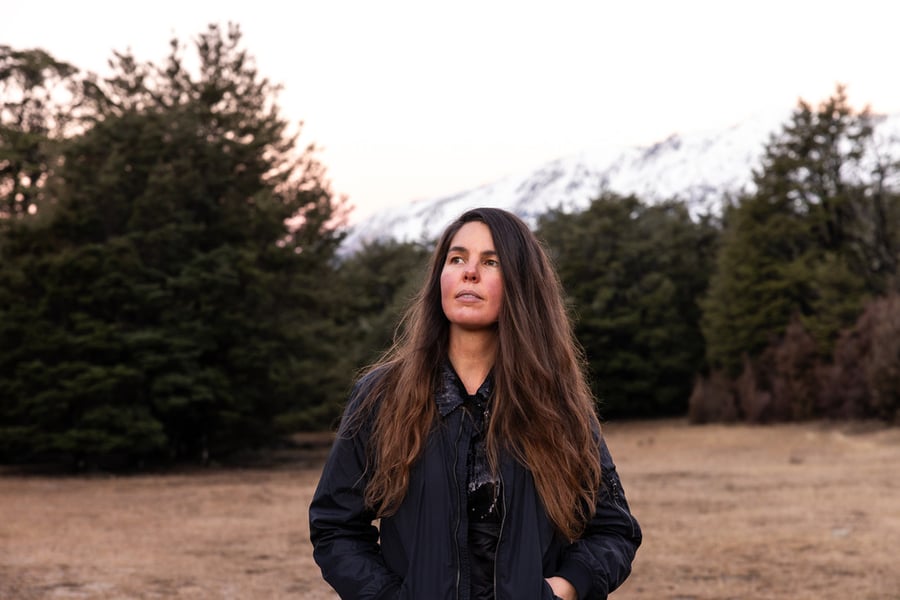
It’s where singer-songwriter Mel Parsons also calls home, and she finds it “hard to imagine living anywhere else.”
“I’d love to see the musician per capita stats on Lyttelton compared to the rest of the country,” she tells me. “There must be something here that we’re all drawn to.”
What drew Parsons to the town is its community, as “you can always bump into people you know around town… but it also has enough hiding places that you can keep to yourself when you need to as well,” and the views. Those beautiful views. “Being able to see the ocean from home is hard to beat, and it feels like the view is completely different from every aspect of town.”
Love Music?
Get your daily dose of everything happening in Australian/New Zealand music and globally.

We’re catching up in an email exchange to talk about Castle Hill, Parsons’ new album which, as its title betrays, was recorded quite far from home, about an hours’ drive back through the Lyttelton Tunnel.
Producer Josh Logan took Parsons to a studio in a remote lodge in Castle Hill in the Southern Alps, where she and her band — Aaron Stewart (bass), Jed Parsons (drums), Ben King (guitar) — settled for a week. She booked the sessions before even writing any songs, which might have put undue pressure on a less experienced songwriter.
Her decision paid off: Castle Hill is an album that sounds vibrantly alive. Unlike Sabotage (2024), her previous record, Castle Hill was recorded live with her band in one room, with “very few overdubs” and “all live vocals.”
“We all lived on site, played music through the days and nights, and ducked for a fresh dip in the creek, or a walk in the hills when we needed a break,” she fondly recalls. “Bliss. I highly recommend this way to make records!”
Castle Hill feels expansive and alive, communal and communicative, but Parsons’ deeply personal songwriting still rises to the surface.
The album, she says, is packed with moments “that emotionally have a bit of a wallop,” but the emotional heft at the heart of the tracks never feels forced. She agrees. “I think they come out in a natural way after they’ve gestated for the required amount of time, you know?
“My writing process is almost exclusively on my own — sometimes it’s really easy and other times it’s like pulling teeth. I guess that’s the challenge of it, and what keeps you coming back is when you are writing and feel like you’ve hit a vein and you just get in the zone and it’s quite a buzz to see what comes out.”
No track is perhaps more heavy than the “autobiographical and exposing” “Don’t Leave the Light On”, which finds Parsons contending with the aftermath of an emotionally abusive relationship.
Some of the lyrics will be gut-wrenchingly relatable to some listeners (“The day you wouldn’t stop the car / You laughed at me and my guitar / Bitter taste upon the tongue”), but solace arrives in the form of a repeated refrain filled with resolve. “I say man, man, you’ve got some work to do / I know that it’s not me, it’s most definitely you / I say man, man, you’ve got some work to do / I know that it’s not me, it’s most definitely you,” Parsons sings, vigorously reclaiming her self-worth. “It can be quite emotional [to write such a song], but I invite it in a way,” she admits. “I think that you have to be in that state to tap the heart of a song.”
There are a lot of melanchlic indie-folk atmospherics in the tracks, and Parsons admits to being “obsessed with sad songs.”
“But at the same time, I love an upbeat club banger as much as the next person,” she hastens to add. “I guess we use different styles of music for different things. I think maybe sad songs have the potential connect to a deeper part of us? I’m sure there’s a more scientific explanation than that.
“Maybe the mystery is part of what draws us in, and in sad songs often the vocal is more intimate and lyrics possibly more present so there’s that very human connection directly to voice? I don’t know, please let me know when you find out!” (I’ll get back to her on that one.)
Last Friday, we unveiled our mid-year New Zealand albums list, cataloguing what has been a tremendously strong seven months for Aotearoa music.
If it hadn’t been released on the same day, if it had even been released just a few days earlier, Parsons’ new album would have been a guaranteed inclusion. Other critics agree on its quality. “It’s warm without being soft, grounded without feeling small, and easily one of her most assured releases yet,” wrote Muzic.NZ in a glowing review last week.
Now on her seventh album, she’s one of the most consistent singer-songwriters in modern Aotearoa music; so much so, in fact, that she’s released albums in each of the three last decades. “This makes me sound ancient!” she responds when I relay this fact. “But I guess you’re technically correct. I feel compelled to make and perform music so it’s pretty easy from that angle… It’s just what I love to do and will continue to do until I’m physically not able any more. It’s such a vital and energising career, lots of highs, just as many lows, but I wouldn’t change any of it.”
On a random phone call with an Australian publicist in the middle of last year, I casually mentioned that I lived in Lyttelton (at the time). The publicist’s voice rose a few octaves.
“I adore Lyttelton, daaarling!” she said. “Do you know Mel Parsons?”
“Not personally, no. But she’s an incredible musician,” I replied.
“You must go say hello to her in town. You must. I think she’s severely underrated.”
I left Lyttelton shortly after that phone call, but I proffer the publicist’s words to Parsons over email. “Well, I guess it’s better to be underrated than over-rated?! she responds. “Australia is where my biggest listening numbers are, actually, so one of these days — maybe — I’ll get my minute over there! Honestly, it’s not something I spend much time thinking about, but it’s always nice to hear that kind of feedback.”
One place Parsons most certainly is not underrated is her homeland.
She’s a regular face during Aotearoa music awards season at this point. Aotearoa Music Awards, Silver Scroll Awards, MMF Music Awards — she’s been nominated for the lot. Two of her albums — 2019’s’s Glass Heart and last year’s Sabotage — have competed for the Taite Music Prize, and she likely stands a good chance of being nominated for a third time for her new album.
While Parsons acknowledges that critical success “feels nice” and is “a pretty helpful thing for publicity,” it’s definitely not what matters most to her. The greatest success, she says, comes “when a song connects with an audience.” Even if Castle Hill isn’t garlanded next year, expect to see Parsons’ face anyway. “I’m always at the awards whether I’m nominated or not because, alongside the fancy glamour and accolades, it’s where our music community gets to hang out. We have an awesome music community and it’s a joy to be a part of.”
Because Parsons is just one of those musicians who deeply cares about Aotearoa music as a whole; there’s no prioritisation of personal glory over the collective. She’s done “a little on the governance side of some industry bodies,” she tells me, and she insists they all have “a really pro-artist lens.”
“[…] I have an optimistic outlook on our industry,” she adds. “Independent artists like me do get really great support. That said, I think we can always do more for emerging and early career artists, which can be a really tough space to navigate on your own.
“There are definitely parts of the system framework that are flawed, and there’s always things to be improved or better implemented, but there are a lot of really positive and energetic people working behind the scenes to get our music up and out to the world.
“It’s easy to pile on to ‘the industry’, but one thing I think is often forgotten when talking about it is that, for the most part, the industry is actually just a great bunch of people who are also really passionate about music.”
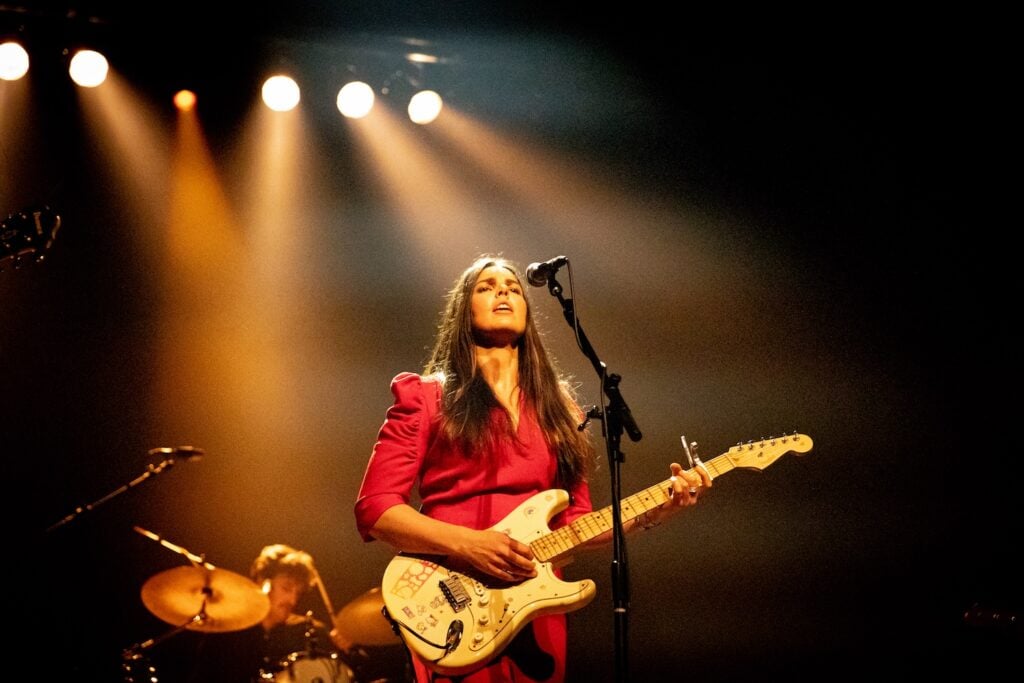
Credit: Cartwright Creative
While she feels supported by the likes of the NZ Music Commission and NZ On Air these days, and feels like “one of the very lucky ones” who can regularly tour due to her extensive “back catalogue” and “grassroots fanbase,” Parsons knows she had to work hard — very hard — to get here. “I spent a lot of years grinding and getting turned down for everything until I was more established. It’s almost like if you prove you can muscle through and show that you’re serious and all in, they’re more likely to get behind and invest in you… I’ve been independent my whole career and have built a pretty good system that is quite direct with my fanbase… Pre-order campaigns ahead of records etc.”
Now that Castle Hill is out, Parsons will celebrate her new album on a national tour between the final week of August and the first week of September (more information here), when she’ll play some of the most beautiful theatres in the country.
“When you get opportunities to play in amazing spaces like these, it’s such a treat,” she says. “There’s a lot of history and feel in them already — it adds a layer to the experience of the show and heightens everything. I love being in the audience in all of the venues that we’re playing on this run, so it’ll be a buzz to be on stage… I’m looking forward to every night, but it’ll be my first headline show at the Wellington Opera House so that’s a big one for me.”
She’s having none of it, however, when I ask her to name a favourite city and/or venue to play in Aotearoa. “Impossible question, and one a savvy indie artist would never answer on the record! It sounds trite, but I’m as happy playing in a woodshed as I am in a theatre, as I am on a festival stage.”
View this post on Instagram
She feels “very lucky” to have travelled her homeland as much as she has as a performing musician, not to mention her myriad overseas treks too.
“A lot of overseas missions over the years, as well as countless laps around Aotearoa,” she says. “I think the nature of travel has a great symbiotic thing for artists… For me, travelling puts me in an open-minded space… and I think as a songwriter you just drink it all in and store it up in your ideas bank. There’s something about getting out of routine and regular places that is very energising and inspiring.”
Parsons will be accompanied by her full band on the national run, but these tough economic times can sometimes stifle tours. “Touring is really tough at the moment and even more expensive than ever, so being able to take a band on the road is a real luxury,” she admits. “I still have to switch my tours up and do solo runs, which don’t carry quite as much risk.”
After the culmination of her album tour, she’s looking forward to simple and soothing comforts, intentionally slowing down in the artists’ town she calls home. “Getting into the garden, saying yes to coffee, going for walks,” are her immediate post-tour plans. Bliss. Still, she likes having a new challenge not far ahead. “I’ve got some international stuff coming up, a wee trip to Canada and a run in Europe… I think having things to look forward to keeps me energised.”
Mel Parsons’ Castle Hill is out now.

