



























Find out more about our Māori-language initiative here.
“It takes one generation to lose a language and three generations to restore,” Māori Language Commissioner Rawinia Higgins once said.
Last year marked the 50th anniversary of Te Wiki o te Reo Māori | Māori Language Week with the official theme, ‘Ake ake ake — a forever language’.
Translated into te reo, “Ake ake ake” means “forever and ever”, or “everlasting”, a most fitting theme for a language that has endured through the generations in the face of much suppression.
The resurgence of te reo in recent decades is backed up by statistics.
In 2023, there were 213,849 te reo Māori speakers in Aotearoa, up from 185,955 in 2018 — an increase of %15. Also in 2023, 4.3% of people reported they could hold a conversation in te reo Māori.
This resurgence has been reflected in art and music.
Love Music?
Get your daily dose of everything happening in Australian/New Zealand music and globally.

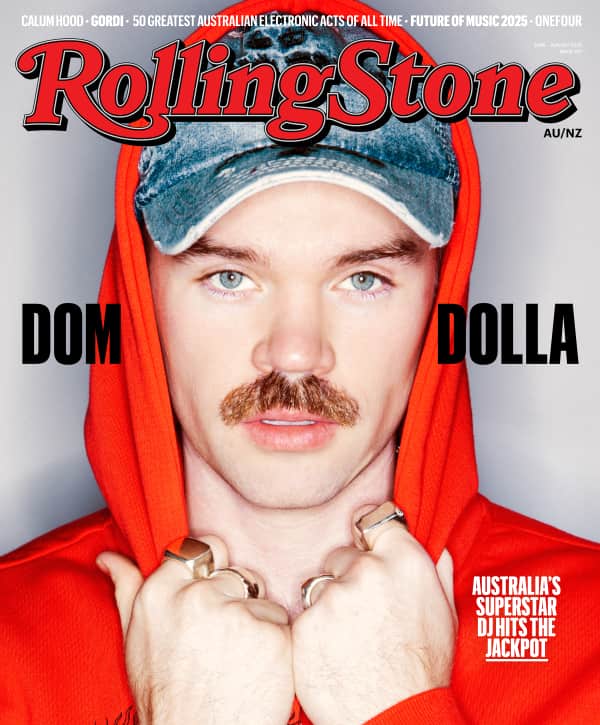
Over the past month, we connected with musicians from across Aotearoa as we launch our new initiative to cover more Māori music on Rolling Stone AU/NZ.
It became clear that each one possesses a unique journey with te reo; the reclamation of any language is a careful and slow-burning process. All of them consider themselves bilingual, moving between te reo and English in their music; some find this easy to do, and others encounter more difficulties.
The biggest takeaway, though, is that singing and making music deeply enhances their connection with te reo.
For breakout star Rei, expressing himself artistically comes much easier in te reo than English. “Sometimes the lyrics sound super cheesy when you translate them from te reo to English, but in terms reo they sound super poetic,” he says. “There are so many words in te reo that mean multiple things, so the opportunities for wordplay is super cool.”
Huia Hamon, a Tāmaki-based multi-hyphenate, is more emphatic. “Writing in te reo is not the same as writing in English! The ability to write in ahua and haere, emotion and movement, not about emotion and about movement, is the difference.
“When I first started singing in te reo with my limited reo (it’s still the journey), I was singing but not quite understanding, but now I listen back, and I can really see the journey. Whakamua! I feel so grateful to be on my waiata Māori journey, as my nana was fluent and she was my first teacher.”
Queer electropop star Ardon England recently translated his song “EGO” into te reo on “WHA MAI RĀ”, which “wasn’t just about changing words.”
“It completely changed the way I connected to the song,” he reveals. “It made me think more deeply about every lyric and what I actually wanted to communicate. It became something much more spiritual than I ever expected.”
“Te reo Māori has a depth that’s hard to describe. Some kupu hold generations of meaning, connection, and emotion that don’t always have a direct English equivalent,” he adds.
For Rā Toia Booth, who forms Ra Charmian with Hayden Booth, her native language “carries such depth and beauty that it’s not always easy to translate directly into English.”
“Sometimes a single kupu can hold layers of meaning that take an entire sentence to explain in English,” she says. “Writing in te reo has made me think more deeply about what I’m trying to say. It’s such a poetic language, and when you really begin to understand the meaning behind the words, there’s a beauty to it that’s hard to describe.”
Reggae star Israel Starr made a big change this year: he now goes by Iharaira Starr, using his te reo Māori name for his art. He finds it easier to use te reo in daily life “when dealing with hard subjects or conversations where it could be slightly confrontational.”
“I had an example recently, where instead of saying ‘I felt disrespected by you,’ I was able to use the word ‘whakatika’. This allowed me to express this in a way that I was still able to hold my mana about me and not feel like a victim. Express my point of view with calmness and love rather pointing the finger,” he says.
Multimedia artist Tipare finds speaking “to be the hardest part of life,” which is why she makes art.
“My brain doesn’t work with words that way very well,” she explains. “And yes, the concepts within the languages are polar opposite. I feel safe within te reo Māori. Rested. He reo whakatau. English is like walking a tightrope and everyone is waiting for you to fall.”
Sunreturn signing Junny is just starting out on her te reo journey, but she knows “there are stories, emotions, and concepts I could only articulate with it.”
Son & Water member Daimond Porima Ferguson is in a similar position.
“I am still finding my way and on the journey in writing te reo Māori songs,” he admits. “It is a goal of mine to tap into that further, and I am learning more as my career goes on.”
For the group SUB-TRIBE, there are “certain emotions and ideas that just carry more depth in te reo Māori.”

