




























Supplied
Why Are These Legendary New Zealand Musicians Playing a Gig with Children in Hamilton?
On August 23rd, a bunch of iconic Kiwi musicians will play with school bands in Hamilton. How did this intergenerational gig come to be?

Just over two weeks from now, Clarence St. Theatre in Kirikiriroa Hamilton will play host to a unique music event.
On the evening of Sunday, August 23rd, members of Zed, Opshop, and Hello Sailor will take to the stage, as will Hollie Smith and two former members of Split Enz. Video premieres courtesy of The Mutton Birds and The Exponents will be shown on a big screen.
The Clarence St. Theatre stage that night will also feature performances from school and youth bands from the local area, mixing it with the Kiwi music legends.
But how did this intergenerational gig come to be?
“The idea really came from feeling like our education system doesn’t do enough to encourage creativity or teach kids that anything is possible. Self-belief is something that needs to be nurtured. Too often people give up on their dreams or get pushed into the idea of finding a ‘safe’ career path.”
Those are the words of Lachie Holt, a man who really knows what he’s talking about. The Hamilton-based school teacher runs Amplify Aotearoa, which he started in 2021 to show “young people that their dreams are worth chasing.”
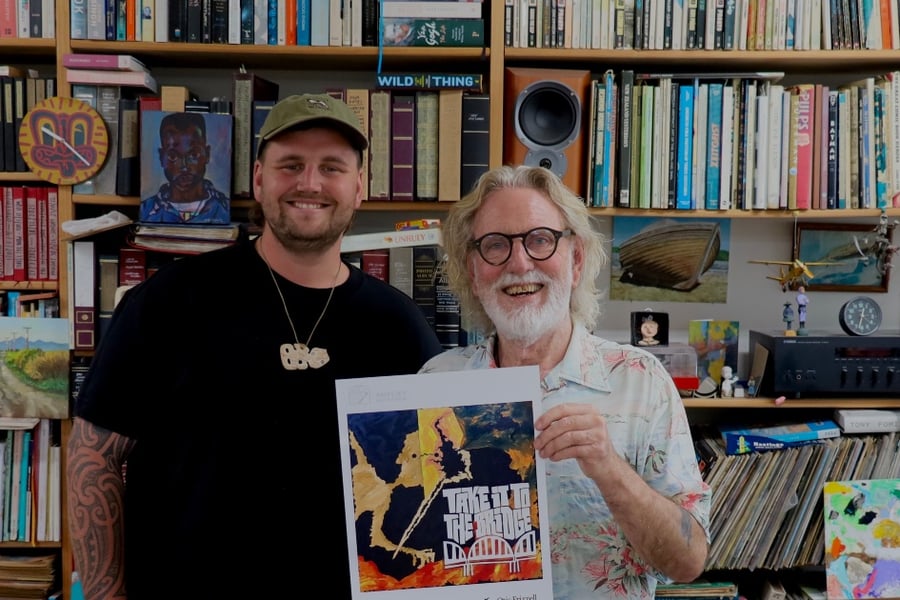
The forthcoming Clarence St. Theatre event, dubbed ‘Take It to the Bridge’, is his most ambitious project to date. Not only will it unite rangatahi bands with all those iconic Aotearoa music names for a live collaboration performance, but the tracks will also be pressed onto a limited-edition vinyl, celebrating the creativity and voices of our country’s youngest musicians.
Love Music?
Get your daily dose of everything happening in Australian/New Zealand music and globally.

View this post on Instagram
Over multiple phone calls and email exchanges between March and June, Holt spoke with passion about Amplify Aotearoa.
Liam Finn was involved with the project in its first year back in 2021, when Holt had a class band record two songs, which were later pressed onto a square 7-inch record. “What’s really special is that those same three kids are now part of this project as well,” Holt reveals. “Since then, I’ve tried to create a project like this every year.”
The 2025 edition of Amplify Aotearoa was its “biggest success yet,” creating a Split Enz tribute record that even made the Official Aotearoa Music Charts. 2025, Holt says, was the “right time to expand the opportunity — bringing the excitement and experience to more tamariki and rangatahi, while also creating a proper live show to take it to another level.”
Last year’s project came at the ideal time for Holt, too, who admits he was “feeling pretty drained” after a period in social work. “When I moved back into the classroom, I knew I needed a project that would get me excited about teaching again.”
It initially started out small — just ex-Split Enz member Mike Chunn playing a handful of songs to celebrate the band’s landmark 50th anniversary — but it “just kept growing.” Eventually a group of 10-and-11-year-olds from Hamilton East School were asked to design album artwork, and Holt got three other former Split Enz members, Noel Crombie, Wally Wilkinson, and Paul Crowther, involved.
Holt initially crowdfunded last year’s project, but Karl Lock and JB Hi-Fi, alongside Stebbing Recording Centre,(read about 4EPs, another independent Aotearoa record that Lock and Stebbing both proudly supported, here) stepped in and helped take it to another level entirely. The record debuted at No. 2 on the Aotearoa Albums Chart and even made the top 20 on the main Albums Chart, which Holt humbly says “was pretty surreal.”
An obvious question is staring me in the face: how the hell does a school teacher in the Waikato get so many genuinely iconic Aotearoa musicians to take part in a project like this?
According to Holt, “it’s actually been pretty easy!”
“There’s no real secret to it — I just send them a message, and more often than not they say yes,” he reveals. “I think the artists can see the value in the kaupapa. The world needs more creativity, and there’s something really special about seeing different generations working together on songs that have shaped our country.
“Even watching the artists’ reactions can be amazing — sometimes the kids know tiny details from the original recordings that the musicians themselves have forgotten. It must be a pretty cool feeling, 30 or 40 years later, seeing rangatahi still learning your songs and realising your music is still having an impact.”
New Zealand Music Hall of Fame inductee Jordan Luck, who led The Exponents for years, quickly realised Amplify Aotearoa was “a wonderful initiative” after doing some preliminary research into it. He hopes the children get a lot out of the experience. “I was taken with and fascinated by music from my earliest memories,” he explains.
“Discovering what instruments make what sounds was beyond belief. I gathered orchestral instruments fairly well but was astounded when I discovered what a bass guitar was doing! I trust the newcomers benefit in this way from Amplify Aotearoa. That isn’t to forget recording and production as well. And how to tune an instrument!”
Jesse O’Brien, who formerly played in Hamilton rock outfit Grace Falls, understands Holt’s passion for this project. “I work at a school and thought what an incredible opportunity it would be for some young people to perform on a great stage with some epic Kiwi artists,” he says.
“This sort of opportunity was not available to me when I was a young musician!”
Opshop’s Jason Kerrison shares a touching memory from his own childhood. “Most Sundays growing up, dad was playing drums in the country music shows in Invercargill, and I’d be there with a bag of chips and a Coke, watching. Seven, eight, nine years old. I had no plan to do it myself. It wasn’t ambition, it was just Sunday. But you absorb it. The way musicians count each other in. The looks across a stage when something’s going off the rails. The way a room feels when a band locks in. All of that went in by osmosis.
“Then years later De Funk Express won Rockquest, and part of the prize was studio time. I was on bass, first time I’d ever been on a fancy multitrack, and that sealed it.
“We shot our first music video on 16mm at the old Christchurch Arts Centre. Suddenly the thing I’d been watching since I was seven was a thing I could actually do. It was a permission slip, facilitated by an understanding teacher, Sue Eason at Hillmorton High. My music theory was less than sub-standard. I didn’t want to read and analyse harmony in the Brandenburg Concertos. I wanted to play bass in a band.
“That’s what Amplify is doing. Putting kids in the room. Lachie did it last year too, with rangatahi recording and performing alongside Mike Chunn and Neil Finn. The impact on those kids was massive. He’s not running a one-off, he’s building something special, creating a legacy.”
Holt can’t contain his excitement for the Hamilton gig. He rhymes off the “pretty incredible” lineup: “Hollie Smith, Nathan King from Zed, Harry Lyon from Hello Sailor, Jesse O’Brien from Grace Falls, Jason Kerrison from Opshop, Andrew McLennan from Coconut Rough, Harry Harallambi from Bog Queen… It’s honestly mind-blowing to have all these artists under one roof, all giving their time to support the next generation. Every artist will be paired with schools or rangatahi bands for the performances.”
Andrew McLennan is “excited about the concert and proud to be in such great musical company,” and he hopes that people “get to experience the powerful buzz of creativity and connection [that] playing music brings.”
“I genuinely hope that they feel the incredible buzz and vibe of performing live and that, like it was for me all those years ago, it might be the start of the rest of their lives! A kind of ‘never look back’ experience,” O’Brien says. I’s equally exciting for him, too, getting to play songs he wrote for his old band. “[…] it’s been a long time. So to get to do those live, with some rangitahi, is exciting. I just feel for the students stuck with me instead of legends like Jason Kerrison and Nathan King!”
With multiple chart-topping albums to her name, Hollie Smith is one of the biggest artists on the gig bill. After Holt reached out to her, she checked out some of Amplify’s previous work, “and thought it was a great concept and an awesome way to engage with our rangatahi.”
“I’ve done quite a bit of mentoring / teaching, and I love the energy of a room when things click and you get that excitement of realising what it feels like when music really ‘works’,” she says. She hopes that the children “just have fun and enjoy the process, gain some confidence, and inspire some momentum with what they want to achieve with music… Understanding that music is a constant evolution and all the highs and lows are all part of it.”
Amplify Aotearoa feels, to me, distinctly Kiwi.
Just like I’ve observed in Ōtepoti Dunedin, where legendary musicians from the ‘Dunedin Sound’ heyday, like Robert Scott and Shayne P. Carter, take any opportunity to support the next generation, what Holt’s achieving with Amplify Aotearoa could perhaps only happen in a country like this one. Our musicians deeply care about music and for their fellow musicians; our industry might be fucked on a macro level, but the community spirit is undiminished.
Holt agrees. “I don’t know if there are many other places in the world where you could directly contact legendary musicians and have them say yes purely because they believe in the kaupapa. These artists have had incredible careers — we’ve even got Hall of Fame musicians involved — but there’s no ego. Just genuinely good people who love music and want to give back. I think that says something really special about New Zealand music culture.
As Kerrison acknowledges, every artist involved in Amplify Aotearoa “could be doing something else with their time. They’re not. That tells you something about the project.”
“There’s something different about playing a show where the whole point is the kids, not the headliner,” he continues. “Takes the ego out of it. You’re there to hold space for them. I’ve always respected established musicians who make time to do that. It’s a privileged position, and you should use it to kick the door open wide for them.
“When I was a kid, Leif Garrett was filming [New Zealand film] Shaker Run in New Zealand and came down to our scout den. I’m not comparing myself to him, but that moment was a gift to all of us. Someone you’d only seen on a screen, standing in front of you, talking to you like you’re a person too. It pulls the abstract into reality. The world you thought was somewhere else turns out to be right there. And the thing is, he didn’t have to. Nobody made him. He just showed up.
“That’s what these shows do at their best. We all get to be real together by jamming on one stage. Music in common, music as the equaliser.”
There’s an additional emotional layer to the Clarence St. Theatre event for Holt. The local boy, born and raised in the Waikato, is proud to be showcasing the young talent in his part of Aotearoa. Hamilton, which has a thriving all-ages music scene that recently brought Sydney hardcore crew SPEED to the city, can often get ignored on a national scale (I’m guilty of this, too), and Holt wants the rest of the country to know just how incredible the local music scene is.
“Ironically, because I’ve never really considered myself a musician, I’m actually pretty disconnected from the wider music scene. That said, there are some unbelievably talented young bands coming through Hamilton at the moment. One band featured on the record alongside The Exponents and Don McGlashan that are seriously impressive — and definitely one to watch — is Albert Street. The band includes brothers Leejay and Zak, and there’s always something special that seems to happen when brothers make music together.”
Even with the help of JB Hi-Fi, or Stebbing Recording Centre, or any number of crowdfund supporters, a lot of hard work still has to go into Amplify Aotearoa.
“[T]here’s so much learning tied into a project like this — from researching the artists to designing artwork and creating performances,” Holt explains. “It creates a real buzz in the classroom because the kids have something meaningful to work toward, and an experience they’ll carry with them forever.”
Another pertinent question: do the kids really know these albeit iconic but rather old musicians? In this age of algorithmic playlists and TikTok and Twitch and Twitter, are the songs of Opshop and The Exponents and Split Enz reaching the youth?
“It’s funny — a lot of the kids think they don’t know the artists until you actually play the songs,” Holt reveals.
“A few weeks ago I asked my class if they’d heard of The Exponents and nobody recognised the name. Then I played ‘Why Does Love Do This to Me,’ and suddenly I had a 30-piece choir singing every word at the top of their lungs. We have made a class playlist with some of the songs that will be at the show, now the kids sing every word!”
“I think these songs are just woven into the fabric of Aotearoa. For such a small country at the bottom of the world, we’ve always made incredible music. Maybe isolation helps with that a little bit!” he adds.
View this post on Instagram
For the accompanying record, Holt looked to a Kiwi classic for inspiration.
“We always had ‘Nature’s Best’ CDs playing at home — those classic compilations of New Zealand music. The songs on this project are deeply etched into my psyche,” he remembers. “At one point I was actually thinking about calling the record ‘Amplify Aotearoa: Nurtures Best’ as a nod to those iconic albums. The songs and records are all deeply nostalgic, to be able to create a record with all of the artists I have looked up to and listened to is something really special.
“I often find myself having to pinch myself as I sit in the studio watching these kids performing with these icons.”
“I think that recording, and access to the process of recording, is much simpler these days,” claims O’Brien. “However, making a ‘record’ as we once knew it, distributing and marketing said record is not as linear as it used to be. But the tools and platforms to ‘give it a nudge’ are much more accessible… It’s a different world we’re living in!”
“When I was 14, we were recording on a 4-track cassette recorder in the St. Bedes Hall. We only had access because we’d pinched a key. Kids now are worried about whether they posted enough this week, whether the algorithm picked them up, whether they’ve got a ‘brand’. That stuff eats hours that used to go into actually learning your instrument and absorbing the dynamics of being in a band.
“Now, here’s the contradiction. The same tech that’s eating their attention is also handing them the best music education in history. When I was at school we’d get an itinerant teacher in for 30 minutes once a fortnight (violin, in my case), and then they were gone. That was the tuition. Done. Now a kid can sit down and watch the likes of Rick Beato on YouTube for hours, days, weeks. The acceleration is unreal. The knowledge is there, sitting on the table, if you go looking for it.
“So it’s the greatest time in history to learn music, and it’s the easiest time in history to never bother because you’re distracted by trying to go viral with essentially the same online tool. Same device, same tool. The difference is whether you actually want to learn, or just want to be seen.”
In covering Dunedin’s exciting new generation over the past eight months, I’ve been filled with hope for the future of Aotearoa music — Amplify Aotearoa, and Holt’s enthusiasm, gives me the same feeling. Our arts and music industries, left to rot by the current government, may be struggling, but the passion and work of people like Holt are why Aotearoa music will always survive in some capacity.
Kerrison has mixed feelings about the future. “Hopeful for the music? Yeah. Hopeful for the industry? That’s where it gets complicated. The question is two questions, really. First, are the established artists willing to turn around and pull the next lot through? Some are. Some just don’t realise the value they could impart by doing so. Generally, everyone I’ve met has been pretty generous when it comes to helping rangatahi.”
“Second, are the people making the industry decisions – the radio broadcasters, the policy-makers, the executives – aware of the downstream impact of their calls? Some are. A lot aren’t.”
Commercial radio in this country, he says, is a major issue. “Almost every other country protects its domestic market. We’ve got a voluntary 20% target. Voluntary. Some commercial stations are sitting under 4%. Meanwhile Australia mandates 25% across the day, Canada requires 35%. The reason we can’t make it mandatory is two trade agreements: CER with Australia, and GATS under the WTO.
“Funny thing. The same year De Funk Express won Rockquest, a Labour MP named Graham Kelly was in Wellington trying to push a 20% music quota bill through parliament. And Kelly wasn’t just some politician. He was a working musician himself, a piano player who led dance bands for years. Picture it: me at 17, walking into a multitrack room for the first time, and meanwhile a musician-MP fighting in Wellington to make sure kids like me could actually build a career off this.
“The bill died. Labour promised it again in ’99, Helen Clark killed it in 2000 after the radio industry got in her ear. Mandatory local content is a commercial risk. Playing proven international hits is the safe bet. And these companies have shareholders to answer to — backing local talent is harder to justify on a balance sheet than rotating tracks that are already topping the global charts. Voluntary lets them off the hook.”
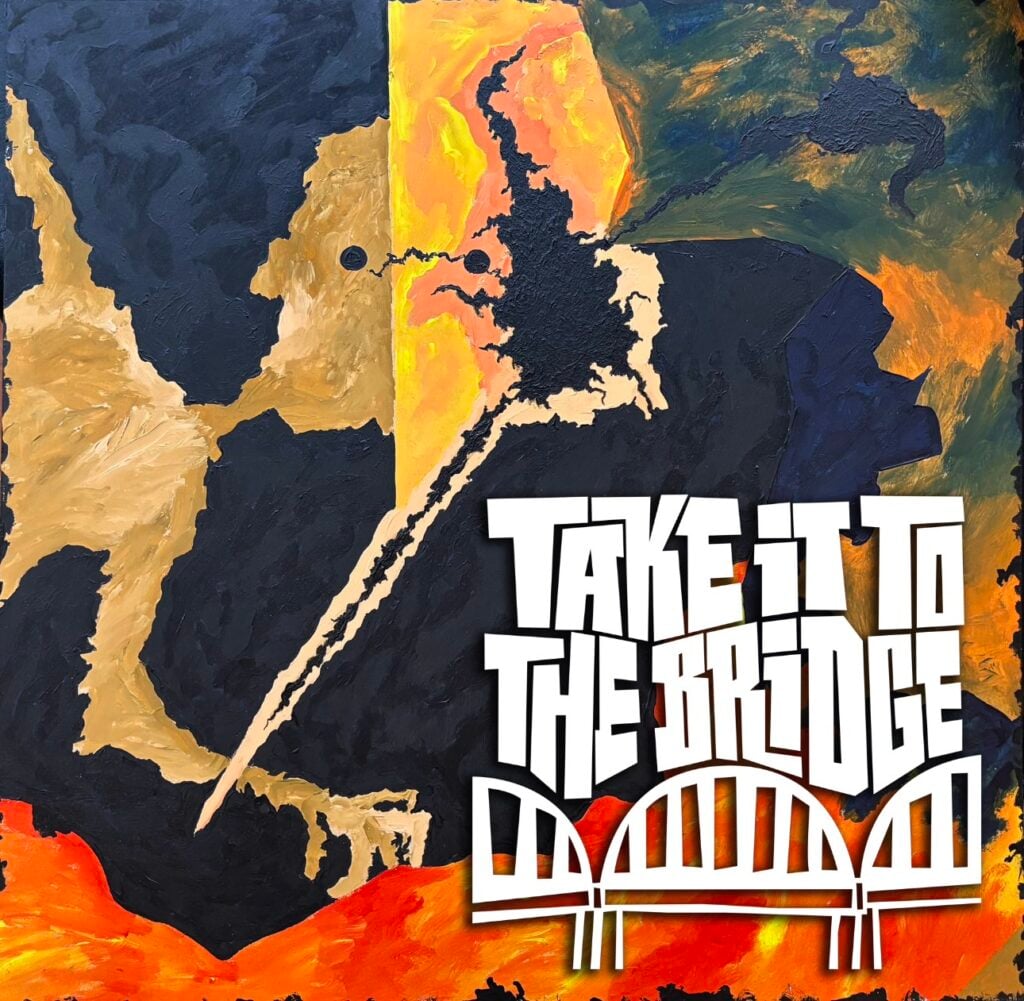
Image: ‘Take It to the Bridge’ LP artwork Credit: Supplied
He cites several illuminating examples from the past.
“Crowded House had to get ‘Don’t Dream It’s Over’ to No. 2 in the States before NZ radio would touch it. My hip hop/funk group The Babysitters Circus — towards the end of Opshop’s time — had ‘Everything’s Gonna Be Alright’ hit No. 2 in Holland before we got any radio support back home. Same pattern, same problem. Kiwi artists have to be validated overseas before our own stations will play us.”
“What disappoints me is how many young NZ artists are telling stories that aren’t theirs. Lives they haven’t lived, in places they’ve never been. Lorde was the antidote to that — ‘Royals’ called it out directly. A teenager from Devonport pointing out we’d never seen a diamond in the flesh, and the world stopped to listen. That’s what telling your own story can do. We need more of that. Encourage them to tell their own stories. Their own reflections of life here. And to do that, they need to actually hear themselves on the radio and in the productions around them.”
Because it’s all well and good supporting our rangatahi at school age, but there has to be something viable waiting for them when they enter the adult world. Fostering the next generation of music talent means fuck all if there’s no future for them.
“[H]ere’s the bigger structural problem hardly anybody’s talking about,” Kerrison says. “An entire generation has grown up subscribed to the whole history of recorded music for the price of a coffee a month. Or worse, the freemium model, free with ads. All at pennies to the artist. That’s reshaped the economics of being a musician more than anything radio policy could touch. The kids coming through aren’t just competing with each other. They’re competing with the entire back catalogue of every band that’s ever existed, all of it instantly streamable, all of it paying out fractions of a cent.” (If you’re reading this, Jason, consider New Zealand’s streaming alternative, Lume, which is trying to offer artists fairer payments.)
Having Kiwi music placed in films, TV shows, and adverts,” Kerrison thinks, could be “one of the real ways out.”
“That’s where the actual money lives now for working writers, and most Kiwi artists don’t know how to get into that tier. I’ve spent the last ten years putting together a book about it, ‘NZ Music in Sync’, pulling together my own experiences and the experiences of other Kiwi artists who’ve made it work. Basically writing the roadmap I wish I’d had when I started out.
“The hope is the next generation can step into that world quicker, with a map instead of having to draw their own. So break the treaty on the radio side. Renegotiate it. Get more Kiwi music in Kiwi ears. But also wake up to where the money’s actually flowing now and teach our young writers how to get into those rooms.
“We’ve got the talent. We’ve always had the talent. What we owe them is a system that lets them sound like themselves and make a living from it.
“We should be exporting a diaspora of New Zealand music out into the world, not importing more music that has nothing to do with our authentic lived experience. That’s what I support. That’s what I tautoko.”
O’Brien is “very hopeful” for the future of music in Aotearoa. “If we can navigate the surge of AI-created music and somehow keep the essence of pain and pleasure, joy and heartbreak, peace and conflict in our songs and in our hearts, then the rangitahi of Aotearoa will continue to be, as they always have, a unique musical voice in the chaos of the world that spins around us.”
Luck, who has been involved with another excellent initiative, Play It Strange, since its formation in 2003, says he has “no fear that the music of Aotearoa will continue to flourish.”
“Especially with the help of projects like Amplify Aotearoa,” he adds.
Holt views the situation the same. “There’s so much talent coming through, especially among young people. The challenge is making sure they actually get opportunities and encouragement to pursue it. There are some amazing people around putting a lot of time and energy into developing the next generation.” He praises Karl Lock at JB Hi-Fi once again. “There are few people as generous and passionate as him about Kiwi music and helping the next generation come through.”
The future of Amplify Aotearoa is in safe hands.
In fact, Holt’s already thinking about future events. “I’d say any of the Finn family, Dave Dobbyn, Bic Runga, or even Matiu Walters,” he says when I ask about his ideal guests.
“But one day I’d love to see if we could take the idea across the ditch as well. If that ever happened, Baden Donegal from Ocean Alley and Kevin Parker would definitely be at the top of the bucket list.”
Holt, however, worries that some of Amplify Aotearoa’s ambitious class projects “would probably be frowned upon in the current system.”
“We’re not really in an education environment that encourages kids to express themselves creatively or take risks trying new things, and I think that’s a shame,” he claims. “Even getting funding for projects like this can feel almost impossible sometimes.”
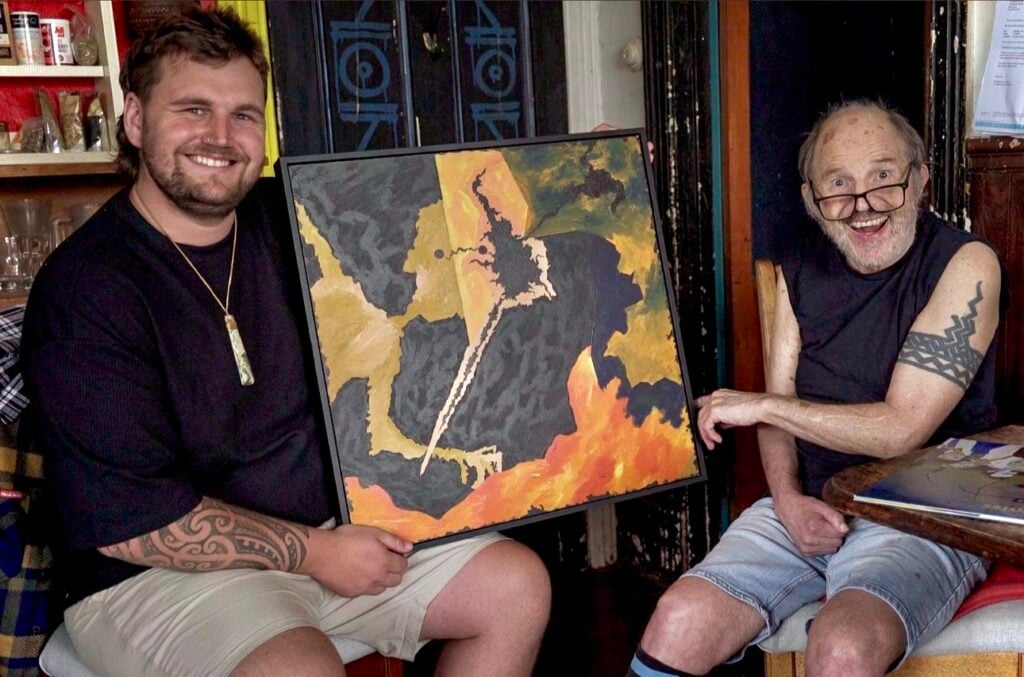
Image: Lachie Holt (L) and Chris Knox (R) Credit: Supplied
But this project, and this upcoming gig, is about the here and now, what can be celebrated as a landmark event for independent music in Aotearoa.
“That they’re allowed, that they’re welcomed in, encouraged. That’s the whole thing for me,” Kerrison says when asked about what he hopes rangatahi gets out of ‘Take It to the Bridge’.
“So many kids talk themselves out of music before anyone else gets the chance to. They decide it’s not for them and that’s that. I was that kid. I’d watch my mates get up there in their fancy tassels and cowboy hats, playing guitar at the Sunday shows, and I never once thought that’ll be me. I was super shy — even peed my pants standing up to talk in front of the class when I was five. The idea of doing it later in life didn’t cross my mind. I was terrified of eyes on me.
“Cut forward 30-odd years and I’ve travelled the world, worked with incredible producers overseas. Most recently I was in Zurich at Powerplay Studios, the room where ‘The Final Countdown’ was recorded, cutting vocals for a Swiss band, Future Memories. That trip meant I got to take my family through Switzerland and France, take my little girl to Disneyland, and kneel on one knee at the Trocadéro with the Eiffel Tower right there in front of us, and propose to my wife. Music opened the door to every single one of those moments.
“None of that was on the cards for the shy kid in the audience watching his mates. So when I say I hope these kids walk out feeling welcomed in, I mean it. If a few of them leave going, ‘Actually, I could do this,’ that’s the win. The rest of it, the discipline, the collaboration, learning to handle a bad gig, that comes if they stick with it. But first they have to believe they’re not just allowed in the room. They have to feel welcomed and valued.”
“It’s going to be a really special show and record,” is Holt’s parting message. “We’re always looking for people who want to support the kaupapa, so if anyone wants to get behind it, we’d love to hear from them.”
Find out more about Amplify Aotearoa here. Ticket information for ‘Take It to the Bridge’ is available here. Pre-order the vinyl here.

