































Ethan Montañer
‘The Higher-Ups in the Aotearoa Music Scene Didn’t Believe in Us’: How Dunedin Produced One of the Best Chart Stories in Years
Ignored by the industry. Struggling for funding. How a grassroots campaign helped four young Dunedin bands compete with Six60 and Lorde in the charts.

This feature is part of our Dunedin Scene Report.
In the middle of July — the week of July 10th-17th to be exact — the Official Aotearoa Music Charts had a rather familiar look to them.
There was US pop superstar Olivia Rodrigo leading the Top 40 Albums Chart, followed by The Rolling Stones (time to retire, already?), Michael Jackson (not a new release, don’t panic — simply the soundtrack to his recent biopic), as well as safe-but-dull ubiquitous chart presences Olivia Dean and Noah Kahan.
Over on the Top 20 Aotearoa Albums Chart, it was a similar story. Six60 were at No. 1, a position they seem to occupy more weeks than not. Breakout star Te Wehi was behind them in second, Marlon Williams’ 2025 masterpiece Te Whare Tīwekaweka, boosted by awards season success, was in third, and Lorde and Virgin were back in fifth.
Nestled amongst those much bigger names, however, were four young bands gamely competing with artists who make the charts simply by way of their stupendous social media followings.
Sivle Talk, Sogg, U-NO JUNO, and Vagina Dry, four bands currently making Ōtepoti Dunedin the best music city in the country, joined forces for 4EPs, a special release steeped in Aotearoa New Zealand music history: it followed the wonderful example of Flying Nun’s Dunedin Double EP, which introduced wider Aotearoa to The Chills, Sneaky Feelings, The Stones, and The Verlaines in 1982, almost a quarter of a century ago.
In that week of July 10th-17th, the collaborative record made it all the way to the top of the Aotearoa Albums Chart, spending four weeks in the mix, and, just as impressively, also made it into the top 10 on the Top 40 Albums Chart.
Love Music?
Get your daily dose of everything happening in Australian/New Zealand music and globally.

View this post on Instagram
But how did four independent bands, who have approximately 4,339 Instagram followers between them (Six60 probably have that many followers in any tiny New Zealand town you can think of), who didn’t even release their record on traditional streaming platforms, reach such lofty chart positions?
Natasha Griffiths, the main person behind the project, doesn’t even have a definitive answer. “Yes!” is her succinct reply when I ask if their chart success took her by surprise.
A fixture in the Dunedin music community for decades, Natasha was so blown away by the bands’ respective talents that she inaugurated DUN Records, a new label to support them and promote the record.
The idea for 4EPs first came to her in dire circumstances. “I was sitting around thinking how fucked the world is and feeling useless about being able to do anything about it. Then I thought about the good things, and a great thing has been the young music scene [in Dunedin] the past few years, and I’ve been working with the musicians, especially as the Pioneer Hall took off.
“So I thought: what can I do that would truly make a difference, even on a small scale with the skillset I have, and I scribbled down a few ideas.”
4EPs was the winning idea, and the record was “a natural progression” for the four bands. “Those of us who can open pathways, and especially help our young musicians to thrive, and remember when necessary to support them, the idea suddenly seemed a no-brainer,” Natasha says.
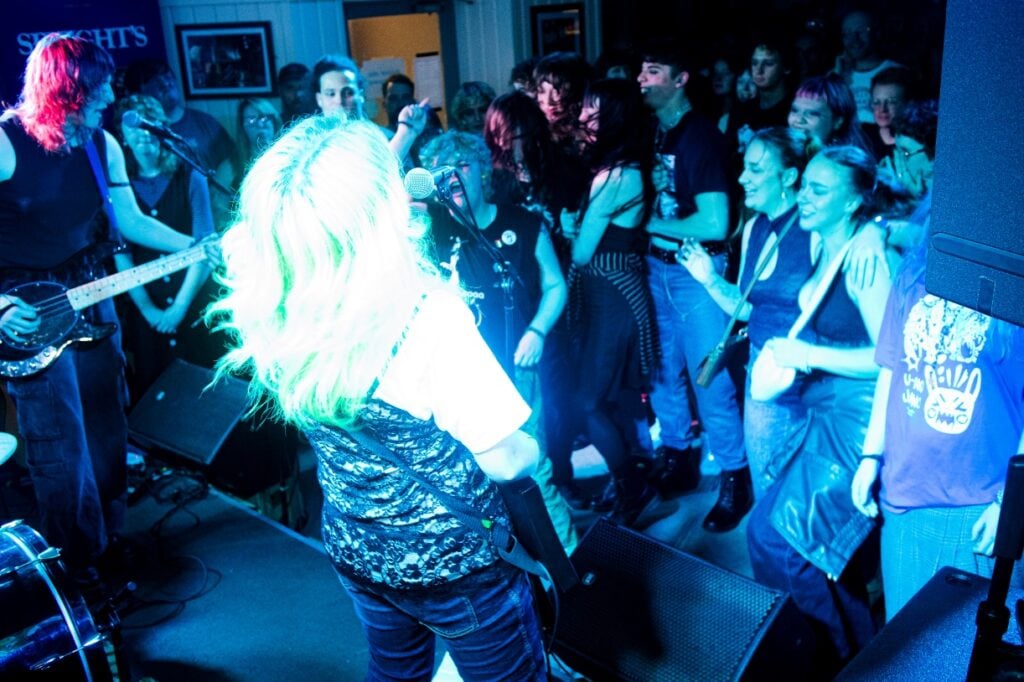
Image: Vagina Dry Credit: Ethan Montañer
4EPs is essentially four individual releases packaged together, with each band given one side each. There’s Sivle Talk’s CRYBABY, Freezer Thaw by Sogg, U-NO JUNO’s you know, and a self-titled EP by Vagina Dry.
Like the Dunedin Double EP, its spiritual forebear, it showcases four connected bands with distinct sounds: Vagina Dry update classic Riot Grrrl for modern listeners; Sogg are all youthful exuberance and anti-authoritarian spirit; Sivle Talk is a one-man post-punk band led by a musician who’s an equally accomplished filmmaker; and U-No Juno are a subtly sweet, raucous noise-rock trio.
Why listen to the thoughts of a musically bereft writer, though, when you can hear from the bands themselves?
Vagina Dry on U-No Juno: “A crisp sweet apple in an autumn orchid” (poetic); “A phenomenal blend of ’90s alternative rock with a sprinkle of softness that makes it special” (technical)
U-No Juno on Sogg: “A precocious band pushing the limits of noise rock”
Sogg on Sivle Talk: “One guy who will write a song about us if we say anything bad about him”
Sivle Talk on Vagina Dry: “An unstoppable force of feminist punk with an un-googleable name”
“The music is really good,” Natasha says. “Obviously they are all spectacularly talented. They are excellent songwriters. Next level musicianship.” She singles out Sogg’s “unreal chemistry that is incredible rare,” and she adores U-No Juno’s “duelling vocals.” There is simply no other band like Vagina Dry, she claims, while Tane Cotton, aka Sivle Talk, “has a vision, and there is no deterring from it.” (Note: Tane is Natasha’s son, but nepotism is only an issue if the beneficiary is talentless.)
The recording process was unsurprisingly DIY. Sogg recorded at South Link Studios, run by Nick Roughan, which offers any artist or band a certain amount of free studio time per year, an absolute game-changer for a city so often overlooked on a national scale. (Pearly*, who featured in our Future of Music 2026 series, are just one of the incredible bands that have recorded at South Link Studios.) The rest of the bands recorded at Tane’s War Possum Studios, aided by local mix engineers Sam Charlesworth and Hamish Waddell.
“I couldn’t financially contribute to the recording, and knew they’d all be fine,” Natasha says. “They had full autonomy. I said, ‘You make the music and I’ll take care of everything else.'”
She doesn’t mind admitting that the margins were “as thin as could be” when it came to getting the record made. “My first thought was to have a cover concept that was cool, yet also saved a bunch of money, i.e. printed sleeves in a gel bag,” she recalls. She “cold-called” Stebbing, a recording studio in Tāmaki Makaurau Auckland, and its sales manager Murray Cullen loved the idea so much that he approved an account “with no upfront costs.”
“It couldn’t have happened without Murray and I working together,” Natasha says. Even with Murray’s help, however, the margins were razor-thin, so much so that Natasha concedes that the EP “would normally be considered a really stupid thing to do.”
The costs eventually came down when the mastering was covered. JB Hi-Fi product manager Karl Lock, “who is really supportive of NZ music,” then put in a big order that increased the print run and lowered the costs further.
Natasha admits that they had to be “savvy” when it came for the EP rollout. “[P]eople had to want to buy it to make it work.” Relics Music, one of Dunedin’s best record stores, got fully behind the project for pre-orders, and even “promoted it as much as we did,” according to Natasha. Relics hosted single release shows in the lead-up to the full physical release, and the store also sold band t-shirts “with no commission,” Sogg reveal. Other independent music stores around the country happily stocked the record, as did JB Hi-Fi, who even put up a full display in one of its stores.
Long before the release, there was word-of-mouth buzz about the record within Dunedin’s close-knit music community. “I kept hearing people coming up to me [and] congratulating me, and having to play dumb like, ‘Oh, 4EPs? What’s that?'” El, the fearless lead singer of Vagina Dry, recalls.
“I’m pretty sure all of us told our friends and word got around quickly, but everyone respected that it was still a secret to the wider Aotearoa music landscape and we managed to keep it that way,” Tane says.
For U-No Juno, it’s a relief to finally be able to wax lyrical about the record. “We really like to spill information about everything we’re up to, [so] keeping the project a secret was harder than expected,” they say.

Image: Vagina Dry play at the Crown Hotel Credit: Ethan Montañer
Pre-order sales of 4EPs were “really good,” Natasha tells me, while CD sales at the launch shows were “crazy good.”
“I figured it would be hovering around the top 5,” she says about its chart success. “4EPs is based on a 100% physical release — everyone is also streaming, and the chart counts both. We went against all the streaming rules. We haven’t had the industry money that usually accompanies a chart success. Then the next week to still be No. 4 solidified things — it means people are still catching on and buying the record, and it wasn’t just a pre-order chart fluke.”
It helped that Aotearoa’s student radio network got behind the release. “All four bands have been killing it around the country [on student radio],” Natasha says. “Again, that only happens when the music is actually good.”
While she concedes “there was a big gap in coverage” by the media of the city’s music scene for years, she singles out Radio One, The Critic, and Otago Daily Times for supporting the hell out of the project. “The Radio One top 11 is always predominantly Ōtepoti bands, it wasn’t like that even a few years ago. Look at what we can achieve when we are all supporting one another.”
View this post on Instagram
There sometimes existed semi-serious rivalries between the great ‘Dunedin Sound’ bands of the ’80s and ’90s, but no such quarrels exist today. Talking to these young bands, you get the feeling that they’d be supporting each other even if they weren’t connected through city and community.
“Ambient yet doomy post-punk with heaps of Dunedin influence,” U-No Juno say about Sogg’s EP entry, Freezer Thaw. “Drum and bass blend together with walls of guitars soaring on top.” They single out the rousing “Argument” as Sogg’s best track on their EP. “To us, this song feels like all the perfect elements of Sogg. Great drum groove, cool guitar sounds and a great bassline that pushes the track forward.”
Vagina Dry’s self-titled EP is, according to Cotton, “[a] blistering tornado of bone-shaking drums and chainsaw riffage, delivering righteous Riot Grrrl anger directly into your eardrums.” He implores everyone to “[g]o listen to it now.” Sogg hail Sivle Talk’s Crybaby as “an instant classic. [We] really love the range of sounds, styles, and topics Tane covers.” “FBI Office” is their favourite track on Cotton’s EP, “just really good angry music targeted at the most deserving people.”
Many of Dunedin’s musical greats of decades past still reside in and around the city, and they’re always happy to support the next generation of talent.
The Clean’s David Kilgour played on Sogg’s cover of one of his band’s classic songs, “Point That Thing Somewhere Else”; Robert Scott, of both The Clean and The Bats, was a guest on the new album from Bunchy’s Big Score, another great local band; Straitjacket Fits and Dimmer icon — and Natasha’s brother — Shayne P. Carter got several young bands to play at the premiere of his 2025 documentary, Life in One Chord; Look Blue Go Purple’s Francisca Griffin regularly attends gigs in the city.
This rejuvenating connection between young and old, however, hasn’t always been the case in Dunedin. “Some years ago, there was a generation of local musicians who loudly complained about the ‘Dunedin Sound’, and also the artists themselves,” Natasha claims. “That wasn’t cool. They thought it was but it wasn’t — and it made me feel quite sad. I’m so relieved it has come full circle and everyone is celebrating one another.”
Most touching of all, Natasha and 4EPs received support from the family of the Chills’ late, great Martin Phillipps, with his estate donating money to cover the upfront costs of mastering. His sisters also kindly donated the original Dunedin Double vinyl to DUN Records for a pre-order giveaway.
[Martin’s sisters] Rachel and Sara lost their brother and are protecting his legacy staunchly and beautifully,” Natasha says. “To be given the opportunity to have Martin a part of this is just of course so special. And I know it has been the same for them.”
View this post on Instagram
4EPs charting was memorable for Natasha and the bands, but it was far from the be-all and end-all — what these young musicians stand for as artists and people is much more important. “Music nowadays is mainly focused on the next big hit and doesn’t prioritise expression and authenticity over profit and capital,” El says.
Because if one throughline emerges from 4EPs, it’s how deeply authentic these four bands are. The ‘Dunedin Sound’ bands were never apolitical per se, but the city’s current generation of bands are more overtly political; a sign of the dismal times, probably.
El writes Vagina Dry songs to combat “the lack of representation in the Aotearoa music scene,” and they single out the backwards “she’ll be right” attitude that still permeates issues such as sexual assault in the country. The band hope that their record charting even with its political content “shows that the New Zealand audience is fed up with the state of the country right now, and the current government. It resonates with them.” AI is also in their crosshairs. “People year for real art from real artists that isn’t backing some big corporation and is alternative to a streaming platform that funds genocide and Artificial Intelligence.”
Sogg say they couldn’t make the music they do “without being authentic,” while U-No Juno “never write thinking of what other people will feel about what we’re doing.”
“If you’re not writing music for yourselves then what’s the point? I feel the authenticity shows through the music,” they add.
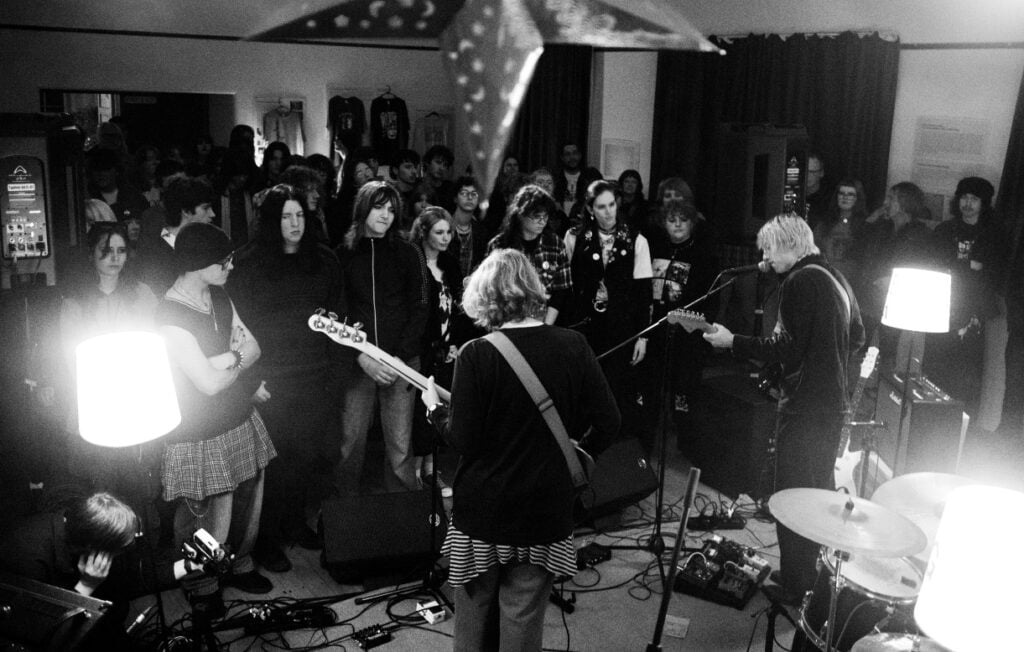
Image: U-No Juno play at Pioneer Hall Credit: Ethan Montañer
Tane has stronger words. “Authenticity in music has been dying as long as money lenders and loan sharks (now called ‘record labels’) have existed. I don’t think it will ever die, but it will be impossible to make it the norm without a complete overhaul of the entertainment industry.” (Amen.)
Natasha was never going to temper these young bands’ forthright political nature. “I am in awe and inspired by these four and so many others in this city… I mean, no one will be touring the US anytime soon! There is so much to stand up against, and stand up for.
“Interestingly, for four bands who were releasing their debut vinyl, no one was even tentatively asking the ‘label’ if there were any boundaries… they just assumed they could be who they are, as they should! I recall even saying something along those lines early on — all I want is for you to be you, as much you as you can.”
4EPs was launched with celebratory shows in — where else? — Dunedin at the beginning of July, one at Pioneer Hall, one of the main homes for the city’s incredible all-ages music scene, and another at the legendary Crown Hotel.
Vagina Dry remember the shows being “a fantastic vibe. Everyone was super happy to be there and it fed into all the performances. We sold all our t-shirts, which helped the band accounts!”
“So many people came to the release shows,” U-No Juno say. “It’s like, ‘Haven’t you seen all these bands before?!’” [It’s] really great to see so many people turn up for these events. It’s always been a very supportive community. I think everyone’s excited to have this release coming from our city.”
“Everyone and their nan was there! One of the weirdest things that happened was people asking us to sign their records — it just feels strange to us,” Sogg add.
Earlier this year, Natasha and the bands applied for a grant to take the tour to the North Island, but their submission was ultimately denied. (A truly baffling and backwards, not to mention ahistorical, decision.)
“It felt like the higher-ups in the Aotearoa music scene didn’t believe in us — we proved them completely wrong,” Vagina Dry state. “Everyone has really come together to back us as a community… It was the support of the tight-knit Ōtepoti music scene that really pushed us into the limelight.”
Two release shows remain, one at Geraldine Cinema on Friday (August 7th), before they finish up at Space Academy in Ōtautahi Christchurch the following day (August 8th). (Ticket information is available here.)
Moving forward, all four bands have big ambitions, and rightly so. “We have been wanting to release an album, mainly write new songs, and hopefully conquer the UK at some point,” Vagina Dry say, adding that they want to continue to “advocate for the under-privileged.”
As alluded to earlier, multi-hyphenate Tane is working on both a Sivle Talk album and a feature documentary, as well as keeping up his web-series, Live on WarPossumTV (watch U-No Juno’s appearance in the series here). “I’m staying busy!” he says.
Sogg’s members, all still in high school, are ready to “get some rest” before working on new music. U-No Juno are working on a full-length album, and other “big things coming.” Plans are already afoot at DUN Records, meanwhile, for more EPs, but Natasha remains tight-lipped about which bands will feature on future records.

Image: Sogg Credit: Ethan Montañer
4EPs started out with 400 vinyl copies, in addition to a few hundred CDs, but supply hasn’t met demand: at the time of writing, Natasha has already ordered a new pressing.
“A physical-only launch is frankly a dumb decision to make,” Tane candidly says, “but we don’t care because artist rights and consumer rights are more important to us than money.”
As he notes, Dunedin is a city that has long held physical media in the highest regard. “[P]eople are enjoying the records and CDs… Everyone is excited about the spotlight that it’s shining on current-day Ōtepoti music… We’re not shoving a half-arsed product in the faces of our fans and expecting them to buy it with no questions. We’re a group of passionate artists who have created something truly special together, and we know how lucky we are to have our music pressed on vinyl.
“To me, it shows that Kiwis aren’t all just braindead consumers and that they want to be respected by the people asking for their money. We’re not too far gone, yet!”
According to U-No Juno, their chart success “shows how big the indie music community is within Aotearoa.”
“I think the authenticity of the release, in both music and ethos, has helped it grow so big. It’s something people can grasp onto,” they add.
Sogg, meanwhile, think it’s a reflection of “how much weight” the Dunedin music scene is carrying these days. “It’s almost reminiscent of a really popular music scene from the same town in the 1980s…” they tease.
Natasha isn’t about to make a sweeping declaration about what the chart success of 4EPs means on a wider scale; the likes of Six60 and Lorde will undoubtedly continue to dominate our charts for years to come. But Sivle Talk and Sogg and Vagina Dry and U-No Juno getting to compete alongside them, even if only for a handful of weeks, gives one hope for the future of independent music in Aotearoa.
“I’m not sure what it means for Kiwi audiences in general, but it does show there is an audience for this music, and for the physical release,” she says. “It starts with the amazing community in Ōtepoti, and it’s gone wider… That’s a win for musicians and audiences.”
Find out more about 4EPs here.

