




























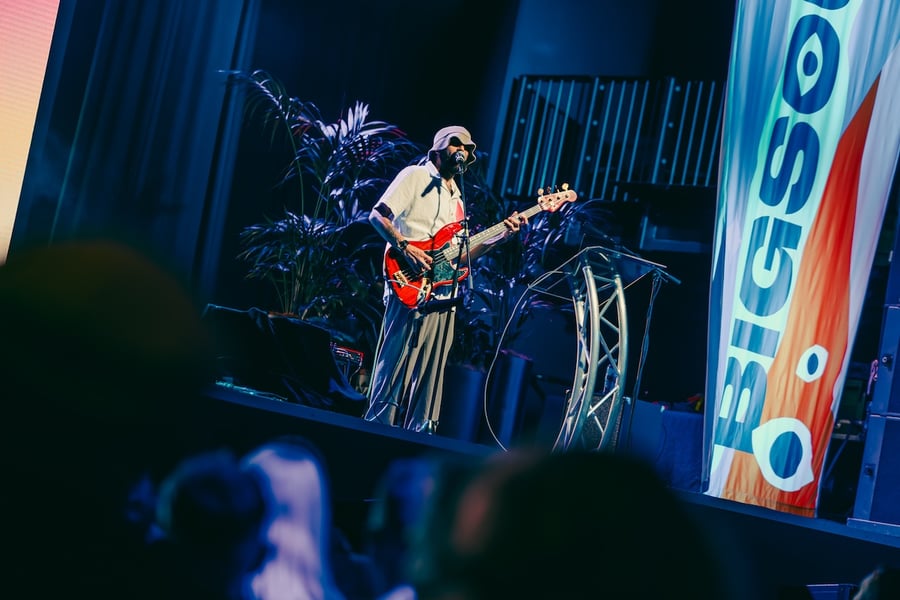
Trials opened this year’s BIGSOUND conference in Brisbane this week with a powerful keynote.
In his 45-minute address, the Indigenous rapper shared his story, from personal anecdotes of his youth, also explored on his recent solo debut album hendle, as well as his experiences in the music industry.
You can read the full transcript of Trials’ keynote below.
Part one — Identity, Raukkan, and hendle
Thank you so much, BIGSOUND.
I mean, we got there, right? We got there in the end. Look at us go. Consummate professional, me. Now, what I’m really good at is dropping my pick, unplugging my guitar before I start, and making really bad PowerPoint presentations. So we’re going to sit through one together.
The following contains the voices, names and victories of Indigenous persons alive and doing really well in some Australian communities. Hearing the names of Indigenous people alive and overachieving may cause sadness and distress, and in some cases may offend against strongly held cultural beliefs. Spoiler: the hero survives.
Love Music?
Get your daily dose of everything happening in Australian/New Zealand music and globally.

Before I get into all the absolutely shameful bragging that I’m about to do — to give some context to the victories and losses that I’ve come across in my many years — I would like to start with the worst photograph of me. Look at that. Pretty much — if you took a photo just then, you’d have the same photo, I reckon. And if you play a guitar or something, you know that face is having a great time up there.
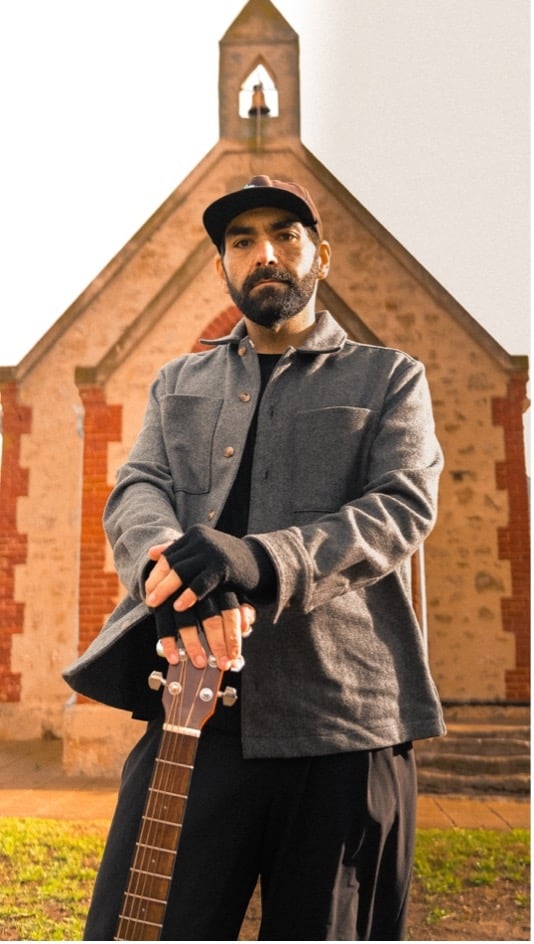
My name is Daniel Hendle Rankine. I’m a Ngarrindjeri and Raminjeri man from Adelaide, South Australia, and for the past 25 years I’ve written, produced and performed music under the name Trials. Also — happy birthday, BIGSOUND. 25 as well. Good on you. Round of applause for them.
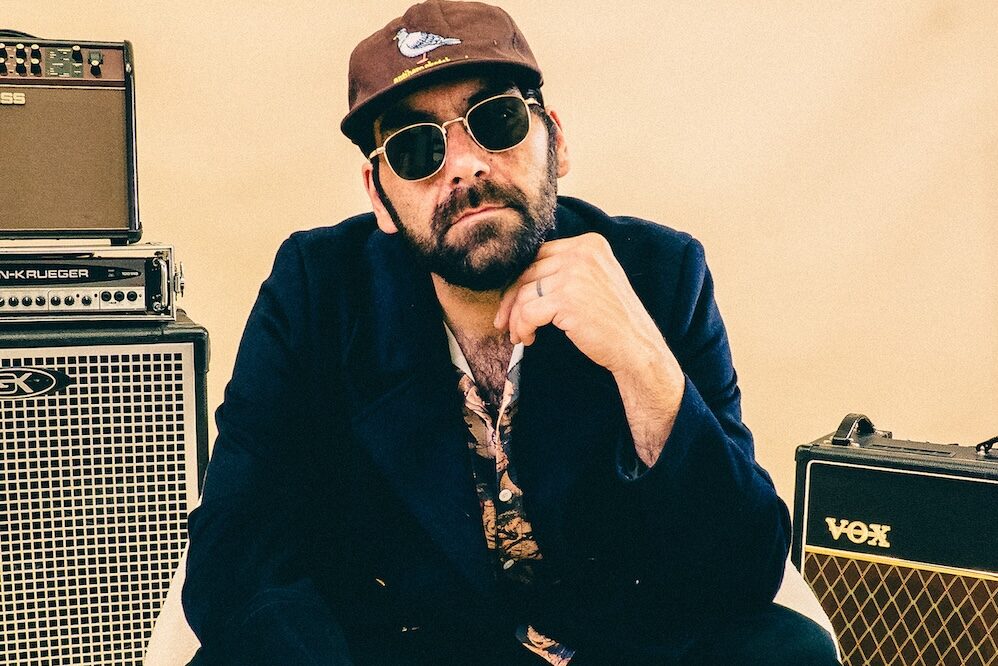
Daniel Hendle Rankine
There you go. I’ve been a published songwriter for over 20 years, and up until a few months ago, releasing records independently my entire career. I’ve got a couple of these Infinity Stones achieved along the way, and I tell you that not so much to say I’m a legend, but mostly to make my siblings feel incredibly inferior about themselves and what they’ve done with their lives. You know. Have a really good think about that for a second.
At last count, I have just over 400 songs registered with APRA, and ten or so of those — I know ten or so of those are very shiny. Ten, you know. So I still do maths on my fingers, but I know that they’re not incredibly good odds, right? And a lot of people in my position, and some of yours, would probably do some unspeakable things to have a big record, or a hand in one that does well. And although I am doing maths on my fingers, I know for a fact that ain’t worth it. But this, however, is everything to me.
The last time I was on this stage was ten years ago. I shared this stage with Briggs, right here, and we introduced the project called [A.B. Original]. […] This is a good photo of me looking at the worst photo of me. It’s a Spider-Man meme.
This time I’ve been invited to discuss with you something even more personal and even more private — if you can call something available on all streaming platforms private, but definitely very personal. A project, and how my experience in the music industry [had a] hand, or a big foot, in shaping it. And that project is called hendle. H-E-N-D-L-E.
I’ve been very fortunate to exist in an industry and play many roles, working with people outside of my genre. Absolute legends. Paul Kelly. Ash Grunwald. Pete Murray. Jimmy Barnes. Real icons, humans, beautiful people, who opened their heart and their studio to a kid who liked rap music, because they [had] the same intention and energy that those fellas have. I’m forever grateful. Grateful for all those conversations, those collaborations that pushed me way further out of my comfort zone than I ever could have imagined.
So, artists — the first piece of advice I have, obviously, is [Paul] Kelly. That’s pretty easy to do, actually. You’ll do that if you hang around long enough; he’s an absolute legend, trust me. Second piece: create conversations where they don’t exist. If you have something in your brain that you need to get out, but you’re not hearing that — be the catalyst. Be the person that starts that chat. Those people did that for me.
This year, I scored the soundtrack to the first Amazon Original Series, Top End Bub, with the incredible Miranda Tapsell — a big tap out, make some noise for Miranda Tapsell here. And I produced with my brothers Birdz and Fred Leone [the record] that helped them secure [Artist] of the Year at the NIMAs last weekend.
Collaborating with like-minded and sometimes completely opposite-minded people has helped me expand that toolkit, and become self-sustainable in an industry that’s built [on] bodies of good intentions.
I have taken all of those skewers — I’ve learned every step of the way from my friends, and I’m still listening — and how to tell my story. And the result is, after 20 years, my very first debut solo album. Yeah. Why not? Why not? Good for me. Why not?
Hendle has a few things. As I said: H-E-N-D-L-E. It is my great-grandfather’s name. It’s my middle name. It’s the title of my album, which is the centrepiece to a three-part [project] — from the negative space art that explodes with colour when you open it, to every single instrument, every single lyric, every mix. Everything on that record is me. Hendle is unashamedly me, discussing the most shameful parts of my life and how I’ve [grown] from them.
As I mentioned at the top, I’m a Ngarrindjeri man. I represent a nation which is made up of a group of smaller ones, one of which is called Raminjeri. That’s me.
The Ngarrindjeri word for meeting place is Raukkan. I’d like to take you to Raukkan very quickly. For those of you fortunate enough to come across one of these bad boys outside of a bathroom — this is a $50 note. The fella on this, this guy’s name right there, this fella here — his name is David Unaipon. Unaipon. The fella that I mentioned at the start.
David was obsessed with the secret to perpetual motion. I bet you didn’t think you’d hear someone talking about that at BIGSOUND, but I am. This fella was the creator of many inventions, including the modern mechanical sheep shearer — tongue twister, but I got it — which drastically changed the country around him. Although this fella was unable to afford the patent himself, so others around him profited off his ideas, with his credit coming decades later. And even then, reasonably tokenistic. I don’t know. Familiar stories, some of you, perhaps? Maybe. I don’t know. You tell me.
This photo was taken [in] the 50th year of settlement of where I’m from. Raukkan has 99 people at any given point, and [one of] those people is Auntie Ruby Hunter — who, if you don’t know, you [should]. To be able to stand on the shoulders of giants like that. You know. I feel it.
In this photo, Hendle is six years old. He’d live under Mission control until 1982, when Raukkan was reclaimed and given back to us — renamed from Point McLeay Mission. Much better name, Raukkan. That’s Hendle right there, [third] from the left. And my Aunty Annie. They looked out for the church, the church looked after them. They looked after community, community looked after [them].
When I was [young] — about the age Hendle is in that photo — my mother and I left the country in the middle of the night, due to a domestic violence situation at the hands of my father. My connection to culture was severed. My identity was shattered. And I felt like I woke up a couple of years later with this fucking weird transatlantic accent thing I’ve got going on.
If my memory was a book, it would look something like this. Just big passages blacked out, where I’m left to weed through all the memories, and maybe [the ones I] used, to try and figure out who the fuck am I.
[I] stopped drinking alcohol and got incredibly sober. Yeah. Why not? Why not? Why not? I miss it desperately, don’t get me wrong. [I] say that to say: if anyone out there has got a little thing on [their] shoulder, I promise you, you’ll be better off for it. Getting that thing — sidestepping these little memories, these black spots — became harder when I had a lot of sobriety. And anyone else who’s tried it knows exactly what I’m talking about.
I started trying to put the times and dates and people and places together, and I realised really quickly that a lot of what I’d come to believe probably wasn’t either true, or was the safer kind of version my brain let me believe, to deal with what I had gone through.
My studio is called a studio because music [is] sometimes made in there, allegedly. But it is mostly a collection of scribbles and half-finished ideas all over the world. I use those walls as a canvas. I was writing down little passages, trying to figure out where I was, who I was. And I realised pretty quickly that I had enough [for a] book.
This is a book called Be an Adult, Have a Breakdown. Solid advice. I feel like if you haven’t had one by your mid-twenties, you are not really living life yet.
This is an autobiography of sorts, of semi-accurate events that I’m still trying to make sense of. Right now, it details my displacement, arriving in a country where nobody looked like me — which was called Tredegar, Gwent, South Wales. Not New [South] Wales. I wish it was New South Wales. The United Kingdom, where I woke up after leaving that night.
We have racism here, but they make it better there. They have a different ingredient — I don’t know what it is. It’s like old-timey something, but they’re very good at it. The racism and displacement that took me halfway across the world followed me for the rest of my life.
When I was there, I would dream about coming back to Australia — the nineties — where there would be no racism. So you can imagine my delight coming home. Not really quite sure where I belonged.
I am very, very, very bad at names. So I apologise, at the start of a week full of networking, for not remembering already. And I apologise for anyone else who has a clown car going through their head at all given times when someone’s trying to talk to them. I am you. I see you. I apologise for us. Faces, however — I don’t forget those.
In between the stories and sounds, my idle hands must continue to do the devil’s work. So I punish myself further by having another special interest, which is painting. Painting was my entrance point into music.
Growing up as a kid in a very low socioeconomic area with very little opportunities, graffiti was a big old output for me. [It] became a way to work through the memories of people I met moving through shelters, emergency accommodation. [The places] my mother and I would move [between] became a timeline in my life.
[I’m] very proud to have launched this collection of works as a gallery. And I’m even more proud to have them on display here, just this week, just across the road. So please, please — if you do leave here, which you will — please go across the road and have a look at some of my paintings. It would be beautiful. There’s some amazing didgeridoos and there’s some amazing artwork, not by me, and I implore you to go check it out.
My brother Birdz will be there as well. You know, anywhere that Birdz is, is a good time. He’s currently at Dan Murphy’s — [can’t] make it right now — but he will be here eventually, allegedly. I’ll also read a chapter from the book, so if you’d like to [hear] from that, please do come by tomorrow.
This is the third and final part of providing an entry point into the project that I have made called hendle. H-E-N-D-L-E. That’s me.
I feel like there’s a certain tone of voice, and a certain level of outrage, and a certain level of otherworldly, ethereal life form expected from Indigenous artists in Australia. And when that happens, that often it attributes our talent, our stories, our lives, our work [to] just something greater — that is so great that it will be used every single opportunity against you. Every single chance they will get, they will try to discount [it]. Because it’s due to the nature of — OK. I think all the fellas in here, I think exposure is what you get offered. I think that’s what it is. There’s a difference between us: we do it for the culture, and to be completely smashed for all self-worth.
To all the artists in the room — not just Indigenous, but especially my brothers and sisters — you must be able to tell your story the way you…
Part two — Ownership, clearance, and the six-letter word
…want it told. Otherwise, it will be told for you, and you will not [recognise] the tone of voice. I can’t stand it. One minute you’re pushing “change the date”, and then the next year all the [?] hoodies disappear.
I have a real hard time measuring that success, and my part in it. I think “useful idiot” is the term.
My album, my art and my book is a full stop on the conversation I’ve been trying to have with society, and a big old industry that I’m not quite sure if I belong in still, after all this time. I didn’t want [to] put out my record this way, and I don’t recommend you do [either]. It is painful, and punishment. But know your worth, my friends. There is none of this without us. Your worth. And that goes both ways.
There is no music industry without us. Without our opinions, our art, our taste, our ownership. Ownership. My friends, remember that.
For many of you in this room, the complexities around ownership of music is second nature. You understand how it works — [who owns] the song and whatnot. If you are unfamiliar with it, APRA AMCOS [are] your friend. Truly, the good guys.
Earlier in my career — before it was a career — I had been making rap songs that sounded like very bad impressions of the music I listened to. I like listening to loud, obnoxious rap with lots of words, lots of samples of samples.
I was very fortunate enough in my career, very early, stumbling my way through this songwriting, to have a few marginally successful records — if you measure success by accolades. One of those, which will remain nameless due to the [nature] of the paperwork that I may or may not have definitely signed… [I worked] with an artist on a number of projects. We worked together, started to get a little bit of momentum in the early two thousands, in a very small scene. And a gold record here accidentally became a platinum one there, which led to a reasonable amount of eyes and ears on our music and the way we make it. Great.
Richy Sandham
Some of that music that I was making was made using pieces [of] somebody else’s music. And that someone, understandably, wasn’t very fucking stoked with that.
I learned a big lesson that time. In the early 2000s, [we] had a particular sound being driven by that high-pitched vocal — you know, the chipmunk soul sample thing. So I took that — it’s good, all impressionists do — add that to my toolkit.
Our record was being played every single day on the radio. Kind of freaking me out a little bit at this point. And the lead singer of [the] band that I had sampled now lived in Australia.
A lot of serendipitous stuff happens in my life that I’ve just [learned] to pay attention to, and not question it, and go: oh, OK. Thank you. I’m listening. When the world screams at me, I am very receptive. And [it had been] yelling for a couple of years.
Our friend — let’s refer to him as such from now on — gave me my first introduction to copyright clearance, and the importance of open dialogue. And the fact that no matter how honest or artistic your interpretations are, or your intentions might be, respect [for the] rules is paramount. You can’t mess with that. That’s the one. I started to understand pretty quickly not only other people’s [ownership], but mine too.
PS: if you’re an artist or a manager or someone, and you’re having [a] discussion this week where there’s some sort of splits that [are] eighty-twenty or ninety-ten or something like that — be honest about it. Tell that artist what the odds really are of recouping. What the odds really are of getting a hit.
The cost of business would be less if we didn’t have to trade on trauma all the fucking time.
At this point, I’ve been sued into oblivion. Allegedly. My APRA statements have red lines through them. I don’t know [if I’d] ever seen one of them before, and [there’s a figure] down the bottom. I’m freaking out. I’m trying to figure out how to — do I play a bar chord? I don’t know what to do. I’m freaking out at this point.
And it’s with that I’d like to take you back very quickly to [nineteen] ninety-four. This fellow right here, if you’re familiar, is the bunyip — we call him the Mulyawonk. The Mulyawonk is a cautionary tale about the Murray River, [to] let young fellas know [not to] mess around near that place. About an hour from Raukkan you’ll find [the] birth of the bunyip. If my family wasn’t near this river, we would be telling [different] stories here.
1994. I’m on the way to a protest — the protesters against the construction on traditional grounds. 1994 is Forrest Gump, Pulp Fiction, The Shawshank Redemption — and secret women’s business. That’s what it was, for me, that year.
The claim was [that] secret women’s business had been conducted traditionally on parts of the land. The council want to develop. Shock. Our community and their leaders, including my Nana [and] my uncle, [were] torn up in the press. A Royal Commission — which everybody holds incredibly dear — claimed the stories were fabricated and had no grounds.
Years later, again — common theme — after everyone is dead, a federal court finds out: we might have made a mistake there. You’re probably right. My family’s claims [were] found to be truthful. And the court reading says “knowledgeable beyond the written history”.
Tell your story, or it gets told for you.
In my gallery, you will find images of pelicans, penguins — alive, well and otherwise. Those penguins were rendered extinct. Killed. Little beautiful fellows, little fairy guys. The stories were [lost], the songlines [gone] over. But travel time was reduced by fifteen minutes. Measure the success, my friends.
Archie Roach. Jimmy Little. Howlin’ Wolf. Curtis Mayfield. This is [the] soundtrack of my Nana’s house, and all these protest songs that [we] would listen to every day. This record has a song called “[If There’s a] Hell Below” — because we’re all going. I fucking love that title.
This record, along with Wu-Tang Clan, and heroes that I’d find myself on national tours with like Cypress Hill and Ice Cube — [they] made music that would infatuate me. The words. The words [pulled] me towards this momentum. Right now — the story sounded the same. They looked like my uncles. And it [was] the only avenue [where] I heard a six-letter word thrown around in an endearing, an inoculating way, [that] didn’t make me feel like nails on [a chalkboard].
Some of my earliest memories in Wales revolve around the same word that I heard a few times before I left — always towards me. Six letters, starting with an N. It’s not that hard. And we’re not playing Wheel of Fortune, so don’t yell it out. Please.
My brain oscillated up and down through the charts just to figure out how kids halfway across the world knew that name for me, but didn’t know me. This is me figuring out racism in real time.
As I stand on stage in a city with some lovely mandatory terms for saying words. Words indeed have always been a fascination of mine — how they’re used, when they’re used, why they’re used. And as we get closer and closer to midnight, me wanting to take a little bit of ownership from the words used against me — life seems to be getting a little bit slippery, for some reason.
The first version of this song I wrote around that six-letter word was called just that. I respect subtlety like I respect the ocean: I see it, I just don’t go too close to it. It’s not for me.
This version contained a sample of Mr Mayfield saying the word at the start. He says a bunch of them — six or seven big old epithets, just to get you comfy.
Leaning on my past experiences — I just told you about, good and bad — I approached the correct channels. Good for me. And identified that the controlling ownership of the recording I wanted [to] sample was now in the hands of [a] private investor. Ownership again. Cool.
PS: if you’re ever trying to clear a sample, give yourself lots of time. Don’t put an end date on that initial invitation — or be prepared when they say yes until the very last day, and then change it to a hundred percent. Just be prepared. I may be talking from experience. Allegedly. Definitely. 100% of the time.
You can’t decide how other people hear your song, but you can decide how the intention comes across. My request [was] denied. No further comment. [They] literally just said: no thanks. Catch up.
OK. I’ve played this game once or twice before. The following is an excerpt from the letter I wrote, along with support letters from some of the industry’s highest level, further explaining my intent. “Curtis Mayfield[‘s] work has been instrumental in shaping my understanding of music as a vehicle for activism. His songs such as ‘People Get Ready’ [and] ‘Keep On Pushing’ became an anthem of the civil rights movement, offering hope and resilience to those fighting for equality, and laying the foundation for our own activism. The sample [acts] as a bridge, connecting my personal experiences with the legacy of artists confronting racial injustices through music. It is a [homage] to the impact, [a] continuation of the dialogue that he championed. I understand the importance of handling such content with care and respect.” I do. You saw that little disclaimer at the start.
“My intention is not to glorify the term, but to shed light on the racial discrimination, the realities of it. I believe that when contextualised appropriately, the sample can serve as a powerful [tool] to provoke thought [and] inspire change, as both of our catalogues [have] proved capable of being agents of…” — trying to relate here, bro. “I kindly urge you to reconsider.” If anyone kindly urges you, then — they’re saying please, fucking do it. “I kindly urge you to consider the clearance decision, taking into account the cultural and artistic context.” There’s the one again. Cultural and artistic context. “I’m open to further discussions, to provide additional insight into the project’s objectives and the sample’s role within it.” I am open for business, please. “Thank you so much for your time [and] consideration.”
No. Thank you. Very swift response. But this time it said: Don’t even ask. Which I actually really respected. That’s pretty cool. Be honest.
Sampling the vocal I heard weekly at home, in a way that juxtaposed the tone the school kid said it to me [in] — felt like the strategy that my heroes used. You can’t decide how people hear your song, but you must do everything in your power to convey that intention. [I] promise you. If you do plan on [writing] songs for everyone — it’s taken me this long to understand the most effective way is to write that song for yourself. 25 years it took me to understand that. Do not think about the audience. Think about yourself. Convey that intention. The audience are the smartest people in the room, and they know what you’re trying to do.
The song I’d written had been denied, and it underpinned and anchored most of the story I was trying to tell. […] That concept, halfway across the world and back — the people didn’t know me, but they knew a name to call me.
Back to the river. I spent a few days back and forth [on] the river, putting the same feet [on] the ground, surrounding myself with water birds, painting, fixating over an idea of not being allowed to use this word, and a way to communicate the concept of it. I’m not a great believer in coincidence, like I said, but I do acknowledge it. Storm Boy. Mr Percival. If you’re familiar with that — this is a moment that you were let in on. This is from my land, on the screen. Sat there with these fat fellows. I see six of them flying around me. No shit. Listen: if I can’t use that six-letter word, I will find one that defines it for me. And these fellas took me there.
Damage. One, two, three, four, five, six. That’s a six-letter word that makes me feel the same way.
Part three — Truth, permission and purpose
…in a way that I didn’t know I could. By being denied the opportunity to use something, I [found a] new way to do it.
I’d like to finish this last section now, focusing on the foundation of everything that [got] me here today: truth, permission and purpose. This is a little songwriting tool that I’ve heard thrown around to justify art, or arguments, or anything. If you can satisfy that — is it truthful? Do you have permission? Is it purposeful? — then evidently it’s a good idea. The truth: my memory is full of blackouts. I have no idea who I am, sometimes. Permission: the people in my stories either aren’t alive, or they are estranged. The purpose? What’s it for?
I couldn’t satisfy any of that. I definitely did not get a [single] on triple j rotation, and my publisher, for the first time in a long time, came up with zero syncs for this album. This album that was entirely produced, written, recorded and made at home with these two big fists debuted at number one on [the] ARIA charts. Despite all that shit.
I don’t say it to brag. I say it to say to every artist in the room: this is ours. The power is yours. You control it. Especially the way that your story is being told. You don’t need half of the things you think [you do] if permission becomes a problem. Being able to use your voice [and] sing the song that your life wrote for you — it’s up to you to figure out how to do it. Getting something important out of your head and out of your heart is one of the best beds you’ll ever make. But there is no better pillow for that bed than a clean conscience. Think about the effects it’s going to have on all the humans around [you].
Surround yourself with smarter people, always. Inspiring others is great, but find a way to inspire yourself first. Fill your cup before you pass it around. Especially my brothers and sisters — because the industry wants free refills. I promise.
I’ve been very fortunate to have some good friends by my [side], including Suffa from the Hilltop Hoods, who steered me right every single time I needed it. I made this record to say: that’s me, I’ve had enough. Hands in the air like I just don’t care — and I think I don’t now, unless it’s something I don’t want. So I finished the record. As A.B. Original, I sent it to Suffa first and I said: Hey, if you get this intention, that’s enough for me.
I told him I never want to do a show ever again. And he said: Cool, would you like to open the arena tour? So I said no, but — my friends fully understood and trusted my intention. They had [no] idea I would pull up with six samplers, one guitar, two different little pieces of equipment, and just me up there. To tell my story, sing my songs, and cry with a big old bucket hat on my face. I love my friends, and I love that they trusted me with the intention.
I know what I’m saying, how I’m saying it, and why I’m saying it. As [I] said — we live in a country that weaponises words, and stands by while women are murdered by a loved one or family member at a fucking insane rate. Every 11 days. Just hold that for a sec. 11 days. A woman in Australia is killed by an intimate partner. That would have been us.
1800 FULL STOP is a crisis line for anyone in need. Women, children — that’s my story, but they’re not exclusive [to it]. This mob help anyone, anywhere. Find the emergency respite that [is] needed. And they do it on a budget. A ten dollar donation to [this] mob will get an operator to pick up a call all week.
In a big old AI era, it was important as fuck for me to have my hands on every single part of this. The artwork, the images — everything you see is unashamedly me. “Little kids notice all the big mistakes” is a lyric from a song I wrote called “What’s the Colour of Love”. Your choice says everything about your intention.
Repeating this message every single night on that stage, and [the] signal boost my brothers gave me — because they trusted the intention — allowed me to put my own money into this merchandise, sell every single T-shirt before the tour was even halfway through, and donate enough of it to Full Stop that they now have operators for fucking years.
Again — this isn’t bragging rights. None of this is cool, dude. Hands [in] the air is great, but the conversation in the car on the way home is what I want. That’s real estate. I need that.
If you don’t start a conversation you want to happen, it will not [happen]. Truth, permission and purpose — find it. If you can’t, you’re probably on the same train as me. I couldn’t satisfy those tools. But I did satisfy myself.
Going into this week, a lot of you are going to be very nervous about making the right connection. And you’re right — you [are], but only as much as you want to [be]. Every artist thinks some opportunity that someone else has gotten is unique to them. Negative. Six or seven people passed on that first, I promise you.
It’s up to you if you want to trade that part of yourself for that. Trust yourself. Understand what you need out of the music industry — I stress that: what you need, not want — and what you are willing to trade for it. If you get something for free, my brother, you are the product.
Managers, business people in this room — hello. If you have the land you live on in your email, please come and tell me something about it later on. I’d like to hear some more. I’d also like you to engage Indigenous artists before and after NAIDOC Week. That would be fucking crazy. Wow, that would be wild. Just — just for something different, let’s give it a go next year.
Final piece of advice I’d like to finish [with] is two quotes, because [I’m] feeling super pretentious right now. One is Miles Davis, who said it takes a long time to sound like yourself. You will make mistakes along the way, and that is part of the magic. That’s why I fucking love this game.
In 2012, I attended my very first BIGSOUND as an audience member, and during that I was lucky enough to sit in on a keynote [by a] phenomenal artist by the name of Clare Bowditch. Please [make] some noise for her.
Now, I will paraphrase this, and I will mess it up — because in case you can’t tell, I am poorly educated, but I am passionate. [She] said the very poignant piece of advice that stayed with her — and with me, the second it left her. And I quote: this is a very, very small industry. If you plan on being around it for a little while, don’t be a dickhead.
My name is Dan. My album is called hendle. Thank you so much.

