






























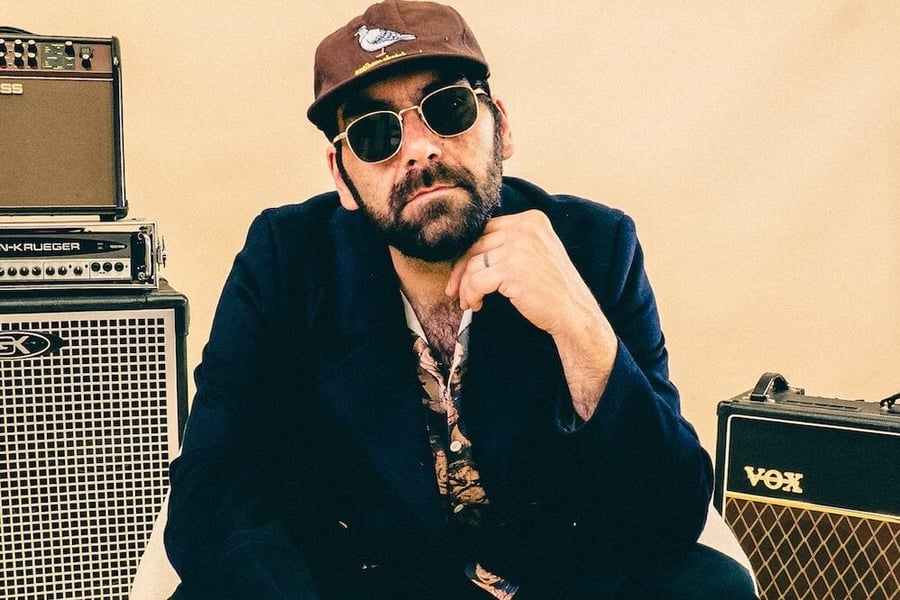
For over two decades, Daniel Rankine has developed a creative catalogue that speaks to a life lived unashamedly; a life that has navigated many different chapters, good and bad.
Better known to most Australian audiences as trials, the award-winning rapper, songwriter, producer and instrumentalist driving seminal hip-hop projects including Funkoars and A.B. Original, Rankine’s artistry is built on pairing beats and arrangements that make bodies shake, with lyricism that lands with impact.
As evidenced on records like the acclaimed Reclaim Australia, there’s a specific talent in creating music that speaks truth to power while also establishing a purely entertaining soundscape for listeners to get lost in. It’s an element of the music-making process that trials thrives upon, each time he steps into the studio.
“I learned a long time ago that there was almost a subversive nature in getting serious topics onto systems with jovial, happy, big beats,” he tells Rolling Stone AU/NZ. Setting down a bass guitar and taking a seat, trials smiles as he unpacks his process, from the studio to the stage.
“One of my go to’s is where, if I’ve got something serious to talk about, it’s going to be on the most light-hearted, uplifting music you’ve ever heard. I’m trying to get on stereos, first and foremost. If you can play it and bang your head along, that’s step one. Step two is that every once and awhile, a lyric will grab you. That’s all I need, I’ve got you.”
View this post on InstagramLove Music?
Get your daily dose of everything happening in Australian/New Zealand music and globally.

With the release of his long-awaited debut solo album, hendle, the MC and producer presents his most personal storytelling to date.
A multidisciplinary project that includes the album, as well as a visual art series and memoir, is a story of survival: detailing the early years of trials’ life, navigating cultural and personal identity as a proud Ngarrindjerri man; while also unpacking intergenerational trauma, mental health struggles and systemic racism.
The album itself is deeply reflective and resonant — it is an album that could only have been made at this time in trials’ life, where he himself has arrived at a place of inner strength and boldness to be able to unlock some doors on his childhood and young adulthood that had been firmly bolted for years.
“It started off as me just trying to piece together my memories,” trials notes. “They’re so fragmented and amalgamated to the point where years become the same day. It was difficult for me, so I started writing them all down chronologically; dates that I could remember. Sooner or later, they started becoming chapters. I would write a little note underneath saying what I remembered; each one would flesh out and the chapter title would become a song title.”
“The album basically represents my life up until 16 years old. That’s when I take self-agency and move out…that becomes a whole other album. It gets crazy from there. People sort of know my story from then because that’s when I started making records. Up until then, this is all the stuff people don’t know.”
The music is textured and vibrant in places, while also pushing into brooding moments of production that give additional weight to trials’ raw and personal lyrics. Tracks like “whistle while I walk” and “what’s the colour of love?” emerged as strong singles, providing great insight into the layered tapestry that is hendle as a whole.
Naming the record hendle, trials’ middle name, and the name of his paternal great-grandfather, is a statement in itself.
Acknowledging family legacy and the challenges experienced during his upbringing; experiences that have ultimately shaped the man he is today, trials exposes some of the most vulnerable areas of his life through the music.
He wants to be clear, though. This is not a trauma porn album. It’s an album built around resilience. A record that acknowledges where trials has gone right, as much as it acknowledges the mistakes and hurdles along the way.
“I don’t want people to watch and listen to this and get their kicks because they’re sad,” he says. “This ain’t that. This is a survival story and this is why I’m proud to present it the way I am.”
“I wanted to provide an entry point for someone to see themselves in this,” trials adds. “That is why there are ten different songs that are varied but all live under this one umbrella together. There is a cohesive tangent that runs through it all, but each song is a different area for someone to see themselves in.
“There are so many different aspects to this thing, we all wake up every day worried about something buried underneath something else. It’s all worth paying attention to. That was a big thing I’ve figured out, especially with my sobriety journey; I’ve been spending a lot of time inside my brain, wondering where I’ve managed to go right, when friends and family of mine may not have been afforded the same opportunities to do so.
“I’ve been trying to put these songs together never in an influential way, I’m always just trying to say, ‘This is what I’ve done. If it works for you, that’s deadly.’”
trials has already been able to debut this new era of his career, touring Australia with longtime friends and collaborators, the Hilltop Hoods, earlier in 2026. Performing new music to arena audiences has provided trials with a surge of electricity to the brain – the response reaffirming that his steps into this new direction is already going beyond pure personal fulfillment.
“When I’m up there and I’m talking about mob like Full Stop Australia, who are just there to help people understand and navigate life, helping to get them into positions they should be in,” he says. “When I’m talking about them during a song and then afterwards they’re reaching out to me saying that they’ve got a whole bunch of new monthly donors because of things I’m saying up there… that’s all I need.”
Of his relationship with the Hoods, trials speaks to their enduring impact and influence on hendle.
“One of my biggest influences and heroes is DJ Debris,” he says. “That guy is such an unsung hero. When I’m out there rapping and then I start DJing, then I start on the guitar and go back to rapping again, that’s all because I’ve seen DJ Debris do it already!”
Similarly, trials counts Suffa from the Hoods as a main soundboard for every release and project he has worked on.
“Suffa hears everything I ever do, first. Always. When I have a full record, a full album, I send it to Matt and ask what he thinks of it,” he adds. “No liner notes, no nothing, no caveats at all. He’ll give me his opinion and if it is what I’m aiming to do, I know I’ve done it.
“We did it with the Reclaim Australia album: we showed Uncle Archie [Roach] first, and Matt. If those two people understood what we were trying to do, that’s all I needed. The conversation is paramount to me. People talking about the music in the car after the show is all I want.”
Trials also points to blues musician Ash Grunwald as another key influence on the way he approached instrumentation on hendle. Having collaborated in the past on Grunwald’s music, a natural musical relationship was born between the two; the impact of which has made its way into the rhythms and builds the listener can hear on trials’ latest release.
“That fella took a chance a long, long time ago. He sent me a message asking if he could come to my house and make some songs,” he remembers.
“He drove across the Nullabor with a truck full of guitars. He was the first person to put a guitar in my hand and taught me that strumming each morning was a cool way to get ideas across. By the end of the day, you’re settling into getting a sound that really represented how you felt that day. I took both those influences and ran a mile with them.”
Reflecting on hendle, now it is at the stage where the album is set to no longer solely belong to trials, the artist is at peace with releasing the music into the wild.
Understandably, the nerves and insecurities that surround any album release can manifest in different ways throughout the lead up, but trials is happy to have this music exist for people to discover more about him and potentially, find moments of relatability and solidarity where needed for themselves.
“Art is so subjective, everyone gets to make what they will out of it… that’s how I’ve been dealing with it,” he says. “I’m going to put this out there and if someone can see themselves in my music, that means the world to me. That’s all I’m doing it for.”
“I had to understand that everyone has their own opinions and their own versions of stories,” he admits. “The most I could commit to was realising that this was my reality and this was my truth, my version of it. This is how it affected me moving forward. It was difficult to try and understand that; what was real and what isn’t real. It’s a strange journey, but it’s much harder to leave that door locked up forever.
To know it’s there and to not go into that room…it’s a huge burden and weight on my chest every day. As soon as I started to explore that and clear the room out a little, make sense of it, it became clear to me that if I could put this down and explain it in a way that really explained what these situations meant to me and means to who I am today…it’s worth it.”
Trials’ hendle is out now via Island Records Australia.

