




























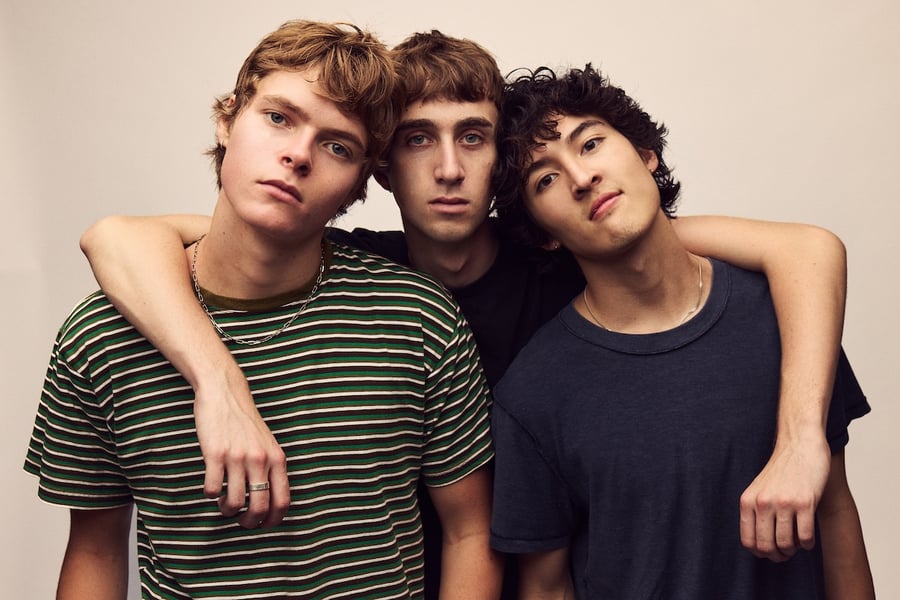
Despite only having released their first single in December last year and their debut EP Bunny this month, People I’ve Met are a band that has been on the grind for a few years.
After meeting in high school and deciding to take music seriously by the time they went to college, the US indie trio – made up of Moses Martin, Orlando Wiltshire and Andrew Suster – packed their bags and moved to New York City where they had only two goals: record music and play as many live shows as they could.
Fast forward to 2026 and the band, who are all in their early 20’s, have not only dropped their five-track EP, but they’ve also achieved some feats that even more established bands could not brag about this early in their career, like supporting Australia’s royel otis on their US tour and playing to packed out crowds at New York’s famous Mercury Lounge.
Talking to People I’ve Met in their first-ever Australian interview, what’s most remarkable is the old school approach. They aren’t interested in social media followings or jumping on the latest TikTok trend. One could even argue that Martin, being the son of Coldplay frontman Chris Martin, could be something to lean into for attention. But this band is adamant that the success they seek will simply come through hard work, dedication and above all, the music.
Rolling Stone AU/NZ: Just to set up the backstory — maybe walk us through the inception of the band. I know you started with a different name, but how did you guys meet, and how did the band start?
Andrew Suster: We all met technically in middle school. We came together in high school under random circumstances. Orlando and I had played in bands before in school, and Moses had done his own thing musically, but we came together in high school and started writing music together — just practising, not doing anything too seriously until we got to college, where Orlando and I went to NYU and Moses was at Brown. We decided to take it really seriously around then and play shows about once a month at bars and different clubs around New York. Only in December of last year, we released our first song, which was really special. We’re starting to really get going on the promotional side and take this seriously.
Orlando Wiltshire: It’s a lot of years of planning and growing and then figuring ourselves out musically — and then outside of music. Then it’s like, fuck it, let’s release now. And now it’s almost like we’re just starting to be a band.
Love Music?
Get your daily dose of everything happening in Australian/New Zealand music and globally.

Rolling Stone AU/NZ: The really interesting thing about this band, obviously being very young and fresh, is you still took that very old-school approach — record music, play a lot of shows, and worry about a release later on. Was that a conscious decision?
Moses Martin: It was a very conscious decision. I was honestly the one who was really anti-releasing music for a while, which was slightly silly. Ultimately, I think I was really obsessed with the idea of getting it right — and making sure not only that what we were entering the space with was the strongest thing we possibly can, but then also that we can be ready for anything that happens, and have a lot in the balance to just work on and lift off from. It was very much an intentional thing.
Rolling Stone AU/NZ: Is there a reason you were anti-releasing anything soon? We live in an age where it’s probably more important to get something trending on TikTok before anything. To say ‘We’re not going to’ is a bold move. Was there any fear in that decision?
Martin: If anything, it was a decision made out of fear of being lost in a great musical world in which everything gets forgotten really quickly and not many things get attention. We were really conscious of being positive that we were in the right space to release music so that people would actually listen and hear it, and so it wouldn’t get forgotten.
Suster: It was also this really special feeling of playing live without having released any music — playing our first time in New York to 40 or 50 people each time, it growing and people telling their friends, having it be this really natural and ground-up approach that didn’t feel we were something on TikTok somebody heard of, but more an energy that people wanted to be a part of and come out to see our shows. Now we’re figuring out how to incorporate all aspects of being a band in the digital world. But starting with that foundation really helped us in the long run.
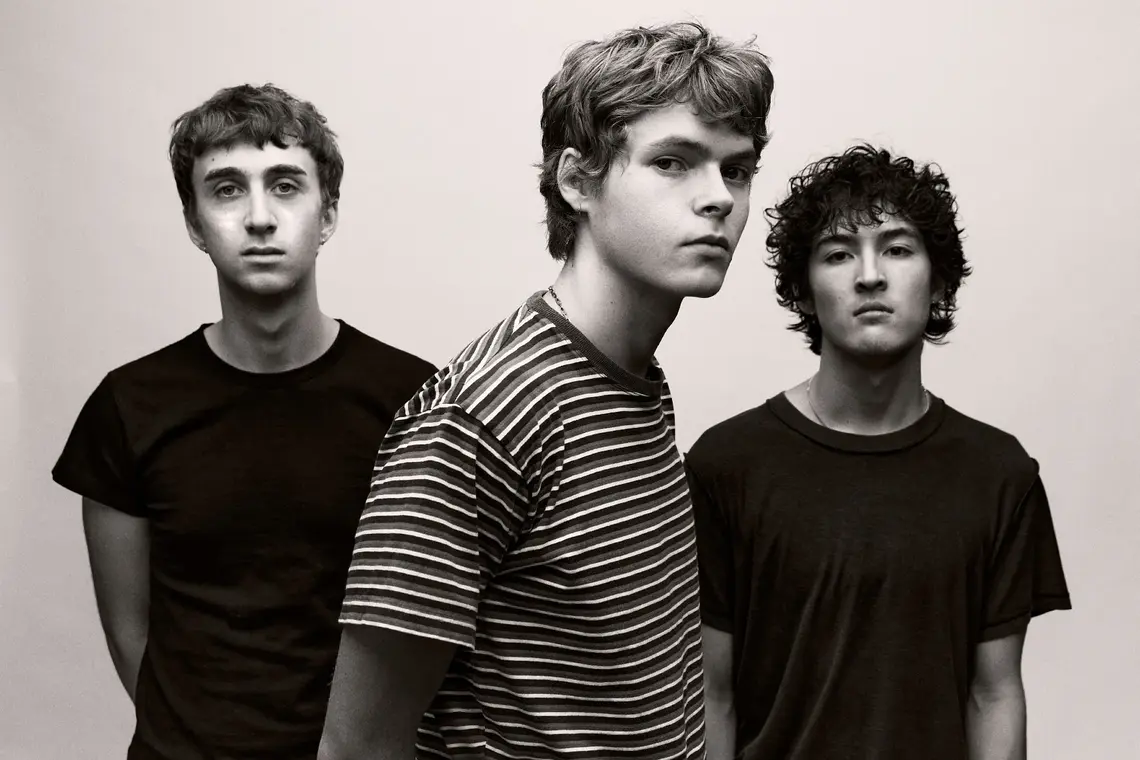
L-R: Andrew Suster, Moses Martin, Orlando Wiltshire. Image: Mikayla LoBasso
Rolling Stone AU/NZ: Orlando, you said it feels like you guys are starting now, but we’ve established it was a conscious decision to hold off. When did you decide that you’ve done enough gigs, it’s time to release something?
Wiltshire: A lot of it is letting the natural course of things take place. We didn’t fully know when to do things, but I knew we wanted to at minimum have a couple of people that would listen to the song if we released it — not just throw it out there when no one even knew us. We definitely wanted to at least play to some people, and then it naturally happened. We had a few songs that felt good, we got them produced, and then it was, okay, I think it’s time. It just feels right right now.
Rolling Stone AU/NZ: As a three-piece, what limitations does that create — or was being a three-piece a conscious choice over a four- or five-piece? Has it forced you to get quite inventive, not just in a live sense but in a songwriting sense?
Wiltshire: A big thing is how do you make the whole sound big when you’re playing it live? The fourth member live is the laptop — a bunch of tracks playing through the speakers, and then trying to make those tracks have a live sound to it, whether it’s distorting it a bit or putting a bit of a room sound. We just have a laptop running the whole time with tons of sounds and little extra things.
Suster: We’re building some more stuff out, too. From the recording side, if we were to write one of our tracks and it’s just me on the bass, Moses on the guitar and Orlando on the drums, that’s not bad — but it’s not as full as it could be. It’s definitely forced us all to play things we don’t normally do. Orlando will be on a synth at one point, I’ll be on a guitar, Moses will be on the piano. It’s forced us to learn all the different instruments, which helps us live as well — we have a better understanding of each other and what we’re playing. Also, it just looks really cool. I was pretty adamant about the three-piece — we said, should we add a guitarist? And I was like, I don’t know. There’s something about the three-piece — Nirvana, The Police. It’s just so iconic.
Rolling Stone AU/NZ: When you guys were jamming in middle school and then started taking it seriously in college, was there a North Star for this band? Listening to this EP, I can hear the obvious ones — Phoenix, The 1975 — but I can also hear tidbits of The Cure.
Martin: The real North Star was trying to create our own sound. Obviously, we have such a wide range of influences, but our real north star was trying to figure out what the three of us sounded like at our fullest potential.
Rolling Stone AU/NZ: You’re still very young and on the come up, but you have a very mature approach to what you’re doing. It feels meticulous. The EP is now out — do you know when you want to work towards a debut album, if that even is to come?
Martin: I don’t know if there’s an exact date we have in mind for a debut album. It’s definitely coming, and we have all the songs for it. We really want to get the timing and feeling right and ensure that we can get all the songs to a place that feels great and authentic.
Rolling Stone AU/NZ: Does Bunny represent the earlier stuff you wrote as a band? Is it a chronological representation of where you started, or is it just the best assembly of songs today?
Martin: No, it’s not a chronological thing in fact, some of these songs are incredibly recent in our discography. I think this just felt like a great place to start and establish what we sound like and show our full potential and the range of sounds we can achieve, and yeah it just felt like a project that encapsulates where we are right now while leaving room for the potential of where we’ll go.
Rolling Stone AU/NZ: A lot of people, when they hear a debut EP, might assume that this band has only just started. We know that’s not the case with People I’ve Met. This EP release is a milestone. When you think back to playing in your garage to now, is this a bucket-list moment for the band?
Suster: I think we want more. I think we want to go to the moon. I’m ready to keep going. We’re all so proud of this project, and these songs mean so much to us. But I’m just excited that people are starting to get the first window into what’s to come.
Rolling Stone AU/NZ: Moses, the elephant in the room, you have, you know, one of music’s biggest names in your family. How do you navigate that in this band? How do you sit with that? How do you navigate that space?
Martin: There isn’t much to navigate. It’s not something we consciously think about or try to avoid. It’s just sort of a fact, yes that’s my dad and I’m grateful for everything he’s taught me, but at the end of the day, we’re doing something that’s just us, and once people hear our music, I think they’ll understand that we’re really doing this because we love it.
Rolling Stone AU/NZ: It’s very obvious you guys have been stamping the New York and LA scenes in particular. Andrew, I’ll ask you this one because you’re the one that said you want to go to the moon — for the Australian readers, when can we expect to see you guys here?
Suster: As soon as we possibly can. We toured with royel otis, who I know is pretty big there, last summer. They’re great, their fans are great. I want to be everywhere as soon as possible, as soon as it’s logistically possible. We love playing live, we love all of it.
Rolling Stone AU/NZ: It’s pretty incredible that for a young band, you guys seem uninterested in social media. The top priority for the progression of this band is to record music and play gigs. Is that fair to say?
Wiltshire: I totally agree. I like playing. I like real life. But I like scrolling. [laughs]
Rolling Stone AU/NZ: Do you get pressure from anyone in your orbit to record X number of TikToks per day? Or is that something you guys drew a firm line in the sand on and said, ‘No, we’re not doing that. We’re running a different kind of race?’
Suster: It becomes tiring at points, but at the end of the day, when we say ‘Let’s film a cover,’ it’s so much fun. We get to do that for, hopefully, forever. Music is so awesome. Not to mention the amount of people that are reaching out from places we’ve never been before who get to enjoy our music is so beautiful. The attention economy is very tiring — but it’s all of the people outside of our reach that get to suddenly be a part of what we’re trying to create. It’s just awesome to me.
Bunny is out now.

