





























Neck of the Woods
The New Zealand Music Community Saved Neck of the Woods. What Happens Now?
Neck of the Woods, a haven for experimental music and marginalised communities, has been given a future after an incredible week of community action. But where does New Zealand's music industry go from here?

You never knew what you were going to hear when you descended those steps.
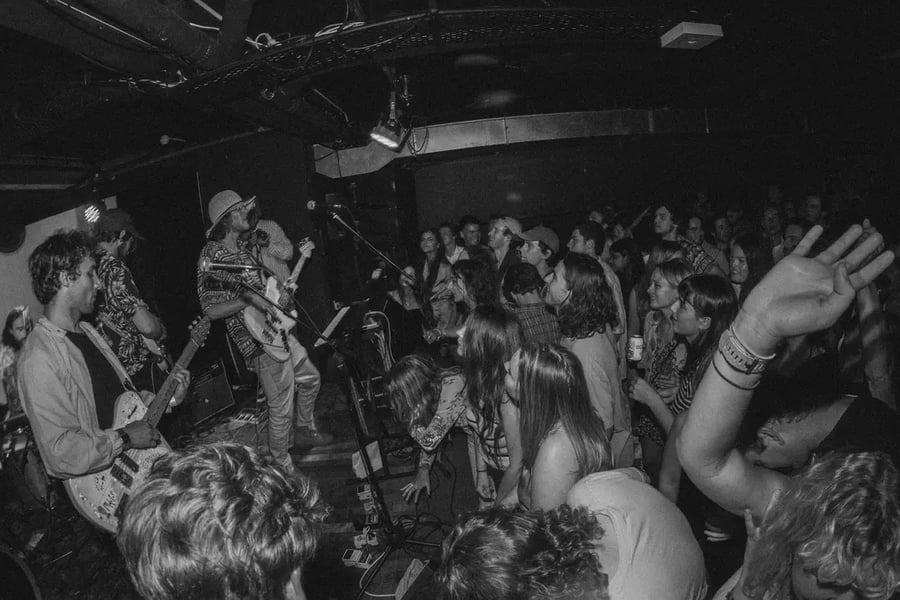
A reggae and dub sound system crew all the way from, of all places, Scotland. Māori and Pasifika artists warming up for Glastonbury. The Beths before they took off. SACHI after they took off. Maybe some Amapiano or Afrobeat, maybe even some indie-folk or pop. Definitely lots of drum & bass, and definitely some of the finest and most experimental producers in all of Australasia.
For 11 years, Neck of the Woods has been one of the most reliable places for live music in Tāmaki Makaurau Auckland. When I first moved to the city from Glasgow in 2017, it had only been open for a couple of years, but it already felt like the venue’s reputation preceded itself; on any given Friday or Saturday — hell, even a random Thursday — long queues would snake along Karangahape Road, oftentimes all the way to St. Kevin’s Arcade, people sucking down cigarettes and limbering up for a night of dancing.
Not long after I arrived, and frustratingly before I could get there for a gig, the Kings Arms Tavern, an old-school boozer and venue located in Newton, not far from Karangahape Road, closed its doors after almost 140 years in business. This city has sadly grown accustomed to mourning the loss of beloved gig spots like the Kings Arms, but that didn’t make last week’s announcement that Neck of the Woods would be shutting any easier to take.
The owners’ statement at the time made for brutal reading: “We’ve been fighting hard to stay open under ever increasing debt. We’ve tried everything but today we’ve had to face the hard truth that after 11 amazing years we’ve come to the end of our journey.”
That statement was shared last Thursday, and almost every second Instagram Story I saw the following day seemed to be about the shock news. The groundswell of support that rose up immediately after, fuelled by direct action undertaken by a music community both young — the new generation just finding its feet at Neck of the Woods — and old — those Aucklanders still haunted by the loss of the Kings Arms — has been spiritually revitalising, in the bleakest of times to be an independent music fan.
Kylie has had a busy start to the year, but then again every year has been busy for them for a while.
Love Music?
Get your daily dose of everything happening in Australian/New Zealand music and globally.

Better known as Auckland-based DJ monoga.my, they returned from China a few months ago, where they showcased their eclectic sound, which traverses dance, pop, techno, glitchcore, and more, to entirely new audiences. (Kylie’s trip was the work of multi-disciplinary artist Kristen Ng, the mastermind behind multimedia blog Kiwese, who has been bringing some of the best Kiwi acts to China for over a decade, including Ōtepoti Dunedin duo Night Lunch.)
The experience was “awesome and amazing,” they say, but “complicated politically.”
“We went to Chengdu, which is supposed to be the most queer-friendly city, but they just shut down a bunch of the queer clubs like a month or so before we arrived.”
Kylie was taken to a local queer community hub, where the “really lovely” people running it were still reeling from a recent police raid, when they were forced to “take off all of the pro-LGBT stuff” that adorned the building. “A week after we left, they got it shut down completely by the police. Raided and shut down,” they tell me.
View this post on Instagram
Kylie knows very well the importance of queer-safe spaces to a city.
They were DJing for a time at a club on Karangahape Road, a short walk away from Neck of the Woods, but “the pay was shit” and the owner “was awful.” The city’s most well-known, quote, unquote, “gay” clubs had increasingly felt unsafe, especially for the city’s marginalised communities. In response, Kylie, alongside co-founders Kartar and Theo, created NYMPHO, a queer club night, in 2021.
“Kartar came up to me in the middle of the dancefloor while I was DJing and asked if I wanted to start a club night with them and Theo, and from there we just brainstormed and had our first event during Pride,” Kylie recalls. NYMPHO celebrated its 5th birthday with “a huge party” earlier this year, held at Neck of the Woods, the latest in a long line of sold-out nights at the venue. “[T]here were so many special ones,” Kylie reflects. “It’s really hard to keep a track of [all of them]. We’re very lucky.”
NYMPHO was responsible for the first community action attempting to save Neck of the Woods.
Under the name of Nymph Ltd., “a group of artists & promoters who have a long standing working relationship with Neck of the Woods,” they launched a fundraising campaign on Give a Little last weekend, unwilling to let Auckland lose one of its most important venues without putting up a good fight first; within just five hours, the fundraiser had raised over $15k.
“For eleven years, Neck of the Woods has been a core pillar of Karangahape Road’s creative communities. They have provided a nurturing ground for countless musicians, bands, DJs, performers and collectives — always leading with integrity, manaakitanga and a genuine love for the communities they provide for,” Nymph Ltd. wrote on the fundraiser page, further noting that Neck of the Woods’ “space and sound system are unmatched, but more than anything it is the people who work there.”
“We found out at the same time as everyone else that it was closing,” Kylie admits. “I sort of refused to believe it, and I was bargaining, [in] the bargaining stage of grief. I just hit them up and was like, ‘Can you guys just tell me how much you need?’ They allowed us to start the Give a Little, and it’s been a huge success. I had a lot of hope at the beginning, but it’s incredible that everyone’s come through like this.”
Kylie, Kartar, and Theo are joined in NYMPHO by Kat (Odeious), Pūmanawa (Man(k)ila), Kevin, Abbey (RNG+SUS), and Liam, aka DJ and producer ATARANGI.
‘I’ve only been going into Neck since 2020,” he admits, a little sheepishly (as if that’s a bad thing). “I was one of those post-COVID club frequenters!” He joined NYMPHO at the end of 2020. “Kylie taught me how to DJ. We all met during lockdown, we all met on Twitter, like internet friends.”
Liam first heard the news about Neck of the Woods’ closure ahead of an appearance at Tasmania festival Dark Mofo. “I was in my hotel room about to leave to go play [at] the festival. I just sat there on the phone with two [of] my friends. I was like, ‘What the hell are we gonna do now?’”
“You just can’t lose this place,” I say.
“No, we can’t,” he replies. “I mean, there’s still [Karangahape Road venue] Whammy, but Neck of the Woods is so integral to everything that we do in that city.”
“There’s almost two million people here. You can’t just have Whammy Bar handling every event, it’s just not gonna work.”
Kylie agrees with this point. “[W]e’d all be fighting for club nights, [those] who usually do Neck would be fighting for Whammy. So it would become quite difficult.”
“This generation of new club kids that have just moved to Auckland from smaller cities and smaller towns in New Zealand aren’t gonna get to experience what we got to experience if we lose that club.” —Liam
Liam and the rest of the NYMPHO crew may have started out as online friends, but he knows that the internet “isn’t a place for culture transmission in the way that the club is.” When I was sitting in a haze of cigarette smoke through the saloon swing doors at the back of Wine Cellar, he was making friends for life in the Neck of the Woods green room. Third spaces, in other words: places for people to gather that aren’t the home or work, and which historically have often been clubs for queer communities. (Liam expands on the importance of this concept in the video below.)
“This generation of new club kids that have just moved to Auckland from smaller cities and smaller towns in New Zealand aren’t gonna get to experience what we got to experience if we lose that club [Neck of the Woods],” he tells me. Which is a shame: “When I came back for NYMPHO in February, the crowd had gotten progressively younger from when I started going there,” he notes.
View this post on Instagram
Now based in Naarm Melbourne, Liam has been spreading the word about Neck of the Woods and NYMPHO to his new community. He’s been closely monitoring the mass influx of donations to the fundraiser campaign. “Someone from San Francisco just donated $400. It’s crazy, and even the messages on the Give a Little are really crazy. They’re really showing up. It’s really, really crazy.
“What’s also been interesting is seeing that people from Melbourne, like in my audience, are donating… Because they know the importance of these spaces… People have been reposting the fundraiser to their [Instagram] Stories and contextualising it to their own cities. Like someone from Brisbane said, ‘This would be like if Brisbane lost Black Bear Lodge.’ It’s all interconnected in some kind of way.”
Why have queer-friendly club nights found a home at Neck of the Woods? It’s not just NYMPHO: FILTH, a collective which prioritises the nightlife experience for QTBIPOC people and artists, and CHURCH, which aims to create and maintain a safe and inclusive space for the queer community and its allies, have also held events there.
“It’s one of the only safe spaces for queer people to gather and inform the connections that we have been so limited in being able to create because of the way that society has worked against us,” Liam says. “And if we keep losing third spaces like Neck of the Woods that are so vital, there’s gonna be nowhere to go, and then all of the creativity and all of the most meaningful parts of what make Auckland so special are gonna just turn to shit.” (The potential closure of a queer-friendly space like Neck of the Woods happening during Pride month is, I think, uncomfortably on the nose.)
What made Neck of the Woods the perfect place for NYMPHO’s club nights, according to Kylie, is its Safe & Sound policy. There’s even a section about it on the venue’s website: “Neck of the Woods puts good vibes first. We are committed to creating a safe, friendly and inclusive community environment that extends beyond our venue and throughout Karangahape Road. Neck of the Woods does not tolerate any kind of behaviour that takes away from other people’s ability to enjoy their night out; including racist, transphobic, homophobic, sexist, ableist, fatphobic and ageist abuse and sexual harassment. Behaviour that makes people feel unsafe or uncomfortable is not welcome at Neck of the Woods. If you are feeling unsafe in any situation, or witness abusive behaviour, we ask you to please reach out to our friendly bar staff and security team for help — they are fully on board with our Safe & Sound policy.”
Neck of the Woods has always taken the policy “really seriously, from the bar staff to the managers,” Kylie insists. “I could say that as a punter and as a promoter. They also employ a lot of queer people, a lot of women. Everyone I know who works there and has worked there really enjoys working there.
View this post on Instagram
You didn’t think NYMPHO would stop with just one hugely successful crowdfunder, did you?
Almost as soon as the Give a Little page was created and spreading around the world, the team got to work on the Save Neck of the Woods compilation, which Liam claims has been in the works for years. “[There’s] a document in our Google Drive from like two or three years ago with a list of producers that we wanted to reach out to.”
The compilation, he tells me, came together in less than 24 hours. “[…] on Sunday night I was like, ‘Wait, guys, what if we got a compilation?’ And everyone was like, ‘What the hell?’
The following day, he reached out to the manager of Australian producer-of-the-moment Ninajirachi, as well as a few others, while the rest of the NYMPHO team reached out to their own friends. “[W]e got this overwhelming amount of submissions from people who have played Neck of the Woods, or [from] friends of ours who have been important to the Neck of the Woods ecosystem as a whole,” he says. “In a few hours, I wrote the press releases and the liner notes. We finished working on it at like 1am New Zealand time this morning. I think our last submission came through at like 8 o’clock this morning!”
“It’s a space that has fostered countless artists and contributed so much to our music community here in Aotearoa. Playing your first set at Neck of the Woods is seen as [a] rite of passage for many artists.” —Caru
Kylie is particularly excited that Ninajirachi is on the compilation. They were a fan “before she blew up, by the way,” they’re keen to impress upon me, stretching back to 2020, so it meant the world when NYMPHO brought her to Neck of the Woods for a special show. “I cried on the dancefloor, which I don’t always do!” they admit.
Alongside Ninajirachi, the Save Neck of the Woods compilation features Cute Throat (multiple tracks), Alice 4Ever, Liam (as ATARANGI), Hasji, Lady Shaka, Lucky Boy^, Kylie (as monoga.my), and many more. DJ Casper has indisputably the best track title, or at least the most delirious: “Iggy Azalea is like my albino child I randomly give birth to in a pre-historic African village during Pangea. My early human brain thought she was demonic because of her albinism so I wrapped her in a malanga leaf and left her (Work Edit)”. (If your track turns out to be shit after you use a title like that, well, that’s on you; DJ Casper’s, luckily, is a banger.)
Caru, who’s been on Rolling Stone AU/NZ a lot recently with his link-ups with Auckland MC Brandn Shiraz, also contributed to the compilation, and can’t imagine his hometown without Neck of the Woods.
“I cannot exaggerate how important Neck of the Woods is to our nightlife in Tāmaki,” he says. “It’s a space that has fostered countless artists and contributed so much to our music community here in Aotearoa. Playing your first set at Neck of the Woods is seen as [a] rite of passage for many artists.”
Caru and Brandn just won their first-ever Aotearoa Music Award, for Best Electronic Artist, and Caru acknowledges the integral part the venue played in getting him there.
“They provide a crucial space that nurtures creatives and makes putting on events accessible to up-and-coming artists. We desperately need venues like this — I can’t imagine achieving the success I have in music without Neck of the Woods. Losing them would be a devastating blow to our creative community,” he adds.
When I reached out to the Aotearoa music community to hear about their Neck of the Woods memories, the response was swift and overwhelming.
See for yourself:
SACHI: “Neck of the woods has been the foundation of so many artists’ stories. It has always been a pivotal space in the Auckland scene.”
Local producer HAAN808: “A place like Neck of the Woods is so crucial because not only is it an environment that brings people together, it’s a place that passes through generations, and each generation creates their own new memory. I remember going to a gig at Neck of the Woods and seeing Alix Perez play, and it was probably one of the best gigs I’ve been to. It was also because of the talent that was playing, but what added was the atmosphere and the togetherness that a place like Neck of the Woods brought. It didn’t matter your background or colour or race or however you choose to present yourself — the music and the environment is what made that night so memorable for me.”
Resident George FM DJ Pixie Lane: “Hearing the news about Neck of the Woods hit hard. It’s a huge loss for so many of us in the scene. I started a club night called ‘Disco Rally’ there, a night built to give up and coming artists a place to shine and a dance floor people could lose themselves on. That’s what NOTW gave so many of us! A safe space to find your people, and it’s the core and heart of how many of us had our start.”
Rolling Stone Future of Music alum 9lives: “I honestly can’t believe NOTW is shutting its doors. It was a place for me and my friends to go and enjoy the music that we love, and on an amazing sound system. I’m giving my best wishes to the crew and everyone involved with NOTW.”
DJ Concussion: “Hearing the news of Neck of the Woods was a devastating loss to me and 1000s of others. But we are rallying together as a community and the amount of money donated just goes to show how many of us care so deeply for Neck of the Woods. [It] truly deserves to be saved and we will save it! I do love the way our community has come together in this hard time. It’s when we need each other the most! I’ve been coming to gigs left, right and centre for years. It’s always been one of my favourite spots.”
Crystal Chen remembers turning Neck of the Woods into a “romantic and cosy jazz lounge” to celebrate her album release last year. “[W]e hung up lanterns and put bar stools around tables by the front of that small stage (which we managed to fit a 7-piece band onto)… I also sold my homemade ginger beer which exploded on the bar staff, it was crack-up and they turned it into a custom cocktail.”
“All the gigs I’ve been to there are shaped by the music and performance, any genre and energy, NOTW accommodates an affordable canvas for this vibrant and diverse Tāmaki scene. From NYMPHO club nights, where you go hard and lose yourself, to soul-soothing ethereal jazz that you can bring your mum to, NOTW has always been where I see familiar faces and friends take the stage.”
For producer and artist INNUSTA, Neck of the Woods “is more than just a venue.”
“It’s a cornerstone of Auckland’s underground music scene, and one of the few places where emerging musicians & artists can properly get their art in front of people,” he tells me. “I’ve always felt like our scene is special because it’s built by people showing up for each other. Every artist, promoter, label, radio host or festival that’s ever found talent and culture through spaces like Neck is part of that story. None of this happens by accident. It happens because people care enough about the music to keep showing up.”
Along with two “best friends and favourite local producers,” he put together a sample pack for the fundraiser, and he didn’t think twice about lending help where he could. “That’s what the underground means to me. It’s never been about clout or recognition. It’s about protecting the spaces that let creativity, connection and new talent grow. If we want the next generation of artists to have the same opportunities we’ve had, places like Neck of the Woods are worth backing.”
View this post on Instagram
‘Last Call’ at Neck of the Woods — for now — was on Sunday.
“The train is leaving the station for the last time,” the venue wrote in a social media post, announcing a stacked lineup of Halfqueen, Bbyfacekilla, Fox Glove, and DylanC for its swansong. “Come down and have one last dance with us.”
If you were there nice and early, just as doors opened at 7pm, you would have seen Auckland Central MP Chlöe Swarbrick manning the decks. It was the furthest thing from a PR stunt, though: long before she became the co-leader of the Aotearoa Green Party, Swarbrick worked at Neck of the Woods, doing gig promotion and marketing and myriad other tasks, “pretty much around when it first opened.”
“[I]t’s been pretty much a fixture of almost my entire adult life,” Swarbrick tells me over the phone, in the middle of a mad dash to the airport. “I was there for, I think, about a year… This really actually goes back to the core of why I’m in politics — the closure of the Kings Arms was one of the things that spurred me into it.”
View this post on Instagram
She was initially hesitant to open the event (“I think it’s obviously a bit of a cliched bit, [the] politician DJ”) and she was expecting an empty room, but the venue was already “packed out” by 7:20pm. “The energy in there was insane… One of the major takeaways here is that, I think on the left we’ve spent a good 10 years wringing our hands and arguing in rooms amongst each other, perfecting our arguments and debating points, and we’re not winning.
“The only way that we are going to win and to grow our movement is to have some goddamn fucking fun. And that is what our dance and music and art provides us, the platform and the opportunity to bring people together on a really instinctive, basic community level, to understand the things that we have in common.
“And I think that fun and joy is also a regenerative resource that can power us when we feel overwhelmed and fatigued and exhausted and remind us of other things that really matter, because at the end of the day it’s community.”
“We all have full-time jobs and don’t have a lot of cash to spare anyway. So why would we expect our audience to pay more? Obviously that’s not a particularly sustainable business model either, unfortunately.” —Kylie
Because when a government doesn’t prioritise arts and culture, the artists don’t just scuttle away — they work themselves to the bone in order to keep doing what they love.
NYMPHO is going nowhere, and both Kylie and Liam are excited about its future, but their economic margins are razor-thin. “We break even most of the time. It’s extremely tight,” Kylie confesses. “We all have full-time jobs and don’t have a lot of cash to spare anyway. So why would we expect our audience to pay more? Obviously that’s not a particularly sustainable business model either, unfortunately.”
NYMPHO has received funding in the past, from the Burnett Foundation and others, but Kylie says “there needs to be more” funding opportunities for groups like theirs. “There’s not really many we can apply for, that let us apply for government funding,”
When I ask Liam what keeps him going, he gathers his thoughts. “The answer to that question changes over time quite a lot. I think it means a lot of different things to me. I’ve kind of been in and out of the music industry since I was like 16, [so] to have this solid landing place, this partying collective that I run with my friends, which means so much to so many people — it’s kind of only really started to hit me over the past year that what we do is actually important to people.”
There’s a lot of money to be made in live music in Aotearoa. A hell of a lot, it seems.
A recent research project, conducted by a team including staff at Massey University and the University of Canterbury, found that the live performance sector contributed at least $17.3 billion in social and economic value to the country in the 12 months to June 30th, 2024.
According to the same report, for each dollar invested by the community in live performance, $3.20 — a combination of consumer and producer spending — was returned in value.
“It doesn’t just include the ticket price or even the glass of wine or beer that someone has at a theatre or a venue, but this whole suite of other spending, including things like going out to dinner beforehand, maybe what they spent on the taxi all the way through to money on babysitting,” associate professor Dave Carter, who worked on the project with a team of over 100 data collectors, told RNZ.
But that return value and those night-out accouterments — the pre-drink, the post-drink, the second post-drink and the third, the dinner, the Uber ride home — can only happen in a thriving economy, not a sinking one.
We started a new series on Rolling Stone last month, Making Music, Making Ends Meet, focused on the cost-of-living crisis currently facing our musicians, which kicked off with a furious, expansive essay by Auckland-based singer-songwriter Jazmine Mary.
“To remain an artist” today, under these conditions,” Mary wrote, “is a radical act.”
“I cut corners and live a lifestyle that is at times extreme to be able to support being a musician,” they admitted, listing the myriad ways they’ve earned money to support their music, and while the hard-working hustle of musicians like Mary is admirable, it shouldn’t be this hard for them.
“If there was no money in music, I’d accept it. I’d accept that this is something we do for love and compulsion and creation, but that’s not the case. There is money, and me and my peers are generating it. I’m just getting a crumb of it,” Mary added pointedly in their essay. “Right now music operates as a pyramid scheme with Live Nation, Spotify, Ticketmaster, and other slippery rat bastards at the top. We are being told it’s hard to tour and profit from shows because of fuel costs and venue costs and people aren’t interested. I call bullshit.”
“The idea that punters not going to a show on a Friday is the reason I’m struggling to make a living from music is the same school of thought that says my single-use coffee cup will stop all the damage being done to the climate by massive corporations. There are people responsible for me struggling as an artist and I want us to hold them accountable and I want it to happen now.”
Auckland experimental musician day13n readily agrees with Mary’s missive. “While the cost of living continues to rise, and people can no longer afford the things that bring us joy, the government continues to line the pockets of the wealthy while turning a blind eye, or actively exploiting the people and institutions that create culture. Live music contributes $17 billion per year to the GDP in NZ, yet funding continues to be cut,” they tell me.
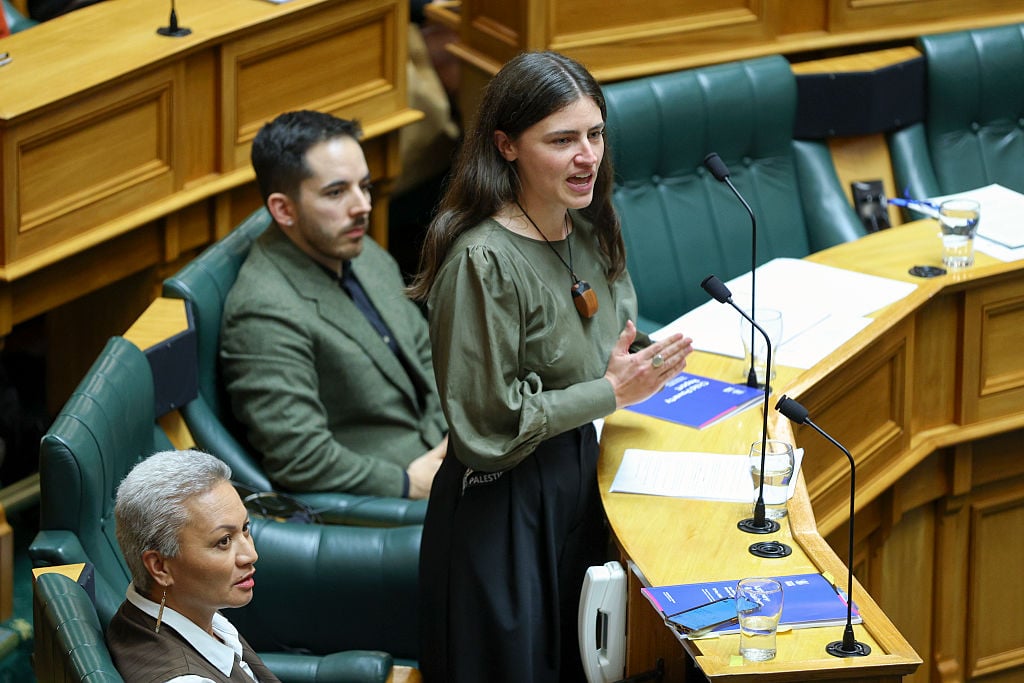
Image: Chlöe Swarbrick Credit: Hagen Hopkins/Getty Images
“I recall someone saying to me once upon a time, ‘Hard times make good art.’ I’m friends with a lot of artists and musicians, and I’m constantly kind of talking about, well, how do we get people organised? How do we get people unionised? How do we get people thinking about this issue as a collective and as a structural issue? And the basic fact is it is incredibly difficult to organise people who are exhausted and overwhelmed and don’t have the requisite resources to make ends meet, let alone having the resources necessary to be the ones who oftentimes are putting on shows and trying new things,” Swarbrick says.
There’s a Dick Move song, which is probably a real crowd-pleaser when they play it at their home base of Whammy, called “Karanga-a-Hape”.
It’s tucked away in the back half of their 2025 album Dream, Believe, Achieve, a little overshadowed by the more overtly political tracks on the record. “I hear ya / Take me home / Long live, our mighty / Karanga a Hape” is its simple refrain.
As Ponsonby Road seemingly morphs more and more into a gentrified Sydney-or-London wannabe, and the CBD is, well, the CBD, Karangahape Road remains the chaotic, fun, beating heart of this city; it always will be. But Karangahape Road needs venues like Neck of the Woods and Whammy, and events like The Others Way, and stores like Flying Out, not to mention bars like Verona, to thrive.
“[Y]ou go down to Whammy every other weekend, even if you don’t really know what’s gonna be on, you are going to encounter something that’s phenomenal and absolutely worthy of the world stage.” —Chlöe Swarbrick
“Losing a venue like this [Neck of the Woods] doesn’t just hurt the local scene, it hurts the whole ecosystem,” Pixie Lane says. “Neck of the Woods is where an artist actually gets the chance to grow before they ever reach a festival stage. If it’s not there, then where will we foster our talent?”
“In the current economic climate, we’re already seeing too many culturally significant venues and creative spaces disappear, and it would be a real shame to lose another one,” DJ and producer TOFUSHOP says. “I sincerely hope Neck of the Woods can continue to be a home for the communities it has nurtured and supported over the years.”
“Neck of the Woods is a crucial component of the Auckland live music scene,” day13n adds. “Mid-sized venues are few and far between in this city, and Neck of the Woods provides a launchpad for-up and-coming artists to build their careers, and connect with more established acts.”
Swarbrick is somewhat hopeful. “[Y]ou go down to Whammy every other weekend, even if you don’t really know what’s gonna be on, you are going to encounter something that’s phenomenal and absolutely worthy of the world stage. We have so much creativity, we have so much talent, but currently we are losing it under these economic settings. Which is why they desperately have to change.
“We need these smaller spaces that allow our young local musicians to get a foot in the door to try things, to build an audience, to grow their reputation. And I mean, not in any way, shape or form to infer that this is what’s gonna happen there, but we also need to make the point that, you know, in order to make really good art, you also need to have spaces [where] you can take risks and maybe sometimes make bad art as well!”
Neck of the Woods coming under threat so close to a major — and hopefully transformative — milestone for the local area feels especially poignant.
For 11 months, between 2023-2024, I lived on the fourth floor of Karangahape Road’s historic George Court, looking directly onto Mercury Lane and the rapidly developing Karang-a-Hape Station, which means that for approximately 11 months, my morning coffee was accompanied by the friendly waves of construction workers and the sounds of near-constant drilling and whirring. According to the latest update, the new train station will finally open in the latter half of 2026.
The much-missed Mercury Plaza, just as beloved as Neck of the Woods but for different reasons, was torn down in 2019 to prepare for the arrival of the station, and although the food court was an irrevocable loss for so many Aucklanders, it felt in service of something purposeful: a City Rail Link that would help to modernise a city whose public transport was sorely lacking. But mass construction on Mercury Lane and over on Pitt Street was always going to bring teething issues.
In an attempt to placate this, a City Rail Link Hardship Fund was set up for businesses struggling due to the construction. According to Stuff, however, barely $500,000 of the fund’s $12 million was paid out, with just 51 applications being approved by the start of 2022. The highest payout, Stuff claimed, was $39,258.
“[D]isruption was always inevitable,” Swarbrick reflects, “and it’s pretty frustrating that it was never planned for because there’s actually other countries and jurisdictions [that] do this stuff and it doesn’t have the same kind of devastating impacts on small businesses. They plan — for example, requiring commercial rent relief and all of those other bits and pieces.”
And hell, what’s even the point of a shiny new train station if there’s no venues for people to go to once they alight?
“Now, at the final hurdle, we have institutions like Neck of the Woods which are looking as though we might lose them,” Swarbrick says, sighing.
“This is what happens when we have set up an economy that is operating by rules that are very short-sighted for the benefit of commercial, mega-corporate kind of profit at the expense of community and culture and everything that we all love and care about.”
About halfway through writing this piece, the Neck of the Woods fundraiser reached its target of $150k, ahead of schedule.
It means that, at least for now, the sombre past tense of my opening sentence — “you knew” — can enter the present — “you know”, as Neck of the Woods looks, tentatively, towards the future. And it’s envisioning something major for the immediate future: “[W]e want you all down here for the biggest comeback party this city has ever seen,” the venue wrote yesterday.
“We have the opportunity to reimagine and put in place more sustainable models of operation not so tied to bar takes,” Neck of the Woods owner/operator Jonah Merchant told UnderTheRadar this week.
Once the Give a Little fundraiser closes on Saturday (June 27th), when it will hopefully have healthily surpassed the $150k mark, several more fundraising events are planned, all “crucial to ensure a smooth reopening” for the venue.
View this post on Instagram
There’s ‘Sounds to Save Neck of the Woods’, taking place across Whammy next Thursday (July 2nd), “showcasing just some of the incredible talent and mahi” in Auckland’s music scene, with all proceeds going to Neck of the Woods. Before then, Garage Project Kingsland is donating all proceeds from beer pints this evening (June 26th, 5pm-11pm) to the Give a Little fundraiser.
NYMPHO also has a Google form for people to submit ideas about how Neck of the Woods can enter “a more sustainable future.”
So, where do we go from here?
The funds from NYMPHO’s fundraiser, according to the Give a Little page, “will be broadly allocated toward final operational obligations, outstanding venue expenses, and wrapping up remaining contractor and staffing commitments incurred during this final trading period.” The $150k (and counting), Kylie tells me, will “clear their debts,” and the venue will “look to reopen.”
“Like they’re obviously not gonna reopen this weekend. They deserve a rest!” they add. “Nothing’s gonna happen without extensive community consultation. So they’ll look to reopen and have hui with the community to help them come up with a new business model.”
One part of the “business model” that plainly isn’t working is dwindling sales in alcohol.
Long gone are the days when our alcohol companies propped up local music, helping to launch the careers of still-going artists like Dave Dobbyn.
As a semi-functional alcoholic Scot (what a tired cliché), I gave it my best shot for years, filling the coffers of Whammy Bar and Wine Cellar and Neck of the Woods and Red Bar with (what I now know to be a shameful amount, thanks to an app I recently downloaded) money almost every weekend, but as more and more people turn to sobriety, like me, or simply don’t have enough passive income to buy as many drinks as they used to on a night out, there has to be a major rethink about nightlife commerce.
Swarbrick agrees. “[W]e currently have a music venue infrastructure, and therefore a cultural infrastructure, that is so dependent on alcohol sales, and obviously that then begs the question of all the other further problems down the track…”
View this post on Instagram
She’s been in touch with the team at Neck of the Woods “about what the next iteration” of the venue looks like. “[O]bviously, we’re just doing our best to stabilise things and make sure that we keep Neck of the Woods there.”
“Do we want to create an economy where these places can thrive? Because it’s actually not rocket science,” she says. “Other countries and other cities have done this, and it really boils down to whether we are willing to decide that it is actually our priority to support local [artists and venues], which means that we have to have economic and tax settings that genuinely invest in ourselves and in our jobs and in our creativity, our events, our spaces.
“And also, god forbid, regular punters having enough resources to go out. And that is why we need a fairer tax system. It’s why we need to tackle corporate greed and also to lower the cost of living for food and housing and power bills.”
“[W]e need to rethink the finance model for live music venues and nightclubs. I think it’s a mistake to look at them as hospitality offerings. In reality, they’re closer to art galleries, theatres, museums, and the like.” —Martyn Pepperell
Te Whanganui-a-Tara Wellington-based journalist Martyn Pepperell sees the crisis as “a convergence between a cost-of-living crisis and a set of culture shifts.”
“Back in 2019, I could already see pretty clearly how much rent, utilities and the general cost of everything was tracking upwards. Over the last six years, it’s mushroomed,” he says. “[W]e need to rethink the finance model for live music venues and nightclubs. I think it’s a mistake to look at them as hospitality offerings. In reality, they’re closer to art galleries, theatres, museums, and the like. These places are fundamentally a form of cultural infrastructure that helps to enrich our lives. The real question is how do we balance the books and make them viable? I don’t have any answers here, but I know something has to change.”
This decade so far has seen the live music market become increasingly consolidated under the control of multinational corporations such as Live Nation, Ticketmaster, and Ticketek. These global entities utilise vertical integration, which involves them taking ownership of various stages of the production process, establishing suppliers, manufacturers, and distributors rather than outsourcing them. They have agreements in place with New Zealand councils which cover many of our larger venues.
These domineering entities take control of much of the live music supply chain, from venues to ticketing to promoters, and it’s paying off handsomely: according to The Music Network, Live Nation obliterated the competition in Pollstar’s 2025 ANZ Focus Charts, posting total gross of more than $312 million with upwards of 2.7 million tickets sold. This revenue pile was more than double that of TEG Group in second place, with $135 million and 1.6 million tickets sold. Live Nation’s market consolidation continued late last year with the acquisition of festival producer Team Event, who run Electric Avenue, New Zealand’s biggest two-day music festival.
The consolidation of our live music industry really only benefits the big companies, which has been called out in Australia. Live Nation was the focus of a parliamentary inquiry into the country’s struggling live music sector in 2024. The Media Entertainment and Arts Alliance told the inquiry that the live music industry had fallen victim to “Amazonification” by Live Nation and TEG due to their vertical integration models.
“This industry has always been about control and in particular control of artists and access and distribution,” the president of MEAA Musicians, Kimberley Wheeler, told the inquiry. “But the difference in the past was that those controlling interests were at least based here and had some sort of connection to our society and our social fabric. It wasn’t necessarily great for artists then, but when you introduce the sort of faceless international corporations that are now taking hold, it’s amplified the financial pressures.”
Among several recommendations, the inquiry suggested a ticket levy on large music events in order to fund grassroots live music as a potential solution. The British government called for a similar levy in 2024, proposing that proceeds be placed in a grassroots venues fund.
Independent Music Venues Aotearoa (IMVA) knows that “systemic change” is required.
“We cannot rely on crisis fundraising to sustain the infrastructure that supports live music in Aotearoa,” the organisation wrote in a statement yesterday (June 25th). “The effort to save venues like Neck of the Woods must be part of a broader movement.”
The live music sector can be strengthened, IMVA believes, by “unlocking alternative funding sources for independent venues”; “supporting the growth of creative opportunities across the regions”; “improving the sustainability of essential creative and cultural infrastructure”; “ensuring policy and regulatory settings enable and support live music and venue operation.”
IMVA puts it simpler elsewhere in its statement: “Strong venues = a stronger NZ music ecosystem.”
View this post on Instagram
We all need to start thinking more holistically about music, otherwise we’re fucked.
I’ve been trying to practice this in my work, too. I know that if I write an article — yet another one — about Taylor Swift on Rolling Stone, it will get a lot of page views. But what does it really achieve? Another article about a big-name star bloats the digital sphere even more, and it certainly doesn’t benefit the already-hugely-successful star. But if I write a Rolling Stone article about a smaller, independent artist, the benefits, aside from the obvious emotional-cum-personal significance, can be substantial: it might help them get on festival bills; it might help them with a funding application; it might help them secure a travel visa; it can get them noticed by publicists and labels; it can increase their online following and streaming figures; if they’re especially lucky, it might even lead to a support slot for a band like the Foo Fighters.
The same principle applies to our industry. We can’t have multinational corporations like Live Nation and Ticketmaster, or major venues like Spark Arena or One NZ Stadium, dominating our cities. Government funding can’t just go to global artists. We need as many grassroots venues as possible, and we need our independent artists to be backed financially, so we don’t lose the next generation of Kiwi talent.
Ōtautahi Christchurch has been abuzz lately due to the opening of the new One NZ Stadium, which was celebrated with an inaugural concert featuring Six60, Synthony, and more, but just weeks after that event, Hide, a vital venue for emerging electronic music in the city, announced its closure. Christchurch was already a city in need of more smaller, mid-tier venues — it’s futile to have a major stadium in a city with not enough grassroots venues surrounding it.
“Will they just make music in their bedroom and then step straight onto the stage at Spark Arena? It doesn’t work that way,” as Fuzen Entertainment director recently said to RNZ.
At a recent panel conversation between Swarbrick, Big Fan General Manager Savina Fountain, and IMVA Advocacy Manager Taylor MacGregor discussing Auckland’s music scene, Fountain cited the controversial Major Events Fund, which is ploughing significant government investment into bringing global stars like Robbie Williams to Aotearoa while local applicants struggle to access the funds.
“I think at the moment, what I’m noticing is an imbalance of where the funds and the attention is going,” Fountain said. “The mahi that goes on in the local music scene, that is grassroots, we are growing the next Six60 who can actually play those stadiums, and that money is going to stay onshore. It’s not going offshore. It’s not going to the big multinationals. But we can all coexist. It should be part of the same ecosystem.”
Did you know that there was a petition to save the Kings Arms?
The petition had a not-insignificant 6,398 supporters at the time, but it still wasn’t enough to save the tavern from the bulldozers.
Even now, if my partner and I walk from our home on Karangahape Road to a gig at the Powerstation, avoiding an Uber fare, she’ll turn to me, as we cross the motorway and enter Newton, and say something to the effect of: “The Kings Arms used to be down there. You would have loved it. I wish we could have gone there together.”
My partner and Swarbrick and so many other Aucklanders are still hurting from the loss of the Kings Arms, all these years later. This shit stays with you, imprints on a place and its people.
I don’t want to be on Karangahape Road one or two years from now, walking past St. Kevin’s Arcade and then Sal’s, saying, “Remember Neck of the Woods? We had some great nights there.” Because if we’re not careful, every night out will be a ghost story.
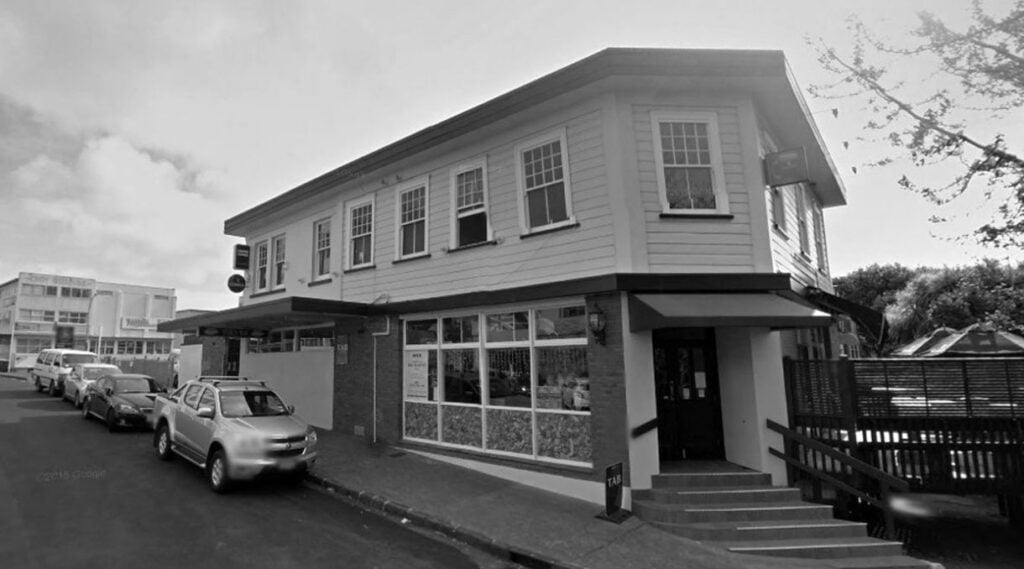
The Kings Arms Tavern
“I really hope this radicalises people. And I just ask anybody who cares about music and the arts and culture in this country to understand that they are just as entitled as the corporate lobbyists who feel that they get to tick off their wish lists with this government.” —Chlöe Swarbrick
Neck of the Woods is saved for now, but there’s much more work to be done.
For Swarbrick, who first turned to politics because of the Kings Arms’ demise, she thinks this invigorating week of community action has shown “the power of the people.”
“I think this shows us the power of community and it does actually demonstrate that when the people come together and organise and collectivise our resources, that we can in fact do things,” she continues. “I really hope this radicalises people. And I just ask anybody who cares about music and the arts and culture in this country to understand that they are just as entitled as the corporate lobbyists who feel that they get to tick off their wish lists with this government.”
“Support local venues, independent local venues,” Kylie says. “Especially New Zealand readers, vote for people who will increase arts funding, which is definitely not this current government. See what you can do for your local scene. Support them in as many ways as you can.”
They pause for a second. “But also look after yourself, you know? I don’t like this sort of blame culture that goes around where people are always shaming people for not being at a certain gig, or not being at every gig ever, you know?
“And also donate to the Give a Little if you can!”

