





























Dave Mustaine is signing his name thousands of times when Rolling Stone AU/NZ reaches him.
Not figuratively. Not in the legacy-sealing sense that might seem appropriate for the leader of Megadeth as the band prepares to bring more than four decades of history towards a close. He is literally autographing tens of thousands of copies of his new memoir, In My Darkest Hour, while talking.
Each book, he explains, comes with an image of Mustaine preparing to undergo radiation treatment during his battle with throat cancer.
“It’s a gnarly fucking thing,” he says.
After signing so many, has his signature started to lose its meaning?
“It looks like Danny Masante,” Mustaine jokes.
It is a fitting introduction to Dave Mustaine in 2026 — looking backwards, confronting mortality and still finding something to laugh about in the middle of it.
Love Music?
Get your daily dose of everything happening in Australian/New Zealand music and globally.

More than 40 years after forming Megadeth, Mustaine is finally talking about endings with something approaching certainty. The band’s 17th album, simply titled Megadeth, is their final studio record and recently reached No. 1 in both Australia and the US. Their current run has been announced as their last world tour. And this November they return to Australia as very special guests on Iron Maiden’s ‘Run for Your Lives’ tour, playing Adelaide, Melbourne, Sydney and two nights in Brisbane.
Maiden, meanwhile, are celebrating their 50th anniversary.
There is something almost too neat about the pairing; one of metal’s great institutions celebrating half a century alongside another preparing to take its final bow.
“Well, this is it,” Mustaine says when asked what changed between previously leaving the door cracked open on Megadeth’s future and deciding this really would be the end. “We are going to be wrapping things up.”
The funny thing is that almost everything Mustaine says afterwards makes him sound less like a man retiring than one still finding reasons to be excited about Megadeth.
That drive has carried the band a considerable distance. Mustaine formed Megadeth in 1983, and they have since sold 50 million records worldwide, earned a Grammy Award alongside 12 further nominations and placed seven albums inside the Billboard Top 10.
For metal fans, much of the résumé needs little introduction. 1986’s Peace Sells… But Who’s Buying? became Megadeth’s first platinum album and would later be ranked No. 8 on Rolling Stone’s list of the 100 Greatest Metal Albums of All Time. Rust in Peace followed in 1990, also going platinum, before 1992’s Countdown to Extinction reached No. 2 on the Billboard 200, earned double-platinum certification and delivered “Symphony of Destruction”. In 2016, the title track from Dystopia finally earned Megadeth their Grammy for Best Metal Performance.
There have been plenty of chapters in between. Lineups have changed, the industry around them has transformed, and Mustaine has survived throat cancer. Yet, when it came time to make album number 17, the best way forward was to go all the way back.
View this post on Instagram
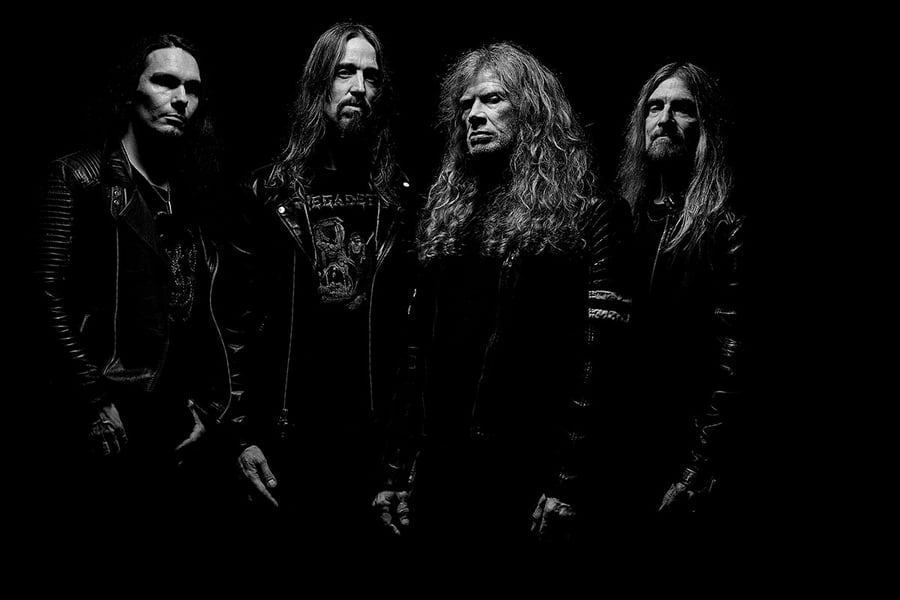
Before recording Megadeth, Mustaine sat down with guitarist Teemu Mäntysaari, bassist James LoMenzo and drummer Dirk Verbeuren and worked through roughly 205 Megadeth songs. They listened, discussed what they liked and immersed themselves in the catalogue before beginning the new record. Mustaine has described it as giving the current lineup the “weapons” they needed to make it properly.
There were other echoes of the past, too — the band tracked drums at North Hollywood’s One On One Recording, where Rust in Peace had been mixed decades earlier.
But when asked whether anything struck him differently while revisiting that much of his own history, Mustaine doesn’t pick a classic riff or forgotten song.
He thinks instead of the music Megadeth made during the period in which his wife’s mother was dying.
“I do think that the songs that we did during the time period when my wife’s mom was dying were really meaningful because I was in denial until just recently about her passing away from Alzheimer’s,” he says.
He recounts the horrific circumstances of her death after becoming disoriented while camping.
“I was furious,” Mustaine says, “but what can you say?”
For listeners, a 40-year catalogue can divide neatly into albums, lineups and eras. For the person who lived it, those records hold something else as well: moments in a life.
That made the title of the final album particularly interesting. After Killing Is My Business… and Business Is Good!, Peace Sells… But Who’s Buying?, So Far, So Good… So What!, Countdown to Extinction, The Sick, the Dying… and the Dead! and the rest, why end with a record simply called Megadeth? Was this an attempt to sum the band up, or strip everything back?
“Ooh, that’s a delicious little question,” Mustaine replies. “I like that. Well, you threw me a little curveball there.”
“I think I’m kind of pulling things back, trying to get back to what is the core fundamentals of what the band is and the playing and the singing and what the songs were about,” he concludes after a moment of thought.
Part of the path back came through punk.
Mustaine says punk covers have a habit of changing the mood around a Megadeth record, and recalls recently being on a tour where Fear were playing another stage. An opportunity arose to revisit an MD.45 song with the Megadeth lineup, and the band agreed.
“I think that those little things breathed so much life back into Megadeth,” he says. “It was critical, and you can feel it on the new album.”
The album itself hardly sounds designed as a gentle farewell. Mustaine described its basic tempo as “very fast”, said the band deliberately avoided ballads and summed up his mission rather succinctly: “I just want to come in and completely destroy.” The record includes the fast and melodic “Tipping Point”, punk-influenced “I Don’t Care” and the self-explanatory “Let There Be Shred”.
Mustaine also brought an unusually meticulous approach to making it. Megadeth worked through individual drum, bass and rhythm parts, deciding whether sections were too fast or too slow and refining them accordingly. According to Mustaine, there is only one other record in his career on which the process was approached in quite the same way: Countdown to Extinction.
If this is really the end, there is no suggestion Megadeth wanted to coast into it.
Their Australian dates place them alongside another band that understands longevity better than most. Iron Maiden bassist Steve Harris says he and Mustaine have been friends for years and that Maiden are “very proud” to have Megadeth joining them on their last world tour.
For Mustaine, Maiden’s ability to survive at that level comes down to something fairly simple.
“I believe that if you treat your fans right, you’re going to keep them,” he says. “And Iron Maiden is a band that is very fan-centric. So they really know how to keep their fans in the middle of the herd.”
Megadeth have their own long history with Australia. Their first tour here came during the Rust in Peace era around 35 years ago; this visit will be their ninth.
So put the Mustaine who walked onto an Australian stage in 1991 next to the one preparing to return in 2026. What would the younger Dave make of the man he became?
“Oh, I’d be pretty fucking impressed with me.”
There is no false modesty in what comes next.
“As many people have tried to squash me, as many people have tried to hold me down and push me back, I would be fucking excited to meet me and just say, ‘You did it. You never took shit from anybody and you did it,’” he says.
And what does today’s Mustaine make of that younger version?
“He was very, very driven,” he says. “I probably would’ve lost my mind working for me. But anybody that worked with me, one thing was for sure: they got better.”
It is Mustaine in remarkably concentrated form: aware that he could be difficult, entirely unapologetic about the standards behind it and deeply proud that he survived everything that tried to stop him.
Even a question about the emotional aftermath of Megadeth’s final show gets a characteristically unexpected answer.
After more than four decades of albums and tours, what does he hope to feel when he wakes up the following morning and there is no next Megadeth tour waiting?
“My fingertips.”
He explains that areas of his fingers and right thumb are numb and points out the scar beginning to form in the middle of one hand.
“See that thing right there in the middle of my hand?” Mustaine says. “Looks like a chicken’s foot right there.”
His other hand does not have the same scarring.
“Yeah, it’s a bummer,” he says. “But I’m going to keep fighting until the very end and be the Dave Mustaine that everybody knows and loves… and some hate.”
That determination inevitably hangs over In My Darkest Hour. Mustaine’s first memoir appeared around 15 years ago. This one comes after cancer, losing and regaining his voice and confronting the possibility of mortality in a far more literal way.
View this post on Instagram
Yet, when I ask what he can say about himself now that he could not have said honestly in that first book, Mustaine doesn’t suggest that age has suddenly made him more candid.
“I think I probably would’ve been just as forthcoming,” he says.
What has changed, he suggests, is the experience he has accumulated through years of working with people, recording and touring, and therefore his ability to be helpful in telling the story.
Was there ever a point during cancer treatment when he genuinely thought his voice, and perhaps Megadeth with it, could be gone?
“No, I wouldn’t let myself think like that.”
Positive thinking all the way?
“Yeah. God damn it.”
That refusal to contemplate defeat helps explain the version of his own history Mustaine would prefer people remember.
As a new memoir arrives and Megadeth approach the finish line, what part of the Dave Mustaine story have people spent too much time talking about?
“I think people have focused too much on the feud,” he says, “and I think they missed out on a whole lot of really great Megadeth music.”
He has an invitation for anybody who did: “Come check us out. I think they’ll like what they find.”
Four decades of albums and performing make a strong argument on his behalf.
Eventually, our conversation turns back towards Australia. I mention that I would like to see Megadeth when they arrive in November, but living in regional North Queensland puts the closest show in Brisbane roughly two days away by car.
Now Mustaine starts asking where exactly that places me.
“You’re way up north,” he concludes.
Then, from the man in the middle of discussing Megadeth’s last world tour, comes an unexpected consolation.
“Well, I wish you could see us,” he says. “Maybe when we come back next time, you will.”
Next time?
“Yeah, I think we’re going to do one on our own,” Mustaine replies. “This was really great to do this with Maiden, but I’m not sure. I could be totally wrong, but I usually don’t make mistakes.”
If Megadeth return to Australia for a headline tour, this might not be the last time we see them on our shores?
“Yeah, let me check on that. I’ll keep you posted. I’ll keep you posted.”
It is worth taking exactly as Mustaine gives it: a possibility, rather than an announcement. But it is also difficult to imagine a more fitting detour in a conversation about endings.
He still has more books to sign and other interviews waiting, so we finally wrap things up.
“All right, Jade, you take care of yourself,” Mustaine says. “All right, honey.”
And then, after a conversation finality, he leaves with one last sentiment.
“Hopefully we’ll see you next time.”
Iron Maiden ‘Run for Your Lives’ Australia Tour with Megadeth
Tickets on sale now
Wednesday, November 11th
Adelaide Entertainment Centre, Adelaide
Friday, November 13th
AAMI Park, Melbourne
Sunday, November 15th
Allianz Stadium, Sydney
Wednesday, November 18th
Brisbane Entertainment Centre, Brisbane
Thursday, November 19th
Brisbane Entertainment Centre, Brisbane
Jade Kennedy is a journalist, photographer, and publicist based in Queensland, with over 20 years’ experience in the Australian music industry.

