





























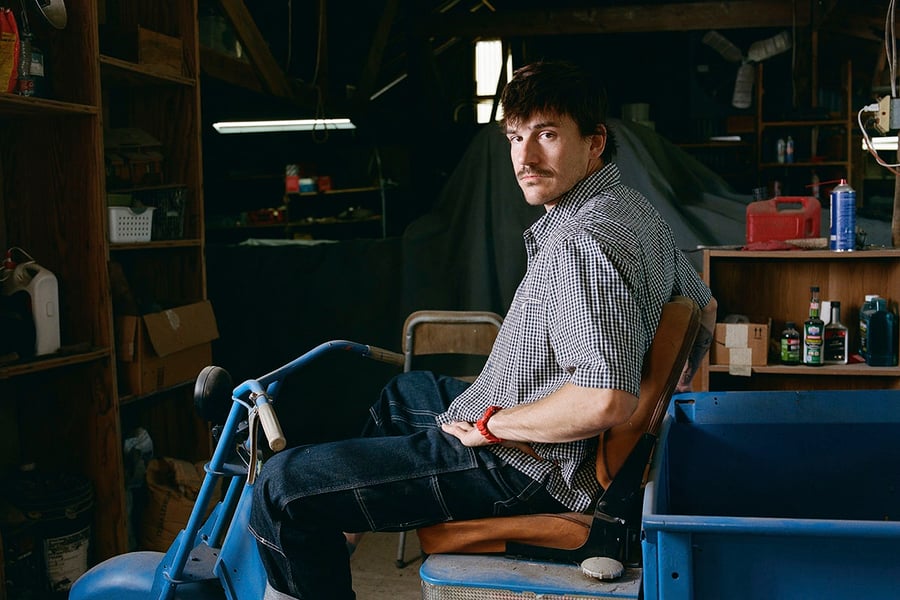
Within minutes of talking to Nick Carpenter, he tells me I’ve found the byline for his new album.
King of Having Fun sounds triumphant. Perhaps even a little cocky. But underneath the big, communal moments are self-doubt, discomfort and sadness. So I ask the man behind Medium Build whether it’s actually an album about learning the difference between having fun and being okay.
“That is the best and most succinct way of saying it,” he says.
There’s 10-year-old Nick, riding his bike to Taco Bell, drinking soda, goofing around with friends and making VCR tapes.
Then, there’s Nick at 30.
“Just drinking and doing drugs and there’s that sort of fun,” he says. “There is this sort of threat of like, ‘Oh, this is a guy who’s totally carefree.’ I got really good at having fun, capital alcohol, drugs, F-U-N. Or just swiping the credit card and just being like, ‘Whatever, YOLO,’ type shit.
“And then yeah, it’s like, that guy’s having fun. But if you literally push it, it breaks. It’s just all facade. Being okay. You nailed it. That’s the byline as hell.”
Love Music?
Get your daily dose of everything happening in Australian/New Zealand music and globally.

I’ll take it.
When Carpenter sits down with Rolling Stone AU/NZ, King of Having Fun is only hours away from release and, after a long stretch of support slots, Carpenter is itching to get these songs in front of his own crowd.
“I feel ready,” he says. “I’ve heard these tunes one million times and I really made them with the intention of playing them live. So it’s like, God, just get me on the streets playing these tunes.”
The record has plenty designed to be yelled back at him, yet some of its strongest moments come when Carpenter gets quieter. “Do Something Productive” sits right on another uncomfortable divide: the space between appearing functional and actually being well.
“Functional has been my mode since I was a child,” Carpenter says. “Mom and Dad are busy, or money’s tight, or we’re at church — don’t speak. I learned how to function at a very early age with the belt and the wooden spoon. You just learn to be good and work.”
Then came adulthood. “Pay your taxes, learn how to do mail, learn how to file stuff, learn how to get your licence,” he says. “All this shit that I just didn’t know how to do.
“Being well is not taught to any of us, unless you’re really lucky and you have some great mentors in your life,” Carpenter adds. “I don’t know anyone who’s like, ‘Hey, by the way, you can do all that stuff, but if you’re not checking in on yourself, if you don’t have great friends, if you don’t have a plan for when you have really bad brain days…’”
Carpenter wasn’t diagnosed with bipolar disorder until later in life. With that knowledge came a different understanding of some of the days he’d left behind.
“There were all those days of my life that I ruined because I just didn’t know how to say, ‘Oh, I need to go to bed, I’m having a bad day.’ Or instead I just punish my partners or roommates by being like, ‘I’m crazy.’
“Functional is something, but I’d rather be well.”
The road makes that harder.
I tell Carpenter that I sell merch for artists on tour, so I understand that even a week of moving from city to city can destroy any pretence of routine. He’s out there for months.
“I’m still learning that, Jade,” he says.
View this post on Instagram
There have been tours where Carpenter stayed sober, went running, called people and went to the movies… then, there were the other ones.
“Some tours were times where I was just like, ‘I’m going to get drunk. I’m going to find the crustiest hole-in-the-wall place, and I’m going to make friends with the old man who’s barnacled in the corner, and I’m just going to black most of this out,” he says. “That was a coping mechanism that worked for me for ages. But it started getting really toxic.”
Taking away the thing that numbed him hasn’t necessarily made the road easier.
“Now I’m present, and I’m, as you said, maybe okay, but it’s not easier,” Carpenter says. “I think I actually had a better time just sort of numbing out.”
So now he’s figuring out what present-day Nick does with a day off in Kansas City, knowing nobody, staring at a concrete parking lot.
“Okay, I guess I’m going to go to a putt-putt course,” he laughs.
Australia has hosted both versions of Carpenter.
He has returned repeatedly, including recent support runs with Role Model and Alex Warren as well as his own headline shows. He says his best friend moved here in 2016 and later became a citizen, so he feels at home Down Under.
But some of his lowest moments happened here, too.
“Yeah, that’s where I blacked out and destroyed my life one night in Sydney,” he says. “Or there’s that hotel in Adelaide where I wrote the note to my team saying, ‘If I don’t quit, I’m going to die.’”
But he doesn’t blame Australia for the person who arrived in it.
“I think it would be so unfair to demonise a place for how I showed up,” he says. “If I hadn’t had the clarity, then maybe I’d be gone or maybe I’d still be in the hole.”
One of those moments of clarity came at a Fremantle dog beach on a spectacular, warm day.
Everyone was lying in the sun. He wanted to die.
“I knew I was depressed when it was just the most beautiful day of my life,” he says. “I was like, ‘Oh, this has to be chemically coming from inside me because I’m in heaven. This is heaven.’”
Carpenter even loves the disorientation of touring here: wake up, airport, plane, another city, another show, another hotel; rinse and repeat.
“I personally really fucking love it,” he says. “It feels like going into the upside down and be like, ‘This is like us, but different and there’s no guns. That’s kind of cute and nice.’ And I always just feel safe.”
Contradictions suit Carpenter.
On “Perceived”, he sings: “I don’t want to be here. I don’t want to be gone. I don’t want to be perceived at all.”
It’s an inconvenient feeling for someone who has built a life around standing on stages and asking people to pay attention.
“I’m trying to figure that out,” he admits.
Growing up, Carpenter’s older brother was the “squeaky wheel”. Nick was the one everyone assumed had it handled.
“They’re like, ‘Nick’s cool, he’s got it figured out,’” he says. “Everyone’s attention was sort of somewhere else. There’s a piece of me that really loves being the underdog or being in the shadows and working in silence.”
And yet…
“At some point I must’ve gotten tired of being ignored and then I started screaming my songs hoping that people would pay attention to me.”
Now people are paying attention. The question has since changed.
“How do you wield it?”
Carpenter has watched musicians get that answer spectacularly wrong: “being creepy to girls on tour”, throwing their influence around, or disappearing into gambling, drugs and sex.
“There’s so many places that I think people go to because they actually feel really uncomfortable with the power and the privilege,” he says.
His answer isn’t to pretend he has none.
“I think I have to admit that I have it and then be a good handler of it,” Carpenter says. “Know that I have this immense gift and I enjoy it. It brings me these perks, but it also brings me a bunch of things that I don’t like.”
As Medium Build gets bigger, Carpenter seems intent on keeping parts of it small.
“Feed the Boys” is almost startling in its simplicity. Among some of the fullest arrangements he has ever made sits something that feels closer to a voice note.
That’s deliberate.
“From the beginning of Medium Build, there’s always been an ethos of the less gear, the better,” Carpenter says. “I had so many friends that got lost with their toys and their tools and trying to make everything perfect.”
Even now, he wants pieces of Medium Build to retain the intimacy of the living-room shows he played for years. One in Perth in 2019 drew a grand total of six people.
“I’ll never forget that gig,” Carpenter says. “I’ve forgotten a lot of gigs, but I will not forget that gig.”
A fight broke out in the audience that night.
“I mean, you don’t think a fight can break out between six people, but it can.”
It’s an excellent argument for keeping things intimate. Those stripped-back moments on King of Having Fun are also reminders.
“It’s like me calming myself down,” he says. “‘Hey, Nick, remember just you and the guitar is still good, even though you’ve got all these little tricks and toys now. Don’t get too big. Keep some intimacy for folks.’”
When we speak, Carpenter is hours away from testing that philosophy somewhere with a little more history behind it, but I tell him we’re running out of time.
“We can go a little,” he replies. “We’re cool.”
So I ask him about the Grand Ole Opry. Carpenter grew up in Georgia. His father, now 75, grew up listening to the Opry every day because his mother loved it. She died 13 years before Carpenter was born. That weekend, her grandson would make his Opry debut.
“There’s just no perspective,” Carpenter says. “You’ve got this institution that’s a hundred years old. They’ve been broadcasting since 1925, and I get to go be a blip of it.”
His parents would be there. So would the first woman who booked him in college in 2013.
Carpenter doesn’t talk about the Opry as proof that he’s made it. His mind goes somewhere much bigger than his own career.
“Humans are just this tiny, tiny, tiny blip in the history of the world and the universe,” he says. “What a lucky thing we are to be on this planet at the exact right time where oxygen and plants can happen.
“And then what a lucky thing it is for me that I made music at a time where the Opry has deemed that I’m acceptable to come play it.”
After everything Carpenter has said about being seen, there’s something fitting about him approaching one of the biggest moments of his career by making himself very small.
“Lucky is kind of the only way I can describe it.”
For all the scale now surrounding Medium Build, one of my favourite moments on King of Having Fun involves neither a storied stage nor a huge singalong. It involves a badly-behaved dog.
At the end of “Cone Off”, Carpenter starts howling.
A dog howls back.
“That’s my little girl, Brisket,” he says.
Carpenter rescued her in Alaska, where she had been a village mutt. It took two years to break the habits of eating anything left unattended and jumping into the back of whatever truck happened to pass.
Her appearance on the record wasn’t planned.
“I just started howling at the end of that track, and then she just went for it,” Carpenter says. “She’s heard me sing for years, but that day she shined, and I’m so glad she’s finally on wax.”
Carpenter has three dogs. Brisket is still the wildest and the least well-behaved.
“It starts and you’re like, ‘Damn, this dog is so difficult.’ Now I really feel like I understand her a little more.”
Medium Build’s ‘King of Having Fun’ is out now.

