




























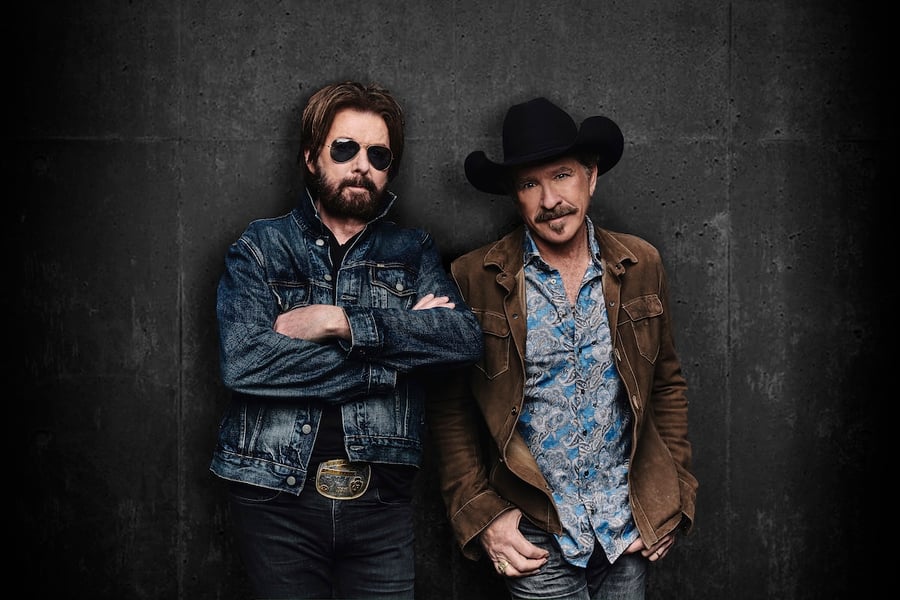
Of everything Brooks & Dunn remember about Australia, it is the flying foxes that still seem to trouble Kix Brooks.
From a high floor of their Sydney hotel on their last visit, he and Ronnie Dunn watched them stream across the evening sky and over the bridge. “Very Wizard of Oz-y,” Brooks recalls, still sounding faintly unnerved by the whole thing. “Pretty freaking freaky.”
Dunn’s memories are less gothic, although no less vivid. He remembers being driven away from Rod Laver Arena through what seemed like miles of people spilling out into the night, “bouncing off the walls” and having an excellent time. The duo wanted to join them. Their handlers apparently had other ideas.
“Don’t take this as a bad thing,” Dunn says, “but it’s kind of like Texas on steroids down there. They’re just full blast.”
Brooks & Dunn will finally get another look at the country that made such an impression when they return to Australia to headline CMC Rocks QLD in March 2027. It will be their first visit since 2009, and their appearance comes during the festival’s 20th anniversary at Willowbank Raceway in Ipswich.
The timing feels right. Brooks & Dunn are also marking 35 years since Brand New Man, the 1991 debut that introduced their turbocharged meeting of honky-tonk, country and rock. Next month, it will receive its first vinyl pressing. In November, the Country Music Association will present them with the Willie Nelson Lifetime Achievement Award, placing them alongside former recipients including Dolly Parton, Johnny Cash, Loretta Lynn and George Strait.
There are tidy ways to tell that story now: 20 number-one hits, more than 30 million albums sold, 17 million concert tickets and 16 CMA Vocal Duo of the Year wins, a Hall of Fame induction. Ask Brooks and Dunn what they recognised in the two men who made Brand New Man, however, and the answer is much simpler.
Love Music?
Get your daily dose of everything happening in Australian/New Zealand music and globally.

“We had no idea about anything,” Dunn says. “We didn’t have a clue.”
They expected three to five good years, at best. There was no long-range plan for becoming the most awarded duo in country music history, let alone for watching “Neon Moon” find another generation through TikTok decades after country radio had moved on.
“If somebody would just give you the book on success and go, ‘Oh, you’re going to be here’…” Dunn begins, imagining someone showing them their future.
“Shut up,” Brooks cuts in.
“Not going to happen,” Dunn continues. “There’s no way of knowing.”
What they did know how to do was work. In their first two years, Brooks estimates, the duo played around 200 shows. They had come from bars, and when their debut took off, they deliberately kept playing them, only now the honky-tonks were packed.
“We wanted to get the band tight,” Dunn says. “You want to go woodshed.”
That apprenticeship matters to both men, especially now that festivals and streaming can push young artists towards headlining slots after only a couple of hits. Brooks sees the uncomfortable result: an act elevated before audiences know enough of their songs, left to fill the gaps with covers.
“When we first started, I think one of the first two years we did 200 shows,” he says. “We were bar guys anyway. We were just used to playing bars with not many people in them. So all of a sudden we’re packing these big honky-tonks, and man, that was heaven for both of us.”
By then, country music itself was changing around them. The genre’s early-‘90s boom put country acts into arenas on the nights after rock bands, forcing performers to think bigger when it came to staging and production. Dunn remembers a time when a country crowd might politely applaud between songs. Brooks & Dunn’s crowds were different.
“They’re moshing at one point,” Dunn laughs. “They’re throwing bras at us.”
Three decades later, he hears stadium audiences sing their lyrics louder than ever, including at recent US dates with Morgan Wallen. “They know them better than we do,” he says. “We carry pretty big darn production and it’s like they’ll drown you out at times.”
Technology upended the business Brooks & Dunn entered. The internet did not even warrant a mention in the contracts they signed 35 years ago, Brooks points out. At the time, a compact disc felt like the purest possible way to deliver music. When country radio stopped playing an artist, as Dunn says it eventually does in every career, the obvious pathway to an audience appeared to close with it.
Streaming brought new arguments about how musicians are paid, but it also kept the door open. Brooks & Dunn’s 2019 album Reboot paired their catalogue with Luke Combs, Kacey Musgraves, Ashley McBryde and Thomas Rhett. Reboot II followed in 2024 with artists including Lainey Wilson, Morgan Wallen, Jelly Roll and HARDY, further blurring the line between country’s old guard and its current stadium class.
View this post on Instagram
The duo’s songs did the rest. “Neon Moon” became a viral phenomenon. “Boot Scootin’ Boogie” never really left the dance floor. “Red Dirt Road”, drawn from the rural landscapes of Brooks and Dunn’s respective childhoods, kept finding people who had never seen anything like them.
Brooks remembers meeting a city kid outside Newark, New Jersey, who told him “Red Dirt Road” was the story of his life.
“It would be like somebody from the outback, I guess, and somebody in downtown Sydney saying, ‘That song is the story of my life,’” he says. “That makes you feel good, that a song has some kind of universal message that gets through to folks.”
The lifetime achievement award offers an obvious invitation to look backwards, but neither man sounds ready to settle into museum-piece status. Dunn is particularly resistant to the assumption that audiences only want the catalogue.
“Somebody said to me, ‘You don’t go see Elton John to see Elton John do new music,’” he says. “But I’m not going to let go of the fact that, no, I can turn out music that’ll make you tap your toe.”
In fact, Brooks & Dunn are making a new record now. Dunn volunteers the news with a joking disclaimer — “This is not shameless promotion” — before describing how quickly the familiar uncertainty has returned. Even after everything they have made together, song selection can still catch each man off guard.
“We both hunt,” Brooks says. They write together occasionally, but still tend to follow their own instincts before bringing discoveries back to the duo. “We just do whatever’s comfortable and healthy at the time, trying to make and find the best music that we can.”
Asked what there is left to improve after 35 years, Dunn does not hesitate. “Songwriting, and how the songs reach out and touch people and are timely and relevant,” he says. “That’s the ultimate goal for us.”
“There’s not a magic tree somewhere where you can come pull them off,” Brooks adds. “But occasionally you can go running away going, ‘I got one.’ At least you feel like you do some days.”
Australia has waited a long time for another Brooks & Dunn show. Some of the people at CMC Rocks will have been there during the duo’s last tours; others were not yet born. Brooks believes the cultural connection will make sense to both. Australia, he says, has its cities and sophistication, but it hangs onto its country identity much as America does.
“It feels like home,” he says.
The studio versions of Brooks & Dunn’s hits are polished documents of the pair at their peak. The live show, Brooks promises, is another thing entirely: looser, more physical and more likely to come apart at the edges.
“We’re pretty much unravelled onstage,” he says. “What you hear is probably a pretty clinical version on a record from the message that you’re getting from us onstage.”
Dunn supplies one final clarification. “It’s not going to be the Red Hot Chili Peppers,” he says.
Maybe not. But the last time Brooks & Dunn came to Australia, they found a country operating at a level Dunn could only describe as Texas on steroids. In 2027, they intend to meet it there.
“We’re going to have as much fun as you are,” Brooks says. “Just bring it.”
CMC Rocks QLD returns to Willowbank Raceway, Ipswich, from March 19–21, 2027.

