




























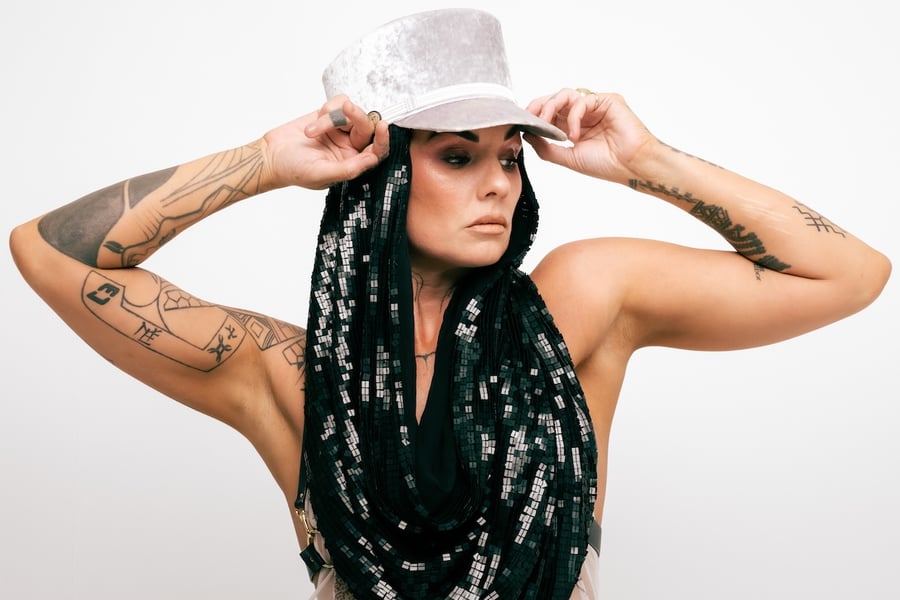
Sitting 18 stories up on a rooftop just down the road from Manhattan’s Times Square, with the towering Empire State Building in view, a cautious joy radiates from Hollie Smith as she opens up about her latest record.
The singer-songwriter made the trip to New York City to put the finishing touches on her latest album, A Quiet Revolution, which is now in its final stages and set for release in early 2027.
For more than 20 years, Smith has been regarded as one of Aotearoa’s top musical talents. Her ability to create and express raw emotion that strikes listeners at their core has earned her a loyal fan base and a place among the country’s most accomplished artists.
Smith is one of a few Kiwis to have four consecutive solo albums [Long Player, 2007, Humour and the Misfortune of Others, 2010, Water or Gold, 2016, Coming in from the Dark, 2021] reach number one on the RIANZ charts. Now she’s aiming for a fifth.
But the album is more than a milestone. It’s a chance to regain momentum. It’s her first record set to be released entirely independently – without the backing of a label.
“I think the album has come together really well. There are a couple of songs on it that are really clever and quite different,” she says.
The work reflects Smith’s commitment to an industry that has tested her resilience many times over. From a record deal that fell through early on, to a dream to venture overseas upended by the pandemic, and an ever-changing industry that presents new challenges around every corner, Smith has faced more hurdles than many.
Love Music?
Get your daily dose of everything happening in Australian/New Zealand music and globally.

But her passion for live performance, drive to create her best work, and fear of failure keep Smith going. While she’s developed a knack for adapting, she doesn’t shy away from acknowledging the grit it takes to keep moving forward.
“It’s a really hard time in the industry, and it’s a really hard time to adjust to what that’s going to look like,” she admits. “New Zealand is really struggling at the minute. This is the least amount of shows I’ve had since I was 13, and I have been doing it for 30 years.
“I’ve gone from three shows a month to three this year, so that’s really hard to stay motivated about because that’s where the dopamine comes from when you’re performing. It’s tough out there; we all recognise that, and entertainment is the first thing to go.”
She put A Quiet Revolution together on the back of her nationwide ‘Bones’ tour after relocating to Tauranga, giving herself three months to write at least 12 songs to take on the road. It led to more than 50 shows from Bluff to Whangarei.
“I would chuck my keys in the car, drove basically the whole country, just doing tiny shows and the bare bones of the songs – how I wrote it before it’s been arranged or recorded or produced- and had really great feedback, and really amazing response,” she says.
Smith’s stripped-back gigs showcased a new catalogue of work in its simplest form, just as it first came to life from her mind to paper.
“It was really interesting; there was a lot of crowd interaction, talking really openly about the songs and where they came from,” Smith explains. “It was a really good way to gauge how the songs landed.”
By the end of the tour, she had all the makings of her next album and set out to transform each track into a multi-instrumental production, bringing in co-producer Abraham Kunin to help Smith unlock the potential of each tune.
For A Quiet Revolution, Smith tapped inspiration from Erykah Badu and D’Angelo – albums Smith has loved since they were released. While intertwining genres, Smith’s soulful signature tones remain the centrepiece, with her earthy jazz and blues roots shining through.
“A couple of the songs I’d written while on the road with the Bones tour definitely had more of a jazz lean to it because I think I was already thinking more in terms of the production of the album, through the instrumentation,” she says.
“We’ve got upright bass, double bass, on a couple songs, which obviously brings a totally different element and a lot more of that jazz feel, but a lot of really rich piano stuff as well.
“My piano players that are on this album, they’re all really heavily influenced by jazz, so that comes through quite a lot.”
Among the more personal is the album’s opening track “4LC” – an ode to the late Chris ‘Mu’ Faiumu, founding member of Fat Freddy’s Drop, who passed away in July 2025.
While attending his tangi, Smith was reminded of the positive force of his aura and how blessed she felt to have known him.
“He was this peaceful being that we loved to be around, that just spoke to me, and so this song was about feeling lucky to have known him because he was who he was. His legacy lives on, and the people he’s touched and the music he’s left behind, and it’s bigger than just him,” she says.
Across the album, through her lyrics, Smith ventures into the political sphere, addressing Roe v. Wade, women’s and human rights, US politics, and digs into the more delicate moments of her own experiences.
“There’s quite a big swing,” Smith admits. “There’s one I wrote about a crush I had for about five minutes, and then I realised that would be way better if that just stayed in my head,” she reveals with a big laugh.
The album’s name is derived from “Message In A Bullet”, which explores feelings of being surrounded by chaos, uncertainty, and the nature of the online universe.
“There’s so much noise at the moment, internet and news, crazy stuff happening. It’s a bizarre life to be living at the minute. It’s just so loud, and within all those things there’s microcosms of other arguments and people’s opinions, and it just feels like no one’s actually listening to anything,” she says. “There’s just noise everywhere, and this one is just that. I think a whisper would be more impactful than a scream. The song is about ‘can we have a quiet revolution?'”
She credits her dad, Steve McDonald, as one of her earliest musical influences, who is a blues-rock guitarist and worked with her on her earliest recordings when she was just 16.
“He’s an amazing, really good player. He used to do lots of gigs that I went to when I was little,” Smith explains.
“I always had an affiliation with that style of music. It went from me watching The Sound of Music almost every single day when I was little to finding a VCR of a James Brown concert that mum or dad would have taped off the TV, when En Vogue opened for him.
“‘It’s A Man’s Man’s Man’s World’ was one of my favourite songs. I would just rewind, play, rewind, play, and taped it onto a cassette so I could listen on a Walkman. I was obsessed with James Brown and En Vogue.”
She also recalls hearing Madonna’s “Like A Prayer” outro for the first time, which opened her eyes to music’s power to unlock emotion from within. “It was my favourite thing in the world.”
As a rising star, her aptitude was further accelerated by the teachings of her revered music teacher, Deece Guisinger, who made a monumental impact on her formative years at Northcote College on Auckland’s North Shore.
“He was heavily into jazz, and they had a really cool jazz big band, brass section and everything, so I started singing with them when I first got to high school,” she explains.
It was his encouragement that helped her to truly grasp what it took to deliver lyrics with a value that let the weight of words be projected, heard, and felt.
“[That] was a big lesson into understanding a deeper level of what music can become, so I started writing quite differently after, and definitely interpreted my singing of other people’s songs differently too,” Smith explains.
“It was teaching me how to feel a song as opposed to singing a song; you have to figure out what the intention is, your intention and how you want people to be able to respond and how you want to make them feel.”
Today, Smith’s fans hail that ability as one of her greatest strengths.
“I’ve got a really loyal following; I think that’s one thing that people appreciate with the music I have released that resonates with them on a more emotional level,” she says. “I think my content as well.”
It was in 2006 when Smith became a household name countrywide with her mesmerising delivery and performance of “Bathe in the River”, written by Don McGlashan for the movie No. 2.
The song’s soaring popularity, which saw it spend more than eight months in the official top 40, took Smith some getting used to after initially feeling conflicted by the whirlwind.
It took seeing what it meant to other people for her to really understand the song’s significance.
“It’s been at funerals, it’s been at weddings, it’s inspired people to do other things, all sorts of stuff”, she says.
“When I started performing it and seeing the reactions of people and hearing stories from people afterwards, I realised it’s not about me, and now I just love it because it’s become a New Zealand classic that I was lucky enough to be a part of doing.”
A year later, she released her debut solo album and was on track for a major deal with a record company hailed as Smith’s ‘pinnacle,’ known for its integrity and widely respected. She was spending a lot of time in New York as it came together, when fate had other plans.
“It was wrong place, wrong time, which is why it sucked; it wasn’t anything that I could have changed,” Smith says. “I had protected myself 100 percent in the contract, and all that kind of thing, but something shifted.
“I spent a long time recovering from that emotionally and financially, which I never did financially, and I don’t think I have ever have emotionally either to be fair,” she admits with a giggle.
While she wasn’t the only one impacted, she says the eventual fallout was brutal, and the lasting impact only fed her inner critic.
“I don’t feel like I deserve to be anywhere, I criticise myself heavily,” she says.
“I find it really difficult to take compliments. But I think that’s got worse as I’ve got older, feeling less relevant. Every step of doing this album I’ve had a voice telling me it’s not good enough. It seems to be a running theme – keep striving to make it better.”
Instead of giving up, she pushes forward in search of something great. Being back in New York has ignited a feeling of hope after being reminded that the world isn’t as big as it can feel from home.
“We do what we have to do because we want to create. It never ceases to amaze me how incredibly difficult it is. Having made a living of it for the last 20 years is incredible,” she says.
“In New Zealand we kind of do that thing of don’t talk like that, we’re not allowed to be outward about our success because it seems arrogant. Just being outside the mindset has helped me keep going.”
She’s committed to keep persevering, even if it one day means bowing out of the music industry and taking her guitar to the streets.
“You can’t get away from it; if it’s ingrained in you, you’ll find a way to do it, no matter what.”

