




























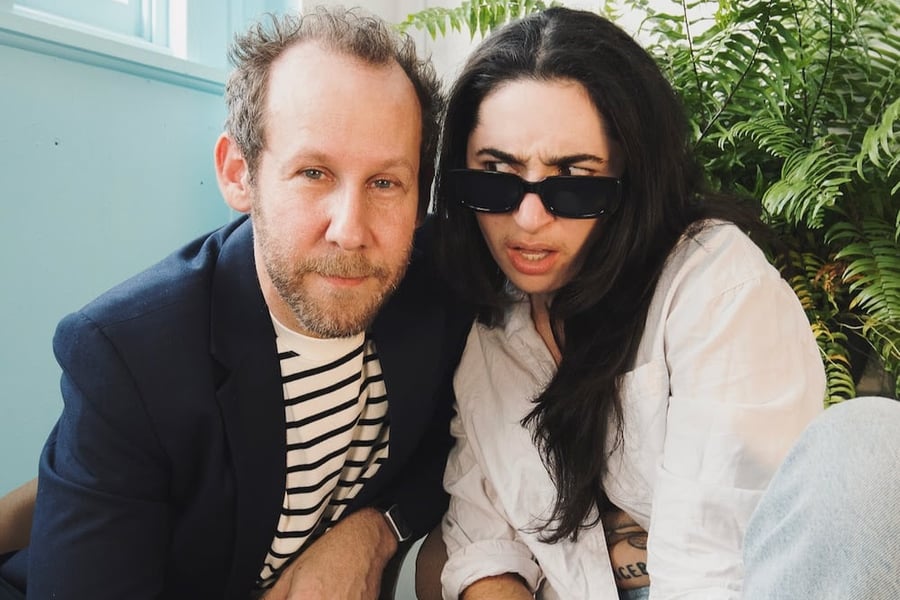
Ben Lee and Georgia Maq will kick off a co-headline tour next month, in which they will deliver a two-hour intimate performance together.
Ahead of the shows, the revered Australian songwriters sat down in an exclusive artist-on-chat to talk about a range of topics, including Maq’s move to the US, the art of songwriting, the end of Camp Cope and so much more.
Check out the full exchange below. Scroll down to see all of the dates and venues, and click here for more details.
Ben Lee: I was thinking, for fans of yours, of Camp Cope and stuff, and them really understanding the journey you’ve been on creatively since moving to LA — it’s a little bit mysterious to them.
Georgia Maq: Oh my God. I think I’m a very transparent person — I started learning the violin and was posting, like, day one, about not being very good at it. I think I’m quite an open person, but it’s also hard to let people know what you’re doing when you don’t really know what you’re doing. I don’t know what the fuck I’m doing. All I know is I’m going in a more organic direction — and a quieter direction. I think after eight years of yelling, I just didn’t want to yell anymore, you know? There are other voices in the space that are way more important than mine, and I served a role at one point to be a voice.
Lee: How would you define that? You mean like a teen-angst kind of thing? Being an angry young person?
Maq: I never liked it when people would describe Camp Cope as angsty, because I feel like angst is anger but with no direction, or just anger for the sake of being angry. But we had a very good reason to be angry at what we were angry about. And so when people would describe it as angsty, I’d be like, it’s not angst, because that kind of minimises the experience of being three women — or one woman — in the music industry.
Love Music?
Get your daily dose of everything happening in Australian/New Zealand music and globally.

Lee: That’s absolutely true. But I do think there’s like, where we stand in the face of living in an unjust world changes from when we’re young to as we get older. Like, the shock we’re in as young people, like, ‘Oh my God, I can’t believe the world’s unfair, or hypocritical.’ Whereas as we get older, we sort of sadly accept the injustices as part of life a little bit. So I do think that changes.
Maq: I feel like I’m doing that as I get older. Like, am I just tired? Am I just in a privileged position… it’s like being an expat in America as well. I’m just here trying to focus on art and trying to survive in America, which is a hard thing to do.
Lee: America has played a very vital role in sort of expanding our sense of what’s possible.
Maq: Yeah — how did you move to LA? What visa did you get? How did you kind of do it? And how old were you, and what was that experience like, finding your feet?
Lee: Yeah, my thing was a little bit different, because I was actually signed to a US label from when I was 14, basically. And record deals back then were like proper record deals, you know? Where you got tour support and all that, so I always had the ability to get working visas and all of that. But I was explaining to someone last night that I was an indie artist in Australia, which meant selling about 1,000 copies of my albums, and proportionally, I was the same size artist in America, but because it’s a bigger population, that was selling 30,000 or 40,000.
So I could tour, and I had opportunities. It wasn’t that I was a massive artist in America, but there was work to be done, gigs to be done. I also just think it’s so funny, because as creative people, as much as we’re not competitive innately, like, we kind of make art because we need to. We also want to find out how good or how bad we are. We want to stand in the biggest town square, in the biggest marketplace, and just figure out: are we any good? And I think you can kind of do that in America.
Maq: Yeah, especially in LA, ’cause everyone is so, everyone’s amazing. It’s like LA and Nashville. Nashville definitely has the best players, so any time I go to Nashville, I’m like, ‘Fuck, I’m so bad at guitar.’ But then in LA I’m like, ‘You know what? I’m pretty good at guitar.’ But yeah, Nashville, it’s just a whole other beast.
Lee: The competition here is, like, because there’s so many more people, and everyone’s in LA to be like, ‘Alright, let’s fucking go, let’s try to make a career.’ Just through our friendship, watching you find your feet as a solo artist too, and how, coming out of such a strong band dynamic where you had that. I’s like being in a band, for better or worse, you have that family support for everything you do and you gotta try and assemble new commitments, new connections, when you’re out on your own. It’s a very trial-and-error sort of process.
Maq: It’s really hard, because in the band I was so supported. When I said the thing on stage at Falls Festival, I don’t think they knew I was gonna say anything, but they had my back the whole time. Whereas as a solo artist, all you have is your friends who aren’t on stage with you; they’re just little people in your phone who you see. So it’s a really different thing. And also, having been known as Georgia Maq from Camp Cope for so long, instead of, now I just wanna be Georgia Maq, but I’m not sure if I’ll ever beat who I was in Camp Cope. Did you ever feel that way with Noise Addict?
Lee: Not with Noise Addict, ’cause Noise Addict was more of an idea… but I felt that for sure with “Catch My Disease” or “Cigarettes Will Kill You.” You have certain albums or songs. You know the woman who wrote Eat, Pray, Love? I forget her name. She did a TED Talk after she wrote that book… that was one of the biggest books that has ever come out, and she said it’s crazy knowing that whatever you do next will be a failure in comparison. Obviously, we’re talking on a much smaller scale, but still, it’s very humbling to realise that.
Maq: It’s so real for artists — I have friends who have really massive fucking songs, and we’ve talked about it, how they’re like, ‘Everything I do gets compared to that, and I’ll never beat that.’ Living in their own shadow a bit. It’s crazy when the biggest competition is yourself. I think it’s a very human thing to be competitive. I tried to fight against it for a long time. Like in school, it was kind of my excuse to not want to play sport, ’cause I was like, ‘Well, I don’t believe in competition, I don’t believe humans should be in competition with each other.’
But then it’s like, I’m always trying to beat myself. Whatever I’ve done in the past, I’m trying to top that and achieve bigger things than what I’ve already achieved, and that sometimes feels like a totally impossible task.
Lee: Well, that was what was so cool about this last tour you did, coming to Australia. ‘Cause obviously there was the political stuff going on, but also, I think the fear of bringing back your solo work and being like, ‘This is where I’m at,’ that was a real thing. You were really representing yourself creatively, and it was so amazing being in those rooms and feeling people get into it.
Maq: I think I was very upfront about that on stage, and I really talked about, like — being like, ‘Hey guys, it’s me. You all know me, you all know everything I’ve said, all the things that were written in the press, my Instagram — you know me.’ And I just wanna acknowledge that, and acknowledge where I am on this weird journey of, you know, Camp Cope ended, and then I moved to America, and it’s kind of been a bit of a mystery of what I’m gonna do next these last few years. I just wanted to be really upfront about that when I was performing, to kind of let people in, I guess. I like being honest with people.
Lee: It’s funny how that unknown — being in the unknown creatively — and to tie that into the tour we’re doing, like, just doing things and not really understanding what they’re gonna look like, but just going on. It’s exploration, right? It’s very scary to be in the unknown, but I’ve noticed, as I’ve gotten older, when I was working with Tom Robbins on this project we did together…
Maq: Who’s Tom Robbins?
Lee: He’s a writer — he wrote some amazing books, like Jitterbug Perfume and Even Cowgirls Get the Blues. Great, great writer, great American author. We wrote a musical together. But I’d just finished an album cycle, and we were emailing, and he asked what I was up to. I said, ‘Well, I don’t know, I’ve sort of got to start exploring again,’ and I was nervous, ’cause it was that sense of, OK, the slate’s clean… and he wrote back, ‘How exciting — that’s my favourite part.’ As you get older, it’s nice to make some peace with the fact that we’re so lucky we get to genuinely explore and not know, when so many careers are so prescriptive and predictable. And there is genuine emotional risk in the idea of reinventing yourself creatively and discovering things.
Maq: I like the ability to be able to explore and do different things, like this tour with you. I don’t know what that’s gonna fucking look like. I don’t know how it’s gonna sound or anything like that. I’ve also been secretly making pop music on the side that I’m gonna put out under a different name at some point, with the idea of never performing it in front of anyone in my life. But I just love music so much, because you can just do anything. And I know it doesn’t matter.
Lee: Literally, I was talking to someone last night about our tour, and they were like, ‘What’s it about?’ and I was like, ‘I don’t know — except that I know that when we sing together, I feel something.’ I feel such a loving energy in singing and playing with you. I feel like it’s healing, it’s healthy. It’s a healing feeling.
Maq: It’s like when you’d have parties at the house in Laurel Canyon, and everyone would just be jamming and being silly. It kind of brings me back to how those days and nights were some of the happiest I’ve had since being in LA. It felt so real. It wasn’t about being cool
Lee: Remember, me, you and Amy Taylor — who was on what?
Maq: Amy was on the bass. I was playing the drums… didn’t know how to play the drums! But it was just a really good, fun vibe. Nothing beats singing with people; it’s the best feeling in the world, and I just wanna do that forever. I love it when people sing along at shows — I just love it so much.
Lee: As much as I miss LA, and I miss friends, and I miss so many things, it makes me so happy that, when I first came to LA in the mid-nineties, especially in the acting community, Aussies really hooked each other up. You were always invited to things, barbecues, people’s houses — there was a real sense that the community was small, and people needed to stick together and help each other out. I really wanted to help recreate that a little bit for the musicians, and I’m so happy. I just keep one eye on that Instagram group thread, and just knowing that it’s there. I feel like it’s really beautiful the way Australian musicians are sticking together and helping each other out in LA. It makes me really happy about it.
Maq: I hang out with quite a few Australians, a lot of Americans, but a lot of Australians too. It’s really nice just feeling like we’re all in this together.
Lee: That whole, what do you call it, “blowjob-gate,” or whatever the scandal was, at the Tote — it overshadowed the process of deciding to do the Camp Cope reunion in the encore. You didn’t mention that at all. You totally pulled that off discreetly.
Maq: I know, it was a secret. I just had the idea, and I was umming and ahing about it for a while, ’cause I’m like, is it too soon? It’s like getting back with your ex, which is literally what it is, but in a platonic marriage.
Lee: But the best thing was, cause you didn’t advertise it or anything — it wasn’t like a proper comeback with pressure, it was like a gift to your fans.
Maq: Yeah, it was a reward for selling out the Tote shows… but also, I don’t know. I wanna be more than just Camp Cope.
Lee: You are. I always think, though. I always watch bands do that. Like Billy Corgan and Smashing Pumpkins breaking up whatever — and you kind of know that life isn’t linear, and nothing is forever. It always feels like there’s no need to make things so final; it’s not a death. It’s music, and you’ll honour it in the way that’s appropriate at the right time. So you never need to fully close doors.
Maq: I don’t identify with those songs anymore, because they’re so old, and they were so personal and specific, they were just so deeply about me. Having to relive that every night. Like, The Doors — one of them used to pretend to cock the guitar like a gun and shoot Jim Morrison, who’d dropped dead. He’d do it every night, and he would get “killed” every single night on tour. And at what point does that kind of get to your head a bit? That’s kind of how Camp Cope started to feel for me, because, you know, it was only about eight years, but, I wonder if it would be different if the songs weren’t so… if my songwriting was lighter, you know what I mean? Because every Camp Cope song is a song I wrote alone in my bedroom, facing my demons through the music. And having to relive those demons night after night, it’s a hard thing to do. Emotionally, it’s a hard thing to do.
Lee: I saw Iggy Pop, maybe close to 20 years ago now, but it was interesting. He did this thing on stage where he mimed breaking a bottle, slashing his chest, opening the wounds and rubbing the blood all over himself. But he mimed it. But this is something he’d actually done back in the Stooges, back in his junkie days, you know? And I was thinking a lot about how, when we set up self-destructive patterns, or dark patterns, in our creativity, there are ways to sort of transmute that. It’s like he found a way to access the energy of that without doing it. I was really impressed with that, ’cause I thought, if you’ve built a legacy on the idea of self-destruction – I’m not saying that’s Camp Cope, I’m saying that’s Iggy Pop’s thing – but it presents the same predicament of what we do with art we’ve made with a younger, maybe less mature energy, and how we take that into our adult life in a way that’s sustainable. There was always that question of, had Kurt Cobain survived, had he not killed himself, how would he have performed those songs as he got older? He wouldn’t have been able to scream like that, he’d have had to find another type of delivery, as Bob Dylan did, you know? It’s just a very interesting challenge for artists.
Maq: Singing those Camp Cope songs again, I was like, whoa, it’s a workout. And sometimes it’s not sustainable. I’ve dealt with a lot of vocal stuff, and seeing videos of Adele not being able to reach that note in “Rolling in the Deep” anymore, and getting the audience to sing it — that’s a way of doing it. That always plagued me, ’cause my voice— I love my voice, I love the sound of my own voice. And the thought of not having it anymore… I just had an upper respiratory infection, lost my voice, and it’s devastating. It’s crazy, and I just didn’t want that to happen to me frequently. I’ve started to think about, I’ve never done any vocal warm-ups or anything like that, and I’m just thinking, especially with the amount I’ve been touring the last few years, I need to think about how I’m gonna protect my tool. I’ve just never really thought about that before.
Lee: I want to talk about the songs you’ve been writing — all your new songs — ’cause I know you still feel a little bit in the shadow of your past, but I do think the more people hear your new songs, you’re carving out a territory that’s yours, you know? It’s so amazing. How is writing different for you now?
Maq: When I first moved to LA — and I talked about this on stage at the shows — I was like, I’m gonna play a lot of new songs that aren’t recorded, because when I first moved to LA I was like, ‘Oh, I gotta get into songwriting sessions, try to write with this person, these people, try to get in with this producer,’ and stuff like that. And realising that was a good thing, but it wasn’t who I am. It took me a second to realise that.
Lee: It reflects in your songwriting when you’re alone, writing about something that hurts, to get that out, your specifics are so not like anyone else’s. I remember some of those songs you did with people, and it was like the edges get shaved off a little, and it becomes general, and your brilliant, weird lyrics get lost a little, you know?
Maq: It took me a while, ’cause it’s like you can’t see the forest through the trees. So it took me a second to realise that, and then I started writing alone again — using songwriting as I did in my early twenties, as a tool to help me get through hard parts of life. So I started writing alone again, and I was just like, ‘Oh, hi Georgia, you’re back.’ That’s how it felt. And especially with “Rearranging Chairs on the Titanic.”
Lee: I came away from that last show you did just really reinvigorated about, just the beauty that can be in songwriting, you know? I feel like your new songs, there’s just such beauty in them, and it was very, very inspiring.
Maq: I’m so excited to play them with you, and have harmonies, it’s gonna be great. I’m gonna bring the banjo.
Lee: I also think it’s fun for us, because, just being the types of people we are, where our personalities are part of what we offer as performers. Like, we want our songs to be amazing and we want to play them well, but we’re also both kind of these complicated packages, and I think we both feel the yearning to be understood and to be seen. It’s nice to create platforms where we get to share our humour, our rebelliousness, our cheekiness, along with our music. I’m excited to get up there and just play like little kids together, on stage.
Maq: Me too! I think it’s gonna be really good. I need to start locking in and listening to all your songs. e gotta keep getting that list going.
Lee: I feel like people coming to these shows are up for wherever we wanna go — there’s no rules to it. As long as we’re dropped into it and enjoying it and playing together, it’s gonna be really special.
BEN LEE AND GEORGIA MAQ’S ‘THE TWO MOST ANNOYING PEOPLE YOU LOVE TOUR’ 2026
Tuesday, September 23rd
Princess Theatre, Brisbane, QLD
Wednesday, September 24th
Melbourne Recital Centre, Melbourne, VIC
Thursday, September 25th
City Recital Hall, Sydney, NSW
Friday, September 26th
Milton Theatre, Milton, NSW
Monday, September 29th (18+)
The Rechabite, Perth, WA
Tuesday, September 30th (18+)
Freo Social, Fremantle, WA
Thursday, October 1st (18+)
Hindley Street Music Hall, Adelaide, SA
Friday, October 2nd
Canberra Theatre, Canberra, ACT

