



























This feature is part of a series on New Zealand cinema.
New Zealanders have always had a spiritual, respectful relationship with the mythical bush.
From Sam Neill and Julian Dennison escaping there in Hunt for the Wilderpeople, to a remote hike going wrong in the psychological thriller Loop Track, our native forest has featured prominently in many local films.
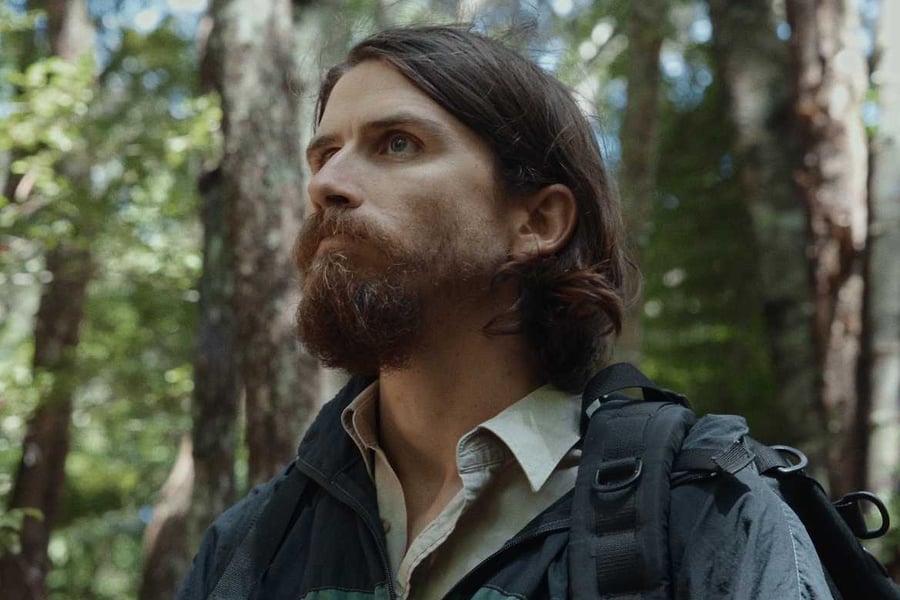
But what’s really going on out there? Akin to a Kiwi Blair Witch Project, a new found-footage mockumentary film, In Search of My Moehau, expertly plays on our fear of the unknown.
It’s the work of Kieran Charnock and Jonathan Watt, who co-wrote and co-directed the film. The pair have been friends since high school, so making a film like this together — let alone one that’s playing at New Zealand International Film Festival 2026 — was a dream come true.
“We’ve known each other for so long — too long, some may say. We know each other so well that we kinda know what each other’s thinking. Also, I think we have different strengths and weaknesses that balance out our work,” Charnock tells me.
Here’s In Search of My Moehau‘s intriguing premise: the main character, Morris Fubbins, ventures deep into the bush in search of his missing father, who he believes was kidnapped by a mythical creature. The film is framed as the final project of documentarian Werner Altmaier, as he follows Morris’ obsessive quest to find the “Moehau.” The ‘documentarian’ encounters a man battling his thoughts, isolated in nature, turning into a self-mythologising adventurer.
Love Music?
Get your daily dose of everything happening in Australian/New Zealand music and globally.

In Search of My Moehau is the type of offbeat, wholly idiosyncratic film that Kiwis seem to do so well. Just like The Ungrateful Tenant, The Weed Eaters, and so many other contemporary works, it strikes a deft balance between creeping unease and dark comedy, not always easy genres to merge.
“I honestly think the tone of the film evolved over the course of the filmmaking process, and we ended up with something we weren’t expecting by the end of it (but not in a bad way),” Watt reveals.
Another way in which In Search of My Moehau is distinctly Kiwi: it couldn’t have been a more DIY production. “I hope that viewers are inspired to see what can be done in just a week of shooting in the bush with $2,000 and a few eager friends!” Watt says.
Charnock and Watt, accompanied by their excellent cast, didn’t mind carrying their gear and food all the way into the bush and back every day of filming. Why didn’t they mind undertaking this time-consuming and presumably back-breaking chore? Because it meant they got to make a film with their friends, a film they’re rightly immensely proud of.
I spoke with both filmmakers to find out more about the project’s origins, their appreciation of the mockumentary format, the difficulty of finding funding in New Zealand, and much more. Read our full conversation below.
Find out more about In Search of My Moehau here.
Rolling Stone AU/NZ: Was it always your plan to use the mockumentary format for the film?
Kieran: Jonathan and I have always been drawn to the fictional documentary format. Some of the first projects we filmed were pilots for mockumentary series. The format wholly supports our aim to capture unfiltered life. The intention is always to observe human behaviour, rather than direct an acting performance.
In particular, we’re interested in exploring mockumentary through a dramatic lens, as opposed to the comedic lens that is often the case with mockumentaries these days. We have plans to keep pushing the boundaries in that direction. I think a part of me is interested in trying to convince the world that the characters I made up in my head are real people, and the film I wrote actually happened. I don’t know why I’m trying to do that, but I know that I’ve always been interested in what’s the most authentic.
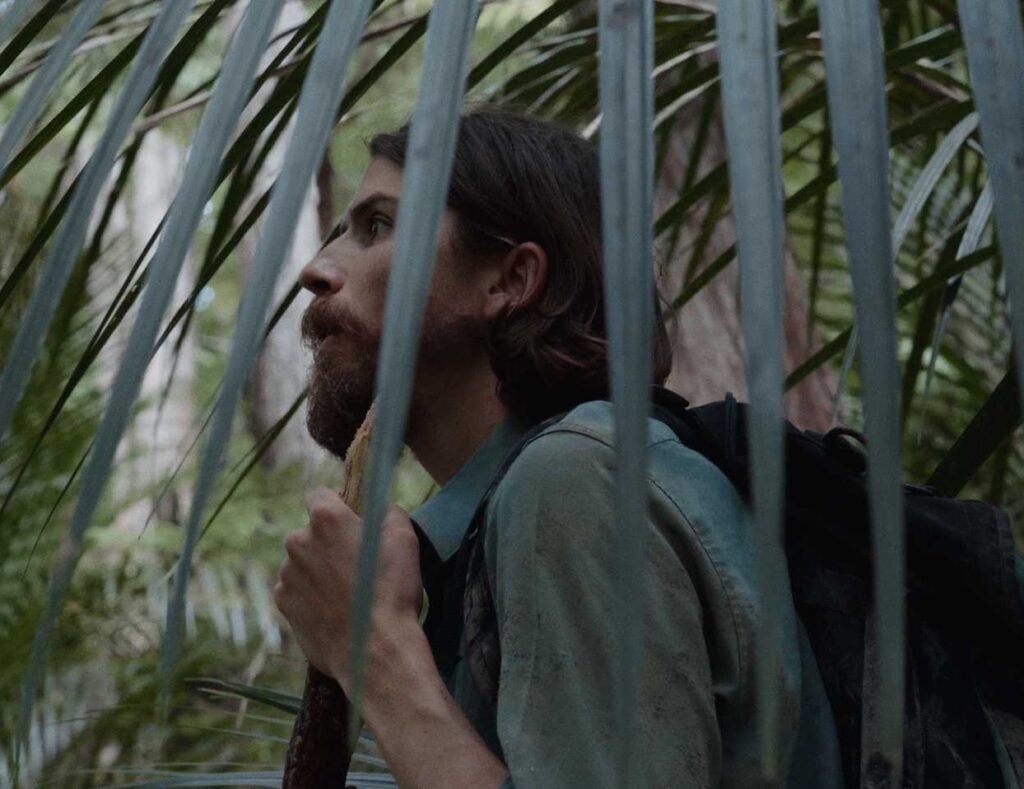
Credit: Supplied
As an actor, I would often immerse myself in character throughout filming. I think I didn’t want the ‘playtime’ to end. I didn’t want the imagination to be over. I think that’s what I’m hoping to do with the fictional documentary genre — I want to blur the lines between what’s real and what’s not, what happened for real, and what was just pretend.
Jonathan: Yes — we grew up on watching mockumentaries such as This Is Spinal Tap, The Office (UK), and found-footage films such as The Blair Witch Project and Paranormal Activity. We have always loved mockumentaries and have made a lot of them in the past as they are far cheaper to make convincingly than traditional films. We also love the ‘reality’ that they can capture — particularly in performances. Something we have always been interested in making was a ‘dramatic mockumentary’ — and this is what we might have done with In Search of My Moehau, which, at its heart, is a tragicomedy.
Kieran: I think I only re-watched one film in the lead up to making this one: Kenny by Clayton Jacobson. I’m a huge fan of that film. It’s one of the biggest inspirations I can think of for the way I’m trying to make films.
Jonathan: I can’t say I rewatched anything specifically before the shoot but I do regularly rewatch The Office — both UK and US. They are both great.
Kieran: We met in the first year of high school, we were 13. My recollection is that we were both interested in drama and creative writing. It was pretty quick after meeting that we started making films about ‘Don Ramiro’, a Spanish assassin, and lip-sync music videos for West Side Story. We filmed short films together on my miniDV camcorder every weekend we could. Back then, we were both hugely inspired by Robert Rodriguez’s El Mariachi and Desperado.
Jonathan: We met at Rathkeale College in third form. We both loved films and filmmaking and soon were spending most weekends and school holidays together making short films with fake $2 shop guns. A huge inspirtiation for us with Robert Rodriguez and the fact that he made El Mariachi for only $7,000. We have been making films together ever since.
Kieran: We’ve known each other for so long — too long, some may say. We know each other so well that we kinda know what each other’s thinking. Also, I think we have different strengths and weaknesses that balance out our work. I’m good at creating a chaotic set to capture spontaneity and unfiltered emotion, and Jonathan’s great at making sure we don’t go too far off track!
Jonathan’s a great writer and he’s always got the throughline of the story in his mind, which is helpful, because it means our story is coherent to an audience at the end of our work. He’s also great at making sure we push through with our process when doubts creep in (as they always do). I would have pulled out of making this film a few times if it wasn’t for his commitment and encouragement.
Also, there’s no way I would enjoy filmmaking as much if I wasn’t making films with Jonathan, and other great friends. I always try to keep in mind the well-known but often forgotten wisdom: it’s not about the money, it’s not about the prestige, it’s about relationships. I think that’s what matters at the end of the day. So, if there’s a chance to work with my friends on a film shoot — I’m going to do all I can to make that happen.
Jonathan: I think we both complement each other in our strengths and weaknesses. Kieran is definitely more technically minded than me, and also better at working with actors, as he is an actor himself. I think I always have the story front of mind, as well as the big picture ‘finished film’ playing in my head — so I’m always thinking back to the script or forward to the edit to make sure we’re on track with the story. I’m also sure that I would have given up on filmmaking a long, long time ago if it weren’t for Kieran — I really value our friendship and shared passion for films and filmmaking. It has been so good to have someone else to work with — to share in the many failures, but also the small successes.
Kieran: Really interesting question. That’s something I’m still learning. I wouldn’t consider myself a film buff. I don’t actually watch many films these days (maybe one every couple of months). When I’m shooting a film I’m just trying to create or find the atmosphere I had in my imagination when I was daydreaming it. And then when I’m editing the film, I’m purely going off an instinct of what feels real to the character, what feels ‘unstaged’, and quite crucially, what feels interesting to me. I’m not thinking about other films and how they do things. I’m just going with my instinct. I’d rather fail following my intuition than succeed trying to copy what someone else has done.
I think tone really comes through in the editing process. We used improvisation for all the dialogue in the film, and whenever we shot the same scene more than once, we never repeated what we’d done before. That meant that in the editing, I had this treasure trove of moments to go through. I’m a big fan of Derek Cianfrance’s films, and one thing he says is that he often views his actors like wild animals in a nature documentary. I feel that’s exactly the atmosphere I’m trying to create through my filmmaking.
Jonathan: I honestly think the tone of the film evolved over the course of the filmmaking process, and we ended up with something we weren’t expecting by the end of it (but not in a bad way). The script was far more comedic than what we ended up shooting, what we ended up shooting was still more comedic than the final film, and what we have now is definitely far more dramatic than what we expected, with only a few comedic moments here and there. I’ll come back to the word ‘tragicomedy’ — as I think this is where we have landed in terms of tone. At the end of the day, what we wanted more than anything else was a film that felt real — so hopefully we have achieved that.
Kieran: It brought a certain magic to the whole shoot. I think getting lost in the middle of a wild and unruly rainforest was conducive to the wild and unruly atmosphere we were trying to capture for the film.
Jonathan: A lot of fun! But also quite hectic and stressful. There were a couple of days where we thought we wouldn’t be able to shoot at all due to the weather, but luckily it worked out in the end. It was also a lot [of] lugging all our gear and food and water etc. into the bush and back every day. I remember one day when the aerial fell off one of the wireless mic receivers somewhere in the middle of the bush, we thought it was all over, but we retraced our steps and by some miracle Kieran found it. We were very worried because at that stage we really couldn’t afford to replace it! We had wanted to shoot a film in the bush for a long time, so it was something that overall we really enjoyed. It is also a cheap place to shoot on a budget — and still looks great.
Kieran: The majority of music came from an incredible Eastern European artist who we’ve never met. They go under the name ‘Kabbalistic Village’, and we found their music through a site called envato.com. If you’re a musician and enjoyed our film, please do get in touch, as we’re always looking for like-minded collaborators.
Jonathan: An incredible independent musician named ‘Kabbalistic Village’ provided the majority of the music. We loved their style and tone.
Kieran: The cast were absolutely incredible. We paid the actors as much as we could, which was just a little more than nothing at all, and I think they gave as much as they would have given if we were paying them millions.
The lead actor, Rama Buisson, didn’t even get paid a cent. He threw himself into the role with everything he had. He threw up over himself and wore those same clothes for three more days, he crawled through a muddy swamp, he fell into a lake, he slept on the floor of my place every night, he chased mythical creatures around the rainforest all day and well into the night. I couldn’t have asked for more commitment from an actor. Nobody could. I can’t wait to work with him again.
It is wholly because of the work of the actors that our film works. If it wasn’t for their all-in commitment to our crazy process, the film would have fallen flat on its face. It would be so easy for them not to have trusted us. We didn’t have a proven-track record. We didn’t have funding. I don’t know why they chose to trust us with their time and energy, I don’t know why they gave everything they had. I’m so grateful they did.
I am an actor myself, and I’ve had the good fortune to act in a number of films. The reason I got into filmmaking was to work with actors. I can’t stand actors not having a job, and everywhere I look, I see the best actors in the world all unemployed. My whole filming process is catered to give the actor maximum freedom, and my process was set-up by all the things I didn’t like on set as an actor.
For instance, I always loathe the 30-minute lighting set-ups, the 2-takes and then we’re done, the specificity of saying lines written down in an office, by someone far removed from the set and the other actors. I remember once I was acting in a WW1 TV show. The writer came to the set. In the shot I was to be thrown to the ground by the blast of a grenade. We did the shot, and I was thrown to the ground with the help of practical effects and the stunt team. Members of the battalion gathered round me and I mumbled something incoherently. They called cut on the scene and the writer, from his chair, read to me the exact line I had to say. That was one experience of many that shaped my perspective on filmmaking.
When we’re filming, I like to give actors ultimate freedom — as much as they can handle. I like to give them long, 30-minute takes to live in the world of the character — they don’t have marks to hit with their movement, they don’t have written lines to say, they’re free to navigate their character’s impulses however they are moved to do.
Jonathan: Our whole cast, and especially Rama, the lead actor, were incredible. They really trusted us, which is what you need for a film like this with no money and crazy hours and insane situations cropping up every day. Each actor brought themselves compeltely to the film, and provided some great material through improvisation as well. We owe a huge debt to the whole cast, and really hope that we can work with them again in future in better circumstances!
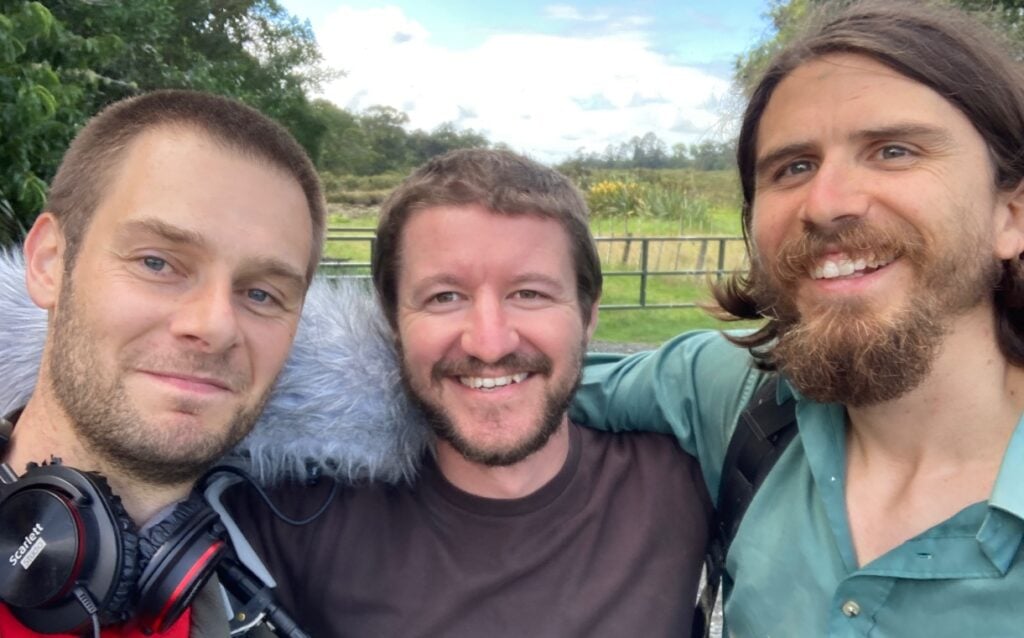
L-R: Jonathan Watt, Kieran Charnock and Rama Buisson Credit: Supplied
Kieran: I really hope that viewers see something a little more unfiltered than what they’re used to seeing in films on Netflix. I hope they feel the aliveness that we’ve managed to capture.
Jonathan: I hope that viewers are inspired to see what can be done in just a week of shooting in the bush with $2,000 and a few eager friends! I hope that young New Zealand filmmakers don’t give up on their dreams just yet (as I have almost done time and time again). Just get out there and make something.
Kieran: Top of the list has to be Florian Habicht. He’s an incredibly curious and playful filmmaker who is always looking to break new ground through his films. His film High Tide was a huge influence on my decision to make this film the way we made it. If you don’t know Florian’s films, I encourage you to go investigate. And thank you, Florian, for inspiring me!
Jonathan: Paul Thomas Anderson is a huge inspiration for me, as are Derek Cianfrance and Ari Aster. I’m also inspired by the greats such as Francis Ford Coppola and Martin Scorsese. I’m a huge fan of Rough House Pictures and their HBO shows such as Vice Principals and Eastbound & Down. I think they really nail the tragicomedy better than anyone. Seven Periods with Mr. Gormsby is probably my favourite thing to come out of New Zealand — as irreverent as it is. It’s another one of those shows that I’m not sure whether I should laugh or cry when the credits roll.
Kieran: I watched a film at the film festival called Smog a few years ago, and it seared itself onto my mind. I’ve never met the filmmaker, but his name is Alex Liu. I read that he recently got funding from MGM (!) to make his first feature film, it’s called God Bless You, Mr Kopu, and it’s coming out soon.
Jonathan: I’m a huge fan of James Napier Robinson and his work, particularly The Dark Horse and Joika. I also loved the Educators TVNZ show.
Kieran: Both Jonathan and I have been applying for funding in New Zealand for the last 15 years and we’ve only ever been successful in getting $10,000 in total. That’s about $750 a year between us. Yay.
To be honest, I’ve decided to channel the effort I was spending applying for funding from the government into making films. The process of just a couple of people each year (usually the same people) getting the funding doesn’t appeal to me. I’d rather they split the money between everyone who’s putting in the hours and that way everyone gets to grow and learn.
Jonathan: Incredibly difficult. I have lost count of the times that I have almost given up, but of course I am glad that I didn’t. I’m sure Kieran would say the same. We have both been working for over 20 years to try and ‘make it’ as filmmakers in New Zealand, and it seems like every single barrier that could possibly have been raised in front of us has been.
We have both had to juggle day jobs and families as well, of course. After spending years trying to get funding and having very little luck, we decided to channel our energy (and our own limited finances) into just making things ourselves. This is how we made In Search of My Moehau, which we funded completely ourselves for $2,000 and is a 100% purely independent film. We are honoured and humbled to have it accepted to the NZIFF 2026.
Kieran: There’s just not enough money to go around. It’s no one’s fault. It is what it is. The bright side is you can make films without money if you feel the need. When it comes down to it, I’d rather be a filmmaker with no money, than a guy looking for money in order to be a filmmaker. But I’m very lucky in that the style of film I really like can be done with no money. I imagine you’d need a fair bit of money if you want to make science-fiction films. But, then again, I chose to believe constraints can breed creativity.
Jonathan: Funding is incredibly difficult to come by. So much so that we had to stop chasing it, realising that if we spent the time and energy we were putting into funding applications into actual films, we would have a lot more to show for it. Of course, we do still hope that we may be able to get funding for future projects after In Search of My Moehau.
Credit: Supplied
Kieran: My instinct is that instead of the NZ Film Commission giving just three filmmakers $3 million each to make a film, I’d rather they give 90 filmmakers $100,000 each to make a film. That way a lot more people get to play and learn, and the same amount of money is dished around the community — it’s just spread out amongst a lot more artists.
Jonathan: I am worried that New Zealand has fallen into a culture of ‘endless development’ — there are always so many projects ‘in development’, but so few actually getting shot and released. New Zealand needs to invest in its emerging filmmaking talent. This country needs to take more risks and look to reward people who just ‘get out there and do it’. No script will ever be perfect, and every script will develop and change during filming and editing — that is just the nature of filmmaking.
What other films have you worked on in recent years?
Kieran: In the last 12 months, I’ve been almost cast in four feature films. However, due to funding, producerial decisions, or narrowly missing out to another actor, none of those parts came to fruition. I think one thing I’m being asked to learn at the moment is the importance of pivoting in a career. Persistence is so valuable and so powerful, but so too is pivoting. If you’re constantly meeting resistance over a number of years, and you’re starting to feel like you’re not getting the chance to contribute to your community, then pivoting can be quite powerful.
I always wanted to be an actor, but I really enjoy the ability to make your own work as a filmmaker. Being an actor for 15 years had started to make me a passive person. I was always waiting for someone to offer me an opportunity, and it froze me, and then it started to kill me. I wanted to contribute so much, I wanted so much to be part of a team. Being shown a window into an exciting world, and then having the curtains shut in my face, time and time again, it’s really worn me down over the years. But, through filmmaking, I’ve been able to shift my passive attitude into an active one. I’m coming alive again now that I feel I have the power in my hands to make things happen.
Jonathan: Aside from doing almost everything on our own films with Kieran — I have worked in crew roles on a few different films. Notably, my first real job in film was on The Hobbit trilogy. I was in the middle of my first year of university and got a call asking if I could be in Miramar at 5am in the morning the next day. Needless to say, I was. I didn’t have a car and there was no public transport at that time of the morning, so I ended up walking an hour to work every morning.
It was 100% worth it, though, and turned into almost a year of work. I also worked at Weta Digital as a runner for a few years. I also write outside of film and have recently self-published a novel entitled An Eastern Western under a pen name. This came about due to feeling hopeless about that fact that none of our scripts were being funded — with a novel, however, once it’s written it’s done!
Kieran: Jonathan and I have a dozen scripts we’d like to get made one day, but until someone comes knocking, we prefer to just keep active. We have a script for our next feature film mockumentary ready to go. We’re going to shoot it at the end of this year. Our goal is to make three back-to-back feature films and get them into three consecutive NZ film festivals! But I aim to stay focused on the work and not the results. I intend to tend to the garden of filmmaking, and not worry about the fruit. The fruit will come if it comes… like this lovely opportunity to be part of Rolling Stone magazine! What a lovely bit of fruit! Okay… back to the garden now…
Jonathan: Obviously, it would be incredible if In Search of My Moehau opened the door to some funding opportunities for us. If it doesn’t, however, then we will still just keep making films as we have always done. We have countless scripts for both feature films and TV ready to go. Probably my favourite project that we have written is called Unfamiliar. It is a mockumentary about a Wairarapa-based UFO club — The Masterton Extra-Terrestrial Investigation Society. I would love to be able to make this one day!

