



























Find out more about our Māori-language initiative here.
One language doesn’t have to lose for another to live.
Calling English a “bastard language” was always going to dominate the headlines surrounding Green Party MP Tamatha Paul’s recent speech in Parliament. It was provocative, blunt, and designed to challenge.
But it wasn’t the most important thing she said.
Underneath it sat a much older question. Why are so many people threatened by hearing the Indigenous language of this country spoken alongside English?
Recently, legislation passed recognising English as an official language of Aotearoa, joining te reo Māori and New Zealand Sign Language.
In practice, English is the country’s dominant language. It never needed legal protection to survive, but te reo Māori and New Zealand Sign Language did.
Love Music?
Get your daily dose of everything happening in Australian/New Zealand music and globally.

Yet every time te reo appears on a road sign, in a government department, on a passport, or in the media, the same argument resurfaces. That somehow English, or Pākehā culture itself, is under attack. But one culture doesn’t have to diminish another in order to thrive.
Paul pointed to a recent parliamentary delegation to Wales, where Cymraeg appears ahead of English on public signs. “The world didn’t fall over, and the world didn’t end,” she said. “People still knew where they were going.”
View this post on Instagram
Māori have never feared the English language — they embraced it, in fact. The reverse, however, has not always been true.
My koro grew up in the Bay of Plenty speaking te reo Māori as his first language. When his siblings were born, nurses gave them English names like Barry and Greg, writing them onto their birth certificates. His parents didn’t see that as something being taken from them. They saw it as a gift.
In Parliament, Paul reminded the House why te reo Māori has protected status in the first place, “because it was beaten out of Māori, systematically.”
When koro started school, if he ever spoke te reo Māori in class, his teacher would slap his hand with a ruler. Still, he learnt English. He joined the Navy. He built a life. He speaks proudly about every part of that journey, but nothing compares to the look in his eyes when he sings waiata he still remembers from childhood.
My taua’s story is different. She grew up in Ōtepoti, where te reo Māori almost disappeared entirely. She never became a fluent speaker, but she remembers the songs. Even now, as some memories fade, koro only has to start singing before she’s on her feet, swinging her hips, joining in every action she still remembers.
That’s because te reo Māori was never just a written language.
It has always lived through pūrākau. Through karakia. Through whakapapa, and especially through waiata. Music carries memory in ways language alone sometimes cannot.
One of my last memories of my great-grandmother is watching her strum her ukulele while she sang. Her name was Te Koara. She was the granddaughter of Ema Karetai, known for being one of the last fluent Māori women from Ōtākou.
Today, many people once again speak the language here. That isn’t because English disappeared. It’s because te reo survived.
Over the past month, Rolling Stone AU/NZ connected with Māori musicians from across Aotearoa to find out what te reo means to them. Again and again they described something English simply couldn’t express.
SUB-TRIBE said there are “certain emotions and ideas that just carry more depth in te reo Māori,” explaining that singing in the language feels “less like I’m performing and more like I’m honouring something that’s always been there.”
Multimedia artist Tipare described using English as “walking a tightrope,” while she felt te reo Māori is “he reo whakatau” — a language of peace — where she feels safe. Rā Toia Booth of Ra Charmian mentioned single kupu carrying layers of meaning that take entire sentences to explain in English.
Huia Hamon perhaps said it best: writing in te reo Māori, she told us, isn’t writing about emotion, it’s writing in emotion.
What stood out amongst all the conversations wasn’t a desire to choose one language over another. It was the freedom to express themselves through the language that felt most true to who they are.
That’s why the debate has always missed the point. Te reo Māori doesn’t threaten English. It enriches Aotearoa. As Māori, we look back not to live in the past, but to carry the best of it into the future.
For generations, te reo Māori was deliberately pushed to the margins. Decades of revitalisation slowly brought it back into everyday life. It was reclaiming the place it had always belonged. Yet even now, that place continues to be challenged.
The question is not whether te reo Māori deserves space. The question is why, after everything it has survived, some people still believe there’s only room for one language in the country we all now call home.
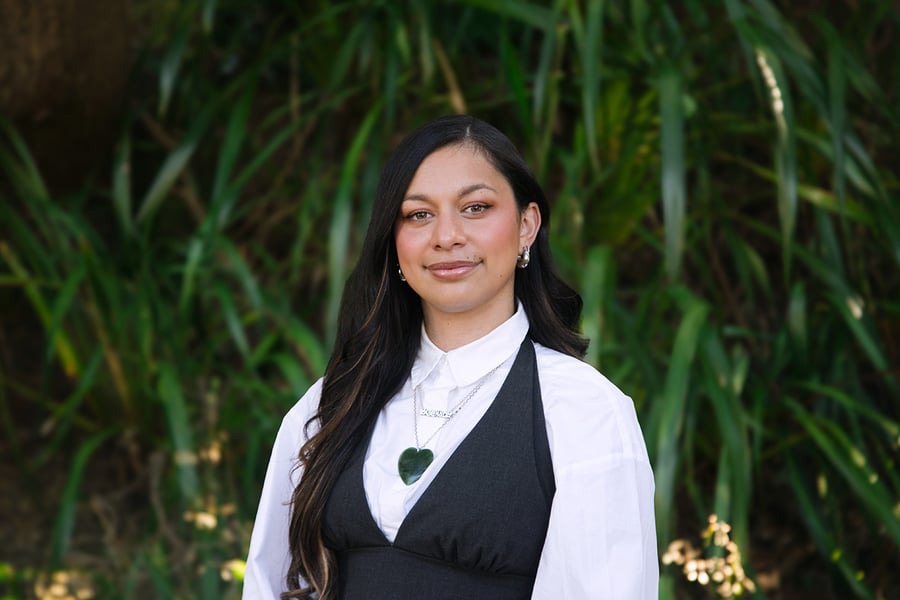
Ani Ngawhika (Kāi Tahu, Ngāti Whakahemo) is a journalist, musician, and storyteller from Ōtepoti, whose mahi centres on te ao Māori.

