




























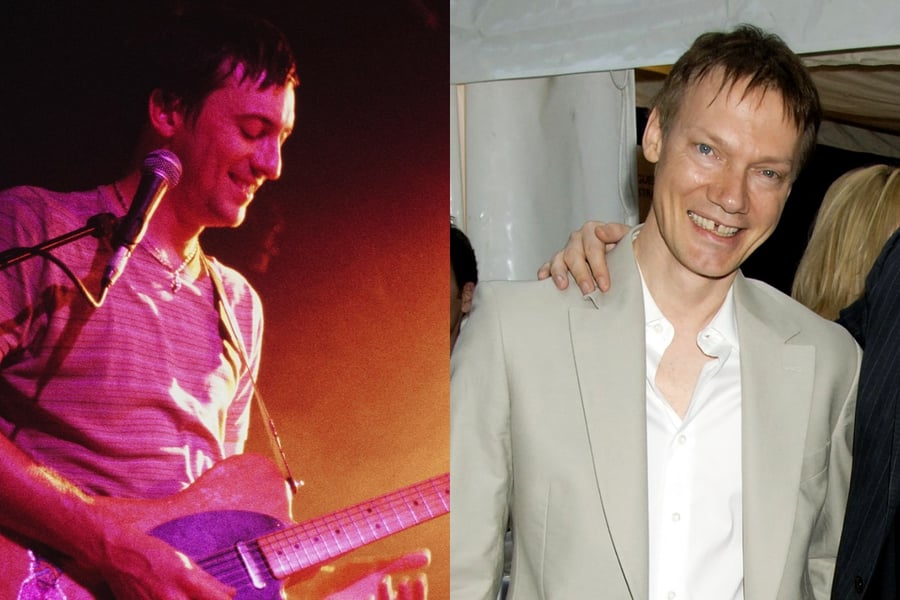
The news last week that producer William Orbit had died at age 69 sent people back to revisit one of the most remarkable catalogs in Nineties pop. Along with Madonna’s “Ray of Light,” Orbit’s greatest achievement in the studio might have been producing Blur’s “13,” the sprawling, experimental 1999 album on which the British rock band exploded everything they were known for at that time, incorporating new electronic and noise influences.
Blur first encountered Orbit when he contributed an eight-minute reimagining of their 1997 song “Movin’ On” to a remix project. “We really liked what he did,” recalls Blur guitarist Graham Coxon. “I picked up on some sort of perversion in him musically, and I thought, ‘This will be interesting.’”
Singer Damon Albarn, bassist Alex James, drummer Dave Rowntree, and Coxon spent the summer and fall of 1998 working with Orbit at studios in London and Reykjavík, Iceland. It was their first time pairing with a producer other than Stephen Street, who had helmed the band’s first five LPs, and the collaboration yielded a mesmerizing and intense new sound. “13” won rave reviews and spun off two of Blur’s best-loved hits in “Tender” and “Coffee & TV.” It was also the last Blur album to include Coxon as a full-time member until 2015’s “The Magic Whip.”
Coxon called from the instrument-filled room in London’s Muswell Hill region where he and Rose Elinor Dougall make music as the Waeve to share his memories of working with the producer he calls a “genius.” This interview has been lightly edited and condensed for clarity and ease of reading.
I instantly liked William. He was a very elfin-looking guy. He wouldn’t have looked out of place in the Moomins — if he had a big green felt hat on, he’d look like Snufkin. And he had this very intense look, but his mouth would ripple into this strange, beautiful grin every now and then. I think he found all of us quite funny. Instantly, I could tell that he was up for approaching sound in any kind of weird way. He really liked heavy sounds, whether that was coming from a guitar or some sort of synth. Sound excited him. We got the measure of him that it was going to be anarchy. We thought he was this genius who was a bit tinged by madness — but, well, that’s what genius does.
We knew the songs loosely when we went in. We’d have the chords or the riffs, and then for 40 minutes we’d just improvise. We went until the end, until there was absolutely nothing left in us, no more ideas, and the jam would collapse. We’d record all day, and then he’d stay up all night organizing it all. William would structure the songs — he would get the good bits out and bring them down to a more palatable length — and the next day, he’d go, “Oh, this is what I did with that.” It was amazing. The next day, you don’t really remember anything that you’ve done in the heat of battle, so to speak. It was like listening to songs that magically appeared.
He was very courageous with sound, and that’s what I liked about him. Nothing would scare him, and I tried a lot. He was unshakeable, really. You couldn’t rattle him with sound. He’d completely embrace it and use whatever you’ve done in the most intelligent and brilliant way. “Bugman” was totally nuts. He’d make the dirtiest of my guitar sounds even dirtier. If a guitar is that fast and it’s in tune, it’s not that far away from synthesizers, really — it’s just a filthy sound. I think he liked the chaos.
Love Music?
Get your daily dose of everything happening in Australian/New Zealand music and globally.

With “Battle,” I remember I got into the studio early and finished off the mixing with William. On the second or third chorus, when the big guitar comes in, it was just heavenly to me. With “1992,” I did the same thing, I got in earlier than everybody else. I was so excited. There’s this little harmonic, this note that came up in the guitar. I said, “Can we grab that and put some reverb on it?” And he put it through a plate, and it was the funniest thing. He’s wrestling with this big desk, turning these knobs up. That little note turned into this absolute cacophonous thunderstorm, all from that one note on the guitar. I remember his eyes really wide and laughing his head off, and me laughing my head off as well at the sound he was managing to get out of it. He was playing the desk like some huge musical instrument. And the results are just incredible. It’s one of my favorite things that Blur ever did.
“Coffee & TV” was a song where we had a rough chord sequence, and Damon might’ve had a little bit of a melody. I said, “Well, I’ll tell you what, I’ll go out tonight and I’ll write some lyrics and I’ll come back.” He says, “Well, if you write lyrics, then you’re going to sing it.” So I wrote the lyrics that night and came back. I had a couple of tries on the vocals. Finally got the vocal kind of right. There was an instrumental section after the second chorus. I was like, “I’ll stick something in there. That’s my bit.” And I grabbed a guitar and hit it. I was bending down to my pedal board and hitting buttons. I wasn’t really looking at the guitar, I was just bending notes, and then looking down at my fingers again, and then clicking other pedals. Later on, mixing it, I was like, “Bloody hell, that solo’s great.” It was completely abstract expressionist. William got that solo, which really is one of my favorite guitar solos ever, and it was done off the cuff.
Madonna dropped in when we were recording. I was in the live room doing some silly guitars, knocking around, and then I looked through into the control room and Madonna was standing in there. I was like, “Oh, shit. Do I stay here or do I get the courage to go and say hi?” We all said hi. And I remember at some point during the sessions for 13, we had a go at doing something over a beat that William had put together. I remember really, really liking jamming over it, but we didn’t get anywhere with it. And then later on that same year, Madonna came out with “Beautiful Stranger.” I’m like, “Oh, that’s that track!”
There were lots of laughs with William. There was a lot of grinning. He would always make us feel good about what we’d done, and that was enough, really. By the late Nineties, we were all completely burned out. I was probably drinking quite a lot. But what was so good about recording with William is that it was so loose. You could get an awful lot out of your system during those improvisations. It was just like therapy. It was amazing, really, for me to be let loose, not told to turn down, not told to tune up, not told there’s too much distortion.
We’d bump into him after that, but he was so in demand. It was a real shock the other day when I heard. We’re all getting on now, but I had no idea that he was that age. I always thought he was our age. His enthusiasm and his energy for making music were insane. Rose and I are mixing the next Waeve album now, and I’m doing a few gigs later on in the wintertime. Who knows? We may even do a William Orbit-related Blur song.
From Rolling Stone US

