




























Find out more about our Māori-language initiative here.
An artist working with Sunreturn is usually a guarantee of quality — Cindy, Babe Martin, Amamelia, and many more great acts have released via the Tāmaki Makaurau-based indie label — and so it proved to be the case again with Junny.
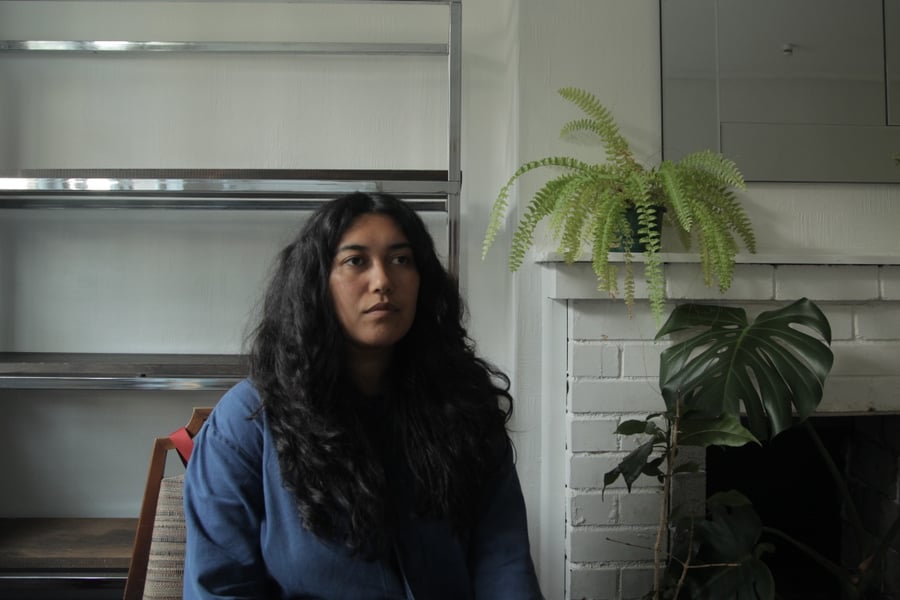
Junny is the musical project of Jenn Tamati, a singer-songwriter working out of Whangārei.
She released her impressive debut EP, Kumara Suite, in June, working closely with frequent collaborator Amamelia (who featured in our mid-year New Zealand albums list last week) to craft the sonically diverse collection.
“I’m excited and relieved to have ‘Kumara Suite’ out in the world,” Tamati says. “It needed to be released. I found myself every now and then wanting to change something or execute something differently but that’s just me developing and changing and it’s better actually if I apply that to new projects. Let this one be what it is and say what it says.”
Tamati adds that Amamelia — aka Amelia Berry — was the ideal collaborator in finding the right sound for the EP.
“Amelia really understood what I was trying to reference and then she was incredible at naming and sourcing these production sounds. We share a sense of humour with art and a love for working creatively with things that are often considered ‘bad’ – in this case outdated sounds that had saturated commercial music of that era. Amelia really helped play with these ideas creatively and push them without tipping over into full pastiche.”
Love Music?
Get your daily dose of everything happening in Australian/New Zealand music and globally.

The EP’s title track and “OOTD”, another highlight, fared well as singles earlier this year, earning support from Aotearoa’s student radio network.
It’s still early days for Junny — Tamati’s debut performance only came in April alongside LEAO and Hun Lynch — but the mellow and lo-fi Kumara Suite is the perfect showcase for the project.
We caught up with the up-and-coming talent to discuss her favourite waiata, her Māori identity, her te reo journey, and more.
Follow Junny’s music here and here.
Rolling Stone AU/NZ As we look ahead to a new year in the Maramataka, tell us how you’ve been going and what’s ahead for you?
Junny: I am settled and grateful and looking forward to continuing to be 🙂
This year’s Matariki theme is all about encouraging all people to celebrate Matariki together. How are you marking the occasion this year?
Watching the star rising with my dad and partner at dawn (a different star, Puanga, is important and more easily viewed in Te Tai Tokerau), then kai with whānau in the evening.
Where are you from in Aotearoa?
He uri ahau nō Ngāpuhi, Ngāti Pikiao, me Ngāti Tūwharetoa hoki.
I currently live in Whangārei.
View this post on Instagram
How would you describe the space you’re in creatively at the moment?
Hmmm, restful, recuperative, reflective. Matariki appropriate.
Do you think your Māori identity is something you consciously write about, or has it become impossible to separate from who you are as an artist?
I’d say both. I am unequivocally Māori so that is inseparable from anything I make. But also, as is a common experience with people from colonised cultures, I spend time assessing myself, deciphering what has been fostered or not, valued or not, and I’ll make a deliberate effort to adjust skills/values/practices in all areas of life.
Some emotions seem easier to express in one language than another. Have you found te reo Māori has allowed you to express things you couldn’t quite say in English?
I am yet to attain my reo Māori in a significant way, but I know there are stories, emotions, and concepts I could only articulate with it.
Do you think Māori music is still underrepresented in Aotearoa music? If so, what can be done to change this?
I guess that depends on what we’re centering with that question. Iwi radio stations play mostly reo Māori music. Ngāti Hine FM has an incredible playlist that I’m constantly Shazaming (to no avail). Independent and community radio stations play Māori music. There are reo Māori artists and albums that kura kaupapa kids across Aotearoa know every word to (see: Maisy Rika or groups like Torea who are hugely popular). While ‘mainstream’ media does have a responsibility to offer adequate representation, I would also encourage people to assess [what] is mainstream for them and explore new-to-them channels of music and culture that exist and are thriving in many ways.
What’s your favourite waiata of all time?
Choosing anything as an all-time favourite is difficult! The first waiata that came to mind today is “Taka-wiri-hanga” by Piwai Tuhua and Kimoro Taiepa. It’s about the origin of poi and the connections to the taiao and atua. I have a CD called Te Urunga from 2002 released by Te Hau ora o Te Tai Tokerau and performed by a rōpū of young people from around the region (including the kaitātaki Tane and Wahine of my highschool rōpū at the time). This version is performed with an intricate 3-piece harmony — I used to thrash it to try and learn each part.
And who’s one young Māori artist you think our readers should know about?
I love the Bandcamp releases from Waikirikiri School, a Kura in Gisborne, particularly the track “Waikirikiri Swag”. It was put up in 2017, but I reckon all those kids would still be pretty young. I’m waiting for the day I see a new artists’ release and I can trace them back to this school and these tracks. Big mihis to Matua Rob who is credited with recording and producing the tracks.

