





























This feature is part of a series on New Zealand cinema.
It wasn’t until I left Aotearoa that Hunt for the Wilderpeople really spoke to me.
The first time I watched it, in a packed mall cinema in Auckland, I was sucked in by the action, the humour, the Rhys Darby (at the time front–and–centre in the national consciousness courtesy of the long tail of Flight of the Conchords influence back home) and of course, the crowning of Taika Waititi as New Zealand’s next great filmmaker.
Nevertheless, I left Wilderpeople entertained, but not necessarily as moved as I’d hoped. Wilderpeople, from the moment of inception, was positioned (correctly) as a moment of arrival for New Zealand’s last true auteur — his legend was of course set in stone in his home country, but after Wilderpeople, he was an export headed for grander shores. As an avowed fan of Boy, the fact that Wilderpeople was so sleekly designed, a work of near absolute joyousness and optimism, left me wondering whether Waititi’s darker impulses had been abandoned altogether.
A year later, when I was living in Austin, Texas, my response was different. I discovered the true spirit of Wilderpeople for myself. It was my first time travelling abroad solo, and homesickness was an everyday occurrence. I noted that Wilderpeople was screening at the cinema where I worked, the Alamo Drafthouse. I sat down for a screening and quickly found myself in tears, such was the intensely familiar, New Zealand quality of the film’s images, sensibility and movement.
It was as though the screen had opened a portal to the country I had grown up in, and missed very much. I could practically feel the clean, Kiwi air circulating in the room. Everyone in New Zealand has their favourite Taika, it’s true — but few would disagree that Hunt for the Wilderpeople is the quintessential Taika, an absolute encapsulation of everything that had come before, and more than a bit of what would come after.
I think it’s fair to say, too, that the film was an encapsulation of New Zealand itself — or rather, how we’d like to see ourselves. As Letterboxd user @leeyim put so succinctly: “this isn’t even a work of fiction, New Zealand is really just like that.”
Love Music?
Get your daily dose of everything happening in Australian/New Zealand music and globally.

Across Waititi’s ‘New Zealand years’, which included Boy, Eagle vs Shark, What We Do in the Shadows, Wilderpeople and the short films Tama Tu and Two Cars One Night, Waititi had proven himself extraordinarily adept at finding the universality in the Kiwi specificity — he had a knack for not only how we talk, but the things on which we fixate, the cultural detritus that triggers echoes of a shared, nostalgic past. It was this that I found so moving, watching in a Texan cinema. Hunt for the Wilderpeople is, in a sense, as much of an export as its director was about to be — it is a summation of how New Zealand sees itself, packaged for the world to sample.
Much like Waititi’s other New Zealand films, it serves a dual purpose better than most — it allows us to celebrate ourselves, in all our idiosyncrasy, beauty and weirdness — but it also presents us, proudly, to the world: rugged, goofy, good–natured, self–deprecating.
New Zealand’s most commercial cinema has long chased this dual purpose — the works that we support the most fervently are the ones turned outward to the world, advertising our scenic beauty, our inimitable sense of humour, our quiet, humble way of life. It’s a sword that cuts both ways. Sometimes, this manifests as self–consciousness, an insistence that we are good enough, that we are worthy of being considered one of the big boys, and so on.
This paradox — work that serves as tourism fodder but also closes the gates, suggesting you wish you could be here, don’t you — can be seen throughout our history, in films like Hugh McDonald’s sweeping 1970s documentary This is New Zealand, which captured alpine landscapes on three synchronised 35mm projectors to present a kind of ‘mega–widescreen‘; but is perhaps no more potent than in Peter Jackson’s Lord of the Rings trilogy, which, though technically not qualifying as a New Zealand film due to its international financing, nevertheless bears the hallmarks of one.
The Fellowship of the Ring, especially, with its student–film DIY attitude, grit and fervour, legitimately transformed New Zealand into an impossible, fantastical space–like Pandora after it, Middle Earth was a place that people longed for, but could never truly attain — that is, unless they came to New Zealand.
Credit: Supplied
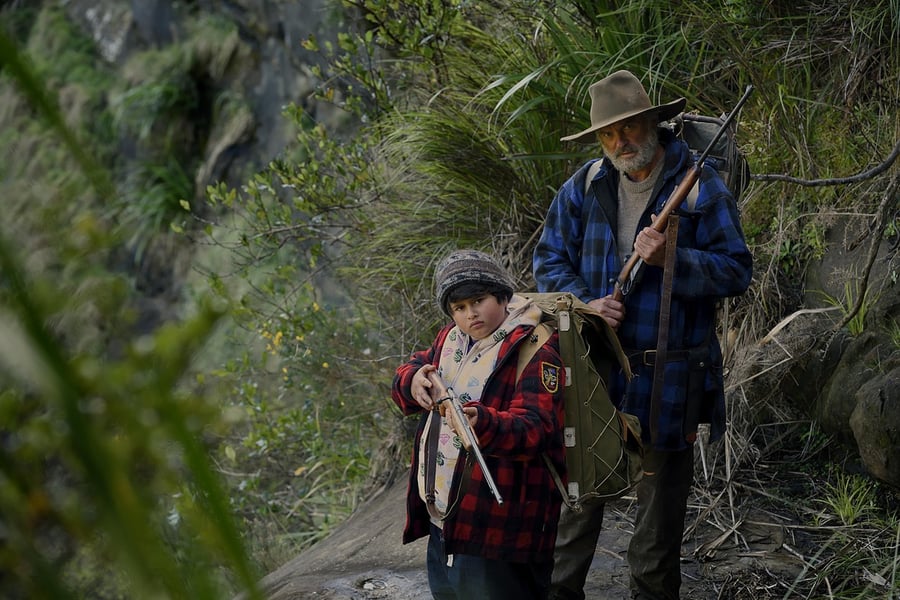
This kind of enticing, daydreamable quality is the space that Wilderpeople enters into, arguably the first time that Waititi really married the commercial sweep of a grand, wild, beautiful Aotearoa with his modern, piquant sensibilities. An adventure film as rich and suggestive as many larger, more expensive blockbusters, its New Zealand is certainly not without its share of darkness — questions of institutional abuse, alcoholism, neglect, colonialism and violence linger on the outskirts of the story, never fully making their presence known — but its heroes are people to admire. Even its antagonists are likeable, in their own way — such is the nature of Waititi’s comic stylings. It trades in a kind of Boys’ Own wish fulfilment, suggesting a world in which even the chubby, self–conscious, innocent and, crucially, Māori teenager Ricky Baker can fulfil the grand Kiwi ideal of the ‘Man Alone’.
Traditionally a white, grizzled, entirely capable male, the Man Alone was the platonic ideal of the colonising Pākehā discovering self–actualisation amidst New Zealand’s rugged landscape. First laid out by Samuel Butler’s 1872 novel Erewhon, it can be seen in the writing of Owen Marshall, James K Baxter, and in films like Smash Palace, Utu, Vigil, and so on.
In the 2000s and 2010s, this trope faced intense, prolonged interrogation — in Robert Sarkies‘ Out of the Blue, it is the man alone who unleashes terrible harm on the community around him; in In My Father’s Den and Stray, it is the quest for isolation that bars either film’s central protagonist from genuine healing; in Coming Home in the Dark, the man alone is rendered monstrous, an obscenity forged by New Zealand’s colonial history and retreating back into it. In Waititi’s own Eagle vs Shark, Jemaine Clement’s Jarrod is totally won over by the concept, but finds himself unable to live up to the image. Said Brenda Allen of Waititi’s debut feature: “Local audiences, if they choose, may enjoy jokes against themselves while perceiving colonialism and the European centre from which it came as the real butt of their alternative readings of the jokes. The message then becomes: ‘We, down under, give you the finger, knowing that you will not notice. We are no longer under your spell.”
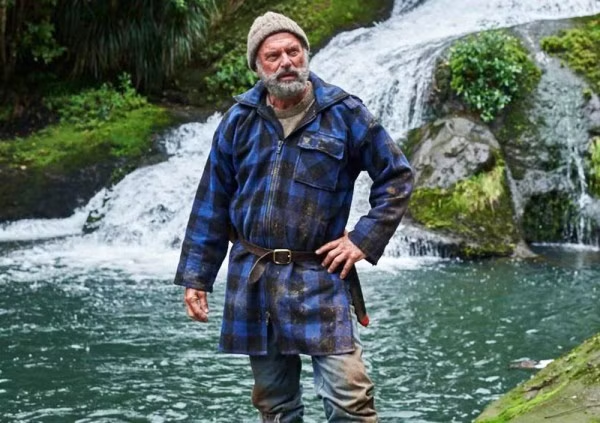
Then there’s Uncle Hec, played by Aotearoa hero Sam Neill, at once a subversion of the Man Alone trope and an earnest ode to the redeeming qualities one might find within it. Neill is no stranger to the notion of colonialism’s influence on our nation’s art — his Cinema of Unease, a documentary exploring the country’s most vivid film movement, the New Zealand Gothic — explores the Man Alone trope at length. It is a kind of homecoming then, that Neill, that onetime Spielbergian hero, the actor who straddled local and international success in a way not seen until, well, Taika Waititi, would once again play a Man Alone himself.
Neill had, for a while until this point, served as something of an Antipodean ambassador, oscillating between international projects like Jurassic Park 3, Wimbledon or The Vow and lending his considerable status to local projects like Australian film The Hunter or Under the Mountain. Neill still had star power, something that Waititi had never really handled in such a way before Wilderpeople, and the director ensures that much of the joy of Wilderpeople is in seeing this great elder statesman of New Zealand cinema headline what was sure to be (and indeed, was) the nation’s biggest ever film.
It is a superb performance, one of gentle gradations of feeling, as the spiky sweetness of Ricky Baker overrides his affinity for solitude. When we first see him, he is Man Alone personified — gun in hand, wild boar slung over his back, wielding a vocabulary of huffs and grunts. His position as such, though, is immediately undercut when the ‘escape‘, such as it is, from child welfare authorities, gets underway. Hec, in a moment of blind rage, makes to strike Ricky, instead trapping and twisting his ankle, leaving him immobilised.
Against Neill’s magnetism, Waititi deployed his ability for discovering new talent, and utilising undervalued local stars in ways they had never been before. Thus, Julian Dennison. The future Ricky Baker was not a stranger to cinema — he had earned a key role in Louis Sutherland and Mark Albiston’s underrated Shopping in the years prior to Wilderpeople, but it was in working with Waititi that Dennison truly found his voice. His Ricky is instantly iconic — the name ‘Ricky Baker‘ alone still carries a strong cultural cache in New Zealand a decade later, with Dennison displaying an uncanny ability for both comedic timing and pathos, conjuring a relationship with Neill’s Hec that is profoundly moving.
Elsewhere, actors make the most of a handful of scenes: future star of major Kiwi films Cousins and The Convert, Tioreore Ngatai–Melbourne, is a luminous presence as Kahu, a source of salvation for Ricky; while local comic legends Rhys Darby, Cohen Holloway, Oscar Kightley and Troy Kingi leave indelible impressions.
Even celebrities of other practices, like popstar Stan Walker and journalist John Campbell fed into the film’s pervasive aura of a big–tent celebration of Kiwiana — a heavily–mustachioed Walker even gets one of the film’s most hilarious lines, interrogating Ricky’s experience in the wild alongside Hec with “He push you in those prickles?”
It is two key supporting roles where Waititi’s knack for casting is most well–highlighted. Rachel House, a dramatic presence in Whale Rider, The Dark Horse and White Lies, is so revelatory as Paula, the self–styled ‘welfare Terminator‘ to Ricky’s Sarah Connor (“the first one, before she could do chin–ups”) that it ensured the actress‘ ability to become a recognisable figure in Hollywood productions — that exquisite down–home rasp a highlight of Pixar’s Soul and as Minecraft‘s Malgosha, among others.
Meanwhile, the national treasure that is Rima Te Wiata appears for only about 15 minutes of Hunt for the Wilderpeople, yet leaves such an outsized presence as to haunt the entire film to come. It is a performance of palpable kindness — her Bella is no simple matriarchal figure, never sacrificing her character’s sharp edges or well–meaning foibles, and embodying the idiosyncratic Kiwi goodness the rest of the film aspires to along the way.
For a film packed with wild boars, car chases, men dressed as bushes, thought–extinct birds, and enormous scenic plateaus, it is Bella’s placement of a humble hot water bottle — a ‘hottie’ — in Ricky’s farmhouse bed that is the film’s most singular, enduring image. In New Zealand’s land of mouldy, uninsulated housing, the hottie is a staple, particularly snuggled at the feet of children’s beds. It carries a potent, uniquely New Zealand strain of nostalgia — it’s what got me crying when I watched Wilderpeople abroad.
For all the film’s many moving parts, what arises most certainly is the notion of Taika Waititi as a supreme cultural force — in a sense, it was a goodbye. No New Zealander who watched Wilderpeople, to this day the most successful New Zealand film of all time, had any doubt that Waititi was no longer just ‘ours’, but the world’s.
View this post on Instagram
Soon after, Waititi would enter into the Marvel Cinematic Universe, wielding his comedic voice to usher in a revitalisation of the Thor property, locating the essential goofiness of the God of Thunder in Thor: Ragnarok. I would argue, though, that few Waititi films after Wilderpeople gave the auteur as much liberation, crafting a story of scale with, seemingly, few masters to be accountable to beyond his own ambitions and inspirations.
Waititi meets this challenge with some of the most assured direction of his career, blending the customary darkness of New Zealand’s wild locales with the visual language of classic adventure cinema. Frequently highlighted is Waititi’s dizzying panorama sequence near the end of the film, the camera whirling around key figures as the seasons change, to the dirge–like sound of a Leonard Cohen tune.
As with What We Do in the Shadows, which made use of the same gravity–defying technology as Inception on a mere fraction of the budget, Waititi’s underrated ambition in the use of story–boosting technological trickery is on full display here.
It is in the film’s elegance of tone, the managing of story threads, the true smoothness with which the story unfolds that most assuredly revealed Waititi’s ability to manage classically wrought, blockbuster–scale cinema, something he would wield to enormous box office success and Academy Awards in the near future. What allows Wilderpeople to endure over almost every other Waititi film, though, is the way it feels so confidently and firmly planted in New Zealand soil, an evocation of the country’s humility, good humour and humanity.
Tom Augustine is an Aotearoa-based filmmaker and writer. Tom is currently Chief Film Critic for Rialto Channel NZ’s VIEW Magazine. Tom is also a regular contributing writer and cultural critic for various national and international publications including Little White Lies, The Spinoff NZ, Metro NZ, The New Zealand Herald, and others.

