




























Find out more about our Māori-language initiative here.
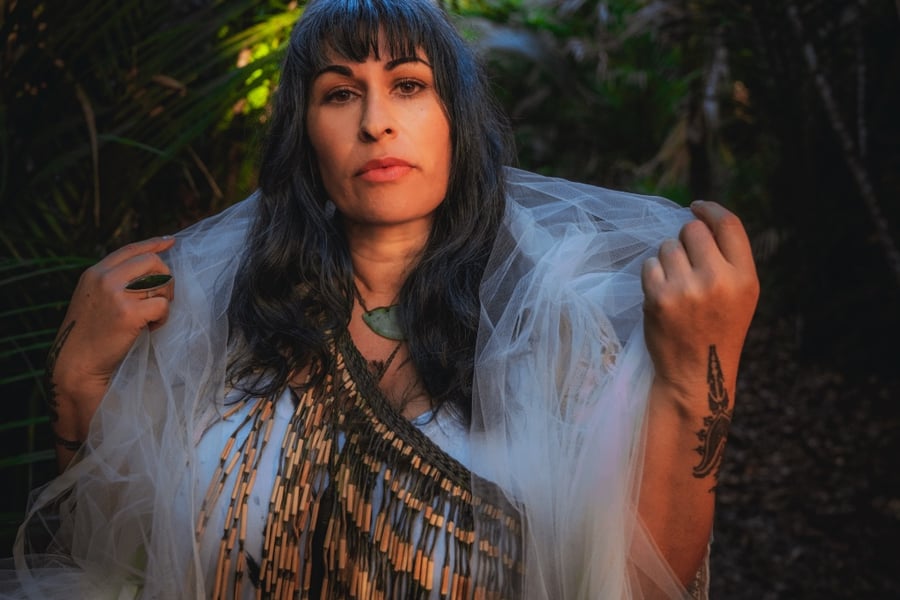
If there’s a job to do in the music industry, Huia Hamon is the person you should ring. Publicist, producer, collaborator, singer, songwriter — she does it all.
Based on the outskirts of Tāmaki Makaurau, where she runs Kog Studio alongside Chris Chetland, she can be heard across a number of great musical projects.
As simply Huia, she’s been remixed by AROHA, linked up with Lady Shaka and Rei, and released last year’s stirring collection of waiata, Kawakawa.
Alongside Chetland (Baitercell), she also forms Pakōpakō, a Māori dancefloor duo recently joined forces with reggae/dancehall vocalist Just2Māori for the electrifying “Do It Like That” (listen below).
What unites Hamon’s projects is an unwavering commitment to showcasing the uniqueness of Māori music, particularly of an electronic-meets-dance variation.
This extends to her work away from music-making, too, whether it be supporting new genre voices as a producer at Kog Studio or running HŪHĀ Music, an online hub that promotes te reo Māori musicians across the world.
Love Music?
Get your daily dose of everything happening in Australian/New Zealand music and globally.

In an in-depth chat, Hamon told us more about her music, her deep connection to Matariki, her views on the Aotearoa music industry, and more.
Follow Huia Hamon’s music here and here.
Rolling Stone AU/NZ: As we look ahead to a new year in the Maramataka, tell us how you’ve been going and what’s ahead for you?
Huia Hamon: I literally have Matariki tamoko’d on my chest as my guide for the year! So many plans seem to be emerging at this time of year. As we work on a global timeframe, our friends’ tours head into summer, and we tend to turn inward and work on emerging ideas.
For me personally, it’s always been so coincidental with a lot of music and art releases, new, surprising opportunities like the Ponsonby Matariki activations. Without even timing it for Matariki, we did a Matariki gig, three with Rei, released two waiata, “Korikori” and “Rangimārie, Peace” AROHA remix. It’s cold out but the creative ahi/fire is burning within!
Where are you from in Aotearoa?
I’m from Pohoe Valley, Waiomu, up the Coromandel Coast, but living in Tāmaki Makaurau on the other side of the harbour.
How would you describe the space you’re in creatively at the moment?
I’m planting seeds at the moment, planning and brewing, making Matakite dreams. Thinking of the future and what I can do now to make things better and create more international trade paths for waiata Māori. We’re also finishing some waiata that have been sitting for a while in different language collaborations, ready to release, and planning international music residencies here in Aotearoa with Turtle Island (Canada), Cymru (Wales), Sapmi (Norway), and First Nation from Ahitereiria (Australia).
Do you think your Māori identity is something you consciously write about, or has it become impossible to separate from who you are as an artist?
Being here in Aotearoa as Māori with whakapapa that is connected to the land is a privilege, as I see many of our people around the world grappling with their identity as Māori and craving that connection to Aotearoa. I really notice when I travel to other countries, how it keeps me grounded and confident in myself and proud to be Māori and many other whakapapa lines, which express when I am in another origin land (such as Portugal).
Some emotions seem easier to express in one language than another. Have you found te reo Māori has allowed you to express things you couldn’t quite say in English?
Writing in te reo is not the same as writing in English! The ability to write in ahua and haere, emotion and movement, not about emotion and about movement, is the difference. When I first started singing in te reo with my limited reo (it’s still the journey), I was singing but not quite understanding, but now I listen back, and I can really see the journey. Whakamua! I feel so grateful to be on my waiata Māori journey, as my nana was fluent and she was my first teacher.
View this post on Instagram
Do you think Māori music is still underrepresented in Aotearoa music? If so, what can be done to change this?
Māori language in general is still not seen as the taonga it is. Our country is still full of generational racism, the ‘Indigenous Pākehā’ complex, and monglot preferences. However, te reo Māori was here first and will always be the reo and expression of Aotearoa.
The waiata Māori we write in the electronica, dance Hiko music realm is unrepresented and unsupported. Aotearoa has major bias and preferential attachment issues, and the perception of what ‘Māori music’ is (which to me, means it has te reo Māori in it) has been embedded through this bias.
We can change this by fixing our judging systems, looking at the data and futurisms, connecting with our Indigenous allies (HūHĀ Music is doing this) and realising the truth that te reo Māori music is many genres and an international standard and worthy of major support.
We have excellent Māori music without the support — imagine if it had the tuatoko it needs?
What’s your favourite waiata of all time?
My favourite Waiata Māori is — “E Tae” by Ruia, Hawaiki (the whole album, actually). Ruia Aperahama was first my waiata Māori Mātanga reo and supported the style I wanted to do as a 26 year old.
And who’s one young Māori artist you think our readers should know about?
There are so many… but I think you should be on the waka for Te KuraHuia, Thee Bad Mana Wāhine.
They can kanikani, sing in many languages, act, hula, poi, rap, and are ātaahua too… Kia kaha, kia māia!

