





























Musicians have always worked day jobs and side hustles to fund their art, and as Australia and New Zealand continue to battle a cost-of-living crisis, the need to do so grows greater.
In Making Music, Making Ends Meet, Rolling Stone AU/NZ meets different musicians to discuss their life away from music, how they sustain their careers, and what they think needs to be done to improve our music industry.
Through a mixture of op-eds, interviews, videos, and more, our new series captures their experiences, both good and bad, as well as their hopes and fears for the future.
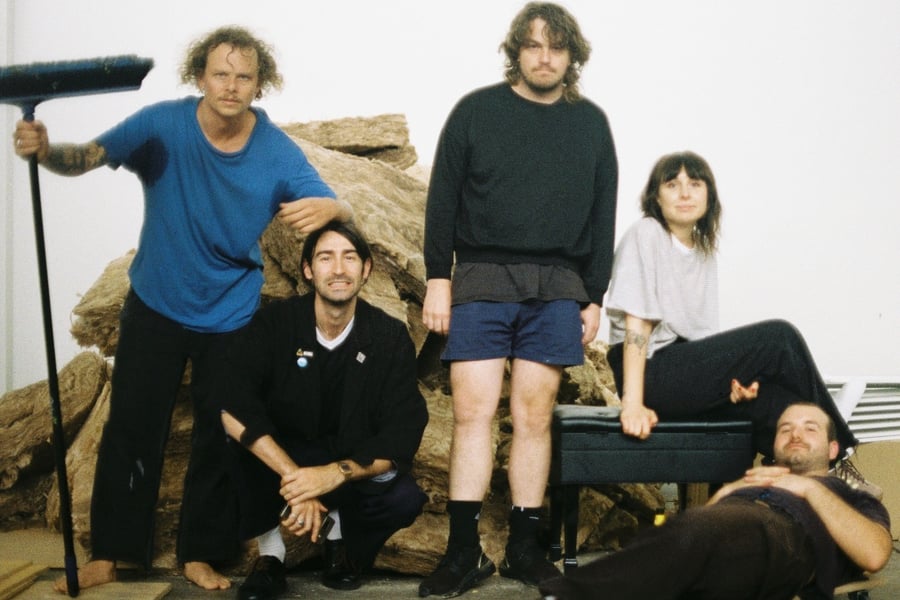
Next up is Marthouse Records founder Dougal Shaw, who is preparing for ‘Odd Ball 3’, a final party for his DIY label as it goes on an indefinite hiatus.
We caught up with Shaw to discuss 10 years of Marthouse Records, the ups and downs of running an independent label, how he balances work and music, and much more.
Ticket information for ‘Odd Ball 3: Marthouse Forever’ can be found here.
Rolling Stone AU/NZ: Can you remember your earliest job?
Love Music?
Get your daily dose of everything happening in Australian/New Zealand music and globally.

Dougal Shaw: Swinno’s Spuds. I was 13, worked every Thursday night in a baked potato trailer that was shaped like a steam train. They would pull it up in the car park of a tyre shop in Rockhampton. After we dropped the trailer back to Swinno’s place he gave me a lift home on his Harley.
Have you had a favourite job?
Being Artist.
Years ago my brother and I were speaking about being an artist and how you just have to commit at some point. You spend your life developing all these skills, things you love doing, but you’re conditioned to think of them as hobbies and not a ‘real job’.
The next day I quit my job putting up posters and decided I was Artist — that I would just do whatever I had to do to make rent that month. Music, tattoos, posters, merch, album art, graphic design, music videos. That was over 10 years ago and now I’m world champion number 1 artist.
View this post on Instagram
Has the balancing act between music and work gotten easier or harder over the years?
In a way it starts to become one and the same. It’s just [about] getting better at figuring out what’s the priority today. The thing about music is you’re somewhat of a time traveller, you spend a fair bit of time in the future. You’re doing the work now booking a tour that’s 11 months away.
The tour is the deadline for the album rollout that needs to start three months prior. The album rollout is the deadline for the music videos you’re dreaming up. You have a three-month window between tours, so maybe you can smash out a bunch of tattoo or design work, buy yourself another two months off for the album tour. The trick is being present and putting all your juice into the thing you’re doing today.
Do you think there’s a taboo in the music industry about working part-time jobs to fund one’s career?
I wouldn’t think so. Most musicians I know have part or full time jobs. I did for a long time while I was training to be world champion number 1 artist. I was a telemarketer on the Gold Coast which bought me a ticket to go live and play guitar in Canada for a year; I was a dishy in Northern Rivers which bought me a ticket to go live and play guitar in the UK and Europe for a year; I did 4am starts slinging fruit at Vic Market so that I could go to uni and learn sound production; I put up posters while running a DIY space. Working-class artists be working.
Tell us about the economics behind your most recent tour. Was it self-funded?
[It] was self-funded. Last year we toured Oz twice and did a month in Europe/UK. [It] was actually our first international tour where we came back in the green. I guess that funded our Oz run in Feb. The kitty fluctuates, but it feels like the more we’re active the more we’re able to stay active — so I guess the scales are ever so slightly in our favour.
How thin are the monetary margins when it comes to something like a national tour?
Couldn’t be much thinner. [On] the Feb run, we sold out most shows and only just broke even. We used to do it a bit cheaper — crash on floors, do the long drives — but we’ve done 20 Oz runs now. There’s only so many times you can call in favours and the transport is a catch-22: if you drive the band saves on flights, but everyone loses an extra few days on the highway and misses out on work. It’s not like a Euro run where you can do 30 shows in a month, drive three hours up the road and go again. You can only really play weekends here so you’re lucky to do eight shows in a month. It’s cooked — would recommend.
Do you worry that independent musicians are going to be priced out of touring in the near future?
People will always find a way. The creative spirit persists. The human urge for connection, community, and counterculture perseveres. I believe it.
What can the government do better to support artists and musicians?
Some rock solid AI legislation for a start. The pricks are ripping us all off and selling us back cheap knock-offs. Ban Suno, ban Spotify, Ban AI music on Australian radio. Ban use of AI in music compositions and art in general. Harsh penalties for ticketing companies price gouging and adding ridiculous, unnecessary fees and driving up ticket prices. Subsidise flights and accommodation for artists. Get pokies out of pubs. Legislate Australian independent artist quotas for tech, ticketing, and touring companies so that people leeching off all our hard work and community building have to reinvest.
Non-competitive grants — if you tick the boxes and spend a month getting together all the required information, support letters, and documentation, you get the funding. Publicly fund and nationalise one of the community radio stations so we have a national broadcaster that platforms and more closely reflects actual music communities and artists who are putting in the work outside of the industry framework.
I got ideas for days, let’s fuckin’ goooo.
Tell us about ‘Odd Ball 3’. What can people expect from the event?
Just a big party. The Odd Ball concept has always been about not taking yourself too seriously. It’s a winter ball, but it’s all a bit cooked. People in ball gowns and fancy suits, other people in gorilla suits, leather, double denim, probably an elvis impersonator, a clown, a horse.
We always hire a photobooth for the red carpet entrance and you get a strip with your pals to put on your fridge, free pics for all. We do some recordgiveaways and shit. This year is all Marthouse, a big final send-off for the label, so all the active bands on the label are playing or DJ’ing. Launching a couple of final surprise records. Slinging rare merch and test-presses. Everything must go! Everyone must go! Ending the label on a high and using the opportunity to bring everyone together from the past decade.
What was the initial vision behind Marthouse Records?
So it started in a sharehouse then we got the lease on a big warehouse behind A1 on Sydney Road. We set it up with a big DIY show space, art gallery, recording studio, 18 artist spaces — a group of forward-thinking artists, musicians, film makers, animators, writers, tattooers, hat makers, doers. It was/is based around this ethos of ‘art as a revolutionary tool’. A way of modeling how we thought the world could operate. DIY, art, music, community, sharing skills and ideas, pooling resources, creative resistance. Finding ways to operate on the fringes of late-capitalist society — then it got sold off to developers lol.
I wanted to keep the community alive so the label was born out of the rubble. A record label was never really something I intended to do but people kept asking me to do stuff, put on events, and put out music that I liked. 10 years. Feels like a nice full circle, so I’m putting a pin in it.
What’s your highlight of 10 years of Marthouse Records? Impossible to pick just one?
Right now I’m working on a high one, if you’ll indulge me a story:
My dad, Phil Shaw, had a band in Brisbane in the late ’70s/early ’80s — The Saints/Go-Betweens era when Joh Bjelke-Petersen was waging war on art and culture in QLD — [called] The Billy Mummys. Driving, goth-y new wave à la early Cure or something. They made some recordings, but he followed his girlfriend at the time back to Amsterdam, was away for a couple of years, and the band had dispersed by the time he got back to Brissy. A few years later my older brother came along and then me. He was always strumming a guitar but never had another band.
Dad’s always spoken about the-record-that-never-was, unfinished business, for 40-plus years. This year I’ve been quietly sourcing and digitising his old cassettes, tracking down his old bandmates on socials, and whatnot, an old gig poster his bassist Andrew Massie made, a set of photos from a gig that his late best friend Sheena Dunn took.
I’ve made it my mission to press the long-lost record and gift it to him before the label wraps up. My pal Erik mastered it last week. I’ve just been on the phone to Paul at Zenith, and he’s hustling to get it over the line.
The Billy Mummys LP, A Date Not to Forget, recorded in Brisbane in 1983, will be available at ‘Odd Ball’ 2026. C’mon, that’s a highlight.
Did you ever feel like quitting running an indie label over the last 10 years? It must be hugely stressful.
Well, I’m quitting now hehe, but mainly to spend more time with my bub. There’s been moments, but for the most part it’s been pretty low stress, high pleasure. I only ever worked on stuff I really loved and knew I could put the same energy into as I would my own work. I have a lotta respect for art and artists and have never taken it lightly being trusted with someone’s work.
Are you hopeful for the future of DIY music in general?
I’ve been running with this idea of DIT over DIY: ‘Do It Together’.
But yeah, feelin’ hopeful. I’ve been making a conscious effort to be optimistic. It’s not hard to be cynical when you look at the state of the world and the clowns running the show; when you’ve got countries murdering with impunity, manufacturing consent for genocide, you can easily be like “everything’s fucked, why bother.”
But I reckon if there’s one thing that comes out of dark times it’s people making interesting art. People always respond to crisis with art that challenges the status quo and kinda guides us back in the right direction. When I see people doing that, I feel hopeful. I try to be one of those people.
What’s the plan for the immediate future? Rest? A new project?
Finishing off new world #1 album. Getting someone else to put it out for the first time is going to be sick. Just going all in on Dr Sure’s. I love making stuff all the time, so it’s been great putting some of that energy into other people’s projects, but I’m excited to just put it all in one place for a bit.

