




























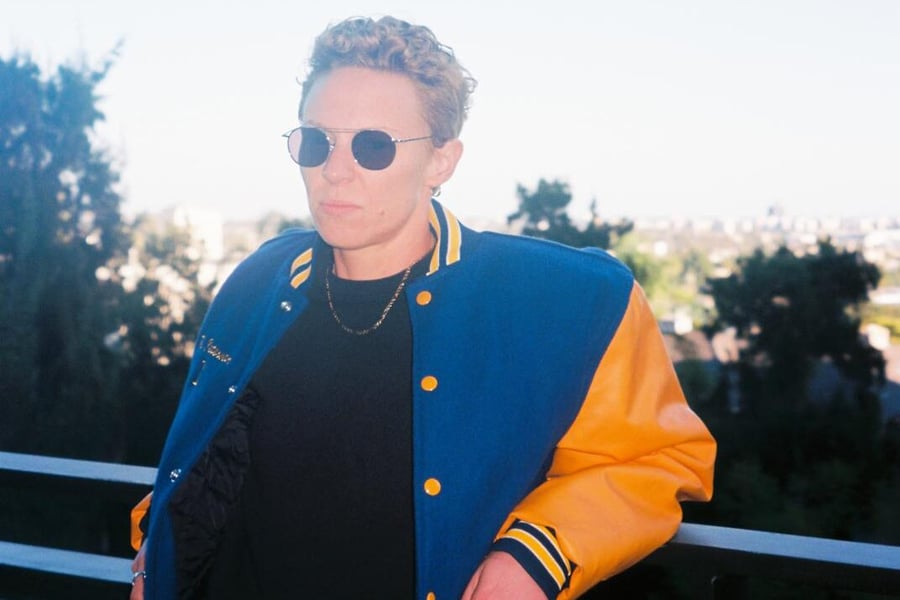
Six years after her last album, La Roux is ready to let go of the past and embrace a new chapter.
Today, she returns with Old Flames, her fourth studio album and arguably her most personal work yet, marking a new chapter for an artist who helped define the sound of late-2000s pop.
Best known for hits like “Bulletproof” and “In for the Kill”, La Roux – real name Elly Jackson – first burst onto the scene with her Grammy-winning self-titled debut in 2009. Since then, she’s continued to carve out her own path, collaborating with the likes of Tyler, The Creator and Skrillex while remaining fiercely independent in her creative vision. Her latest offering is no exception, with Jackson writing, producing, composing and arranging the entire record herself.
But Old Flames is about much more than musical evolution. Written over several years against the backdrop of a turbulent personal life, the album sees Jackson confront the breakdown of a 17-year relationship, addiction, sexuality and identity, all while grappling with the uncomfortable realities of change.
Sonically, it’s a nostalgic trip through ’90s pop and R&B, drawing inspiration from everyone from All Saints to Mariah Carey, with a visual world influenced by cult favourites like Donnie Darko and Twin Peaks.
The album also arrives off the back of a major Australian tour supporting fellow 2000s pop icon Hilary Duff, an unlikely pairing that’s introduced La Roux to a new generation of listeners while giving longtime fans a healthy dose of nostalgia. And while she’s grateful for the enduring love for her biggest hits, Jackson is keen for audiences to discover there’s far more to her artistry than the songs that made her famous.
Speaking to Rolling Stone AU/NZ, La Roux opens up about the long road to Old Flames, finding the courage to embrace change, her complicated relationship with “Bulletproof”, and why, after all these years, she’s finally starting to feel like the artist she’s always wanted to be.
Love Music?
Get your daily dose of everything happening in Australian/New Zealand music and globally.

Rolling Stone AU/NZ: It’s been more than six years since the release of your last album, Supervision. What have those years looked like for you, both personally and creatively, and what made now feel like the right time to share new music with the world?
La Roux: Now is just the right time because it’s finished. I think it mainly just took that amount of time for me to get this project into a place where I felt it was complete, that I could communicate it to the world, and that it felt like a cohesive body of work. Initially, I wasn’t making a record with intention. I was just experimenting in 2020.
I had just put another album out that got marred by the pandemic. We couldn’t tour it and had to cancel everything around that. I think it’s more difficult than people realise to finish an album, do all the visuals for it, make music videos, do the album artwork, put it out, and then four weeks later think about making another album just because the pandemic hit. I just think it’s wild, the unrealistic expectations.
You need space, and you need to live in between those thoughts to make new ones. I needed to go through some more shit and gather my thoughts. A couple of the ideas on the record are a little older than others, and some I wrote right at the end of the process. So it really is the best cherry-picked parts of stuff I’ve done over probably a four or five-year period. But I don’t write loads and loads of material. I tend to focus on the things I think are my best ideas.
I also take quite a lot of time for perspective. On Trouble in Paradise specifically, I spent so long on that record every single day that the perspective just wasn’t there at all, and I got lost. On this record, because of the pandemic and because I kind of didn’t give a fuck anymore, I allowed myself that time to do a few weeks here and there, then not listen to it for a while, then do a few weeks here and there and not listen to it for a while, and try new ideas.
It’s a combination of many things. Plus, the backdrop of my personal life at the time was pretty difficult with my relationship, going between breaks and breakups and getting back together and stuff like that.
It sort of gathered itself over time, and eventually the references I was pulling started to crystallise into one place. I was like, ‘Okay, I understand what I’m doing now and I can move forward with the sound of this record.’ But it takes time for the sound of a record to form, and also the visual world that goes with it.
For so many artists who are self-produced and also creative-direct most of their own projects, I think you forget that world-building is so important. The world feeds into the music and the music feeds into the world. There’s a symbiosis, and they happen together, spiral together, and you need to wait for one to keep catching up with the other. I would never put a record out unless the visual world was just as worked out as the sonic world. So that takes time.
You’ve described Old Flames as a process of admitting what you got wrong and saying goodbye to certain ways of behaving in love, life and music. Was making this record a cathartic experience, or did it bring up things you hadn’t quite come to terms with?
I think it was both. When I listen to it now, I can really hear myself struggling with trying to move on in my life, but also being too scared to, which to a certain extent I would say is always true of a person.
I lived in the same house and had been in the same relationship since I was 21. The deep craving for change has been palpable, but it’s also hard because I don’t love change. As a neurodivergent person, safety in things being as you expect them to be is kind of a necessity, but it’s also trapping. You’re stuck in this tension where you’re like, ‘I really need things to change. I want to live in a new space and I need to have a different relationship and different experiences to learn about myself in different ways.’
If you’re always doing the same things – wearing the same clothes, living in the same way, having the same lifestyle, going on holidays to the same places – nothing can shift within you because it’s all just the same. I think it’s so necessary to have external and internal change at the same time. I’ve been working on that for a while, but it involves me overcoming quite a lot of fears, actually.
View this post on Instagram
The album explores some incredibly personal territory, from the breakdown of a 17-year relationship to addiction, sexuality and identity. Were there any moments where you thought, “Oh, am I really going to put this in a song?!” How did you navigate being so open and vulnerable?
I think there’s still a healthy amount of ambiguity in what I’ve written. You’ve got quite a lot of artistic licence in a pop song. There were moments on the record where I wrote something and thought, ‘Fucking hell, that person’s gonna know it’s about them,’ or, ‘Shit, am I really saying that? Am I really letting people in that much?’
But you pull from so many areas of your life in a song. For instance, in some songs, one verse is kind of about one thing in my head and the other verse is about another thing. No one will ever know that apart from me. A pop song needs to be personal to connect in some ways, but you also need to deliver a perfect three-and-a-half-minute statement that makes people feel they can really relate to what you’re saying.
Being overly specific sometimes is a hindrance. I think you need to be 100% honest, but maybe not 100% specific, and get that balance totally right. I feel like I probably did my best job at that on this record since my first record. There are definitely moments where I’m trying to be honest, but I also kind of hope people don’t get what I’m saying.
[In discussion of Lily Allen’s West End Girl:] It’s very bold, which I always really respect about Lily, but I don’t think I could be that honest.
I’ve always lived a very private life as an artist. Most people have never seen a picture of the person I went out with for 17 years, don’t know what her name is, don’t know anything about her. I think that was because I wanted to protect her and me. I feel like that’s quite rare, to be able to stay that private.
You’ve written, produced, composed and arranged the entire record yourself, which is no small feat! How important was having that level of creative control when making something so personal, and did you find yourself approaching things differently?
The only thing I approached differently was the lyrical content and the techniques I used to get this into the genre I was imagining. As a producer, it took really studying the records I wanted it to give me the same feelings as, and really respecting those arrangers and composers.
I always do that on every record. Trouble in Paradise was a real study of the genre and era I was referencing then as well. We obsessively listened to the things we were referencing and went, ‘Why is that so special? Why does that hook hit in that way?’ In Tom Tom Club, for example, we were obsessed with the panning of this one hook: how it pans, and whether it’s one keyboard part or three keyboard parts separated and then made to feel like one riff. Then you think, ‘Should we do that with our riff?’ There’s lots of stuff like that.
The study was the same, but I had to learn different techniques. This is probably some of the tidiest composition I’ve done. I always have a lot of melody hooks, and in the mixing process I had to sit down and hone in: ‘Okay, this is the most important part of the melody here. Then that melody can drop out and the other most important part can take over here.’ Making sure there aren’t too many things crossing over, and the placement of things, became super important, especially in songs like “Night Vision”.
I don’t feel like it makes any difference how personal it was, though, because something people don’t understand about my records is that I’ve always composed them. This isn’t new. My team and I are just fed up with people not knowing I do it, so we’re really trying to ram it home on this record. People often wonder why my records take a long time. In terms of the composer and arranger, it’s just me. It takes time when I’m not musically trained, I don’t read music, and I have a lot of ideas. Often it’s the editing that takes a lot of time. I don’t feel it was super different to other records; just what I referenced was different.
Sonically, Old Flames draws on a whole world of influences, with “Cabin Fever” in particular serving up some glorious ’90s pop nostalgia. What were you listening to, watching or obsessing over while making this album? Were there any unexpected inspirations?
Some moments of ’90s cinema, and the nostalgia of that time = most of the ’90s, really, in terms of the visual world and the feeling. It’s “Right Here” by SWV with the “Human Nature” sample, it’s All Saints, it’s Mariah Carey’s “Heartbreaker”, it’s little bits of Justin Timberlake, which is probably the latest reference on the record in terms of time and date.
It’s the essence of what I think every millennial misses about the ’90s. Casual was king in terms of style. It wasn’t shiny. It was a simple time, just before mobile phones, before everything started to get too fucking complicated. It was the last time things weren’t always trying to feel futuristic. I wanted to sonically and visually pull that back and have people be able to sit in that world again.
The musical references are scattered across that period of pop music, and so are the visual references. Cinema has played a bigger part in this than on any other record. Films like Donnie Darko, and even bits of Twin Peaks, have influenced what I’ve been doing visually. The character study of the male character in Donnie Darko, played by Jake Gyllenhaal, has really inspired the way my look has developed and is developing — that college ’90s male kind of thing. It’s something I was always slightly obsessed with and slightly jealous of those boys for when I was younger. At 38, I’m like, ‘Fuck it, I’m doing it.’
Your debut album helped define an era of electronic pop, and songs like “Bulletproof” and “In for the Kill” have taken on lives of their own. What’s your relationship with those songs like these days?
I think there was a time when I was sick of “Bulletproof”. As a songwriter, when you have a big song, you want five. When the first thing you make is that big and you feel like you can’t beat it, it can be frustrating as a young artist. But over time you realise you’re incredibly lucky to have one.
The response you get, and being able to end your show on that high note every time, is incredible. I wouldn’t want to take that away from people. And I think I’m probably starting to feel bulletproof for the first time in my life. I’m only starting to feel the truth in those lyrics more recently. Maybe I feel like I’ve earned it now.
It feels like we’re having a full-blown late-2000s and early-2010s pop renaissance right now (I mean, hello, Hilary Duff tour!). What’s it like seeing a whole new generation discover that era of music, and how do you feel about your place in it?
I think nostalgia is a huge part of why I’m on this tour. It’s worked really nicely. A lot of people haven’t had a clue who the opening act is until they’ve got there, and then they’re like, ‘Wait, hang on a minute, this is the ‘Bulletproof’ person.’
I think people who were at university when “In for the Kill” and “Bulletproof” came out are taken straight back to that time – living in dorms, doing their degrees, going out with friends. People say that to me a lot. But it’s also nice to be able to show people the other music I’ve made.
You’ve been joining Hilary Duff on tour across North America, the UK and Ireland, and now Australia! How did this pairing first come about, and what’s life on the road together been like? Any particularly memorable moments so far?
It’s been a delight. Hilary, her family and her team have all been so incredibly nice. There’s been a real family feeling the whole time since June – everyone calls it “Camp Hilary”. I didn’t know her before, and I’m very glad I know her now. Her and Matt are super lovely people, and it’s rare to make friends at this stage of life, especially in this industry.
The American amphitheatres were particularly magical because I’d never played venues like that before, and then the indoor arenas have been fun in a completely different way. It’s been a really nice variation of new experiences.
View this post on Instagram
La Roux and Hilary Duff might not be the most obvious pairing on paper, but you’re both responsible for some pretty iconic pop songs that soundtracked a generation. Have you noticed much crossover between your fanbases? Has a collaboration ever come up in conversation?
We don’t share a huge amount of audience, but because of “Bulletproof” there aren’t many people who don’t know that song. They might not be my hardcore fans, but they definitely know “Bulletproof”, and some know “In for the Kill”.
Luckily, we also have people who come to see me and then stay for Hilary, so there’s a crossover there. It’s great to have access to people who know that song and be able to say, ‘Hey, look, this is the other music that I’ve made.’
With Old Flames arriving today, what do you hope people take away from this new chapter? And now that you’ve said goodbye to some old flames, what are you most excited about moving towards next?
I really hope they feel all of that stuff I’ve just spoken about, with the record and the world I’ve tried to create. I hope they can immerse themselves in that, feel it, and that it becomes a nice escape.
I feel like this record is more connected for me. I hope it starts to ring true with the audience I feel personally aligned with as a human being. One thing about all the dance remixes I’ve had of my songs, and “Bulletproof”, is that it can misalign me with an audience I’m so grateful for, but that maybe doesn’t represent me accurately as a musician, a producer and a person.
This record feels like a real statement of intent: this is who I am, and I’d like to connect with other people who feel like me, rather than people who I think my career has slightly misaligned with who I am and what people think I actually do – which seems to be dance music. I’ve never made dance music in my life, and I don’t have any desire to either. That’s really important to me on this record.
I’m really excited about making my next record, actually. I’ve got a couple of ideas I’m really excited about. And just continuing this, hopefully expanding the world of Old Flames on stage and really pulling people into that world. As well as the tour we have, I’d like to do more touring later in the year, maybe get some bigger stages and do some bigger productions. That’s what I’ve really got my sights on.
La Roux’s Old Flames is out now.

