




























Hilary Duff
Spark Arena, Auckland
Tuesday, October 20th
By 5:30 pm, a snaking line had already formed outside Auckland’s Spark Arena. Tonight marked Hilary Duff’s long-awaited return to pop for her Australasian fans, her first world tour in almost 20 years and her first-ever headline show in New Zealand.
Lizzie McGuire’s stylist seemed to be in town. A sea of sequinned crop tops, diamanté-adorned baby tees, pink fur-trimmed coats, butterfly hair clips and ‘Lucky Me’ merch trickled into every corner of the arena. It was a Y2K fever dream, a collective yearning for a time when life felt simpler, music felt more tangible, and we all listened to the same artists.
For many in the crowd, Duff was the soundtrack to their teenagehood. Best known to an entire generation as the star of Disney’s Lizzie McGuire, she made her breakthrough at just 13. Tonight’s audience was a cross-generational melting pot of Gen Z, millennials, and boomers. Still, there was no doubt Duff belonged to millennials in particular: an artist who defined a specific era for a specific generation. This show was for those who grew up alongside her.
And it would be ignorant to suggest we aren’t in the middle of a full-blown Y2K renaissance. As music becomes increasingly digitised and AI continues to reshape our relationship with culture, there is something comforting about returning to the songs that once played through the tinny speakers of our childhood bedroom CD player. We’re nostalgic for the music, certainly, but perhaps also for the feeling of being young. We’re equally hungry for experiences we can actually touch and feel—like live music. Which makes Duff’s return feel like divine timing.
Love Music?
Get your daily dose of everything happening in Australian/New Zealand music and globally.

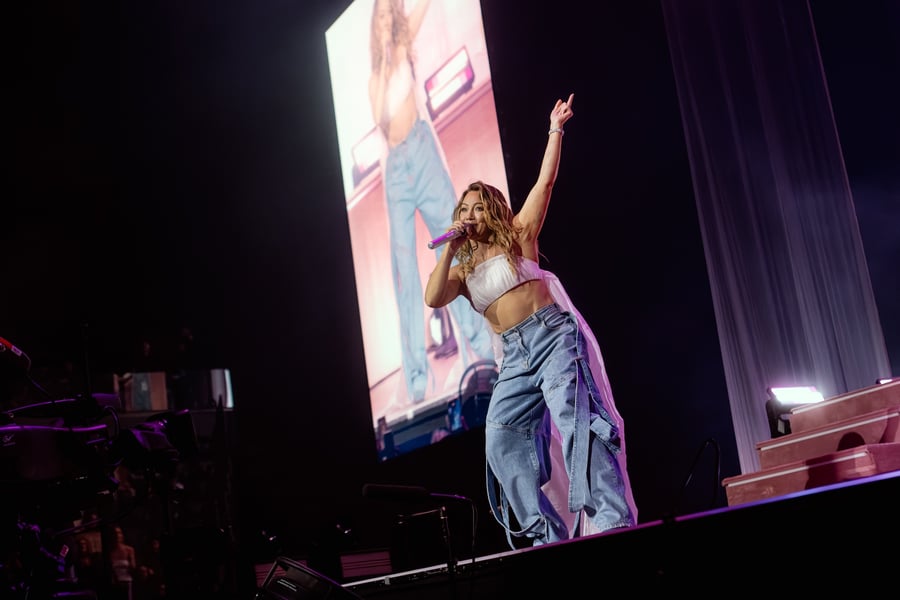
The show begins with the booming beep of an analogue clock. “TIME TO WAKE UP!” Duff’s unmistakably high-pitched voice blasts through the speakers before she bounces onto the stage in denim jeans and a fluttery white top. Like muscle memory, she grabs the microphone and steps into character.
The crowd beams beneath a pastel-pink wash of light as the opening notes of “Wake Up” ring out. “Let’s take it back to 2000,” she announces, and the arena obliges. Forget the usual concert experience; it feels more like a sleepover with hundreds of old friends, complete with singalongs, dramatic spoken-word interludes and the kind of unrestrained enthusiasm usually reserved for watching your favourite movie for the hundredth time. Flames punctuate the drums during “The Getaway”, adding a little theatrical flair to the nostalgia trip.
During “Breathe In. Breathe Out.”, she emerges in a bedazzled crop top that matches the giant disco ball hanging above her. Even the guitarist’s instrument is encrusted with rhinestones. Surprisingly, Duff’s band is an unexpected highlight of the night, bringing a groovy, ’70s sway to the supporting stage arrangement. Duff’s initials are engraved on the drum kit, a small detail that makes the production feel distinctly hers.
It has been more than a decade since Duff released Breathe In. Breathe Out., her 2015 studio album. The woman standing before us now is now 38, a mother of four, and far from the teenage star many of us remember. But the old spark remains. She commands the stage with natural ease, pointing to fans, working the room, and inviting the audience into the performance. During “Beat of My Heart”, she asks, “Quick question, can any of you Kiwis dance?” before bringing a fan onstage wearing an outfit that could rival her own. The crowd bounces in unison, glitter catching the light. Maybe this is what we’ve been missing: not just the music of a particular era, but the collective feeling that we belong to it.
A montage of archival tabloid footage then flashes across the screens, showing Duff in the very Y2K looks the audience has spent the evening recreating. It reminds us where we began, and how much has changed. She is no longer Lizzie McGuire. Like the rest of us, she’s grown out of her younger self. As the montage gives way to the present, Duff returns in a silky white dress, looking more assured and mature than the girl on screen.
The music softens, and she pauses for a heart-to-heart with the crowd.
“This year has been this movement around me coming back to music and how the room feels with you in it,” she says, speaking in that easy, breezy tone that comes naturally from a life spent manipulating her voice for the camera. But this time, you can tell she’s speaking on her own terms. “The room is filled with so much love. It’s best friends. It’s mothers and daughters… grandparents. It’s my LGBTQ+ community,” she says, prompting a roar from the audience. “Always at the front for me, screaming the loudest.”
She isn’t wrong. There isn’t a single bad vibe in the arena. People hug, dance, sway and sing along; dads stand beside their daughters, lovers hold each other, and friends throw their arms around one another.
“I truly wouldn’t want to be anywhere else but here right now,” she says, before launching into “Fly”.
Later, a lime-green couch appears onstage. Duff sprawls across it in socks, baggy jeans and a Mickey Mouse T-shirt—an affectionate nod to her Disney days. Her guitarist leans against the armrest, playing from the floor, and suddenly the arena feels like the sleepover has entered its cosiest phase. She is comfortable, familiar, like someone who grew up in our own home.
A pink mini-fridge then appears on the screen. Duff asks the audience to guess what is inside, and the crowd chants back: “L&P!!!” She rolls the words around in her mouth, unfamiliar with the New Zealand soft drink, before announcing, “Cheers,” as she raises the can in a toast before carrying it into the next song.
That ease carries into “Mature.” In a shimmering silver dress and matching boots, Duff sings, “She’s me / I’m her in a different font”—a line that lands with anyone who’s had to grow into a new version of themselves.
Like many child stars who came of age under the global microscope, Duff deserves the chance to take her victory lap. In the early 2000s, flashing tabloid cameras captured versions of her largely out of her control. Tonight, she stands beneath her own lights, choosing how she wants to be seen. She is no longer trying on identities for the world to judge. She seems to have found one that fits.
The closing stretch brings another dose of intimacy. Duff asks the crowd to switch on their phone torches, remarking that they didn’t have them when she toured last. The arena transforms into a cave of glow-worms. “I’m taking a photo for my Snapchat,” she says, a quintessentially millennial reminder that even nostalgia has to keep up with the times.
Then comes the question everyone has been waiting for.
“I feel like we’re forgetting a big one…”
The crowd erupts as “HEY NOW, HEY NOW!” echoes through the arena. Pink and orange balloons fall from the ceiling as butterfly-shaped confetti blasts through the air. “What Dreams Are Made Of” begins, and Spark Arena sings as one.
Everyone has got what they came for: nostalgia, delivered in its purest form. Lizzie McGuire T-shirts spill out into the Auckland night, glitter still clinging to clothes and faces. But the show was more than a trip back to the early 2000s. Duff meant something to so many of us during a very specific time in our lives. Time has moved on, and so has she. Tonight, she gave us the chance to celebrate who she was, while introducing us to who she is now. Lucky us.

