





























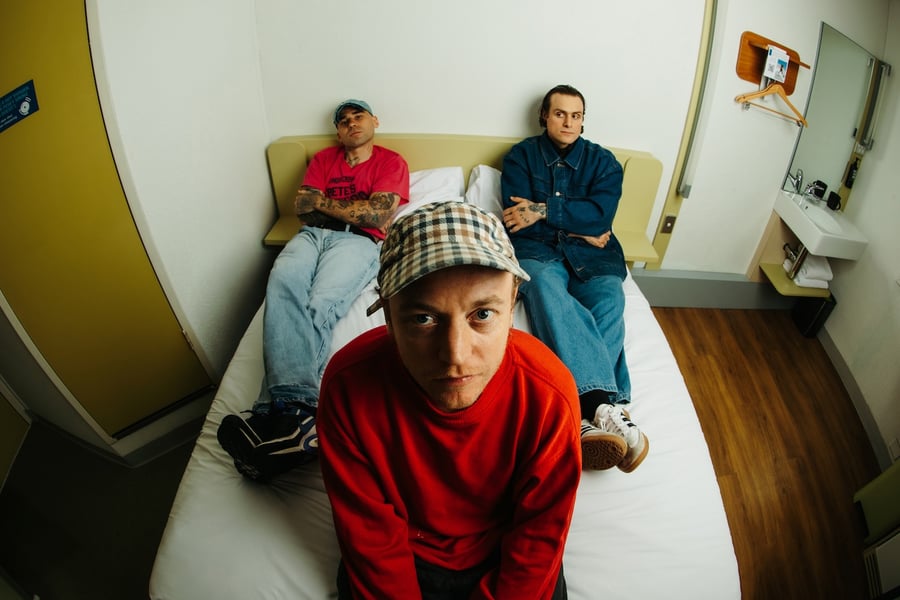
Matt Mason has a theory about why bands tend to lose some of their rough edges as they get older.
It isn’t necessarily success, or caution, or some faceless industry pressure sanding everything down. Sometimes, he thinks, musicians simply get better at hearing what’s wrong.
“When we were listening back to our first album, I was hearing things like how — and this I think is so true for a lot of people saying that there’s the trope of, ‘Oh, I like the earlier stuff better than the new stuff,’” the DMA’S guitarist says.
His theory is that, with time, a musician’s ears become more attuned to the details they once might have missed.
“You can hear mistakes and timing mistakes and out-of-tune guitars, and as you get older, your ears become more in tune with these imperfections,” Mason explains. “And if you’re a bit of a perfectionist or a little bit neurotic like myself, you can’t help but try and go in and fix those things.”
The problem is that sometimes those imperfections were part of what made the music exciting in the first place.
“I think the fact that you can now hear them and you want to fix them, I think that has something to do with a lot of people’s music sounding less raw and a little bit more produced over time,” he says. “Even if that’s not what you’re going for, sometimes you just can’t help it.”
Love Music?
Get your daily dose of everything happening in Australian/New Zealand music and globally.

It’s a particularly fitting observation from Mason because DMA’S’ fifth album, simply titled DMA’S, is in many ways the sound of the Sydney trio trying to unlearn exactly that instinct.
View this post on Instagram
Ten years after Hills End introduced Tommy O’Dell, Johnny Took and Mason to the world, they’ve made a record deliberately reaching back towards some of the freedom, rawness and immediacy of their earliest music, without pretending the three men making it are still the same people they were then.
“I wouldn’t even want to revisit me in my early 20s,” Mason says. “I wouldn’t want to do that again. It’s like I’ve moved on. Life’s slowed down now. We’re very happy with where we’re at.”
Their fans have moved with them. Many of the people who discovered DMA’S in those early years now have families of their own.
“Maybe we’ve all aged together, matured together,” Mason says.
That makes DMA’S less an exercise in nostalgia than a full-circle moment.
After 2023’s electronic-tinged How Many Dreams?, the band did something unusual for three musicians accustomed to the relentless write-record-tour-repeat cycle: they stopped.
A move from Mushroom to Sony afforded them something increasingly precious after a decade as one of Australia’s most in-demand rock bands: time. Instead of immediately rolling into another two-year album cycle, this one stretched to three.
“We just had a bit more time up our sleeves to just let our creativity breathe and make mistakes, but then have time to fix them,” Mason says. “I feel like that’s what set this album apart, is that we just had as much time as we needed to make it.”
Naturally, giving a self-described perfectionist unlimited time came with its own obstacles.
“When you’re working on something and you don’t have a particular deadline or anything like that, you can just endlessly go in circles, just picking things apart,” Mason admits.
That happened. A lot.
But the difficulty also made finally releasing the album feel more satisfying.
“It took so long, it felt like today would never come,” he says.
At the centre of the process was the band’s own studio in Glebe, built to suit them. Much of the album was self-produced there, with DMA’S also working alongside a tight circle including Lach Bostock, Jimi Somewhere and Styalz Fuego. The band were, Mason says, perhaps more hands-on with this record than they had ever been before.
Having their own space changed more than the practicalities.
They could work at three in the morning if they wanted. They could walk away from the songs for a month, live some life, then return with something new to say. Vocals could be recorded on cheap microphones without headphones, speakers blaring in the room, breaking rules they wouldn’t necessarily have been allowed to break somewhere more conventional.
And there was nobody waiting for them to finish.
“When you’re renting out a studio from someone else, and let’s say you have a producer there and you have assistants, and there’s a few moving parts that people are hanging around, you’re on other people’s time,” Mason explains.
That pressure can change decisions.
“Sometimes a lot of musicians can be people pleasers, so they’ll just say, ‘Oh, it’s fine. That’s good enough.’ But if it’s just you there and no one else there, then you can really chip away at it until you’re completely happy with it.”
For Mason, that was one of the great luxuries of having their own space. “You don’t have that sort of responsibility of not wasting everyone else’s time,” he says.
Ironically, all that time eventually helped DMA’S realise that the answer was often to do less.
On previous records, the band had tended to throw layers at a song and strip them away later. Mason had grown tired of the process.
“I thought, let’s just go really minimal with guitar effects,” he says. “There’s no synthesisers on it or anything like that.”
They started with simple sounds and built only when something needed building.
“That was definitely a stylistic choice from the beginning,” Mason says. “We wanted to keep it really simple.”
O’Dell has described a similar shift in his approach to the vocals, particularly on “Windows”. Instead of obsessing over technique, he concentrated on “a performance and a vibe” and tried not to make every note perfect.
“I feel like our first record had a lot of that on it vocally,” O’Dell said. “I was reaching for more of a vibe and performance and the vocal tone, rather than trying to make every note perfect.”
Elsewhere, the rule-breaking became literal.
During sessions in Los Angeles, Jimi Somewhere wanted to record Mason’s acoustic guitar with an SM57. Mason asked for the mic stand.
There wasn’t one.
“He just hits record and holds the microphone in front of me,” Mason recalls.
“We never would have done anything like that a couple of albums ago. I found it was just a really fresh take on it.”
That looseness was partly about reconnecting with what the band’s earliest listeners responded to.
And Mason knows what those listeners think because, against his better judgement, he reads the comments.
“To be honest, a lot of musicians don’t really want to — no one really should be doing this — but I do read the comments sometimes just to gauge where we’re at and to see what people are thinking,” he says.
For Mason, it matters, particularly when the band isn’t necessarily meeting fans face-to-face every day. The comments offered a rough barometer of what people missed.
“I feel like we did lean into, you could argue, overproduction on the last few records,” he says. “Not that I didn’t like that, but I feel like it was time to bring back that raw energy that I think people really liked.”
The trick was acknowledging that they could never recreate the past exactly.
“Even though it’s 10 years later, we’re all very different people,” Mason says. “So even if you’re trying to replicate something that you did 10 years ago, it’s never going to be the same.”
There was unusually good timing, too. While making the album, DMA’S were also preparing for the UK anniversary tour celebrating a decade of Hills End. Relearning those songs forced them back inside the sounds and instincts of their younger selves just as they were trying to work out what still belonged in the band’s present.
That philosophy helps explain why album five gets the self-titled treatment.
Mason sees self-titled albums as statements. In this case, the band had produced much of it themselves, worked in their own studio, and consciously circled back towards elements of their earlier sound.
“It feels like a full circle moment,” he says. “I feel like now is the perfect time to go for self-titled.”
Then comes the less romantic reason.
“Also, coming up with an album title, it’s never easy for us.”
The record arrives in the same year that Hills End turns 10, with more than 250,000 album sales and upwards of 575 million streams now behind the band.
View this post on Instagram
Mason never assumed they would get this far.
When reminded that Took has said DMA’S love what they do and intend to do it forever, Mason repeats the word as though he’s trying to work out exactly what it means.
“Well, 10 years feels like forever sometimes,” he says.
Then he thinks about it again.
“A band even making it to five albums feels like forever sometimes because that’s actually quite rare really. And we didn’t think that we would make it. I didn’t think that we would be making five albums when we started.”
So perhaps this already counts.
“I guess this is forever,” Mason says. “But hopefully another five albums. We’ll see.”
For now, there are these 11 songs.
And each seems to have taken its own strange route onto DMA’S.
“El Alamein”
“Have you been to Sydney? King’s Cross, the lion fountain in the centre of King’s Cross — it’s kind of hard to miss — but that’s called the El Alamein Fountain. And it was a World War battle in Egypt. We don’t write songs about historical events really at all, but I just love the name. When I was writing the song and singing the melody, that phrase kept popping into my head, so I decided to get a book and read about it.
“The first verse is someone who’s in the battle, and then the second verse is someone who’s in the Cross, walking past the fountain going through their own battle in their head. It’s about internal struggles over different generations all connected through this one fountain in King’s Cross in Sydney. It’s my favourite song on the album. It just missed out on being a single, but I think it still has a special place as the first track.”
“My Baby’s Place”
“I think I’ve been there, and I think a lot of people have been there, just seeing all your friends in relationships and getting a bit down. Not jealous, but just sort of, ‘That would be nice.’
“Then the chorus is they’ve found someone, and it’s them and their partner against the world and, ‘Fuck everyone, I’m going to my baby’s place.’ Then it goes back to that sense of longing in the verse, and the chorus is the triumphant, ‘I found my person and screw everyone else,’ which I feel like is an amazing feeling when it happens.”
“Hurracane”
“There’s a few spelling mistakes on the album, and that was just done for fun when I was making the demos on my computer, and then they kind of just stuck. I was like, ‘Oh, screw it.’ It makes the songs easier to look up on Spotify as well.
“‘Hurracane’ is a song about a family’s house getting knocked down to build a freeway and just the heartbreak in that. It’s another kind of story about a moment, which we don’t do as much as DMA’S. We tend to write songs about our own personal experiences. It’s kind of like The Castle, I suppose, except it’s got a sad ending. We’re using the metaphor of a hurricane coming through.”
“Killing Time”
“Styalz Fuego helped out on this one. It was originally just strings — I play strings and I recorded a bunch and sampled it. It started off as a rap beat, about 85 BPM, pretty slow. Then he was like, ‘Look, let’s make it extremely fast.’
“He’s one of those producers that’s just so inspirational. He makes you want to come up with fresh melodies. We tried about 50 different ideas for the chorus, so it was probably the most challenging song to finally finish, but now it feels complete. I feel like you can’t go wrong with a song that fast that has catchy melodies. It’s just always going to be a good combination.”
“Heatin Park”
“It actually almost didn’t make the album. We wrote the chorus in LA with these two young Norwegian producers, and they love nu-metal. We called the chorus idea the ‘Linkin Park idea’ as another working-title demo thing. It was almost about to get scrapped, and then one of our A&R guys had the idea of taking a song that’s about eight years old off our SoundCloud, changing the key and making it fit as the verse and the riff for this chorus idea we had. At the time it sounded insane. I was like, ‘I don’t even know how you came up with that.’
“Heaton Park is obviously a venue in Manchester which is very close to our hearts. We’ve played a few shows there, some famous Oasis gigs have happened there, and so it became another working title — Heatin Park with an ‘i’ as a reference to Linkin Park. Being in DMA’S, I never thought that we would be referencing nu-metal. It’s one of my favourite songs on the album, and we’ve played it live in the UK and they lose their shit when we play it. So it’s definitely a keeper.”
“Emailz”
“I was in a writing session with a songwriter and we were writing a song for her, and this song was just coming out as we were writing it. It’s one of those ones where I always find it a little bit annoying when songwriters say, ‘Oh, I just wrote this song in 10 minutes,’ but this is one of those instances. It all happened really quickly and all the lyrics happened really quickly as well.
“And the ‘z’ on the end is crazy. I think my mum even mentioned it to me. She was like, ‘Why are you spelling all these songs wrong? This isn’t how I brought you up.’”
“One And Only”
“‘One And Only’ is a very old, maybe six-year-old demo that Johnny wrote. Johnny’s little brother had deleted one of his hard drives, so we didn’t have the stems of the song. All we had was the MP3. We went to rerecord the song and the vocals, but it didn’t have the magic that we wanted.
“There’s a new tool where you can extract all the different elements of a song that you used to not be able to do, so we took the vocal from this original demo and then had to stretch it into time with the new version of the song, which took a very long time. I feel like that is a great representation of how we leaned into trying to be a bit more raw and not overthinking the production — just going with the original demos and the original feeling of songs.”
“Dancing Luck”
“‘Dancing Luck’ is a song that Johnny wrote and produced, and I didn’t really have too much to do with it. So I love this song, but I can’t really tell you anything about it.
“It has a lot of production by these two Norwegian guys, Jimi Somewhere and Milo. In LA they added quite a few beautiful sounds, and it has this amazing vocal that just keeps going on and on. But that vocal was the demo vocal. It was a really old vocal that we couldn’t replicate. I feel like it’s an ongoing theme that we just stuck with all of the original recordings we had and didn’t try to rerecord anything if we didn’t need to.”
“Concrete”
“Manchester is a second home to us and we spend a lot of time there. I only started getting into Manchester music through DMA’S — I really only listened to American music before that. I was starting to listen to a lot of ’80s Manchester bands when I was recording this song because I was thinking, ‘Let’s pay respect to a city that’s given so much to us.’
“So it’s my attempt at making an ’80s Manchester song. I love stacked harmonies, which I actually often don’t do that much. I’ve tried before, but it always gets cut out in the mixing process, which I get — it’s a bit of a guilty pleasure. But it has this Byrds-esque harmony stack going on, which is a pretty fresh sound for us. So I’m glad that made the album.”
“Windows”
There is, apparently, no deliberate reason “Windows” happens to be track 10.
When Rolling Stone AU/NZ points out the accidental Windows 10 joke, Mason pauses.
“Oh yeah, I hadn’t thought of that. Nice. That’s good. That’s good. I love that.”
“It made me giggle when I saw it,” I tell him.
“Yeah, no,” he replies. “It’s reminding me I need to update.”
“This is the first time we’ve actually done co-writes with other writers. We went to Nashville and recorded this song with JT Daly and Trent Dabbs. I whipped out my phone and had three different voice memos and just spliced them all together. It’s a love song, but it’s a crazy love song — ‘climb through my window’ or something. It’s one of those insane breakup love songs, I suppose.
“When I showed it to my wife, she was like, ‘Why did you guys write a song about being with someone, but not wanting to be with them? Because you’re all married and all in long-term committed relationships with children.’ And I was like, ‘That is a good point.’ She was joking around, but she was like, ‘What the fuck? Is everything okay at home?’ I was like, ‘Everything’s fine at home. Everybody, don’t worry. It’s a made-up story.’”
“Distance”
“We recorded that with Styalz Fuego at our studio in Glebe. It’s another really fast song, and it’s one that we wrote pretty much for the live show — imagining what our fans react to, what kind of song they want to hear us play, and envisioning the live show in the songwriting process, which is a really fun way to write a song.
“It’s about going on tour and feeling sad at the airport. Johnny just had a kid, I’ve got a four-month-old baby, so I’m sure that as the years go on, that song’s going to be sadder and sadder to play live. But it’ll all be worth it.”

