




























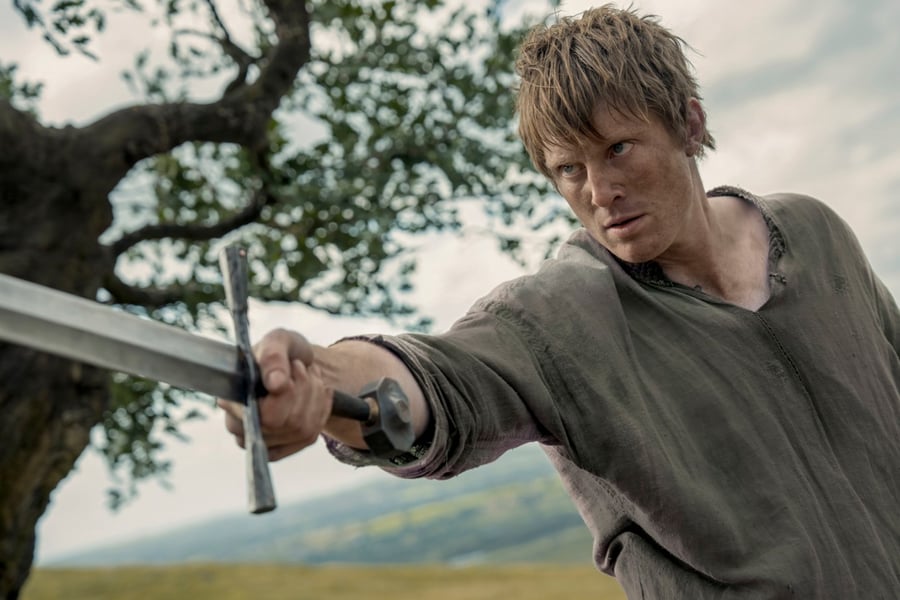
If you tuned into HBO on the night of Jan. 18, or logged onto HBO Max soon after, you would have been greeted with the sight of a man digging a grave under a dark, gray sky. A trip of horses neigh uneasily as a storm rains down upon them. After lowering a body into the ground, the hulking figure with the shovel gives a eulogy. He’s a squire who goes by the name of Dunk, and he’s laying his former master to rest. This elderly knight wasn’t always the kindest, or the most sober of mentors. But given that he virtually raised the orphaned Dunk from boyhood, the young man still mourns his death.
The next day, Dunk vows to continue on, in search of adventure. This strapping young lad fancies himself a “Ser,” the title held by the illustrious knights of the realm; the casual namedropping of King’s Landing and Lannisport confirms which particular universe you’re in. He’s heard tales of a tournament in nearby Ashford, where men with boundless bravery and sword skills can make a name for themselves. A recognizable theme — DUN du-du-du-duh Dun, DUH-du-da-du-daaa-DUN — begins playing over the scene. Dunk promises to make his late master proud. He strikes a heroic pose. The theme swells, getting louder… and louder.…
… And then the music suddenly drops out and we smash-cut to a shot of Dunk shitting behind a tree. This isn’t a modest movement either. It’s an impressively large and quite violent amount of projectile defecating. Real scatological-geyser kinda stuff. Welcome to the new Game of Thrones spinoff.
The origins of A Knight of the Seven Kingdoms go back almost as far as the original Song of Fire and Ice book series that gifted HBO with its biggest blockbuster-TV hit to date. But unless you were familiar with George R.R. Martin‘s “Tales of Dunk and Egg” novellas — the first of which, 1998’s The Hedge Knight, provides the source material for this six-episode prequel — or the way this side project interacts with the larger GoT storylines, you could be forgiven for wandering into this limited series without really knowing it was connected to the massive premium-cable juggernaut at all. Its marketing campaign was modest, especially compared to the rollout given to its sister show, House of the Dragon. (More on that one in a second.) The only dragon that shows up is made of wood and whatever the Westeros equivalent of papier-mâché is, controlled by puppeteers during a makeshift sideshow aimed at late-night drunkards. It does breathe fire, courtesy of primitive theatrical magic, but still.
And the fact that Knight immediately subverts any sense of traditional Games of Thrones grandeur by interrupting its statement of purpose with a poop joke tells you everything you need to know about the show as a whole. The kind of epic spectacle normally associated with D.B. Weiss and David Benioff’s game-changing series is conspicuously AWOL, by design; in a recent Hollywood Reporter cover story, Martin confessed that part of the appeal for his corporate overlords in adapting these stories was that they could do it for cheap. Massive battle sequences and “Red Wedding”-style set pieces come with hefty price tags, and while the novellas eventually bring some sound and fury to the table, they owe less to the War of the Roses and more to Chaucer’s bawdy Canterbury Tales. This show isn’t doing chapters in a saga. It’s crafting an offbeat, occasionally raucous buddy comedy over in the saga’s margins.
Not that the duo doesn’t play a part in the overarching GoT history. The story takes place roughly a century before the events of the flagship series, and once Dunk (played by Peter Claffey) comes up with his knightly title on the spot — Ser Duncan the Tall — you may remember hearing that name mentioned a few times during the original series. He will eventually become a big deal in the Kingsguard. As for Egg (Dexter Sol Ansell), the bald “stable boy” who Dunk first meets when he rides into Ashford, and who eventually becomes the knight’s squire? It’s worth noting that his ova-centric handle is a nickname derived not from his hairless head but from his actual name, which will seem extremely familiar once it’s revealed in full around the series’ halfway point.
But A Knight of the Seven Kingdoms is, at its heart, a shaggy character study that emphasizes shambling alongside this unlikely twosome over whipping them through one battle after another, and it’s that element that makes it a far more satisfying watch than its fellow spinoff. HBO chased a number of potential ideas for post-Thrones shows, including one that would have followed Jon Snow’s further adventures. The one that got out of the starting gate first was House of the Dragon, which dipped into events 200 years prior to GoT and replicated the original’s mixture of scaly beasties, VFX-heavy set pieces, and palace intrigue rife with sex and violence. The ensemble cast featured a similar combo of established veterans (Paddy Considine, Rhys Ifans), fan-favorite actors (Matt Smith, Olivia Cooke), and freshly minted stars-in-the-making (Emma D’Arcy, Milly Alcock). And the show seemed to have taken all the wrong lessons from Thrones’ notorious car-wreck of a final season, and amplified them. There was a distinct feeling that the creators felt they could simply throw a lot of money, deep-cut mythology, and dragons at the screen, and people would lap it up. The only drama even remotely connected to it was happening offscreen.
Love Music?
Get your daily dose of everything happening in Australian/New Zealand music and globally.

House has been renewed for a third season, which will be coming soon-ish to a TV screen near you, which could make A Knight of the Seven Kingdoms feel like nothing more than an IP stopgap. But what showrunner Ira Parker’s take on the Dunk and Egg novellas has done instead is render its sister spinoff more or less irrelevant. Like Andor, the critically praised Disney+ show that dropped a trenchant resistance thriller within the Star Wars universe, this scaled-down look at two peripheral characters proves that you don’t need to simply rinse and repeat the same old story, or give your sandbox a bells-and-whistles renovation. You just need to find something that reminds people of how rich the world you’ve built truly is, and tell a tale that balances those elements of fantasy and imagination with something grounded, emotionally engaged, real. Dunk and Egg may be on a standard hero’s journey, but the manner in which the show walks them toward their mutually beneficial fates feels unique. (That Claffey and Ansell play so well off each other only deepens the sense that this odd couple are meant to stumble down this rocky path together.) It’s also frequently funny, silly, thrilling, sorrowful, ironic, and, obviously, not above a good shit joke.
Each installment has been exponentially better than the last. And given what the show’s fourth episode (which aired this past Friday) sets up for the show’s back half, there’s no better time to catch up with it than right now. The Targaryens — that blond clan of nobles who will curse Westeros with mad kings and bless the land with the Mother of Dragons — eventually come skulking around Ashford. Dunk gets into some hot water with the royals, which requires an ancient ritual known as the Trial by Seven. Having seen the final two episodes, we can confirm that the payoff is huge, even as the show sticks to its smaller scale. By the end of Knight‘s first-season run (it’s also been renewed for another go-round), you feel like it’s only scratched the surface of where it can take these characters, what it can explore in these previously untapped bits of in-universe history. Even better: It makes you excited to be back in that Game of Thrones world in a way that the sound and fury of the other attempt to bleed the intellectual property dry does not. A Knight of Seven Kingdoms isn’t your grandfather’s GoT, and thank god(s) for that. It may have just saved the franchise from its own bloated self.
From Rolling Stone US

