





























James Van Der Beek wore his teen heartthrob status with a light touch. At the height of his fame, he always appeared game in a photo op, a promotional stop, or an American Eagle campaign. Later, he leaned into the gag with his meta performances in Don’t Trust the B*** in Apartment 23, Jay and Silent Bob films, and “Cry Face” meme parodies.
But the grace with which he handled a very particular type of stardom obscures the real accomplishment Van der Beek pulled off with Dawson’s Creek. When the show hit in early 1998 on the barely-there WB network, it was more than popular — Dawson’s Creek changed the game in pop culture. And the series hit, arguably, because of Van Der Beek. He is Dawson Leery. It’s his creek.
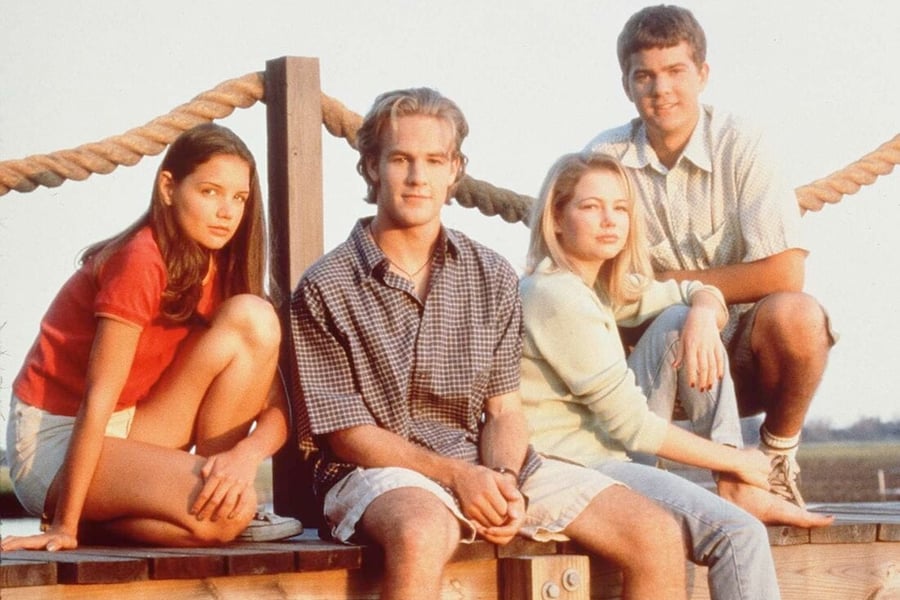
The teen soap’s original hype focused on its creator: Kevin Williamson, the maker of the wildly lucrative Scream movies. But soon the network’s promotional push centered on a dreamy image of Van Der Beek alone on a boat, staring meaningfully at the current. The pilot (and the entirety of Season 1) relied on Van Der Beek to carry the load: Joey (Katie Holmes) was Dawson’s tomboy friend, just like Jen (Michelle Williams) was his new love interest and Pacey (Joshua Jackson) was his then-comedic-but-now-problematic, oversexed sidekick. It’s his point of view — and yes, Holmes, Williams and Jackson all do their parts well. But if Van Der Beek’s performance doesn’t convince the audience to care about Dawson from the jump, none of it works.
The star understood the assignment. In his hands, Dawson projected sensitive, angsty, romantic teen energy. He’s popular but not toxic (yet), looks like a jock but cares about art, and wears his insecurities as easily as his oversized sweatshirt. Reviewing the premiere, critics enjoyed poking fun at the chunky, hyper-aware dialogue (“Our raging hormones are destined to alter our relationship, and I’m trying to limit the fallout”), but most agreed the handsome hero grabbed their attention, with Variety gushing, “as Dawson, Van Der Beek is an exquisitely talented heartthrob.”
Dawson’s Creek was a hit, but a new, particular type of hit. It didn’t have the most viewers, but the most viewers that advertisers wanted — young people with cash who buy things. The first episode attracted a 41 share for teen girls, which means almost half the teen girls in America who watched TV that Tuesday night were watching Dawson’s Creek. The second week, the ratings went up. Van Der Beek hit a nerve: girls wanted to watch a guy who could pine, be open about emotions that they all shared, and have a girl for a best friend. “That’s when life was at its craziest,” he said in a 2020 interview. “At 20-years-old, I got stupidly lucky and found myself in a cultural-phenomenon TV show, and I was suddenly famous.”
The WB double downed on feeding this lucrative micro-audience, and other networks followed. The next year, The New York Times clocked “there are as many as 10 new shows that could be called imitations of Dawson’s Creek in one form or other: that is, dramas built around the concept of a group of young people ‘coming of age.’” Catering to this Creek cohort would soon dominate — a vital cog in the coming Millennial youth pop-culture machine. The now-successful WB would incubate the careers of Ryan Murphy, J.J. Abrams, and Mike White. Snark recap website DawsonsWrap would expand into Television Without Pity and transform how critics and fans interacted with creators. It now seems obvious, but never forget that in another actor’s hands, the role of Dawson — and Dawson’s Creek as a whole — could have easily flopped.
As the series went on, Dawson’s heartthrob sparkle dulled a bit. The writers denied the teen a successful romantic arc, so he moped a bunch, said “soul mates” too often, and made a lot of things about himself in very serious tones. He cried. When the show introduced Pacey as a rival for Joey’s affections in Season 3, it’s not hard to believe that the fan support was anchored in the fact that Pacey was the only main character allowed to have a sense of humour.
Love Music?
Get your daily dose of everything happening in Australian/New Zealand music and globally.

But Van Der Beek always owned the self-awareness and wit his character lacked, which is why diehards continued to love him not just through the run of the show, but for decades afterwards. He knew what Dawson meant to an entire generation of fans. “Don’t take it too seriously,” he told an interviewer in 2020. “Just recognise that you’re able to make people very happy by doing something very simple.”
From Rolling Stone US

