





























Sam Levinson has never let ambition stand in his way. A month out from the April 12 premiere of Euphoria, the show’s creator, writer, and executive producer is at the Warner Bros. lot in Burbank, California, bouncing between multiple editing bays and screening rooms, providing feedback on everything from colour correction to sound design. He marvels at the show’s wide aspect ratio, which allows for more expansive, detail-rich scenes, and the season’s score, by Oscar-winning composer Hans Zimmer, with its cinematic swells.
“A lot of people start out with grand ambitions, but the process can easily wear you down,” says Levinson after a quick golf-cart ride to see a cut of Episode Four with the music placed. “As a team, whether it’s editorial or cinematography, we won’t stop until we get the best version of something. The audience can feel it. They know whether or not you’re trying.”
Still, the road to Season Three was long and arduous. Putting aside the controversies surrounding his most recent project, HBO’s one-and-done series The Idol — which lost its director halfway through filming, spurring a rethink, rewrite, and costly reshoots — the four-year gap since Euphoria was last on air brought challenges both personal and professional. For Levinson, the son of noted filmmaker Barry Levinson (Diner, Rain Man), the spotlight was harsh and unforgiving. And though some of Euphoria’s ensemble players — Zendaya, Jacob Elordi, Sydney Sweeney — saw their acting careers catapult to new heights, others simply didn’t make it. In July 2023, Angus Cloud, who played the gentle drug dealer Fezco, died of an accidental overdose (toxicology reports revealed methamphetamine, cocaine, fentanyl, and benzodiazepines in his system). After filming, Eric Dane, who brilliantly portrayed tortured parent Cal Jacobs, succumbed to the effects of ALS in February of this year.
Through mourning came creative fuel for Levinson, who shares EP duties with his wife, Ashley. The couple had grown close to Cloud, and they last saw him introducing their then-newborn son. “The grief with Angus deeply informed the season,” says Levinson, choking back tears. “He was someone I loved very much. And someone I fought very hard for. Look, I’ve dealt with addiction. I’m well-versed in it. So you’re always kind of prepared, but losing Angus really shook me and made me angry for a lot of reasons.”
These emotions make their way to the screen in the form of Season Three’s storyline, with fentanyl in a starring role. “It’s [a] leading cause of death for people under the age of 45,” says Levinson, who got sober at age 19 following struggles with drugs and alcohol. “That’s where I started this season — exploring fentanyl, how it gets into this country, why [we have a problem with it here].”
The season opens at the Mexico border. It’s been five years since high school, and Rue (Zendaya) is still paying down her debt to Laurie (Martha Kelly) by working as a drug mule. As Christopher Cross’ “Ride Like the Wind” blasts from her Jeep speakers, she’s racing through the desert singing along like she means it.
“It’s one of the best songs of all time,” says Levinson of the 1980 hit. “I was listening to it on repeat. I loved the lyrics and thought, This is what I want the season to feel like. It’s a good way of announcing that we’re back.”
Love Music?
Get your daily dose of everything happening in Australian/New Zealand music and globally.

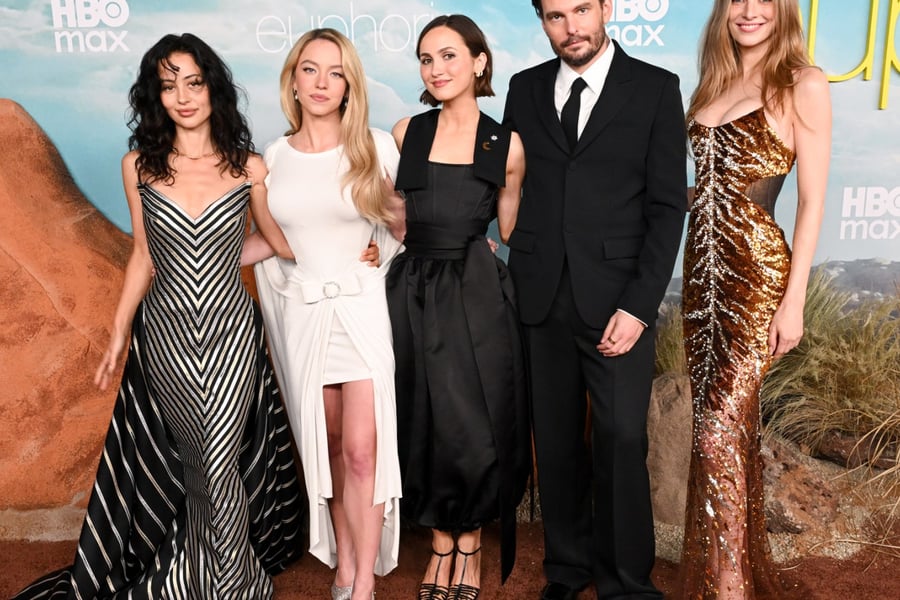
Much of the action finds the gang surrounded by sand dunes and Joshua trees. The border wall — reconstructed for the show in a 15-foot chunk — looms large, both metaphorically and physically, as Euphoria’s motley crew (which includes the lippy Faye, played by Chloe Cherry, understated drug lord Laurie, and menacing newcomer Alamo, played by Adewale Akinnuoye-Agbaje) navigate adult issues and turf wars.
But it’s not all darkness and crime. Jules (Hunter Schafer), now a working artist with a sugar daddy, remains a scene-stealer. In the first three episodes, her story seems tangential, but her sparkling aura takes over every frame she’s in. And unlike previous seasons, which only hinted at Los Angeles, the show leans into the Hollywood glitz, shooting one scene at industry mainstay the Peninsula Beverly Hills, where Maddy (Alexa Demie) and Cassie (Sydney Sweeney) go to see and be seen.
Dane appears in several episodes — diminished as dad to Nate, and now living as a registered sex offender — soft-spoken, funny, and introspective. He filmed his scenes seated. “Eric called me before we started shooting and told me about being diagnosed with ALS, and we had a long talk,” Levinson recalls. “I said to him, ‘However you show up, I’ll make it work.’ He had a lot of grace. He was a beautiful person — intelligent and soulful … and able to find the beats of humour and tragedy [in Cal]. I loved him deeply. I got to say goodbye.”
And Fezco remains a character — in prison for taking the fall in the Pulp Fiction-like shoot-out that ended Season Two — though we only imagine him there, on the other side of a phone call with Rue. “Keeping Angus alive in the story,” says Levinson cautiously, “it was like, if I couldn’t control it in life, at least I can control it in the work.”
MUCH HAS BEEN WRITTEN about production during Season Two of Euphoria, with reports of long hours, last-minute script changes, and at least one on-set injury contributing to an avalanche of press and social media scrutiny. (HBO maintained that “the well-being of cast and crew on our productions is always a top priority” and that the show was “in full compliance with all safety guidelines and guild protocols.”) Complicating matters was a change of corporate ownership, as the network was absorbed first by AT&T, then Discovery, Netflix for a minute, and now, Paramount (pending government approval). At each mega-merger, Euphoria was viewed as prime IP for HBO, and not to be tampered with.
Levinson doesn’t make much of the headlines. Acknowledging the impact of Covid while filming Season Two, and the shift in air date from early 2020 to January 2022, he notes that his “production process always remained pretty dialled in.” Having worked with the same assistant directors for 10 years helped, he adds.
But you could infer there was drama behind the scenes as Levinson and the cast came to terms with Cloud’s addiction struggles. Before shooting started, Levinson says he asked the young actor for a meeting at the production office. Levinson describes seeing a “really skinny” Cloud. “His pupils were pinned, and I said, ‘Angus, I have a feeling you’re doing a lot of opiates.’ It took a few minutes for him to admit to it, and I said, ‘Look, I want to make this season with you. I love you as a person. I can get HBO to pay for a place to help get you clean, because you deserve to have a great life.’”
In fact, Levinson says, he and the network did facilitate a stay in rehab, which pulled Cloud out of shooting for “a few months.” It was one of the reasons for the production delays. “We had to work the schedule around that,” says Levinson. “Angus left the clinic, and he was doing well for a period. And then during shooting, he relapsed again.”
A second intervention and rehab stint followed. “I remember calling my wife and saying, ‘Have the car waiting, because I think I got a shot at getting him back into a facility,’” Levinson shares. “And we had to change the schedule again. But HBO was very understanding, and we were able to move things around. I really wanted to protect what he was going through. [Still], I couldn’t explain to the crew or the cast why Stage 11 was just sitting there for a month when we were supposed to wrap it out.”
Cloud battled migraine headaches due to a previous injury, which Levinson suggests was partly to blame — and perhaps an easy excuse — for his dependence on painkillers. “He was in pain, so it was always a tricky balance of, how does he deal with the migraines without resorting to opiates? And then he would fall into the cycle again.”
After the season wrapped, Levinson says he “had a feeling that Angus wasn’t doing well,” suspicions that were well-founded. “I tried everything to convince him to get clean again. I would tell him, ‘All right, so Fez is in prison, so he’s gotta have a prison body. He’s gotta be working out, so you gotta be in the gym every day!’ He was a beautiful soul, and I loved working with him.”
AS ‘EUPHORIA’ HAS MATURED, it’s gotten more, dare we say, linear. This is especially true of Season Three, which interweaves plot lines of formerly supporting players into their own self-contained arcs within a larger story — like Lexi, played by Maude Apatow, whose Diane Keaton-inspired hipster look pairs perfectly with the Melrose Place-like apartment complex “that is quintessential West Hollywood,” says Levinson, citing one of his “favorite shows of all time.”
It’s also more comical — Cassie in particular shines as a bridezilla whose wedding-day dreams are dashed in splattered blood and tears. “It’s hysterical,” says Levinson. “She’s a very cunning, interesting, ambitious character. She’s never satisfied and perpetually searching for more.” Sweeney, he adds, “is a joy to work with. [She] can literally do anything.… Sometimes I’ll give her a take to just go off: ‘Whatever you want to do, just make sure it’s nutty.’ Then this whole other performance will come out.”
When he began putting this season together, Levinson says that he “intentionally wanted to do something different” in terms of structure. In the first two seasons, he was going for something “more musical and propulsive.” This season, he thought: “Well, why don’t I try doing it as a television show, where there’s more dialogue, where you get to live with the characters a bit more, and it’s not so frenetic and speedy?” With that thinking, he says, “the humour started to poke its way through.”
Levinson’s creative process is also inspired by what he’s listening to. In its first two seasons, Euphoria featured more than 300 needle drops, making music as essential to the series’ storytelling as its glittered, psychedelic visuals. It was intentional from the start, with Levinson and his music supervision team weaving in a host of genres — hip-hop, gospel, Eighties pop, opera — and pricey placements by the likes of Beyoncé, Drake, and Judy Garland. The smooth-sailing vibe of yacht rock was also a go-to, despite the chaos playing out onscreen: Gerry Rafferty’s “Right Down the Line,” Steely Dan’s “Dirty Work,” and the Doobie Brothers’ “What a Fool Believes” made key appearances, and Levinson makes no apologies for the dichotomy. “If I really love a song, I want to let it play, and to sculpt the scene to it,” he says.
Labrinth, the British singer and songwriter, also helped shape Euphoria’s musical identity as its primary composer on seasons one and two. But this season, his name will no longer be listed in the credits. Levinson is tight-lipped about the split, which Labrinth posted about publicly on March 12, writing on social media, “I’m done with this industry. Fuck Columbia. Double fuck Euphoria. I’m out. Thank you and goodnight.” Asked what happened, Levinson tells Rolling Stone, “I don’t know. He’s an incredible collaborator and someone who really built the foundation of the sound of Euphoria.” (A rep for Labrinth, who remains on the Columbia Records roster, declined to comment.)
Levinson is unambiguous, however, about why Zimmer was the right call to step in, crediting the two-time Oscar winner’s scores for influencing his vision for the screen. “On Euphoria, each character’s storyline is like its own film in a way,” Levinson says. “In general, I was less interested in needle drops and more interested in something that guided us through this world.… They’re out of high school, so the pop roots of it have faded away. I see them in these landscapes, dealing with good and evil, the choices you make, the consequences, and the freedom of being older. How I imagined it visually, I wanted to lean into an old-fashioned Hollywood Western score.”
While writing Season Three, Levinson had two Zimmer scores playing: Interstellar and True Romance. “There was something about the Americana of True Romance … It felt like driving across the country and traversing time. There was a romanticism and optimism to it that I really loved,” he says. “Then Interstellar had this wonderment and an underlying religious quality to it that I felt worked well for this season.” He sent Zimmer the scripts, and they sat down for a long talk. That’s when Levinson noticed a giant poster on Zimmer’s wall for Once Upon a Time in the West, the 1968 Sergio Leone spaghetti Western with Claudia Cardinale and Henry Fonda. The film also happens to have Levinson’s favourite score. “I said, ‘Wouldn’t it be exciting to find out what your version of Once Upon a Time in the West would be? … Because I mean it. I want a Western score,’” Levinson says. “And he got excited.”
What Zimmer brings to the sensory experience of the show is grand. Where a lot of modern scores are minimalistic, Levinson says, “I wanted to go the other way. I wanted to push the emotion of it and allow it to reflect the characters’ dreams and hopes and anxieties and wishes.…. The depth of Hans’ work is pretty shocking. When we would get the stems sent over, there were instruments I’ve never even heard of … It’s been one of the most thrilling collaborations of my career.”
The score-to-synch ratio is a noticeable change in Season Three, but there remain some curious song placements: The 1953 Patti Page novelty hit “(How Much Is) That Doggie in the Window?” is paired with Cassie’s titillating attempts at virality. Working her assets for validation on social media and extra income (she and Nate, played by Jacob Elordi, remain a couple), the song “opened the door for a conversation about it lyrically,” says Levinson. “I thought it was a rich and fun way to explore the dynamic between Nate and Cassie. But who’s the doggie?”
Later in the show, new cast member Rosalía contorts at strip club the Silver Slipper — wearing a neck brace, no less — to “Cold as Ice” by M.O.P., the Y2K hardcore rap banger that signalled a split from hip-hop’s shiny suits and bling era to something much grimier.
There remains one elusive needle drop, however. “I’ve tried to use it in everything I’ve made, and haven’t found the right place,” says Levinson of Danzig’s “Mother.” Understandably, it’s a tough fit, but might he get another chance with a Season Four? Levinson will neither confirm nor deny. “With every season, I look at it again and think about it once I’m done with it,” he says. “But yeah, Season Three is a unifying piece, and I’m proud of that.”
From Rolling Stone US

