




























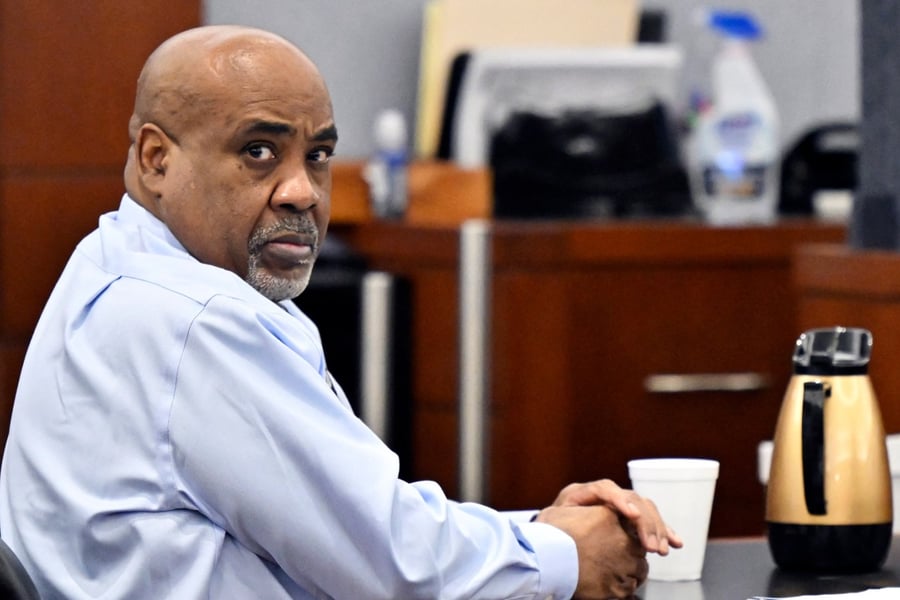
The once-“secret” interview at the heart of Duane “Keffe D” Davis’ murder prosecution was played for jurors Thursday, on the fourth day of his trial over the 1996 drive-by shooting of hip-hop legend Tupac Shakur in Las Vegas.
“Don’t bullshit me, and I won’t bullshit you all,” Davis said at the start of the meeting at his lawyer’s office in Los Angeles County on Dec. 18, 2008. He was there to possibly help himself avoid prosecution on drug charges that could put him in prison for life.
“Nothing you say can be used against you,” former LAPD Det. Greg Kading told Davis, who appeared skeptical of the promise but also weary of his years as a leader of the South Side Compton Crips. He lamented what he described as the “new wave MySpace gang bangers” gaining prominence and the betrayals and distrust of gang life. He said he was “through with this shit” and ready to retire.
Investigators then asked Davis to identify who was riding in the rented white Cadillac that pulled alongside the passenger side of a black BMW driven by Death Row Records co-founder Suge Knight, with Shakur in the passenger seat, as it idled at a red light at the intersection of Flamingo Road and Koval Lane just off the Las Vegas Strip on Sept. 7, 1996.
Davis said he was in the front passenger seat. His nephew, Orlando “Baby Lane” Anderson, was seated behind him, while fellow South Side Compton Crips member DeAndre “Dre” Smith sat behind the driver, identified as Terrence “Bubble Up” Brown.
Davis said he did not have a clear shot, so he passed the gun to the back seat. Smith hesitated, allowing Anderson to grab the weapon and open fire, he said.
“So Orlando shot across Dre?” one of the investigators asked.
Love Music?
Get your daily dose of everything happening in Australian/New Zealand music and globally.

“He leaned over on the window. He rolled down the window, popped ’em,” Davis replied. “If they drove on my side, I would have popped ’em, know what I’m saying. But they was on the other side.”
Former LAPD Det. Daryn Dupree testified Wednesday that he and Det. Greg Kading laid the groundwork for the bombshell interview by first approaching Davis in the garage of his Inland Empire home east of Los Angeles County in late 2008 while investigating the 1997 Los Angeles murder of New York rap legend Christopher Wallace, also known as the Notorious B.I.G. and Biggie Smalls. At that point, he said, Davis was considered a person of interest in the murder because he owned a dark-coloured Chevrolet Impala, and investigators believed Wallace’s killer had been riding in a similar car.
Dupree said they told Davis they had evidence of him dealing cocaine and PCP, and with his prior criminal history, he could be facing a potential life sentence. “We sat in his garage and advised him of what we had,” Dupree testified. They suggested he find an attorney to discuss his options. The parties later gathered at the U.S. Attorney’s Office in Los Angeles, he said.
At that meeting leading up to the Dec. 18 gathering, investigators asked Davis if he was involved in Biggie’s murder. “He said no, he didn’t have anything to do with ‘that one,’” Dupree testified. “We were like, ‘That one? What do you mean?’ And then he said, ‘We did the other one.’ …To me, personally, the only other one was Tupac.”
Dupree said Davis caught them off-guard.
“We didn’t ask him any questions about Tupac. He offered that on his own,” he said. “We were shook. We were surprised.”
The subsequent “proffer session” on Dec. 18 was set to formalise his statement as part of a possible cooperation deal, he said. That meeting was recorded, though Dupree said he didn’t know it at the time. Asked if anybody notified Las Vegas authorities that Davis was going to be talking about Shakur’s murder, he replied, “Unfortunately, no.”
Davis, 63, has pleaded not guilty to one count of murder with use of a deadly weapon and has been jailed since his arrest in September 2023. Prosecutors allege he obtained the .40-calibre Glock used in the shooting and was calling the shots when Anderson allegedly fired.
Prosecutors say the drive-by shooting was retaliation for a beating hours earlier inside the MGM Grand, which itself stemmed from an earlier gang confrontation. Shakur and members of his entourage attacked Anderson after Death Row associate Trevon Lane spotted him in the casino crowd following a Mike Tyson fight.
In his opening statement Monday, Clark County Deputy District Attorney Binu Palal said Shakur and others in his entourage attacked Anderson because they believed he had been among a group of South Side Compton Crips who allegedly robbed Lane, a Mob Piru Bloods member, of his Death Row chain and medallion at a mall outside Compton about two months earlier.
Palal told the jurors Davis essentially confessed when he gave his statement during the 2008 interview with authorities. He argued Davis then made the details of the statement fair game when he later repeated it in public interviews and his 2019 memoir, Compton Street Legend. Davis had been promised his 2008 statement couldn’t be used against him, but he wasn’t granted immunity, prosecutors say.
Davis and his lawyer, Michael Sanft, have centred their defense on the argument that Davis invented his accounts for personal advantage, entertainment and money. He needed leverage in 2008, so he fabricated a story, they say. In his opening, Sanft emphasised that authorities did not charge Davis after the 2008 interview because they didn’t find it credible. He argued the detectives could have tried to corroborate Davis’ claims in various ways but gave up without a thorough investigation. “It’s because they knew he was full of crap,” Sanft told jurors.
Dupree testified that he believed Davis was telling the truth during the 2008 proffer. “I didn’t think Mr. Davis was lying because he put the gun in his nephew’s hand. And if anyone knows anything, from what I hear, Mr Orlando Anderson was the man, besides Keffe D, in that neighbourhood. He was the prince, and his family loved him. I didn’t think that Mr. Davis would put the gun in his own nephew’s hand, dead or alive, and put that smut on him, unless it was true.” (Anderson died in 1998 at age 23 in a shooting with a rival Crips member at a Compton car wash, police said.)
The first witnesses at Davis’ trial was former Las Vegas police officer Garry Dale, who said he rode in the ambulance with the wounded Shakur and repeatedly asked who shot him. Dale testified that Shakur refused to identify anyone, saying, “No, we’ll take care of it.”
Former Las Vegas Metropolitan Police homicide detective Brent Becker testified that after the 1996 shooting, visiting gang investigators from Compton quickly identified Anderson from surveillance video showing Shakur attacking Anderson inside the MGM. The ID made Anderson an early suspect. Becker said Knight came in for questioning three nights after the shooting but claimed he could not identify anyone involved. “I thought he lied to us,” Becker testified.
On Tuesday, James “Mob James” McDonald, a former Mob Piru Bloods member who said he worked unofficial security for Knight, testified under subpoena that the shooting quickly triggered a “gang war” in Compton. McDonald repeatedly resisted defense efforts to make him identify people with knowledge of the shooting. “I know everybody that was there,” he declared, before dodging follow-up questions from Davis’ defense lawyer. “I don’t want to send him to prison, even though we don’t like each other,” he said, referring to Davis. “You’re asking me questions that can hurt him. … You’re asking something that’s gonna hurt this dude.”
Reggie Wright Jr., Knight’s former head of security, followed McDonald on the witness stand. Wright identified members of Knight’s entourage beating Anderson the MGM Grand surveillance video. Wright testified that he had also seen Davis with members of Sean Combs’ Bad Boy Records entourage during a tense confrontation at the 1996 Soul Train Awards in Los Angeles. Wright said someone on the Bad Boy side brandished a gun, but he did not believe Davis was the person holding the weapon.
In his separate testimony, Dupree described himself as being low on the totem pole in the LAPD task force that was working with the federal agencies, including the FBI, ATF and DEA. He said the East Coast-West Coast war pitting Sean Combs’ Bad Boy Records against Knight’s Death Row was a focus. He said the task force signed Davis up as a “confidential informant” in March 2009 and traveled with him to New York. The plan was for Davis to meet up with Eric “Zip” Martin, an alleged drug trafficker identified in court as the link who introduced Davis to Sean Combs. Dupree said they were trying to confirm the claims Davis made during his proffer.
“Sean ‘Puffy’ Combs supposedly had given money to Zip Martin to give to Mr. Davis for payment for the Tupac murder,” Dupree testified. “Fast forward, we go to Mr. Davis, he says he can rekindle that relationship with Zip and get him to talk about the money given from Sean Combs to Mr. Martin that never got to Davis.”
Dupree said the plan failed when Davis arrived in New York, and Martin, who was in poor health, passed him off to his nephew. According to Dupree, he and Kading were trying to solve the Wallace murder with their investigation while members of the task force on the federal level were pursuing a RICO case.
“[They were] trying to solidify that Death Row Records was built on narcotics, and Bad Boy Records,” Dupree told jurors. “I’m from the hood. Everybody knows it was, okay. Everybody knows that those record companies were started with the sales of narcotics. So, the feds were looking at a RICO, we cared about the murders. So, this was chasing the money. This was chasing Sean Combs, to see if he was involved in the hit on Mr. Shakur.”
Combs, now serving a 50-month prison term for his 2025 conviction on two counts of transportation to engage in prostitution, has vehemently denied any involvement in Shakur’s death.
From Rolling Stone US

