




























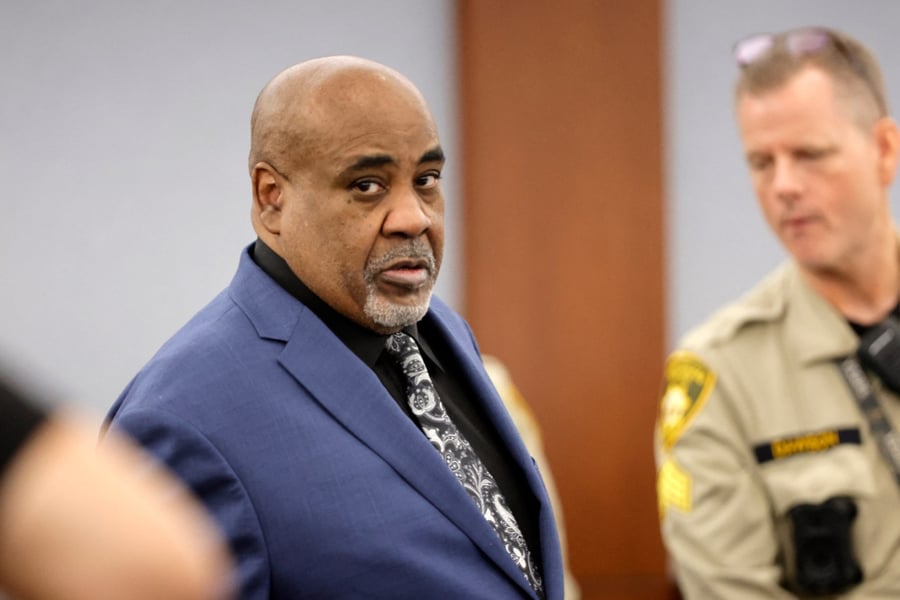
Prosecutors argued Monday that their murder case against Duane “Keffe D” Davis rested on far more than his own words about Tupac Shakur’s 1996 killing. His defence lawyer countered that Davis had lied for years to police, TV producers, and podcasters, and that without those stories, there was not enough evidence to convict him.
“This was a case about gang retaliation and revenge,” Clark County Deputy District Attorney Binu Palal told jurors Monday during his closing argument at Davis’ murder trial in Las Vegas. “This case is drenched with circumstantial evidence even beyond Mr. Davis’ statements.”
Palal started with a “little experiment,” highlighting only the evidence presented during the two-week trial that did not rely on the secret police interview Davis gave to Los Angeles police in 2008 in which he described himself as the mastermind behind the shooting of Shakur on Sept. 7, 1996. (Davis gave the account under a proffer agreement while seeking leniency in an unrelated drug case.) The interview was intended to remain confidential, but the recorded interview was admitted at trial after Davis repeated the details in a BET docuseries, other media interviews, and his memoir, Compton Street Legend.
Palal said the evidence showed Davis and his nephew, Orlando “Baby Lane” Anderson, were prominent members of the South Side Compton Crips who believed they had to respond with violence after Shakur and Death Row Records founder Suge Knight attacked Anderson inside the MGM Grand casino hours before Shakur was fatally shot. The casino beating, Palal said, was itself retaliation for an earlier gang confrontation at a Los Angeles County mall. He reminded jurors they heard directly from a former gang member who was part of the brawl near a Foot Locker store that day who testified that a Death Row Records chain and medallion went missing. Palal said the alleged theft of the necklace was “an ultimate sign of disrespect” that demanded retribution.
The prosecutor then used a courtroom monitor to show jurors copies of the hotel records placing Anderson at the Excalibur hotel from Sept. 6 through Sept. 8, 1996, and Corey Edwards, an older South Side Compton Crips member close to Davis, at the Monte Carlo hotel that weekend. Surveillance video inside the MGM also captured the beatdown of Anderson.
Palal then pointed to a detail Davis provided to authorities in 2008 that, he said, had not previously been made public. Davis told investigators that a group of women had been driving in a Chrysler Sebring near the BMW shortly before the shooting, interacting with its occupants in a celebratory manner. One of those women, Ingrid Stokes, testified during the trial that she had been in the Sebring and had been afraid to speak publicly for fear of retaliation. “Snitches get stitches,” she told jurors.
Palal then turned to Davis’ own statements, asking why he would have supplied “granular details” to police in 2008, including accounts of switching vehicles before the shooting, that implicated additional people if he were merely inventing a story to avoid a potential life sentence. Davis, he argued, could simply have claimed to have heard about the killing rather than placing himself inside the rented white Cadillac with his nephew, or could have blamed someone else altogether.
Love Music?
Get your daily dose of everything happening in Australian/New Zealand music and globally.

“It makes no sense ‘to put that smut’ … on somebody that you love,” Palal said, invoking testimony about Davis identifying Anderson as the gunman. Anderson, long considered a suspect in Shakur’s killing, denied involvement before he was killed in an unrelated Compton shooting in 1998 at age 23. Palal argued Monday that Davis implicating Anderson made the most sense “as a truth to get out of a life sentence.”
“For nearly 18 years, Duane Davis has told the police, television producers, books, YouTube interviewers, anybody that will listen, that he was responsible for the murder of Tupac Shakur,” Palal told jurors. “Tell him you hear him and find him guilty.”
When it was his turn, defence lawyer Michael Sanft portrayed Davis as a showman who fabricated his account to gain an advantage in a criminal case before he repeated and embellished the story because it brought him attention and money.
“He’s not telling you the truth, he’s telling you fiction,” Sanft said of Davis’ 2008 statement to police. He argued Davis’ various accounts conflicted with one another and that some were even contradicted by the evidence. For instance, he pointed to a passage in Davis’ book claiming that Stokes’ Chrysler Sebring was struck by gunfire and had a shattered window. Stokes testified the car was never hit and no glass was shattered.
“The state wants you to believe this was a confession, that he was somehow there in person at the time of the shooting,” Sanft argued Monday. “We’re presuming all this stuff. … We can’t put Orlando in the car. We can’t even put Davis in Las Vegas.”
The defence questioned why prosecutors never subpoenaed Knight, who is now serving a 28-year prison sentence in California after pleading no contest to voluntary manslaughter in a 2015 hit-and-run death. Sanft questioned why Knight would have paid Anderson to testify on his behalf at a probation violation hearing after Shakur’s shooting if he believed Anderson had tried to kill him too. Sanft also asked why Davis wasn’t targeted for retaliation if his role in the killing was as widely known as prosecutors suggest.
Over his two-hour closing, Sanft claimed that the Las Vegas Metropolitan Police Department mishandled the search for the Cadillac, allowed unauthorised people to access the case file, and lost police reports during a technology upgrade. He also asked why there were no police reports or insurance claims from Foot Locker documenting the mall confrontation in which the Death Row Records chain was allegedly stolen.
Sanft said Davis “never read” his own book and argued that even the spelling of his nickname on the cover was wrong. He said “Keffe D” should have been spelled “Keithy D,” pointing to a jacket found during a 2023 search of Davis’ home that bore that spelling. In a counter to Palal’s closing, Sanft replayed part of Stokes’ testimony in which she denied that her group had shouted, “Tupac! Tupac!” as Davis had told police.
“Do not presume anything in this case,” Sanft urged jurors Monday as he asked them to return a not-guilty verdict. “Repeating a fiction over and over again,” he said, does not “make it a fact.”
Davis, 63, has pleaded not guilty to one count of murder with use of a deadly weapon and has been jailed since his September 2023 arrest. His 2008 interview with police loomed large over the trial, particularly the part where he told police he personally handed a loaded .40-caliber Glock to the back seat, where Anderson took the weapon and opened fire through a rear window.
During the trial, jurors heard Davis say in the interview that he had expected the Cadillac to pull up on the driver’s side of the BMW. Palal argued Monday that the BMW’s position at the red light likely was the middle lane, leading Davis to expect that, but that the Cadillac instead pulled alongside the passenger side.
“If they drove on my side, I would have popped ’em, know what I’m saying,” Davis said in the 2008 police interview. “But they was on the other side.”
During the trial, jurors heard from former LAPD Detective Daryn Dupree testified that Davis first volunteered his involvement in Shakur’s killing while investigators were questioning him about the 1997 slaying of Christopher Wallace, the rapper known as the Notorious B.I.G., or Biggie Smalls. Dupree said he and fellow Detective Greg Kading had confronted Davis with evidence they believed linked him to cocaine and PCP trafficking. Facing a potential life sentence, Davis was told he could help himself by cooperating. Davis denied involvement in Biggie’s killing, Dupree testified, but then said, “We did the other one.” Davis later sat for the recorded proffer interview with his lawyer present.
“Don’t bullshit me, and I won’t bullshit y’all,” Davis said at the outset of that first meeting. Kading assured him, “Nothing you say can be used against you.”
Davis told the investigators, “We did what we had to do.” He said the group fled in the Cadillac, ditched it behind a hotel, and then went off to “smoke weed and drink.” Knight was wounded but survived the ambush. Shakur was shot multiple times and died six days later at 25.
During the trial, witnesses described the investigation and atmosphere surrounding the shooting 30 years earlier. Former Las Vegas police officer Garry Dale testified that he rode in the ambulance with a wounded Shakur and repeatedly asked him to identify his attacker. Shakur refused.
“No, we’ll take care of it,” Dale recalled him saying.
Former Las Vegas homicide detective Brent Becker testified that gang investigators from Compton quickly identified Anderson from MGM Grand surveillance footage. Becker said Knight came in for questioning three nights after the shooting but claimed he could not identify anyone involved.
“I thought he lied to us,” Becker testified.
From Rolling Stone US

