





























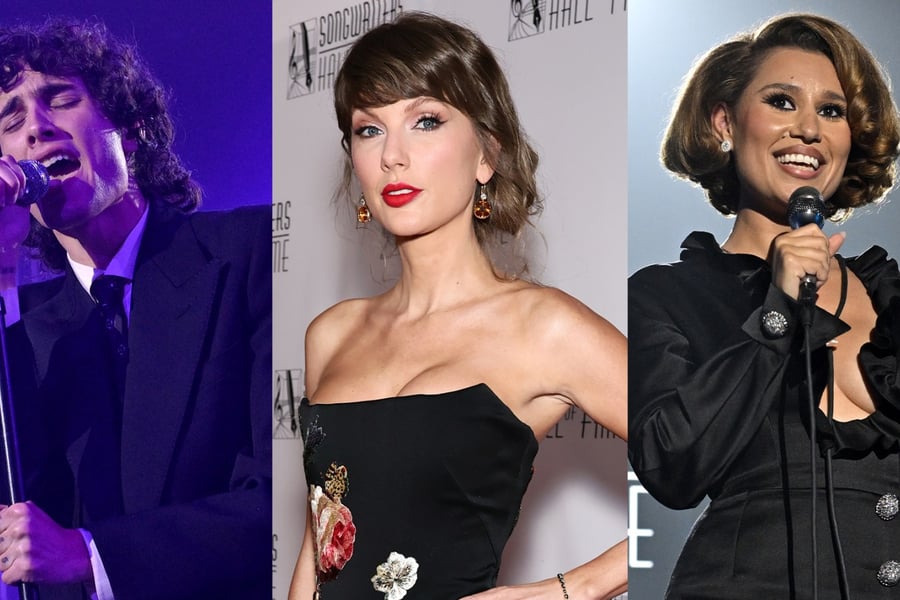
Songwriters have had a tough go of it since streaming turned the music economy on its head. They play a pivotal role — crafting our biggest hits and our cultural touchstones — but to hear the honourees in the Songwriters Hall of Fame‘s Class of 2026 tell it, the profession remains a minefield of rights and royalties. Walter Afanasieff, best known for his work with Mariah Carey, joked about lawsuits related to credits; KISS’ Paul Stanley and John Fogerty referenced label woes; Raye advocated for a songwriter’s share of recording master rights.
To understand music publishing is a bit like trying to explain nuclear fusion. The complicated formulas of splits and royalties are still being dictated by legal decrees dating back decades, and what was once a viable career path — in the days of physical sales, writers credited on album tracks could earn a good living even if those particular songs weren’t singles or hits — now looks more like volunteerism, as many songwriters have decried.
The one percent of star artists aren’t immune from these challenges, though some are more adept at navigating them. Two of the night’s inductees, Taylor Swift and Alanis Morissette, might be the shining examples — both carry major writing credits in addition to being performers. Swift was lovingly introduced at the gala dinner by filmmaker Steven Spielberg (at her request), who said of Swift, “Through her songs, she makes us believe … we can grow up, live, love, make mistakes, succeed, fail, and yet continue to believe in our own self-worth.”
Brandi Carlile expressed a similar sentiment when she introduced Morissette. Following a riveting rendition of “Uninvited,” Carlile joked of being “a dramatic young gay” while growing up outside of Seattle during the Nineties. “When grunge music went from alternative to the Top 40, the charts were dominated by some very intense white men,” she said. “And I love them in my own way, but I needed to hear a woman’s voice sing rock & roll. And that voice came not from Seattle, but from Ottawa. Her songs penetrate our consciousness and pierce the soul.”
Across the pond, Raye, recipient of the Hal David Starlight Award, honed her skills in a “rough around the edges” neighbourhood in South London. “I come from a lineage of not failed songwriters, because writing songs is the commentary of the human experience,” she shared from the stage. “It’s just such a wild miracle when you get to tell that story, and that people will like it, or connect to it, or listen to it, or sing it back to you.”
With that in mind, the Songwriters Hall of Fame paired its awards dinner with tribute performances. Tamar Braxton took on “Single Ladies (Put a Ring on It)”, and Kylie Cantrall sang “Umbrella,” both in honour of work by Christopher “Tricky” Stewart. Madison Cunningham performed an acoustic version of “What’s Love Got to Do With It” and Taylor Dayne belted “We Don’t Need Another Hero,” written by inductees Terry Britten and Graham Lyle.
Rock was represented by Fogerty, whose unscripted and somewhat meandering speech covered his formative years in excruciating detail. He was presented with the Johnny Mercer Award by Steve Miller, who commended Fogerty’s “unwavering fight for artists’ rights.” The Creedence frontman cycled through his biggest hits, including “Proud Mary,” “The Old Man Down the Road,” and “Have You Ever Seen the Rain,” which had attendees (including Swift with fiancé Travis Kelce) on their feet.
Love Music?
Get your daily dose of everything happening in Australian/New Zealand music and globally.

Smashing Pumpkins’ Billy Corgan took on KISS, performing “Rock and Roll All Nite” and “Shout It Out Loud,” the latter with Goo Goo Dolls’ John Rzeznik, who noted the band’s unique enunciation of “ev-e-ry day” in the classic song. In his acceptance speech, Stanley recalled growing up in New York. “I would go to the Brill Building as a teenager. I wanted to follow in the footsteps of Carole King and Gerry Goffin, Lieber and Stoller, Rodgers and Hammerstein, Lerner and Loewe. So, to be in this rarefied company, and to be accepted into this group of people who inspired us and motivated us, is truly something we never could have imagined.” (Gene Simmons, who was honoured along with Stanley, could not attend the event due to a “family emergency.”)
Gavin DeGraw and Sheléa rounded out the night, the former delivering a moving rendition of Kenny Loggins’ “Danny’s Song.” His was among the most energetic performances of the evening, and emotional as well, as Loggins credited his older brother Danny for leading him to music. Joined by his stepdaughter Hunter Hawkins (whose album Loggins is producing), the group threw down on “Heart to Heart” and “Celebrate Me Home.”
Walter Afanasieff enlisted the other major Hollywood star in the room: Jeremy Renner, who praised the songwriter and producer for helping curate “the soundtrack of our lives.” His speech was preceded by Sheléa’s faithful takes on “All I Want for Christmas Is You,” “Hero,” “My All,” “One Sweet Day,” and “Anytime You Need a Friend.”
Naturally, all eyes were on Swift for much of the night, and the unapologetic fan of popular music did not disappoint — singing along, cheering, swaying, even holding on to her guy for brief moments. But even she was mesmerised when Sombr took the stage to perform Swift’s own “Cardigan” and “Dear John.”
“His writing is so exceptional that it makes me actually envious,” Swift said following Sombr’s tribute. “He’s gonna be at the top of my Spotify Wrapped, guaranteed.”
Swift’s induction marked a major milestone for the Songwriters Hall of Fame, as she becomes the youngest woman inducted. The significance was not lost on the artist, who, in her acceptance speech recounted her own development as a writer using the “Mary Poppins bag” of elevated wordplay she exhibits in her own songs.
“Finishing [‘Love Story’] was me trusting my instincts as a writer,” she said. (As she recalled it, co-writer Craig Wiseman had reacted indifferently to an early version.) “Now more than ever, in an industry that seems to be consumed by metrics, data, analytics, and we’re all trying to predict whether something will trend or not… Writers need to trust their human intuition. And I think the thousands of hours I’ve spent lovingly working at this craft have taught me to really be able to identify the ideas that jump out at me, sparkle and linger, the ones that matter to me most.”
From Rolling Stone US

