




























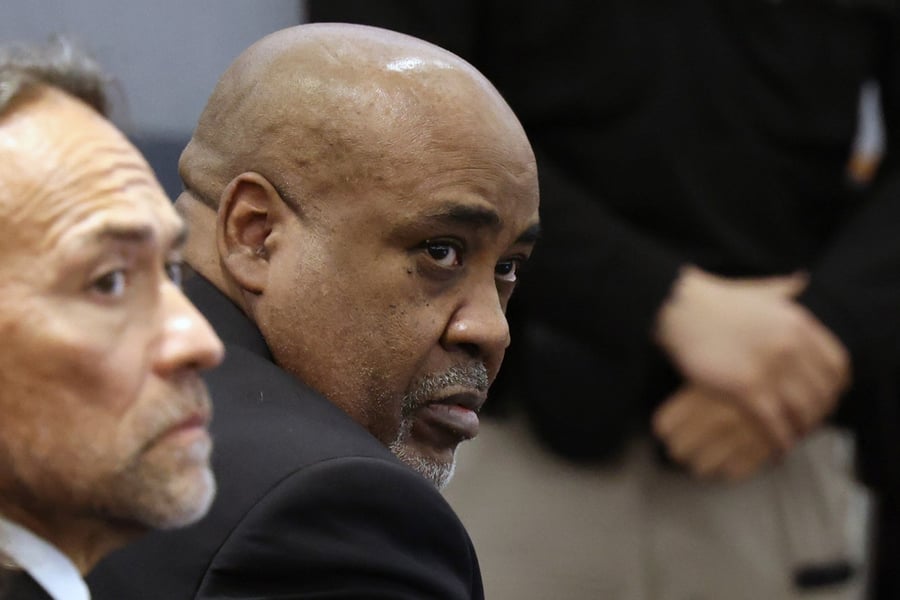
Duane “Keffe D” Davis, the former Compton gang leader convicted of orchestrating the 1996 murder of Tupac Shakur amid escalating East Coast-West Coast rap rivalries, was sentenced Tuesday to 40 years to life in prison, capping a notorious cold-case homicide probe after three decades of uncertainty.
Nevada District Court Judge Carli Kierny sentenced Davis, 63, after a Las Vegas jury needed only three hours to unanimously convict him of first-degree murder with use of a deadly weapon on Aug. 31. During the two-week trial, Clark County prosecutors presented evidence that Davis orchestrated the deadly drive-by shooting by obtaining the gun, passing it to the back seat of a car, and giving his nephew the green light to open fire on the hip-hop legend.
Given an opportunity to address the court before his sentencing, Davis was unrepentant. “I just want my stuff back that they took out of my house, all them pictures,” he said, referring to photographs seized during a search. Asked by the judge if he had anything else to say before hearing his fate, Davis replied, “No, I’m good. I’m going to appeal this case, for sure,” according to a livestream of the proceeding from the Associated Press
Shakur’s sister, Sekyiwa “Set” Shakur, called her brother her protector and the “promise of all our grandparents” in an emotional victim impact statement. In a soft voice as she held back tears, she said her brother was “born an icon.”
“He had so much promise [and] intentions for a better world for our people. He had plans, he had manifestos,” she said. “We lost something. Our whole generation lost something huge.… I do believe when you take a life like that, you do deserve every minute of the maximum amount of punishment to sit down and contemplate what you’ve done to this world, not just to me.”
When it was time to give her sentence, Kierny rebuked Davis for publicly acknowledging his involvement in Shakur’s murder in a BET interview and in his memoir, only to argue that he has since abandoned gang life, become a grandfather, and deserves to live out his remaining years in peace.
“I’m here to tell you that’s not how this works,” the judge said. “You don’t get to take a man from his family. You don’t get to take his very life, his whole future from him, and just walk away from it, especially when that man is Tupac Shakur. The world never forgot about him and his death, and neither did Las Vegas. It took us 30 years, but at this time, you are going to face justice for what you did on Sept. 7, 1996.”
Love Music?
Get your daily dose of everything happening in Australian/New Zealand music and globally.

Davis has maintained his innocence but did not testify in his own defence. His lawyer argued investigators failed to prove Davis was even in Las Vegas when the “California Love” rapper was shot on Sept. 7, 1996. Prosecutors, meanwhile, said Davis orchestrated the shooting as retaliation for an attack on his nephew, Orlando Anderson, at the MGM Grand casino hours earlier.
Surveillance footage showed Shakur, Death Row Records co-founder Marion “Suge” Knight, and others beating Anderson, a member of the South Side Compton Crips, after a Mike Tyson fight. Prosecutors said the confrontation grew out of a longstanding feud between the Crips and the rival Mob Piru Bloods, a gang with ties to Death Row.
A key piece of evidence was a recorded 2008 interview in which Davis told Los Angeles detectives who were working with a federal task force that he had been riding in the front passenger seat of the white Cadillac that pulled alongside the BMW carrying Shakur and Knight near the Las Vegas Strip. Davis said he handed a loaded .40-caliber Glock to Deandrae “Big Dre” Smith in the back seat, but Smith hesitated, allowing Anderson to grab the gun and open fire. “He leaned over on the window. He rolled down the window, popped ’em,” Davis said in the recording played for jurors. “If they drove on my side, I would have popped ’em.”
Knight was wounded but survived. Shakur, struck multiple times, died six days later in a hospital at age 25. Anderson denied involvement before he was killed in an unrelated shooting in 1998. Smith died of natural causes in 2004, and the alleged driver of the Cadillac, Terrence “Bubble Up” Brown, died in a shooting at a Compton marijuana dispensary in 2015.
Davis sat for the secret police interview in 2008 while he was seeking leniency in an unrelated narcotics investigation. Prosecutors said he later forfeited the protections of his cooperation agreement when he publicly repeated the story in interviews and in his memoir, Compton Street Legend. Davis was arrested in September 2023 and has remained in custody.
Defence lawyer Michael Sanft argued that Davis fabricated the account he told police to avoid drug charges and later embellished it for profit. He pointed to inconsistencies in Davis’ various retellings and discrepancies with witness testimony, arguing that investigators failed to corroborate key details. “We can’t put Orlando in the car. We can’t even put Davis in Las Vegas,” Sanft told jurors.
Prosecutors countered that Davis had repeatedly implicated himself in extraordinary detail. Former Los Angeles police Detective Daryn Dupree testified that Davis first volunteered his involvement while being questioned about the 1997 killing of Christopher Wallace, the rapper known as the Notorious B.I.G. Asked about that case, Davis denied involvement but told detectives, “We did the other one,” Dupree said on the witness stand.
In his closing rebuttal, Clark County Chief Deputy District Attorney Marc DiGiacomo said the 2008 proffer agreement was beyond the control of Las Vegas authorities, and Davis benefited from it for years. He claimed Davis eventually went public with his own account because he was angry when Los Angeles Police Detective Greg Kading wrote his own book about the case. The long delay before Davis was charged did not mean Las Vegas investigators doubted his culpability, DiGiacomo said.
“We had to eat crow and allow a murderer to live in Henderson and not charge him because of the various things that happened in this case,” DiGiacomo said. He closed by pointing to a social media clip in which Davis boasted that he had “beat the streets,” “beat the feds,” and “beat cancer.”
“And now he’s trying to beat 12 of you,” DiGiacomo told the jury.
After hearing the guilty verdict, Davis vowed to pursue an appeal. The judge ordered him held without bail. In a jailhouse interview with reporter Jeff Weiss a few days later, Davis said, “Shit, I ain’t worried. I’m getting out on an appeal. They violated my civil rights.”
From Rolling Stone US

