


























Home

The 100 Greatest Punk Albums of All Time

We rank the 100 greatest punk albums of all time: Ramones, Clash, Sleater-Kinney and more.
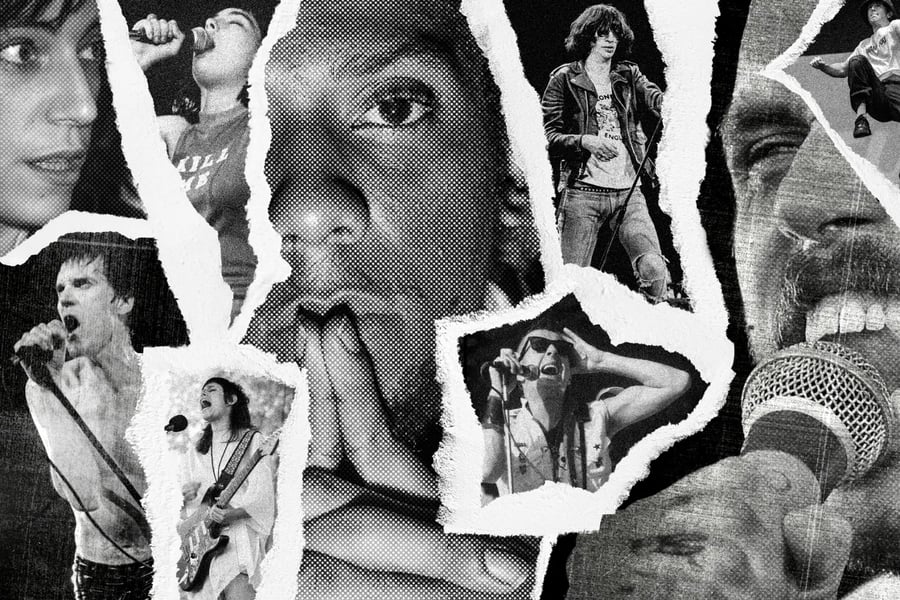
Punk albums photo illustration

ILLUSTRATION BY MATTHEW COOLEY

Punk rock started in 1976 in New York, when four cretins from Queens came up with a mutant strain of blitzkrieg bubblegum. The revolution they inspired split the history of rock & roll in half. But even if punk rock began as a kind of negation — a call to stark, brutal simplicity — its musical variety and transforming emotional power was immediate and remains staggering. To celebrate the 50th anniversary of the Ramones’ toweringly influential self-titled debut, we’ve compiled a list of the 100 Greatest Punk Albums of All Time.

If Ramones was Year Zero for punk rock, it didn’t come without precedent, so we included essential forebears like the Stooges, the New York Dolls, and Patti Smith, artists who were punk in spirit before the style really had a name. When punk did happen, it was an explosion of ideas and possibilities. Along with the Sex Pistols and the Clash, Black Flag and the Descendents, Bad Brains and Minor Threat, you’ll find Gang of Four mixing funk attack and Marxist theory, the ice-storm goth of Joy Division, the Mekons’ existential country visions, riot grrrl radicals like Bikini Kill and Sleater-Kinney, ska punk from Rancid and Operation Ivy, multiplatinum pop-punks Green Day and Blink 182, and new-look hardcore bands like Turnstile and Soul Glo.

Punk and its many offshoots have spawned so much great music that we’ve included a list of 200 related albums to check out. “Punk rock should mean freedom,” said Kurt Cobain in 1991, just as Nevermind was exploding punk values across the middle American mainstream. Here’s one map to where that freedom can take you.

Photographs in illustration by:

Richard E. Aaron/Redferns/Getty Images;  Lindsay Brice/Michael Ochs Archives/Getty Images; Peter Noble/Redferns/Getty Images;  Gus Stewart/Redferns/Getty Images; Jim Dyson/Getty Images; PAUL BERGEN/ANP/AFP/Getty Images; Paul Bergen/Redferns/Getty Images; Lisa Lake/Getty Images/Anheuser-Busch; Richard McCaffrey/Michael Ochs Archive/Getty Images

Contributors:

, , , , , , , , , , , , , , , ,

Love Music?

Get your daily dose of everything happening in Australian/New Zealand music and globally.

From Rolling Stone US

59

Iceage, ‘New Brigade’

This Danish band — whose members were all in their teens when they released their stunning debut — sold knives at their merch table and posted photos of fans who’d been bloodied at their shows. On New Brigade, they deliver a dervish blur of hardcore violence, Scandinavian austerity, and goth introspection — all pushed beyond the sonic and emotional breaking point. New Brigade exuded a sense of wonder at its own chaos and ugliness, but at the heart of the album, you can hear singer-guitarist Elias Bender Rønnenfelt hungering for meaning amidst the maelstrom. “It’s a life, paranoid/You’re blessed with holy hands,” he sings on the cathartic album-closer “You’re Blessed,” his implosive rage fueling a spiritual quest. —J.D.See also: Protomartyr, Under Cover of Official Right (2014); Royal Headache, High(2015)

58

Liliput/Kleenex, ‘Liliput’

LiLiPUT were one of the most fiercely original punk bands — Swiss women chanting in fractured English, in a herky-jerky rush of avant-garde playground bangers and experimental art-funk. The Zurich feminist collective started out calling themselves Kleenex, until the lawyers came knocking, then became LiLiPUT halfway through their career. They were kindred spirits to the Slits and the Raincoats; Kurt Cobain listed “anything by Kleenex” on his famous list of 50 favorite albums. But despite a great string of Rough Trade singles — “Ain’t You,” “Split,” the irresistible “Ü” — they were barely known in the U.S. before breaking up in 1983. This collection has all 46 of their songs, an anarchic hop that practically demands you pogo along, jumping up and down to yell, “Ain’t you wanna get it on?” —R.S.See also: Scritti Politti, Early (1979/2005); Television Personalities, And Don’t the Kids Just Love It (1979)

57

Gun Club, ‘Fire of Love’

Los Angeles’ Gun Club melded the gutter-dwelling ferocity of L.A. punk with the swampy grooves of American blues, with Texas-born yelper and slide guitarist Jeffrey Lee Pierce bringing together his past and present in combustible fashion on cuts like the chugging “Sex Beat” and the cracked-mirror reimagination of blues guitarist Tommy Johnson’s “Cool Drink of Water.” Their 1981 debut has bare-bones production that places Pierce’s frenzied howl at the fore, his stories of sex, drugs, and demons portraying America’s steadily growling underbelly and getting an extra charge from his band’s runaway-locomotive playing. —Maura JohnstonSee also: Rocket From the Crypt, Scream, Dracula, Scream (1995); The Jon Spencer Blues Explosion, Orange (1994)

56

Public Image Ltd, ‘Second Edition’

When the Sex Pistols collapsed, Johnny Rotten started using his given name John Lydon and formed Public Image Ltd. The U.K. release of their second LP was titled Metal Box and retailed as 7-inch singles in a tin can; the traditionally packaged American version was called Second Edition. In any form, this was going to be one of the harshest, strangest records in your collection. Lydon’s surrealist yammerings on “Swan Lake,” Careering,” and “Albatross” ricochet off Jah Wobble’s molten dub-reggae-influenced bass lines and Keith Levene’s banshee guitar peels. “Hindsight does me no good,” Lydon offers on the magisterial meltdown “Poptones,” casting aside his old role as U.K. punk’s biggest rock star. By now, PIL’s revolutionary post-punk has influenced just as many bands as the Pistols. —J.D.See also: Magazine, Real Life; Radio 4, Gotham (2002)

55

Operation Ivy, ‘Energy’

From its opening growl, Operation Ivy’s only studio album lives up to its title. The originators of the California ska-punk sound — combining the gruffness of suburban hardcore with the rhythms of Jamaican dance music — the band went on to influence generations of skateboarders and punks alike, putting Berkeley’s Gilman Street collective on the map in the process. Still, Energy is more than just infectious upbeats. Guitarist Tim Armstrong, who would later go on to start Rancid, and singer Jesse Michaels wrote songs that tackled philosophy (“Knowledge”), scene infighting (“Unity”), commercialism (“Artificial Life”), and even colonialism (“Missionary”) — showing teenagers that they could slam dance and think for themselves. —E.G.P.See also: Screeching Weasel, My Brain Hurts (1991); The Suicide Machines, Destruction by Definition (1996)

54

The Cramps, ‘Songs the Lord Taught Us’

When Songs the Lord Taught Us landed with a thwack onto the world in 1980, it was something of a Rorschach test: Sure, you had turned-off skeptics horror-struck by lines like “I use your eyeballs for dials on my TV set,” but there were also legions of overjoyed misfits thrilled by the way the band’s mix of high-camp, smuttiness, and violent delights toyed with the punk orthodoxy in an unapologetic B-movie kind of way. Luckily, the latter view is what’s prevailed: Though the album was marked by notoriously tough recording process, helmed by temperamental rock icon Alex Chilton, it stands as a testament to the Cramps (and the everlasting love and chemistry between Poison Ivy and Lux Interior) and the instinct and imagination across their careers. —J.L.See also: Pussy Galore, Right Now! (1987); Electric Eels, Having a Philosophical Investigation With the Electric Eels (1989)

53

Devo, ‘Q: Are We Not Men? A: We Are Devo’

Devo bounded out of Akron, Ohio, with a bunch of bizarrely fun songs that treated the hilarious imbecility of modern American late-capitalist existence like a cosmic in-joke. Formed by college buddies in the early Seventies, they sped up their sound after hearing punk rock to create their landmark debut. Are We Not Men? has something weird to say about sex (“Uncontrollable Urge”), religion (“Praying Hands”), masculinity (“Mongoloid”), technological utopianism (“Space Junk”), and much more, with a tense, clattering, oddly jovial sound that made their gospel of devolution sound a lot more fun than whatever the other kids in Middle America were driving around to. —J.D.  See also: Tin Huey, Contents Damaged During Shipping (1979); Human Switchboard, Who’s Landing in My Hangar (1981)

52

The Pogues, ‘Rum Sodomy & the Lash’

The Pogues blasted out of London in the 1980s, bashing Irish folk music in the rowdy spirit of the Sex Pistols and the Clash. “We were all into punk,” singer-poet-blackguard Shane MacGowan told Rolling Stone in 1985. “And once you’ve heard and liked that feel, you can’t really go back to being laid-back.” Growing up in London as Irish immigrant kids, despised by the English as outsiders, they infused their punk attack with the sound of the Celtic diaspora, full of accordion and tin whistle. Rum Sodomy & the Lash has their toughest down-and-out tales, with MacGowan snarling “The Sick Bed of Cuchulain” in his glorious tooth-spitting rasp. —R.S.See also: The Pogues, Red Roses for Me (1984); The Jacobites, The Ragged School (1985)

51

Rancid, ‘…And Out Come the Wolves’

The Bay Area road warriors Rancid evolved from the cult favorite ska-punk band Operation Ivy in the early Nineties. By the time their platinum-certified second album came out in 1995, American punk rock had become neatly codified as ’77 revivalism, from its mohawks to its combat boots, and the band’s co-frontmen, Tim Armstrong and Lars Frederiksen, rarely broke from the doctrine of the first Clash album. But they brought inexhaustible gusto to their spiky-wristbands-in-the-air choruses and always kept punk’s curious links to Jamaican music in sight: The hits “Roots Radicals” and “Ruby Soho” are basically rocksteady songs in bondage pants. —D.W.See also: Voodoo Glow Skulls, Who Is, This Is? (1994); Rancid, Let’s Go (1995)
