



























The 100 Greatest Punk Albums of All Time
We rank the 100 greatest punk albums of all time: Ramones, Clash, Sleater-Kinney and more.
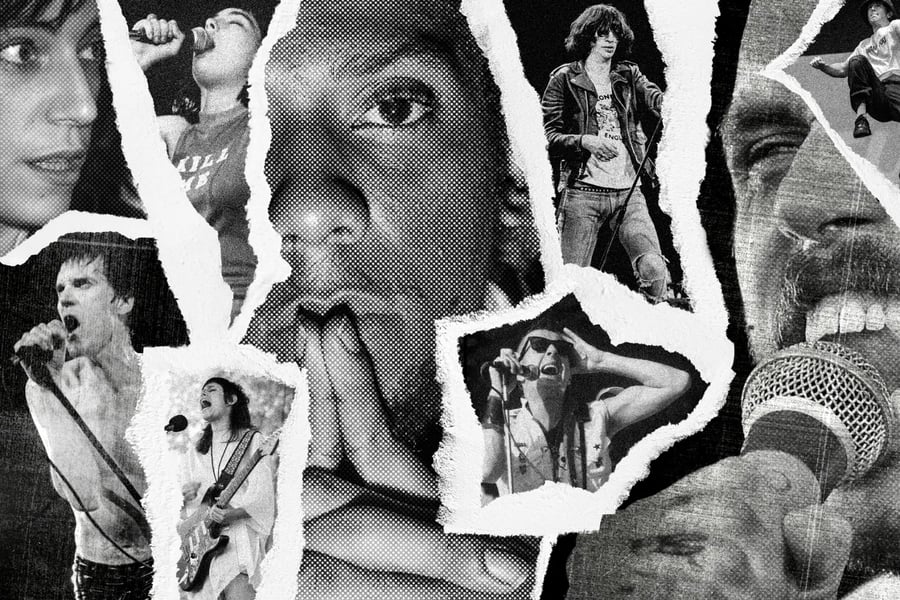
ILLUSTRATION BY MATTHEW COOLEY
Punk rock started in 1976 in New York, when four cretins from Queens came up with a mutant strain of blitzkrieg bubblegum. The revolution they inspired split the history of rock & roll in half. But even if punk rock began as a kind of negation — a call to stark, brutal simplicity — its musical variety and transforming emotional power was immediate and remains staggering. To celebrate the 50th anniversary of the Ramones’ toweringly influential self-titled debut, we’ve compiled a list of the 100 Greatest Punk Albums of All Time.
If Ramones was Year Zero for punk rock, it didn’t come without precedent, so we included essential forebears like the Stooges, the New York Dolls, and Patti Smith, artists who were punk in spirit before the style really had a name. When punk did happen, it was an explosion of ideas and possibilities. Along with the Sex Pistols and the Clash, Black Flag and the Descendents, Bad Brains and Minor Threat, you’ll find Gang of Four mixing funk attack and Marxist theory, the ice-storm goth of Joy Division, the Mekons’ existential country visions, riot grrrl radicals like Bikini Kill and Sleater-Kinney, ska punk from Rancid and Operation Ivy, multiplatinum pop-punks Green Day and Blink 182, and new-look hardcore bands like Turnstile and Soul Glo.
Punk and its many offshoots have spawned so much great music that we’ve included a list of 200 related albums to check out. “Punk rock should mean freedom,” said Kurt Cobain in 1991, just as Nevermind was exploding punk values across the middle American mainstream. Here’s one map to where that freedom can take you.
Photographs in illustration by:
Richard E. Aaron/Redferns/Getty Images; Lindsay Brice/Michael Ochs Archives/Getty Images; Peter Noble/Redferns/Getty Images; Gus Stewart/Redferns/Getty Images; Jim Dyson/Getty Images; PAUL BERGEN/ANP/AFP/Getty Images; Paul Bergen/Redferns/Getty Images; Lisa Lake/Getty Images/Anheuser-Busch; Richard McCaffrey/Michael Ochs Archive/Getty Images
Contributors:
Jon Blistein, Jon Dolan, Brenna Ehrlich, David Fear, David Fricke, Elisabeth Garber-Paul, Maya Georgi, Joe Gross, Kory Grow, Will Hermes, Maura Johnston, Althea Legaspi, Julyssa Lopez, Michaelangelo Matos, Rob Sheffield, Christopher R. Weingarten, Douglas Wolk
Love Music?
Get your daily dose of everything happening in Australian/New Zealand music and globally.

From Rolling Stone US



