


























Home Music Music Lists

The 100 Greatest Guitar Solos of All Time

Blues pioneers, hippie jammers, punk rockers, metal warriors, funkateers, and more
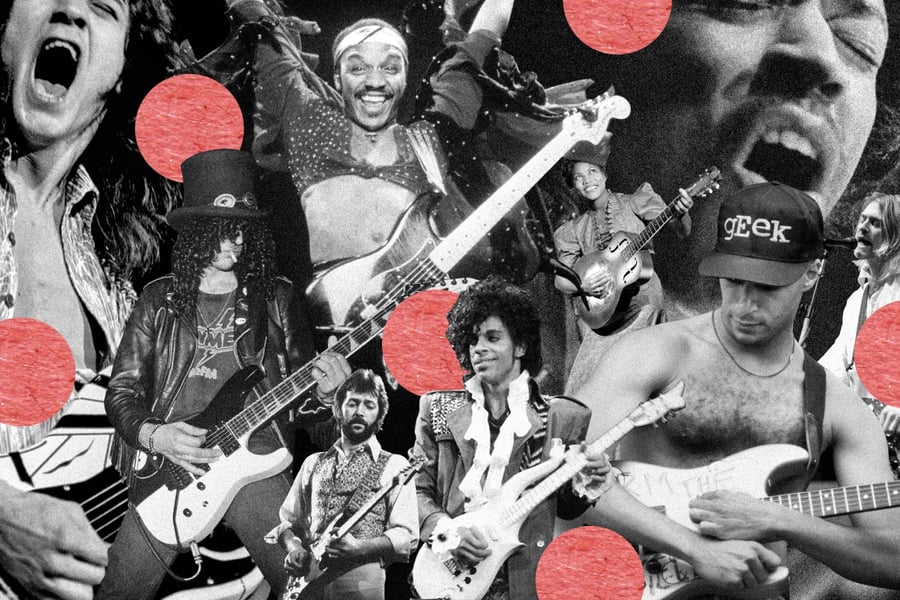
Greatest guitar solos photo illustration

All hail the guitar solo — one of the most indestructibly great art forms in all of modern music. There’s nothing quite like the thrill of a glorious six-string explosion — a long, twisted, never-ending saga that stretches from “Free Bird” to “Purple Rain,” from “Johnny B. Goode” to “Eruption.” Some classic solos come from virtuoso shredders; others are just a blast of awesomely sleazy licks. But they’ve all burned their way into our brains.

Rolling Stone’s list of the 100 greatest guitar solos of all time is a full-blast mix of different genres, generations, grooves. We travel all over history, with blues pioneers, hippie jammers, punk rockers, metal warriors, funkateers. We’ve got surfers, stoners, starship troopers, and steely knives. We’ve got legends like Jimmy Page, Jerry Garcia, and Jimi Hendrix, alongside seasoned slingers St. Vincent and John Mayer, and young rebels like Geese and MJ Lenderman. Some are solos that always make you hum in the car, or play air guitar using the nearest vacuum cleaner. A few you could even sing in the shower. (Hey, we don’t judge. Guitar worship is a sacred thing.) We didn’t include any jazz (Les Paul and Mary Ford’s “How High the Moon” is a pop tune by a guy with a jazz background), and a few entries are instrumentals.

The criterion isn’t sales or airplay — just the six-string brilliance on display. We also took into account that the solo makes the song, and that it doesn’t just repeat the melody line. (A bonus: if you can sing it note-for-note.)

As you can imagine, the arguments we had assembling this list got louder than the final minute of “Voodoo Chile.” Note: This is about solos, not riffs, which is why our Deep Purple classic is “Highway Star” instead of “Smoke on the Water.” Some of these stretch out for double-digit minutes, exploring the cosmos. Others just need a few seconds to make their impact. But a guitar trip can be a cry from the heart, full of rage, joy, hunger, pain, or maybe all at once.

Some of these 100 solos are influential cult classics; others are so universally beloved they’re banned at your local guitar shop. Every fan would compile a different list, and that’s the point. But it’s a salute to the guitar-solo tradition and all the rituals that go with it. So crank up the volume, and read this list loud.

Photographs in Illustration By:

Gus Stewart/Redferns/Getty Images; Echoes/Redferns/Getty Images; Evening Standard/Hulton Archive/Getty Images; Larry Marano/Getty Images; James Kriegsmann/Michael Ochs Archives/Getty Images;  John Atashian/Getty Images; Chris Walter/WireImage/Getty Images; Richard E. Aaron/Redferns; Gie Knaeps/Getty Images

Love Music?

Get your daily dose of everything happening in Australian/New Zealand music and globally.

Contributors:

, , , , , , , , , , , , , , ,

From Rolling Stone US

54

Freddie King, ‘Going Down’

While the other two Kings of blues guitar, Albert and B.B., came from the Mississippi Delta, Freddie King grew up hundreds of miles away in East Texas. But like the other two, he idolized his fellow Texan T-Bone Walker and devised his own massively influential bent-note sound. Freddie had a string of 1960s classics like “Hideaway” and “The Stumble,” worshipped by young English disciples like Eric Clapton, who always called King his original guitar god. But the Texas Cannonball hit new heights with “Going Down,” with pianist Leon Russell — his solo is the essence of pure blues swagger. It became Kenny Powers’ theme in Eastbound and Down. Even cooler, it was John Bonham’s favorite song, which says it all. “My father would always play Freddie King, ‘Going Down,’” Jason Bonham once recalled, “to the amount that it would be really annoying. If I’ve heard that song once, I’ve heard it a million times.” —R.S.

53

Mdou Moctar, ‘Afrique Victime’

Equally inspired by Eddie Van Halen as he is by the Tuareg guitarists of his native Niger, Mdou Moctar is one of the 21st century’s greatest guitarists — and his hypnotizing solo on the desert blues track “Afrique Victime” is a perfect example why. Across the song’s seven-minute run time, the tempo rises and rises as Moctar laments French colonialism’s eternal scar on Niger. By the time he breaks into his solo, it feels like you’re flying warp speed into the desert sun. He plays his solo as if he was vehemently typing away on a computer, sliding back and forth and drumming along the strings, warping the instrument’s tones to mimic a wailing siren. The solo on  “Afrique Victime”’ is frenetic yet liberating — it’s no wonder he’s often called the Hendrix of the Sahara. —J.P.

52

Fleetwood Mac, ‘Albatross’

Peter Green was the doomed guitar genius of Fleetwood Mac, long before the days of Stevie Nicks and Lindsey Buckingham. He exploded out of the London blues scene, with the smoldering ache of “Man of the World” and “Love That Burns.” His moody space-surf fantasia “Albatross” hit Number One in the U.K. — so great the Beatles copped it for Abbey Road, turning it into “Sun King.” Green had a unique tone — he accidentally put the pickup on his 1959 Les Paul Standard backward, but kept it because he loved the sound. (His guitar now belongs to superfan Kirk Hammett.) But at his peak, he had a tragic LSD-related breakdown and disappeared. By the time his old band rebounded with Rumours, he was sleeping on the streets. “The guitar used to speak for me, but I can’t let it do that for me anymore,” Green said in the doc Man of the World. “I can’t let it break my heart again.” —R.S.

51

The Byrds, ‘Eight Miles High’

“It was our attempt to play jazz,” Roger McGuinn said of “Eight Miles High.” In 1966, that was a radical idea, and inspired by John Coltrane’s saxophone spirituals and sitar great Ravi Shankar, the Byrds went straight into the stratosphere. The lyrics are about flying in a plane over London (or are they?), the vocal harmonies are beautifully eerie, and McGuinn’s electric 12-string solo is a perfect statement of mind-warped possibility, rivulets of notes flowing and clustering and breaking apart, designed to mimic the feel of Coltrane’s sax playing. “The continuous flow of air in a saxophone with the valves cutting it off is what I was doing with the sustain,” he said later, ”and making short, clicking kind of notes on the break.” —J.D.
