




























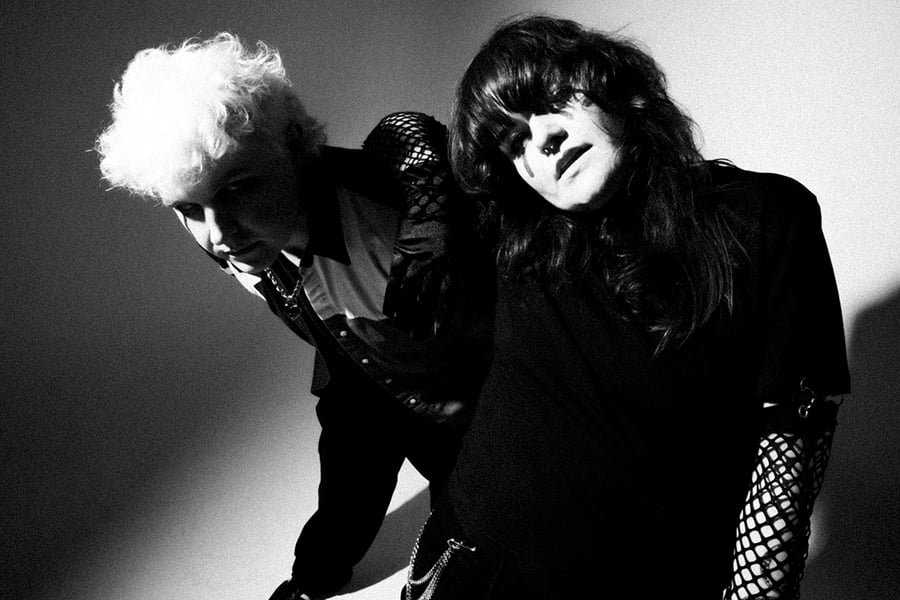
There’s a particular kind of intensity that runs through Cry Club‘s music. The kind that doesn’t just sit in your chest, but claws its way out of it.
On their third album High Voltage Anxiety, the Naarm duo have sharpened that instinct into something more deliberate, more expansive, and, crucially, more ‘them’ than ever before.
Now fully self-recorded, self-produced, and self-engineered, the album captures a band leaning into both their DIY ethos and the chaos of the world around them, from digital-age outrage cycles to political division and burnout. But for all its bite, there’s still a thread of care running underneath it all, a tension between anger and connection that’s become central to Cry Club’s identity.
With a growing reputation built on relentless touring — from European headline shows to supports with The Darkness, WAAX, Stand Atlantic, and FAKER — Cry Club are no longer a best-kept secret. As High Voltage Anxiety lands, they’re stepping into a bigger moment, one that feels both hard-earned and impossible to ignore.
Heather Riley and Jonathon Tooke caught up with Rolling Stone AU/NZ before their FAKER tour to discuss early influences, creative breakthroughs, and why making music in 2026 feels more urgent than ever.
How did music influence you in your early life?
Heather: Some of my earliest memories are of my dad playing guitar and singing, he formed a cover band with some other parents from my primary school and I loved watching them rehearse (especially Satellite of Love singing along to the ‘bom bom bom’s in the chorus). He also wasn’t afraid to make a spectacle, like dressing up in full costume and makeup with my mum when they went to KISS gigs, so it makes sense that he was quick to join in when my sibling and I got involved in community musical theatre! I think having this deep love of music as a family unit made it kind of inevitable that I’ve ended up here now with Cry Club.
Love Music?
Get your daily dose of everything happening in Australian/New Zealand music and globally.

Jonathon: Honestly I grew up in a uniquely musicless environment, the only memory I have of it was my dad occasionally playing a 60s home organ like every share house decides will be sick at some point, with the kitschy built-in accompaniment and everything. The first time I remember music starting to connect with me though was through videogames – randomly things like Mortal Kombat and Kirby’s Dream Course. The real kick off for my interest in music came with Burnout 3 though, a racing game that had a licensed soundtrack full of guitar music that just clicked for me.
What artists influenced you growing up?
H: Definitely my Dad’s favourite artists early on: The Cure, Kraftwerk, Bowie, Garbage, Smashing Pumpkins, Veruca Salt, Foo Fighters. Lots of classic rock melodrama and 90s grunge girls. In my early teens, my first earth-shattering obsession was My Chemical Romance (no surprises there), I heard Welcome to the Black Parade and like… physically felt something shift in my brain. I particularly loved music videos, so I spent almost every afternoon from 2007-2010 sat in front of Channel [v] for hours and hours waiting to find something new that grabbed my attention the same way MCR had.
J: Once guitar as a thing was introduced / made sense to me, I listened to a tonne of classic rock and honestly raided every library CD collection in my radius to rip onto my old laptop. It was a weird roundabout crash course with things like “Oh, Best of Nirvana, heard good things, let’s give it a go” happening out of pure chance.
When did you discover your passion for creating music?
H: Honestly, with Cry Club!! Before the band, I never really thought I was capable of actually creating music, I saw myself as more of a performer than someone who makes music. It wasn’t until I met Jono and we started writing together that I realised “OH wait we can just do this as a team and that works????” that I really discovered how much I love making music as a collaborative process.
J: I remember a super distinct moment hearing “Schizophrenia” by Sonic Youth, looking into their idea of alternate guitar tunings and immediately it was like a switch flicked and I could connect the dots between learning guitar and coming up with my own ideas. Connecting the dots between that kind of alternate rock and the more dance focused stuff coming out of the UK (Foals, Bloc Party, etc) really established an early thing for me.
What are some career highlights so far?
H: Playing a headline tour in Europe is pretty fucking wild! Simultaneously the most challenging and rewarding thing we’ve ever done. ANY festival spot is a highlight for me, they’re just so exhilarating, as well as being able to make music videos after dreaming about it since high school. I’ve also had people say that coming to our shows is the first time they’ve felt like they could dress in a gender-affirming way which just…. fucking demolishes me every time I hear it. THE FANART TOO!! One of the most surreal and wonderful things that I never even considered when we started making music, to have people respond by making their own art really warms my cynical drama school heart.
J: Aside from making music that I couldn’t be prouder of, some moments really do stand out – like the album release show we did for our first album which was one of the first full shows in Melbourne after the lockdowns started. I remember one person coming up and saying how grateful they were to be in a space that felt specifically queer after being isolated for so long. Honestly to be a band that survived the lockdown era is a miracle and a half considering how many of our peers were knocked out by that.
Are you looking forward to any touring plans?
H: YESSSSSSSSSS we’re a live band first and foremost, so everything really comes to life when it’s in the room with people. We’re booking everything ourselves at the moment, so it’s been sick seeing everything lining up behind the scenes.
J: God it’s just the thing that makes it all worth it hey – there’s so much fuss doing all of this stuff when you’re fully independent – but once you actually get to play the fucking show and connect with people, everything just makes sense. We’re supporting Faker in Feb / March but are starting to book more into the year and are excited to share plans when we can!
Tell us about your upcoming album High Voltage Anxiety. What’s the record about?
H: Technofeudalism, the rise of nationalism, late stage capitalism, and what the fuck it means to make art in the middle of all of this. There was a while where the voice in the back of my head would ask “what’s the point? You’re so small, you’re never gonna change anything” but watching politicians in this country try desperately to prevent people from protesting or using their voices, writing an album like this allows us to carve that space out for ourselves and anyone else who’s feeling scared.
J: I think it kind of reflects this weird cultural stasis we’re kind of in right now – the world feels like it’s imploding at pace but also things like a cost of living crisis also mean that your practical experience of the world is also a challenge. This pressure in both the macro and micro sense feels like it needs a valve to release or something, which I think this new batch of songs does for us. Maybe if things were more alright we’d be less pissed.
What kind of personality traits and values do you believe it takes to succeed in the music industry?
H: Being community-minded is one of the biggest strengths any artist can have. Not just with fans, but with other artists!!! It can so easily feel like a competition whether it’s comparing streams, room caps, releases, whatever, but supporting and uplifting other artists is the closest you can get to failure-proofing your shit. You could be the most talented, virtuosic musician in the world, but if you’re dogshit to work with you’re gonna have a much harder time getting back on your feet if you stumble.
J: Resilience is probably #1 – everyone has the strength to continue when things are looking up, but every career is a combination of a long start and peaks and valleys. Even artists we perceive as successful are having their labels say they’re failures till they beat their last success. So to survive I think it is to focus on the parts that make it genuinely worth it even if it doesn’t make practical sense.
How would you describe your music to a potential fan?
H: Campy but in a scary, evil kinda way. A Chappell Roan album produced by Trent Reznor. A collab between Garbage and The Prodigy. Is this making sense? Whatever it is, it’s gay as hell.
J: Honestly I kinda split us up into eras. Album one is a batch of pop songs with a post punk edge, album two is all the different styles of rock music we love and album three is an industrial pop record. I like to think pressing play on our catalogue is like listening to a playlist of your favourite songs by all different bands.
What are your goals for 2026 and beyond? What can fans expect from you this year?
H: I’m gunning for a festival spot honestly, my caveman brain craves Big Outdoor Stage again. Obviously album release is No. 1, mostly so we can scream all of the new shit with everyone after they’ve had a chance to listen.
J: To get our album out the door and play a bunch of fun shows! Anything more than that is awesome, but I think it’s worthwhile to stay grounded and focus on NOW more than some potential future (I say aspirationally).

