





























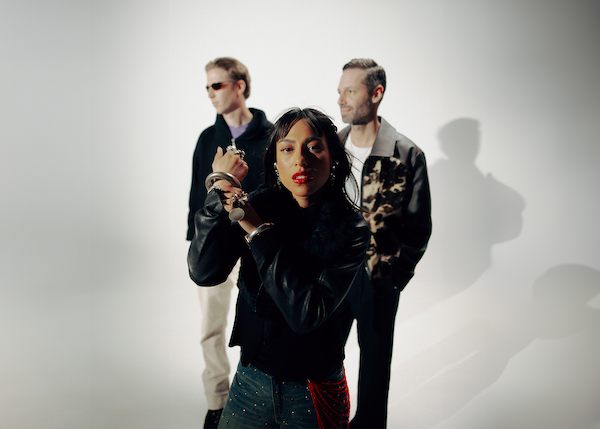
Telenova are offering fans a deeper look inside the world behind their second album The Warning with a short-form documentary, shared exclusively with Rolling Stone AU/NZ.
In the doco, the Melbourne trio capture the moments leading up to release, unpacking the themes, creative process, and emotions that shaped their most ambitious project to date.
Telenova have long thrived in the tension between beauty and unease, and The Warning sees that push-and-pull reach its most exposed and urgent form yet. Written during a period of personal upheaval and creative strain, the band – Angeline Armstrong, Joshua Moriarty and Edward Quinn – navigate the blurred lines between control and chaos, faith and doubt, and connection and collapse.
The result is a darker, more industrial-tinged evolution of their cinematic alt-pop universe, one that trades the fable-like softness of their debut for something more immediate, volatile and human.
As the trio prepare to take the album on the road across Australia and Europe, they speak to Rolling Stone AU/NZ about the realities behind it, including how their creative bonds were tested and strengthened, the private struggles they endured, and how they navigated the uneasy search for hope and meaning in a world defined by noise.
Rolling Stone AU/NZ: The Warning feels both controlled and volatile – how did that tension shape the writing and production process across the record?
Josh: I was slowly unravelling so it definitely was a mix of both the things you mention for sure! On good days when I was sober there was control and on the days when I wasn’t so clear headed or when I was staying up for days like a madman working on the songs in the wee small hours it was chaotic and severe. I think the tension of these things and of reality starting to fall apart informed the feel of the record.
Love Music?
Get your daily dose of everything happening in Australian/New Zealand music and globally.

You’ve described the album as “glimpses of God in a godless world of anxiety and noise”. How did that idea evolve as the songs came together?
Ange: That was a phrase that came to me in hindsight when I was reflecting on the album that we’d written from a very tumultuous time – it was glaringly obvious that we’d accidentally captured the intense emotions of the time in our lives; unease, anxiety, noise, confusion. Those things aren’t just unique to us as a band though, I think those are distinctive qualities of the present time in our world too – with the acceleration of technology at a pace we can’t keep up with (and perhaps isn’t even good for us as a human race?) we seem more isolated than ever and with a somewhat prevalent underlying nihilism and ‘god is dead’ mentality in the West, I think there’s a sense of awe, wonder and hope that’s been lost along with it.
The album captures the noise and anxiety, yes, but there’s a deliberate thread of glimpsing ‘something more’ – curiosity, surrender, hope, awe…breaking through the noise, too. From my personal place of Christian faith, those qualities of curiosity, surrender, hope, awe, and beauty find their ultimate form in a Creator God, so I personally equate these very qualities with ‘glimpses of God’ in and of themselves.
This record captures a period of personal flux – was there a particular moment on the road that crystallised the emotional core of the album?
Ed: For me it was probably when we played our sixth show in as many nights in Copenhagen. I think we were all still jet lagged but hadn’t had any time to adjust. We’d never done a tour in a sprinter van before so it was a lot of time all together, with next to no down time aside from travelling in the sprinter. I feel like things became quite real for us in that incredible city.
Sonically, the album leans further into darker and more experimental territory while retaining your pop immediacy. How did you balance those instincts without losing cohesion?
Josh: I think as we were working on this record we really just didn’t want to repeat anything from the first album or the two EPs we’ve released. As long as it felt new for us then we were all onboard. In that respect I think it just ended up being a push in the directions you mentioned, some instrumental throbbing, some more bombast, cutting chords short or adding some more length to a progression to build tension, all things that were fresh in our songwriting. I think also as we get to know each other more over the years we can push each other’s ideas further and challenge things without being worried of upsetting the relationship.
“Fault Line” sits at the heart of the record’s thesis. What does that song reveal about the band’s dynamic and creative equilibrium right now?
Ange: you know a lot has changed, for the better, since the period of writing and recording, The Warning. We didn’t intend it at the time, but it is certainly autobiographical in how it has captured the tensions from back then. It felt like we were literally on a fault line – the band, and more importantly, the friendships felt very much on a line of either falling apart or having to push through the discomfort, extend ongoing grace to each other, and get involved in each others’ lives more than we ever had before if we were going to hold things together and come out the other side.
“Fault Line’ is a plea. I think we’ve all been (or will be one day in our lives) in a situation where we’re watching someone we love walk a dangerous line, or cross a dangerous line, and yet all the while they’re trying to act like everything is just fine. “Fault Line” is a plea to recognise a situation for what it is, before it’s too late. “Fault line I was trying to warn you // the earth shakes every room in this quiet house.”
Compared to Time Is a Flower, how has your understanding of faith, hope and beauty shifted on this album?
Ange: People will hear different things in both these albums and that’s the mystical thing about music as a language. For me personally, there’s a strong distinction between these two albums. Time Is a Flower still deals a lot with concepts of light and dark, faith and doubt, good and evil, something Josh and I gravitate towards when we’re lyric writing, but I think in Time Is a Flower those things are expressed in a much more conceptual, theatrical, fantasy-kind of way; almost fable-like and poetic. Sonically that album also feels a lot more ‘classic’ and organic to me – cinematic string sections, dreamy chord progressions. There’s a softness and femininity to it that is different to The Warning.
During the time of writing The Warning, I think a lot of those conceptual, almost distant, understandings of faith and hope, were put to the test and played out more literally in our day-to-day lives, in a way that was hyper-personal and raw. The darkness, the doubt, the ugly side to things and how that can mar or impact relationships was much more immediately present for Josh and I.
In retrospect I now recognise that sense of unease and anxiety and discomfort through the more industrial, pulsating, aggressive sounds on the record. The longing for faith, hope and beauty was more pronounced in a very real sense in real life, and so I think there’s more desperation on this record, a kind of chasing and clinging to faith, hope and beauty out of necessity rather than just a ‘poetic’ appreciation of them as concepts.
The Warning feels like a document of private struggles becoming public. How do you navigate that vulnerability as collaborators and as friends?
Josh: It was a bit of a discussion with our management and between the band of how much we wanted to share publicly, I’ve always been happy to be honest so I was cool sharing my experiences. I ended up having to go to rehab in the middle of making the record, it definitely caused a lot of tension and I think things were up in the air because of it. You aren’t a real band until at least one of your members has been to rehab though, am I right? A proper write of passage, ha, total cliche shit.
View this post on Instagram
Your cinematic universe has always been highly visual – did any specific films, images or aesthetics inform the mood of this album?
Ange: I don’t sort of sit down with a mood board of films and images and aesthetics and go ‘let’s create something inspired by these things’, so the images don’t inform the mood in that way. I think the subconscious feelings inform the mood which inform the images. It happens later once the record is closer to being written, that I’ll listen to what we’ve made and just start taking note of the types of images the cross my mind – of course it’s no surprise that those images often directly relate to or capture the feelings of the time in a kind of metaphorical sense. I think of trains rushing by, crowds smooshed together in a subway, hidden moments of beauty like sunlight hitting the side of a glass building, cool blues and greens, motion blur and not quite seeing people clearly, motion, running, sonar sounds and pulsing red lights, rain on the windscreen at night, city lights reflected on damp asphalt, unexpected beauty in a rainbow in an oil slick. That type of palette and imagery makes me think ’90s psychological thriller with an arthouse twist.
With deeper creative bonds forming during this period, how did each of your distinct voices push or challenge one another in the studio?
Josh: As I was saying earlier, when we first got together as a band we definitely didn’t push against anyone’s ideas too hard, we were all very polite and accepting and I guess we also wanted to learn where we were all coming from, a kind of honeymoon period but also one that is a bit more surface level.
Once you spend five years creating though and go on tour and spend so much more time together you lose the ability to hide those things you want to keep private! I think like a healthy marriage (and one where you feel safe that you won’t be divorced easily…) things start to naturally go deeper and you can challenge each other without fear and perhaps without all the niceties. With that we all got to put more of our true identities into the music.
Now that the album is out in the world and you’re heading into an extensive tour, what do you hope listeners carry with them after sitting with The Warning in full?
Josh: I personally don’t mind what listeners carry with them, it’s not for me to have anything to do with the inner world of others and how they respond. I know what the songs mean to me but it will be different to everyone! I think that’s the beauty of making art, we all get to make our own meaning and have our own feelings. All I would like is for the music to make people feel something, even if it’s negative at least it’s a reaction, insipidness would be the worst response.
Telenova’s The Warning is out now.
