



























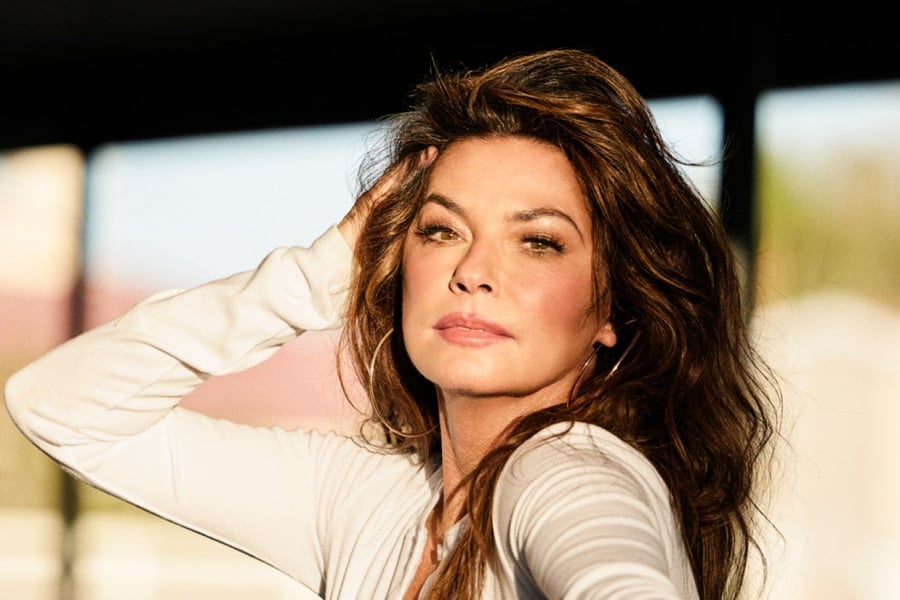
Shania Twain is turning back the clock. On her new album, Little Miss Twain, the 60-year-old singer-songwriter connects the dots between Shania the superstar and the young girl who sang Marty Robbins and Freddy Fender covers in motel bars in her native Canada.
“My first Top 10 [hit] was when I was 30. From the age of six all the way up to then is this whole gap of my life and my music that nobody knows about,” Twain says on a new episode of Rolling Stone‘s Nashville Now podcast, recorded at her property in Las Vegas. “The theme of the album is me catching everybody up on who I am as a whole.”
But Twain, who opened all 12 of Harry Styles’ Wembley Stadium concerts this summer in London, isn’t doing it alone. Little Miss Twain features guest appearances by Tanya Tucker, the War and Treaty, Ronnie Wood, and even Josh Homme. Producer Zach Dawes came to Twain with the idea of having the Queens of the Stone Age leader on “Faded Blue Jeans.” “He said, ‘Josh is a fan. I really hear him on this with you,’” Twain recalls. “I said, ‘Are you crazy? I would love that.’ I’m a rocker, you know? I’m a late-Eighties rocker.”
Little Miss Twain is an autobiographical album, rooted in your formative years in Timmins, Ontario. What was it like growing up there?
Little Miss Twain is a reflection on the whole journey of a pre-recording artist — it’s the songwriter trying to eventually make it to Nashville, around that big round conference table.
Why did it take so long for you to write this record?
Often, if I’m missing my hometown or I’m missing nature, it’s great therapy to sit with my guitar and just ramble on about the place I love. Or the jeans that just no matter how much they’ve fallen apart, they’re still one of my favorite pairs of jeans, you know? That’s where “Faded Blue Jeans” comes in, being 17 and rolling around in the grass with my boyfriend. Things maybe my parents wouldn’t have been happy that I was doing.
The song “Northern Town” has a detailed Dairy Queen order in it. Is that from your childhood?
I want people to taste the flavors and smell the air and be there, so I did my best to describe what it was like then. We would go out target shooting or rabbit snaring or something out in the woods, and my dad would stop at the bar on the way home, and we’d sit in the car and wait while he had a beer. Then before driving us home, he would say, “I’m taking you to Dairy Queen. So, remember, we don’t have to talk about stopping for a beer.”
Your parents died in a car accident when you were 22. How much of that experience informs the album?
I moved to Toronto right after my first little Canadian tour, and I was 20. All my other friends were in college and university, and I’m working in the local bars in Toronto, which is a pretty big deal compared to Timmins.
Love Music?
Get your daily dose of everything happening in Australian/New Zealand music and globally.

But then my parents died, and I have to put my career on hold. All [my siblings] lived with me at the time, and a record deal was likely not going to happen, at least till the kids graduated from high school. I wasn’t really thinking about where I was going anymore. I was thinking about day-to-day.
You have a very sizable queer audience. How have you seen that segment of your fanbase evolve?
I think that if you believe in something, especially if you’re a songwriter, it will show up in your writing, and it will resonate. People know I’m inclusive. They know it through my songwriting. I don’t even have to say it. I didn’t write a song like “Any Man of Mine,” for example, to make a point. I was just talking about myself. I always say be original, and if it’s not you to be broad-minded, then don’t be broad-minded. Don’t be something you’re not.
Ella Langley is having a moment not unlike yours in the Nineties. Do you see any of yourself in her success?
I see her as an authentic songwriter. She sounds original. That’s already a bonus, right? So we already can hear the difference, and she really does seem very unapologetic. That commands respect. I sense that in her, in her aura, and her persona, and the way she delivers a song. I believe what she’s saying.
You opened all 12 of Harry Styles’ Wembley Stadium shows this summer. How did you two meet?
We met at a backstage event, and we just chatted, exchanged numbers, and he said, “It’s my mother’s birthday coming up, would you mind phoning her to wish her happy birthday?” One thing led to another, and he invited me to Coachella. We really came together at that moment as two artists who had already connected as two individuals.
With “Man! I Feel Like a Woman!,” you achieved something remarkable: recording a song about female empowerment that men feel comfortable singing. How did you do that?
“Man! I Feel Like a Woman!” is an expression, so anyone can express it. Nobody owns that exclamation. It’s punctuated affirmation of something that is followed up with something that’s very singable.
Yeah, it was empowering for women, which is how I felt when I wrote it. But it really went so far beyond that. It’s a celebration. I wrote it from the heart. I wasn’t trying to be tricky. I didn’t have an agenda. It was just, “I’m really coming into my own here. I’m really enjoying my curves.” I grew up flattening out my chest, and I wanted to make sure they didn’t bounce when I walked, or when I played football, I’d do bras and loose pants, track clothes. I just thought, “Wow, I’m so over that! I’m like a late bloomer, I gotta enjoy these curves.” And I really started to embrace that when I started making videos. That’s when I realized, “I am so far behind, I got some catching up to do, and, man, I feel like a woman, I’m going to just enjoy it all the way.”
Next year marks 30 years of Come On Over. Do you still marvel at how that album shaped country music?
It still surprises me that it has been considered an album that has reshaped country because the country I grew up with threw me off the reality of what Nashville would have expected. It was like I was living in a time warp; I was writing and making this album that I thought was well within the margin of a “Take This Job and Shove It,” or Linda Ronstadt records or Fleetwood Mac. If anything I didn’t reshape it. I revived something that was already there, just in a contemporary way.
Download and subscribe to Rolling Stone’s weekly country-music podcast, Nashville Now, hosted by Deputy Editor, Head of Country Joseph Hudak, on Apple Podcasts or Spotify (or wherever you get your podcasts). New episodes drop every Wednesday and feature interviews with artists and personalities like Vince Gill, Lainey Wilson, Shaboozey, Hardy, Charley Crockett, Blackberry Smoke, Jason Newsted, Tedeschi Trucks Band, Kings of Leon, Dan Auerbach of the Black Keys, the Black Crowes, the War and Treaty, Carly Pearce, Amy Grant, Luke Grimes, Brandon Lake, Breland, Bryan Andrews, Noeline Hofmann, Adam Mac, Devon Gilfillian, Gavin Adcock, Amanda Shires, Shooter Jennings, Margo Price, Michaela Anne, Ink, Ne-Yo, Rival Sons’ Jay Buchanan, Halestorm, Dusty Slay, Lukas Nelson, Ashley Monroe, Old Crow Medicine Show’s Ketch Secor, Clever, Love on the Spectrum‘s Tyler White, Willie Nelson scholar John Spong, and authors Marissa R. Moss, Josh Crutchmer, Mark Gray, and Jonathan Bernstein.
From Rolling Stone US

