




























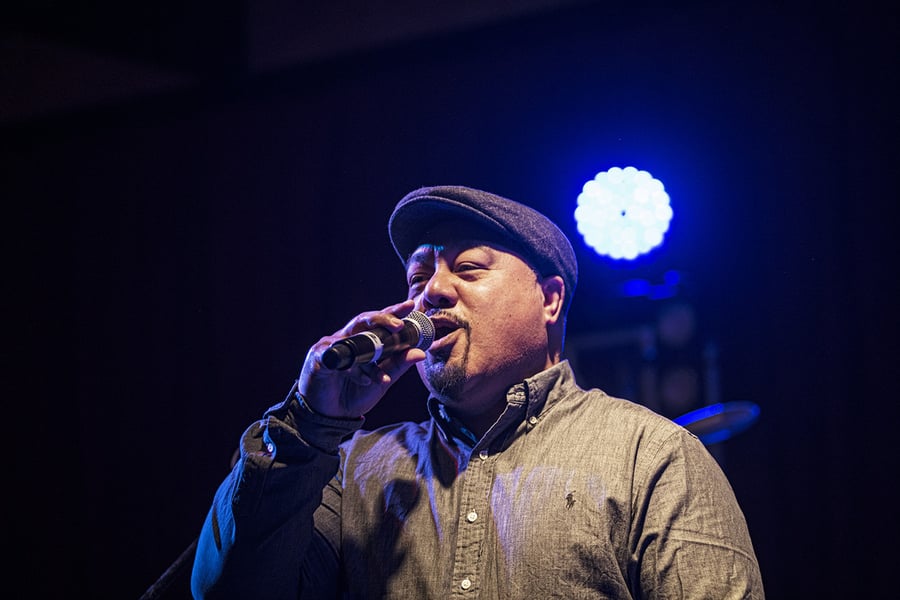
Ché Fu will be the newest inductee into the Te Whare Taonga Puoro o Aotearoa | New Zealand Music Hall of Fame this week. It will be his second time in the Hall of Fame, after he was first inducted in 2014 with Supergroove.
The Aotearoa hip-hop legend will be officially inducted at the 2026 Aotearoa Music Awards ceremony, which will be held at The Civic in Tāmaki Makaurau Auckland on Thursday, May 28th.
To celebrate Ché’s second album, Navigator, turning 25, we’re taking a closer look at his platinum-selling record. A limited edition 25th anniversary silver vinyl reissue of Navigator is out now.
By the time Ché Fu released his second album Navigator in 2001, the Niuean-Māori singer-songwriter, rapper, instrumentalist, producer and DJ was already a storied cultural figure. Even without that double-platinum classic, he would still be remembered for his work in the Tāmaki Makaurau Auckland funk-rock-rap group Supergroove, the protest hit “Chains” with DLT, and his immaculate solo debut, 2b S.Pacific.
All of this makes what followed even more remarkable. Twenty-five years ago, Ché was already beloved. In the wake of Navigator, he became a generation-defining superstar without ever losing his love for the people. From the lush, opening flourishes of “Misty Frequencies”, the album reveals itself as a treasure trove of musical riches.
When I listen to Navigator, it takes me back to the summer of 2001/2002, when Ché was inescapable. I remember seeing his music videos on television, hearing singles like “Fade Away” and “Random” ring out across both underground and mainstream radio, and friends who worked in cafes playing the album on repeat. For a stretch there, Ché’s soulful voice, singalong melodies and optimistic sentiments felt like a unifying force that cut across racial, cultural and generational lines. His songs unified New Zealanders like few before or since.
The son of pioneering Tāmaki Makaurau reggae musician Tigilau Ness (of Unity Pacific) and the late activist and social worker Miriama Rauhihi-Ness, Ché grew up in Grey Lynn in the ’70s and ’80s, during the rise of the Polynesian Panthers and the Rastafarian organisation, the Twelve Tribes of Israel. When he was five, his father took him to Western Springs Stadium to see Jamaican legend Bob Marley perform. The concert was a watershed moment, helping to usher in a reggae revolution in Aotearoa.
Love Music?
Get your daily dose of everything happening in Australian/New Zealand music and globally.

Watching Bob Marley sing songs of freedom, redemption, and unity clearly left an impression on Ché. The influence of Jamaican music, reggae, dub, dancehall and ragga runs through the songs he recorded for 2b S.Pacific and Navigator. Both albums also draw deeply from R&B, hip-hop, and neo-soul, reimagining Black American, British, and Caribbean sounds through a Māori and Pasifika lens.
Before going solo, Ché spent his teens in a high school choir and the Lowdown Dirty Blues Band, a precursor to Supergroove. During his years in Supergroove, he learned about recording studios, international touring and multi-platinum success. Between engagements, he became increasingly fascinated with vinyl and turntables and formed a crew called Wicked Youth with friends who were interested in DJing and rapping.
Ché has described those years as a kind of double life. Through Supergroove, he saw the world and learned about the commercial realities of the music industry. Over time, however, Wicked Youth evolved into Token Village, a live hip-hop reggae band that played at Cause Celebre on High Street. By this stage, Te Whanganui-a-Tara Wellington rapper King Kapisi was living in Tāmaki Makaurau. He could regularly be found freestyling on stage with Ché and other MCs, including Ras Daan, Phatmospheric, and Hazadus. These experiences helped Ché understand where he wanted to take his music.
Years later, when he recorded Navigator, he still had the same MCs around him and shared the spotlight with them on the more hip-hop slanted songs on the album like “Share the Info” and “Roots Man”. On “The Mish (2)” in particular, you can hear a foreshadowing of the psychedelic reality rhymes that underscore fellow Tāmaki Makaurau group Home Brew’s breakout 2008 EP, Last Week. Listen closely, and Ché’s influence is everywhere.
After Ché and Supergroove parted ways in the late ’90s, he had the opportunity to put his vision for a hybrid reggae-hip-hop-soul sound into practice while recording “Chains” with DLT and later on his debut, 2b S.Pacific in 1998. The triumph of the album lies in how Ché and collaborators like Token Village, DJ Manuel Bundy, and the master producer Andy Morton aka Submariner, crafted songs like “Scene III”, “Machine Talk”, and “Waka” featuring Teremoana Rapley. These became top 10 chart singles that simultaneously spoke to the nation and reflected Ché’s dreams, fears and aspirations, as set against the backdrop of his life in Tāmaki Makaurau. From the first week it was released, the album was a runaway success.
Three years later, when Ché returned with Navigator, he’d started a family with his partner. During the intervening time, he’d built a home studio, and taught himself the basics of music production. He’d also assembled a live band, The Krates with players like bassist Chip Matthews, drummer Paul Russell, guitarist Brother Zeb, keyboard player Godfrey de Grut, and other friends from the Token Village era. This time around, he was ready to take the reins. He had messages, killer delivery, and charisma in spades.
In the ’70s, the Black American soul and R&B singer-songwriter Bill Withers famously took the concept of a love song, and decoupled it from romance. By writing about the love at the heart of friendship and family, he crafted evergreen anthems like “Lean on Me” and “Grandma’s Hands”. Across Navigator, Che did something similar.
“Misty Frequencies”, an APRA Silver Scroll-winning song he wrote with Godfrey de Grut, was essentially a love letter to the impact hearing soul, R&B, funk and hip-hop on student radio station 95bFM had on him as a teen. “Random” and “Fade Away” were about friendship, fatherhood, and staying connected. On “Hold Tight”, family. Even “Catch One”, driven by Ché’s version of a romantic love chorus, ultimately returned to family.
The album was visionary in other ways as well. In an era when it was still rare for commercially accessible artists to sing in te reo Māori, his shuffling reggae soul number “He Kotahi (As One)” was a breath of fresh air.
If Navigator marked Ché’s true ascent into the mainstream, it also signalled the arrival of the Tāmaki Makaurau DJ and producer P-Money, who was DJing in The Krates. After Ché heard his early hip-hop demos, he had him provide beats for four songs on the album, lending a cut-up, East Coast boom-bap feel to “Share the Info”, “The Abyss”, “The Mish (2)”, and Ché’s love letter to hip-hop, “The Natural”.
Around the same time, P-Money began recording music with the celebrated Ōtautahi Christchurch rapper Scribe, later finding their own way to the top of the charts through records like “Stand Up”, “Not Many — The Remix”, and “Dreaming”. Looking back on those years, it’s easy to feel like there was something in the water.
Navigator scored Ché a plethora of accolades at the 2002 New Zealand Music Awards, including Album of the Year, Single of the Year (“Fade Away”), Top Male Vocalist, and Best R&B/Hip Hop Album. In the process, Ché became a genuine guiding light for the likes of Nesian Mystik, Scribe, Aaradhna, Savage, Adeaze, and David Dallas as they took New Zealand hip-hop and R&B to new commercial heights in the early to mid ’00s.
On release, Ché’s second album felt like an instant classic. Two and a half decades later, it’s essential to New Zealand’s musical canon. Ché Fu deserves every accolade bestowed upon him. I’m glad we’re giving him his flowers while he can still smell them. It’s only right. Music like this should never fade away.

