



























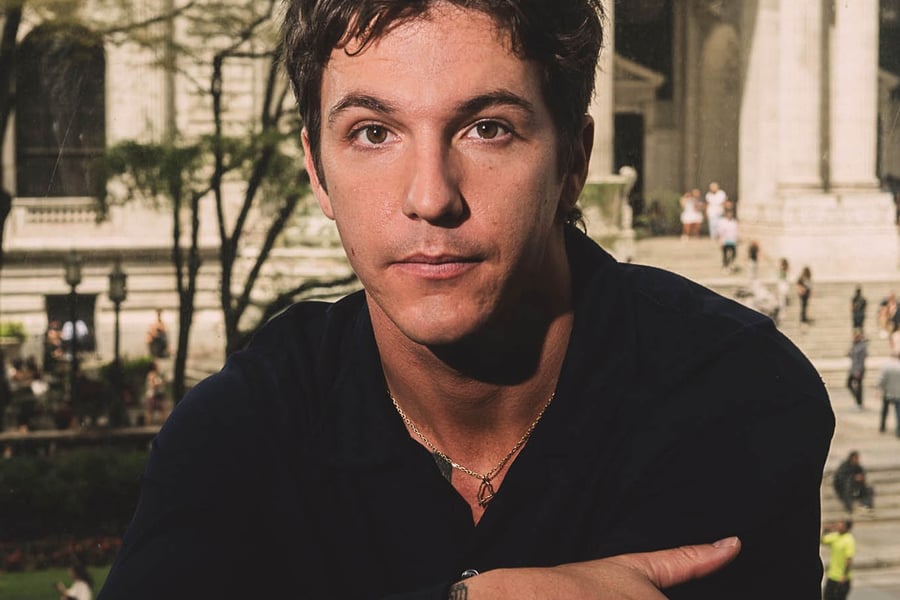
Tucker Pillsbury, a.k.a. Role Model, does not enjoy being pinned down. He knows he makes pop music, but don’t call him a pop star. He’s comfortable drawing on country music — even Toby Keith — but definitely don’t call him a country artist. He’s not even sure about his own stage name, despite his growing fame under it. As he tells it, he spends most of his strong new album, Chuck Timely & The Hourglass, dodging labels, blending vintage influences from Fleetwood Mac to Stephen Bishop in search of something new.
Pillsbury recently sat down for an in-depth Rolling Stone Studio interview, discussing his secret Madonna influence, his girlfriend Dakota Johnson’s one-take cameo on “Love I You,” his nerve-wracking first day acting opposite Natalie Portman, and much more. (Watch the whole interview above or on YouTube.)
The box people try to put you in is “pop star,” and it seems like that’s not necessarily the box you wanna be in.
Well, it’s tough because I do say that I make pop music, and I think as soon as you say that and you’re, like, thrown into this list of names of all these people who make pop music, all of a sudden there’s just constantly this debate of who’s going to be… who is the pop star? Who’s the pop boy right now or whatever?
Main pop boy, yeah.
Yeah… I just don’t want to be in that race, ’cause I’m not trying to be a pop star. And I think you can hear it in the music. Being a pop star is not interesting to me. I don’t want to do that. But I love pop music, and I love making it.
Is part of it you just don’t wanna wear the outfits?
It’s the shiny outfits for me — and the background dancers.
There used to be a lane called Heartland rock — John Mellencamp, Bruce Springsteen, Tom Petty, with Jackson Browne as a kind of L.A. predecessor. I feel like that’s part of the lane you’re steering into. You and Noah Kahan are really in there right now.
Yeah, everyone you just named was on the playlist and was fully referenced all throughout the album. Those are the heroes. Maybe that’s my, my… Maybe we bring back Heartland rock.
I think your team also maybe calls it lake-pop?
Yeah. There’s one guy at my label, I remember him just being like, “It feels like it’s lake music, like lake pop, pontoon pop music.” I think there’s pieces of the early 2000s, like Toby Keith or whatever, and that lake Americana country, but lyrically, those songs don’t really speak to me. But sonically, I love that feeling, and so I think that was a cool thing to play with, is apply a different type of songwriting to that sonic landscape that’s usually used for beer cans and dirt roads and stuff.
Love Music?
Get your daily dose of everything happening in Australian/New Zealand music and globally.

You didn’t wanna write a Toby Keith, America’s-gonna-kick-your-ass song?
Yeah. I’m not, I’m not sure I’m feeling that.
Your relationship with country is interesting to me. A lot of the people drawing on those references in recent years have been more in the country realm, and if a song like Sally were marketed a bit different, it’s not inconceivable you could be seen as a country artist. What are your thoughts on that?
When I put out Kansas Anymore, and especially with the deluxe, I remember for the first time, like, being accepted by a lot of these country artists, and it was so cool. That was enough for me. I didn’t want to be labelled as a country artist, which is why I’m not still wearing the hat. I didn’t wear the hat at every show, and I was trying to ride a thin line, because as much as I wanted that acceptance from the country artists and that community, I didn’t want to be, like, locked off into that box.
If there’s a commonality to how you talk about your career, it’s avoiding being boxed in. You make sure the influences on any song are mixed enough that no one’s gonna say, “Oh, this is a Fleetwood Mac song.” You draw from country without being a country artist, you take on personas like Chuck, and you chose Role Model over your own name. You’re not hiding, but weary of being kept in one place.
Yeah, that scares me. But I also— yes, that scares me, but it’s also a really fun thing to challenge yourself with in the studio. Me, [producers] Mason Stoops, Taylor Mackall, and everyone else that helped on the album — it was just such a battle every day of riding these thin lines and not wanting a song to lean in a certain direction too far. There are two challenges that I love. It’s one, bringing these artists that I love and applying it to pop music. I like that about pop music. It just feels like this umbrella term. It can be anything.
Nothing about this album is on trend for current pop — except that you pay a lot of attention to making almost every part of every song hooky, so much so that a bridge could be sliced out and work as a TikTok, which has already happened to you. Is that just songwriting craft, or has TikTok changed the way people write songs? And if so, I’m not sure that’s a bad thing. Where do you stand?
As far as making anything with TikTok in mind, or clips of the song — I don’t think that in the studio. I don’t think any of us do. And if I ever did, Mason would kick my ass. That would not fly. I do try to rope people in immediately. Like, I think I have an ear for that. But as far as making things for the purpose of going viral or whatever — “Sally” was a great example. None of that was planned, all the way down to bringing people out and all that stuff. Nothing about “Sally” was planned, and I did not have any expectations for that. And so I think I learned from that you can’t plan anything, and so that makes being in the studio a lot less stressful.
When we last spoke, you were about to play Primavera — I believe your first show without the “Sally” bit. Did it feel like anything not to do it, or was it just kinda gone and nothing?
I don’t think anyone cared. Aside from people coming up to me with their daughter and being like, “Can she be Sally when you play Red Rocks in the fall?” or whatever, and then I have to break the news and “I’m so sorry,” “No.” But aside from that, I don’t think anyone cared. If I didn’t believe in this album, Chuck, then I probably would’ve kept doing the Sally bit.
Doubling down, bringing three to four Sallys a night.
But I don’t feel that way, and I think as much as I love the song “Sally,” it’s not… It’s a pretty low bar of a song in my mind. That was, like, a silly song with lyrically the dumbest bridge I’ve ever written.
You have a real beef with your own bridge on that. How did you end up writing a bridge you think is so dumb? Which I don’t really see the dumbness of — it’s fun.
It was just, it was bridge-less for a long time, and then I went in after tour or something, and I just was like, “I think it just needs to be this loose thing. Let’s not overthink this,” and I just did that. Looking back, as much as I love that song — and I’ll always perform it till I’m done — but lyrically, that bridge is like a children’s book, so I don’t… Again, if that is the biggest part of that song, on my biggest song, it feels like a pretty low bar, to be.
At the same time, you said you were surprised it connected, in part because it’s such a Tom Petty thing. Maybe that opened the door to bring in these other influences.
That was exactly it, and I already saw it with “High Hopes.” I really didn’t think people were gonna like that chorus. Also production-wise, it just had this Georgia Satellites, like, masculine—
“Keep Your Hands to Yourself.”
Exactly. Yeah. This masculine vibe to it, and I was like, “Ugh, I feel like people are gonna hate this.” And they didn’t, and I was surprised. I was like, “Cool.” Knowing that they would probably love that song by Georgia Satellites.
“Joy,” the second single — I think you said it’s even better than “High Hopes,” which it may be. Vibe-wise, I got things maybe you didn’t intend: Mellencamp a bit, but Steve Miller, a real mix of things.
Stones too, yeah.
Stones, yeah, I can hear that. Even on the album it’s a little bit of an outlier. It struck me that the same way Sally was a pivot you followed on this album, this could be one of the pivots you follow for your next one.
It is an outlier, in a way, on the album. But it was one of my favourite things. I think the story and the message that I was getting across are so buried, in a way that I wanted it to be. Like, listening to the song, no one’s thinking about this theme of losing childhood joy and all these darker themes. It felt like a really cool cocktail of a song that I was proud came together.
You’ve spoken of this album as a journey from being single and figuring yourself out, but I think there’s something deeper, and “Joy” gets at it — a spiritual malaise, a crisis of meaning beyond being single or not. Then I heard you went into therapy when you finished the album.
Yeah. I think I learned a lot about myself through writing the album, and also just my personal life, what was happening while writing the album. It was all just at the same time, and it was… I was writing in real time about these things and feelings and quarter-life crisis moments and, yes, identity crisis. I think it’s not the first time. I think I touched on it a little bit with Kansas Anymore, and definitely having moments of, what am I doing with my life? Usually, while I’m writing an album — I’m sure that will always happen. I’m sure there’s always going to be a song halfway through the album-writing process where I’m like, “What am I doing with my life? Is this what I’m… Is this my purpose?”
Listening to the lyrics, part of the narrative seems to be someone who had a bad breakup and then spiralled into something like a depression.
Yeah. I think that’s true. Two years is a long time. I just didn’t know what was best for me. I didn’t know, do I go straight into another relationship, or do I really hold off and fix myself first and then go do that? And there were all these questions and no therapist at the time to help me figure that out, so it came out in songs.
“Song Is All You Get” is really stuck in my head — a really good hook. Before I dug into the lyrics, I thought it was about how sometimes all you get out of dating someone is that you write a song, a Taylor Swiftian idea. But that’s not really mostly what it’s about.
Yeah, it’s just about fleeting moments, and maybe… That one was definitely about wanting to go back in time a little bit and make more of these little moments, or be thankful for these little moments you have with someone or people, and then trying to tell yourself it’s okay. Sometimes a song is all you get. Sometimes a night is all you get, whatever. And trying to tell myself to be, like, thankful for whatever you get from an experience or from a person.
The most surprising influence you brought up to me about this album was Madonna. Tell me how you brought that in.
I had a rule going into the album that was like, no programmed drums and no synths. Mason got around that and used a drum machine for “Song Is All You Get” and “Stain,” I think. But I love these Madonna songs. I love the self-titled, and, like, how do we get this danceability without the synths and without the synth bass? I loved her drums and the grooves and everything, and I was like, “How do we pull this into our palette of this Americana organic piano, keys, organ, drums, acoustic?” And that was one of the challenges. Doing whatever she’s doing on synth, like, doing that with piano or guitar. I think Dire Straits had really good, these punchy kind of chords in between the drums from Mark Knopfler, and we pulled a lot from him, trying to recreate what the synths are doing with different instruments.
“Love I You” is about two things I know for sure: being drunk and being in love.
Yeah. Yeah, it’s a drunken song.
And the feel is drunken, too, musically.
Yeah, that was the goal. I had brought in the verses and brought it to Mason. I was like, “I have these verses. I have these chords. Change the chords; they’re boring. Switch the chords so I can just come up with a chorus, but I want it to feel, like, drunk, and I want it to have this swing.” We did it in one day. I had the verses, but I wrote the chorus there, and sometimes once we get going and we find something, we have to finish it that day. We want this to feel like we’re in a bar, so we invited a bunch of people to the studio, a bunch of friends, had a little bit of a party, and then showed them the chorus and had them all sing the chorus together as if it was, like, a bachelorette party, and it was amazing. It was so fun. Stacks of 20 of us in a room — you can hear it — with some drinks in us. That was so fun to watch come alive in a day. We handed them all some sort of a percussive instrument, too, and we’re like, “Let’s just do a take through. All of us, just shake whatever you have in your hand or figure something out.” And if you listen to it soloed, it’s horrible, but it works in the context of this drunken moment in a bar.
But all this is so far away from one person sitting in a bedroom with Pro Tools.
That was another hope, when we had early discussions about just that and how we wanna record it, and we had our friend Omar record everything. He was engineering the whole thing, and he really understood it, and the importance of: yes, this is gonna be, like, a modern pop album, but let’s not treat it that way. Let me bring the pop to it, and you guys record everything.
You have a moment on “Love I You” that makes the song better, which is Dakota Johnson — we can’t be coy about it anymore, you admitted this — she does a really charming back-and-forth with you. My guess is you had to weigh making the song better against the questions it would lead to, and eventually publicly admitting the relationship.
I think that you just said it perfectly. I had that idea, and I had my vocal kind of sitting alone in that bridge, doing the conversation by myself. And we had a list of ideas for people. Mason kept bringing up, “Why doesn’t Dakota do it?” And I was always like, “I don’t… I think keeping those things separate is probably good,” and blah, blah, blah. And then one day he convinced her, and I was just like, “Yeah, let’s try it.” And it was amazing. Her voice was perfect on it. Obviously, yeah, you know that’s gonna lead to discussions online, but also it made the song really special to me, and what a cool cameo to have… She did it in one try, too. It was very impressive.
You’re in the upcoming movie Good Sex with Natalie Portman and Mark Ruffalo, directed by Lena Dunham. Did you film that before recording this album?
Yeah. It was tough, ’cause I had just gotten off tour, and I had this month right before the summer to just start to get in the studio with Mason and Taylor. That was really cool. We started, and we had a lot of conversations. We made a couple bad songs, but it was fine. It was, like, just trying things, and it helped me get back in the mode. And then I got shipped off to New York for the summer, writing a little bit and finding things, but mostly I used that time to figure out what this album was gonna look and sound like. And so I made mood boards, because inspiration was not, like… I was just very busy with the movie, so I was like, “What can I do?” And it was just that. It was, like, mood board and make playlists and get ready to go into the studio when you’re done shooting this, with a clear mind. And that was huge.
I know the first day was stressful on that movie. Walk me through it.
I didn’t eat all day. Truly, I hadn’t been nervous like that in a very long time. And my first day was also, like, one of the biggest scenes. It was, like, when we meet in the movie, and there are 100 extras watching you act for the first time.
With Natalie Portman, by the way.
Yes. Oh my God, it’s making me wanna throw up already. But that day was really nerve-wracking. Everyone was doing the right thing, though. Lena was, like, holding my hand through it, being amazing. Natalie was so amazing and patient.
Did you fuck up your first couple takes?
I didn’t. I fucked up one take, and I didn’t know what you do. It was really awkward — like, no one had told me what you do.
Do you keep going? Do you wait?
So that was — I only fucked up once, which was a miracle. But then literally the next day, no nerves. I think I just needed that first day out of the way and was like, “Okay, I can do this. I made one mistake. I didn’t give my best performance on the first day, but now I’m not nervous, so I will.” And then it made the whole process a lot more comfortable.
How do you silence the “That’s Natalie Portman, that’s Natalie Portman” voice?
I didn’t have that. There was one moment, I remember, where we were doing a scene, and she had a monologue, and I really got lost staring at her and being like, “Whoa, Natalie Portman is delivering a monologue to me.” And that was the one time I got in my head.
You spent so much time sequencing this new album. What albums shaped your idea of a perfect album?
Calico by Ryan Beatty. I think that’s a perfectly sequenced album. I think The War on Drugs, Lost in the Dream, is also perfectly sequenced. All of their albums. Ryan’s a really good example of being intentional about it, and I think he doesn’t care about singles too much. I think he cares about the journey of his albums, and it shows.
I know you have mixed feelings about your stage name and wish you’d used your real name. What are the odds you someday return to your real name, or change your stage name?
I would love to. I really have a gut feeling that it’s too late. But I think what bothers me the most is, no matter what, whenever my name comes up on anything on Twitter, every comment is like, “What parents name their kid Role Model?” Does Post Malone go through that? Or Lil’ Wayne? “Who names their kid Lil?” You just use your brain. Think for a second. Yes, I’ll probably change my name.
From Rolling Stone US

