





























Inside Port Noise, Australasia’s Best Little Music Festival
On Saturday, Port Noise will once again take over the main street of Ōhinehou Lyttelton. To celebrate its fourth year, Rolling Stone caught up with co-founders Ben Woods and Rose Smyth to reflect on the festival's growing popularity, the importance of having diverse lineups, and more.

There’s an ineffable magnetism to Ōhinehou Lyttelton.
When the musician Al Park settled there in 1978, he remarked to fellow musician Bill Hammond, “I’ve found my place.” Hammond agreed. “I’ve found my place as well.”
They landed in a place of contrasts. Lyttelton is both a port town and a quiet village; it has modest-yet-reliable chippies a stroll away from TikTok-approved restaurants; there are barely 3,000 people but it has maybe the rowdiest late-night bar in all of the South Island; it somehow manages to look just as pretty under fog and rain as it does when the sun slips over the imposing crater rim that attempts to shelter it from the rest of the world.
Park and Hammond and many more just like them soon established Lyttelton as an artists’ town, and the list of musicians with a connection to it is long and remarkable — Adam McGrath, Marlon Williams, Aldous Harding, and Delaney Davidson have all called it home, at one time or another, in the past decade-and-a-bit alone.
Ben Woods is also a key part of that list.
His weird and woozy and altogether singular 2022 album Dispeller was, with its shadowy atmospherics and DIY construction, a very Lyttelton record.
Woods holed up in his hometown for a year to make Dispeller, but it was far from a solitary affair. Alongside Ben Edwards assisting on production, his album featured sublime guest turns from Charlotte Forrester, Alastair Galbraith, Matt Davis, Lucy Hunter, Ryan Chin, and the aforementioned local boy Williams.
Love Music?
Get your daily dose of everything happening in Australian/New Zealand music and globally.

Because I mean it when I say that Dispeller was a very Lyttelton record: its tantalising mixture of singular vision-meets-collaborative-effort was the result of being made in a town which allows anyone to be solitary and to keep to themselves but also encourages and prioritises community.
An artists’ town needs a music festival, but for the longest time Lyttelton didn’t have one.
Even though Woods had taken his music to other festivals receptive to his experimental style, they hadn’t always been wholly positive experiences.
“I remember being in a lot [of festivals] where I don’t [sic] feel particularly welcome the whole time,” he says. “Or, I don’t know, a lot of them felt pretty clunky… Not that they were bad or anything like that, I was just like — I feel like you can make small moves, you know? And have a way better outcome in terms of how you make artists feel and how you can make an audience feel, rather than feeling like you’re being herded into a football stadium or whatever.”
That’s when he met Rose Smyth, Or, rather, met her again, with a specific purpose in mind.
“We knew each other already just through classic Christchurch being small,” Woods laughs. According to Smyth, they knew each other “almost forever.”
“I can’t remember how we met,” she continues. “When we were like 15? We also know each other’s families. I was linked with Ben’s partner before Ben and I [met].”
Woods and Smyth were the ideal working partners for the project that eventually lay ahead: he knew what musicians like himself valued at festivals, and she had extensive experience in music promotion. While Woods’ organisational knowledge only extended to putting on DIY shows in Christchurch after the 2011 earthquake brought down the city’s all-ages venues, Smyth had worked on Nostalgia Festival alongside Johnny Gibson.
It was Smyth and Gibson who originally discussed the possibility of bringing a small festival to the area, but the onset of the COVID-19 pandemic stunted this plan. Around the same time, Woods was also impacted by the pandemic. He planned a mini-festival and called it Port Noise, but another COVID lockdown prevented it from going ahead.
Gibson later suggested that Smyth meet up with Woods to chat about doing something new.
“Me and Rose had often seen each other on the street in Lyttelton and shared ideas around how a festival here could be different and special,” Woods told Under The Radar. “We could respect and offer some genuine interest in the artists and audiences attending… We could try and subvert the festival format in fun and surreal ways… I remember we talked about how we’d want the audience to have a great time at the festival even if we had no music at all.”
They already had the name — Port Noise is too good a name to not use again — but they still needed the backing.
“Our friend Kerry was like, ‘I heard you want to do a music festival,’ and I was like, ‘Kind of,’ and she said, ‘You want some money?’ And we were like, ‘Yes!’” Woods recalls.
“And the council just supporting us made it doable,” Smyth says. “Yeah, she works for the council for the arts,” Woods adds. Yeah, there is some support to be had there.”
The first Port Noise debuted in 2023, just under a year after Woods’ second album was released.
He featured on the inaugural lineup (how could he not?), surrounded by a resolutely diverse collection of artists: the likes of experimental rock trio The Dead C, Afro-pop MC Phodiso, techno purveyor WAEWAEXPRESS, Auckland jangle pop icons Voom, and local DJ KeitaMean made for surprising bedfellows you just wouldn’t have caught on the same bill at any other festival. Co-curators Woods and Smyth had set out their stall early.
Every year since has been the same. The Bats, Pollyhill x Samara Alofa, Soaked Oats, and Wurld Series shared a bill in 2024, Jim Nothing, MOKOTRON, Sarah Mary Chadwick, and Farewell Spit the following year.
This year is no different, with Dunedin punks Die! Die! Die!, DJ Sam Harmony, indie singer-songwriters Georgia Knight and Fazed on a Pony, and many more eclectic musicians set to play the fourth edition of the festival this weekend.
Woods says attending Port Noise involves putting your trust in their curatorial touch. “I mean, obviously [it’s] pretty exciting to be able to be like, ‘We can curate this,’ but we can kind of reach out to artists that we’re obsessed with that would maybe never come here.
“[We’re] like, to our audience at least, ‘Come along with us. Trust [us that it’s] gonna be really, really, really good.’” He pauses. “[But] trying to do that but also not be perceived as, I guess, pretentious, know what I mean? This is for everyone.”
“Yeah, or that people think that everyone else knows what the music is and so they shouldn’t come because they don’t,” Smyth adds. “Actually a lot of artists only know one or two acts.”
“That’s kind of the fun of it — having an element of discovery,” Woods says.
He brings up the elusive, enchanting Dunedin artist Maxine Funke, who’s also on this year’s bill. “I love her so much, and she’s definitely got a kind of enigmatic quality. Like you hear the recordings and it sounds very isolated and kind of magical, and she doesn’t play much [sic] shows.
“I played with her once in Dunedin and she did this amazing long-form synth set, whereas I think this [Port Noise] is definitely gonna be more songs. But I like that there’s a few things where people are like, ‘What is that gonna be?’”
It says a lot about the pair’s artistic tendencies that Jujulipps is, I suggest, the most commercially viable artist they’ve booked this year. Woods recalls seeing her at Camp A Low Hum a few years back.
“I’m pretty sure what happened was the lights cut out on the stage. And then there was this guy who had one of those light bars that are like battery operated that you can sometimes typically use on film shoots, that was like a lightsaber kind of thing.
“Someone just had one of those and was following her around, like illuminating her in this massive crab. [It was] completely pitch black apart from this one person dancing around her trying to light her up with this wand. And I was just like, ‘This is fucking awesome.’”
Over the phone, I get the impression that Woods and Smyth could happily embark upon adulatory digressions about each and every one of this year’s artists (complimentary). Jim White and Marisa Anderson are next up.
“[I]t’s pretty niche because they’re a duo who do longform instrumental music. It’s not top 40 shit,” Woods says. “Marisa Anderson’s one of the best at doing what she’s doing. I guess [it’s] like, I don’t know what’s the word, primitive American folk recording, on guitar. White is in [acclaimed Australian instrumental trio] the Dirty Three and plays in the Hard Quartets with Stephen Malkmus.
“So there’s definitely a lot of that – the quality is there, I guess is what I’m trying to say. It’s just not always, how do I put it, directly known.”
If any main street in Aotearoa is primed to host a festival, it’s Lyttelton’s.
You can walk the length of London Street in under 10 minutes, and in that time you’ll pass a spacious town square frequented by buskers on market day, three bars, and, most importantly, four or five venues capable of hosting live music. (Again: this town has around 3,000 people. I grew up in a Scottish village with double the population but only one café, which doubled as the Catholic Church’s post-service gathering point, to its name.)
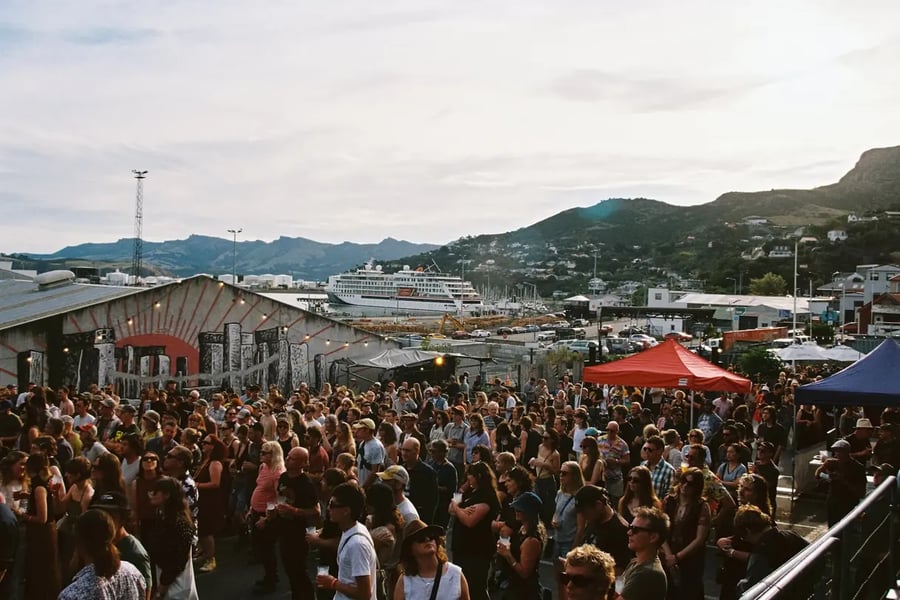
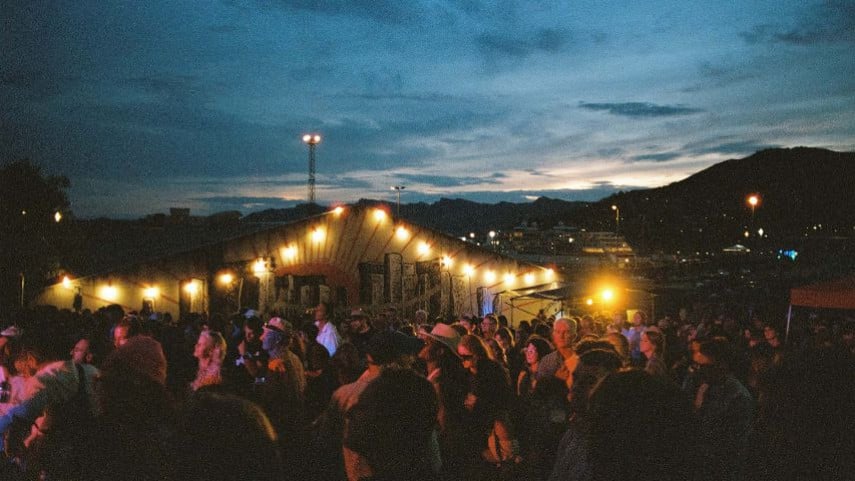
On Saturday evening, the diverse artists will be spread across Wunderbar, Loons Upstairs, Lyttelton Coffee Company (where Woods planned to host his proto-Port Noise several years ago), and two outdoor stages. There will be market stalls selling local food and drink, and attendees have access to unlimited re-entry throughout the night.
View this post on Instagram
Smyth brings up the sadly defunct Festival of Lights, an arts event which used to take over Lyttelton’s main street in winter.
“Yeah, I was thinking about it [too],” Woods says. “That was a massive highlight for teenage me… They [organisers] just closed the whole street down, all the businesses got out on the street and they had a picnic and stuff.
Their Port Noise blueprint closely follows the example of Festival of Lights.
“[O]ne of our main priorities is [to have] a good party, where you just feel nestled and belonging in this space,” Smyth says. “The dream is like [a] very curated, awesome arts [event] but also a block party.” Woods agrees. “I don’t want it to be one thing. You know, you want those intimate moments, the longform, looking at the landscape bits, and I want the Die! Die! Die! kind, just getting kind of melted. You also want a real good party time!
“Well, that’s why you got Our Carlson,” I say.
How to explain Our Carlson to an unsuspecting reader-cum-listener? The dreadfully underrated Australian musician is a thunderous ball of infectious energy and punk attitude. We included his 2021 late-night anthem “Kickon” in our Best Australian & New Zealand Songs of the 21st Century list last year. He is one of a kind.
“He came to Port Noise last year and [we] put a little show on at [Lyttelton venue] Civil and Naval,” Woods says. “People were just like, ‘What the fuck?!’ And then this ‘Domming the Doctor’ song…”
But that’s exactly what Port Noise has excelled at since its inception: bringing challenging music to people who might otherwise never hear it.
“I think sometimes the[se] spaces like this can be a bit dude-heavy,” Smyth acknowledges. And Ben and I both have a penchant for party music. Good party music. The girls in the front.”
“[N]o matter if there is a bunch of Gen X guys who have had a bunch of IPAs… they will be the ones also at the front there,” Woods says. Smyth again: “We all want to be the girls up front.”
I spoke with Die! Die! Die! vocalist Andrew Wilson one month before this year’s Port Noise, and he expressed his excitement about playing the festival. It wasn’t a surprising admission, because Port Noise has quickly built up a reputation as being “by musicians, for musicians.”
“I guess the thing we keep putting in press releases and stuff is [the festival is] artist-led, you know?” Woods says. “Not that it’s just for artists — it’s definitely for everyone… It’s accommodating for everyone, and I want to do that in a genuine way, which means thinking past what is the default assumption of what a festival should do and provide.”
“[M]y partner is an artist, so I think we both have a good perspective on what looking after an artist looks like,” Smyth says. “It always feels a bit cliché, but it’s true [that] it’s kind of your favourite artist’s favourite artist.”
They want to do more for artists, too.
As part of an expanded ‘Week of Port Noise’ programme, the inaugural ‘Hands Across the Water’ will link musicians from Aotearoa and Australia “across the Tasman, with hopes of building creative links between continents.”
“The mingle-meeting situation,” as Woods puts it, will feature sets by Our Carlson, local artist KOMMI, Sweet Whirl (AUS), and the wonderful singer-songwriter Hannah Everingham tomorrow night.
“Everyone who becomes an artist gets this whole push that they need to tour overseas in [the] EU and America, and it’s so silly because it doesn’t actually often kick them off, help them make it, but Australia is right there,” Smyth says.
“I feel like the only other way is really doing BIGSOUND, you know, or like SXSW or one of those things where you can be guaranteed some funding and maybe be able to like, you know, make even,” Woods notes.
He recalls his own “anxiety-inducing” experience at Aotearoa’s version of BIGSOUND, Going Global.
“I was thankful to do it. It’s nice to be given some money to come up and play in front of different people always, but it’s one of those situations where I guess it’s like they’re inviting the industry and they’re inviting a pool of very different bands to come and pretty much do their best… A lot of the music feels quite disjointed from one another… I feel like what that means for some of the crowd is that they’re there for their mates and not for other people.
“So you’re talking to 200 people and, I don’t know, you know like 40 of them will be like, ‘Hell yeah, this is great,’ and the other 160 are like smashing beers and smoking durries. Which is also fine, but yeah, it’s very interesting. And there’s that competitive element — everyone’s like trying to push in front of each other to talk to some poor American guy, jetlagged.”
New Zealand’s premier industry showcase event takes place in the heart of Auckland Central, one island and over one thousand kilometres away from Lyttelton, but North Islanders are increasingly flocking to Port Noise in pursuit of new music discoveries. (The Spinoff sent a reviewer to cover it last year; Under The Radar’s editor said he’s “ponied up and flown from Tāmaki twice to attend” the festival.)
“This year especially, I think definitely more than ever, a huge percentage of people [are] from out of town,” Woods tells me. Smyth has more precise information. “Heaps from Melbourne and Auckland, Dunedin, some from Nelson. This year has been an extreme [year for] out-of-town growth.”
Smyth is acutely aware that there still exists a north-south divide in Aotearoa music.
“There’s so much amazing music that comes out here. It’s kind of like a Catch-22 though, because as much as we want the industry, we also love the space that not having the industry pressure gives artists.”
Their festival, she says, offers artists a platform where they “don’t have to come with some fully realised commercial band aesthetic… And we also recognise that the South Island is a bit disconnected sometimes from the industry… We totally recognise that it’s important for artists to come together in these spaces.”
What’s next for Port Noise? Its growth has already been commendable in four short years.
“Yeah, it’s crazy,” Woods reflects. “It’s absolutely crazy. Every year I say to Rose, ‘This is the one where we need to do exactly what we did last year, but make the back end a little more easy.’ But then we’re like, ‘Hold on, what if we did five other arts events?’ We fuck up our year for it!”
“When do you start planning out every year? As soon as one finishes you’re onto the next one?” I ask.
“I feel like we try our best to wrap it up and [have] a couple months or something of — you know, I obviously want to be a musician. That’s my main thing… And obviously we[‘ve] both got families and stuff so [we’re] trying to be present in that,” Woods answers.
View this post on Instagram
“There’s all the other stuff before you even start booking things — trying to deal with the funding agencies and all the rest of it and scoping out other festivals and trying to find inspiration… Yeah, pretty much straight in.
“[W]e want to do it for everyone, [but] it’s also super cool to be like, ‘This is for this small pocket of weirdos.’ And it’s sustainable [like that]. It doesn’t have to impress everyone… We want to draw everyone in, everyone we absolutely can, and then be like, ‘Check this out!’”
Smyth agrees. “[T]he people that love the weird music are coming and that’s great, but we’re just trying to make sure we are open armsing to the people that could be a little bit intimidated by the space and so we want them to know that we are just going to put on this beautiful good food, good drinks, party and potentially they’ll find a new favourite band… It’s like a really easy, open, fun Lyttelton night for them to experience.”
Woods takes over. “It’s not like we’re trying to get a certain profit margin, you know? It’s like, [we] want this thing to happen that we love and we want to tell as many people about it and have as many friends and people in the community involved as we possibly can and have it be sustainable.”
Port Noise 2026 takes place on Saturday. February 21st. Ticket information is available here.

