





























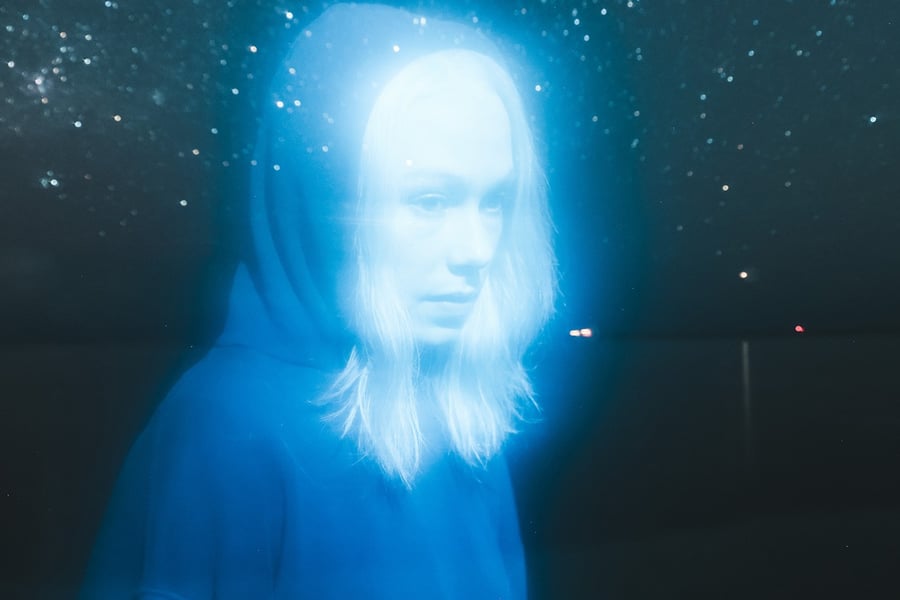
Phoebe Bridgers loves to nod to her heroes. Her lyrics, like those of many of her biggest musical influences, are dense texts, full of winking allusions and subtle references to records, bands, and albums that have shaped her own songwriting. Sometimes, Bridgers uses music as a small narrative detail (see the Lemmy and Smiths shoutouts in “Smoke Signals”), and sometimes she just writes an entire verse about music (see the famous Lennon and Clapton-referencing “Moon Song”). Other times, she’ll make a reference that’s barely noticeable until it’s pointed out (the line about someone being “bored” in the “Motion Sickness” bridge has been interpreted as a dig at the chorus of Ryan Adams’ “Outbound Train”).
But Bridgers’ stunning new album, Lost Weekend, has seemingly even more allusions to albums and songs in her record collection than ever. Here are a few likely call-outs that caught our attention.
Elliott Smith, “Angel in the Snow”
“An angel in the snow/Accident prone,” Bridgers sings in the first verse of “Still Standing.” Bridgers has talked at length about her love for New Moon, the posthumous 2007 compilation of Elliott Smith songs. This is, after all, the same person who once inscribed lyrics from an early version of “Miss Misery” (found, yes, on New Moon) on the Figure 8 memorial wall in Los Angeles’ Silver Lake neighbourhood. Is it a coincidence that the phrase “angel in the snow” also happens to be the title of the opening track on New Moon? Almost certainly not.
Damien Jurado, “The Last Great Washington State”
Damien Jurado is a prolific and criminally under-acknowledged singer-songwriter from the Pacific Northwest. He’s also the only artist whose work was interpolated and incorporated so heavily into Bridgers’ new album that he received a co-writing credit, on both “Lost Weekend” and “Lost Weekend (Reprise).” The melody of those tracks are based on “Last Great Washington State,” a beautiful, six-minute gem buried on Jurado’s 2018 album The Horizon Just Laughed.
The Replacements, “Can’t Hardly Wait”
Is it a stretch to assume the chorus of Bridgers’ new song “I Can’t Wait” (“I can’t wait, but I’m waiting”) is some sort of nod to the Replacements’ mid-Eighties masterpiece “Can’t Hardly Wait”? Possibly, but the fact that Bridgers has previously played around with the same exact song in a different chorus would certainly seem to increase the likelihood: “I can’t hardly wait for someone to replace,” she sang on “Chesapeake,” from her 2018 collaborative album with Conor Oberst as Better Oblivion Community Center. On tour for that album, Bridgers and Oberst made the influence clear when they actually covered the Replacements tune, but that’s not even the only Replacements song she’s performed live.
The Crickets/The Bobby Fuller Four/The Clash, “I Fought The Law”
This one’s pretty simple. On “Lost Weekend (Reprise),” a devastating portrait of grief seemingly inspired by the death of Bridgers’ father, she sings: “I am my old man’s oldest son/I fought the wall, and the wall won.” That’s a callback to the eternal rock & roll classic “I Fought the Law,” first recorded in 1959 by the Crickets (and written by their guitarist Sonny Curtis), made a hit the following year by the Bobby Fuller Four, and turned into an immortal punk anthem by the Clash nearly two decades later.
Bright Eyes, I’m Wide Awake, It’s Morning
Did we really think Bridgers would go a whole album without in some way winking to Conor Oberst? “I’ve been daydreaming about sleeping,” she sings on “Haunted,” one of the album standouts. “But by the evening, I’m wide awake.” That second line sounds like a play on the title of Oberst’s 2005 I’m Wide Awake, It’s Morning, an album we’re well aware Bridgers knows very well. It’s also not the only Oberst connection to this record: The Bright Eyes frontman plays harmonica on “I Can’t Wait.” (Is “Governor’s Waltz,” another Lost Weekend highlight, also a play on the title of Oberst’s 2014 song “Governor’s Ball”? With Phoebe, anything’s possible!)
Love Music?
Get your daily dose of everything happening in Australian/New Zealand music and globally.

The Statler Brothers, “My Past Is Looking Brighter (All The Time)”
Is there any reason to think Phoebe Bridgers is a fan of this late-career deep cut from the country-gospel vocal group the Statler Brothers? Not necessarily, but the song title does appear, almost verbatim, as a pay-off moment during “Liberty Tree”: “Falling in love that night/After our fight,” Bridgers sings, “The past is looking brighter all the time.”
Black Sabbath, “Live Forever”
Bridgers is a huge Sabbath head. When she previewed her new album at Madison Square Garden this summer, she wore a Black Sabbath T-shirt. She’s explained that her penchant for tuning her guitars low earlier in her career came from wanting to sound more like Tony Iommi. So when Bridgers sings “Now I don’t want to live forever/But I don’t wanna die,” on “As Above,” the first thing that comes to mind is “Live Forever,” a rocker on Sabbath’s final studio album (2013’s 13) that just happens to have the exact same pair of lines.
Phoebe Bridgers, “Graceland Too”
Isn’t this list about other artists? Yes, but we’d be remiss to leave off this song. Like her songwriting heroes, Bridgers has been known to sprinkle in a self-referential lyrical or musical callback to her own body of work here and there, and there’s no Bridgers song that has a larger musical bearing on Lost Weekend than this Punisher fan favorite. The “Graceland Too” melody is a recurring musical motif throughout this record, showing up repeatedly and serving, in a way, as a sonic connective tissue through the album’s second half, from the chorus melody of “Liberty Tree” to the instrumental segue “Lost Parade.” (Even the bridge of “As Above” has hints of that same melody.)
Maybe Bridgers is making some sort of deep narrative point here. Or maybe she’s just having some postmodern fun, referencing a song of hers that, as she explained in 2020, itself contains a lyric with a history of being used by others: The “Graceland Too” phrase “rebel without a clue” was, in a five-year span beginning in 1986, found in songs by Bonnie Tyler, the Replacements, and Tom Petty. But whatever larger point she’s making, it all adds yet another layer of meaning to an already fantastic record.
From Rolling Stone US

