




























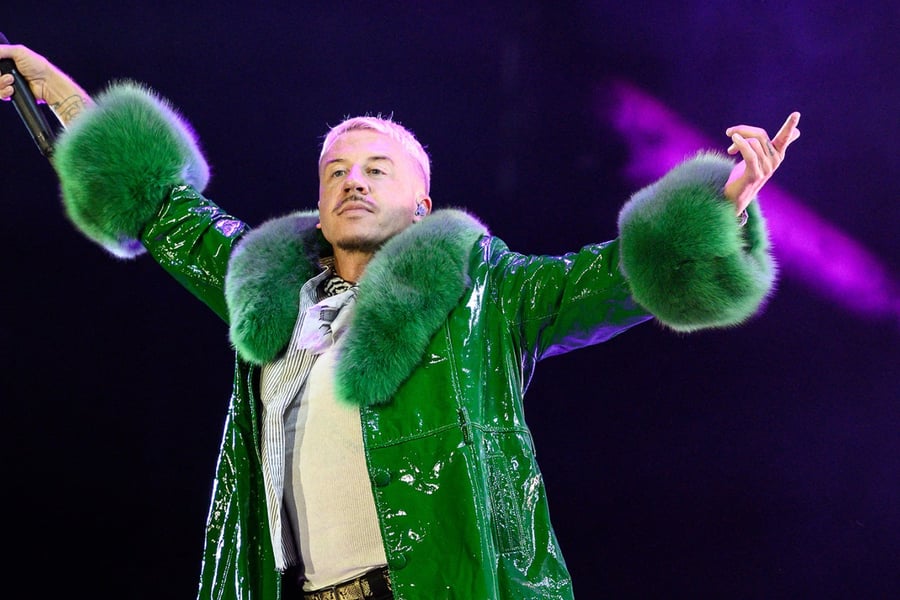
Neither New England Patriots owner Robert Kraft nor the rapper Macklemore have any business being the centre of a serious national conversation, but somehow, here we are. This week, venue owners for Ed Sheeran’s Loop Tour — including, most prominently, Kraft — ordered his promoter to fire the rapper, who was an opening act. Why? He had spoken out from the stage, declaring “Free Palestine” and showing images of the destruction of Gaza.
“Ed told me that Kraft said I would not be allowed to perform in his stadium,” Macklemore wrote in a statement. “Ed also told me that Kraft had rallied some of the other stadium owners and collectively they gave him an ultimatum: If Macklemore stays on the tour, you will not be allowed to play in our venues.”
Kraft, whose Kraft Sports Group also owns the Pats’ home of Gillette Stadium in Foxborough, Massachusetts, where Sheeran is scheduled to perform two shows later this month, admitted to barring Macklemore from the venue in a statement, saying that there had been “too much suffering” in the war in Gaza and that “standing with the Palestinian people and standing against Hamas, antisemitism, and hate should not be mutually exclusive.” He added that he would welcome a conversation with Macklemore “to discuss the facts, because ultimately our goal is the same — peace for all people, an end to suffering, and an end to all hate.” (He did not address the allegation that he had “rallied” other venue owners.)
But then why not have that important conversation before banning the artist? This ham-fisted effort by a rich and powerful man to silence views could have a chilling effect on other artists — or really anyone willing to take a stand for what they believe in. Attempts to muffle creative voices through bullying and strong-arm tactics are fundamentally anti-American and have become all too common in recent years.
Moreover, although Kraft may have the right to ban anyone he wants from performing at his venue — that’s freedom of expression, too, after all — this effort was sure to backfire from the start. There’s a phenomenon known as the Streisand effect, when attempts to hide or censor something draw magnitudes more attention to it. This is exactly what Kraft has unleashed with his actions. Nobody was thinking about Macklemore two weeks ago. Today, millions more people know about his stance on this issue and, thanks to Kraft, many see him as a martyr for a cause.
On Tuesday, Sheeran’s other opening acts (Finneas, Lukas Graham, and Aaron Rowe) quit the tour in protest of the owners’ ban and declared “Free Palestine” on the way out the door. The Irish band Beoga, who have been performing select songs with Sheeran on the tour, also withdrew. The tour seems to be in complete disarray, the apolitical Sheeran being attacked online for not walking away, supporting his opening act, or pushing back against the owners’ demands.
The hate being lobbed at Sheeran is also an unpleasant reminder of the extreme and ugly bullying tactics of the online left. Those gross mob-style pile-on tendencies are unhelpful and will not lead to meaningful dialogue or even results. Little can be accomplished when people of opposing views are simply screaming at each other and not listening. If anything, Macklemore’s outspokenness has prompted people to look long and hard at this conflict and find their moral position. Dialogue doesn’t take away from the strong emotions people carry about war, death, or religion and history. But the internet is not a place of understanding — nuance is lost and reconciliation feels like an impossibility. That doesn’t mean we shouldn’t try.
Love Music?
Get your daily dose of everything happening in Australian/New Zealand music and globally.

Of course, Kraft can simply ignore the vitriol and return to caring about the Patriots’ season — being a billionaire does have many advantages. Lest we forget, this is the NFL that banned Colin Kaepernick for taking the knee to acknowledge Black Lives Matter. A league where a recent study found that 25 percent of its players end up with CTE, yet few talk about that horror on gameday. Perhaps that silence is also designed by a billionaire cabal.
Rolling Stone stands with musicians in these matters, always. If Kid Rock were prevented from playing Yankee Stadium by an angry left-wing owner, we would say the same thing: Lift the ban. From Ice-T’s “Cop Killer” to Bruce Springsteen’s “41 Shots,” the artists formerly known as the Dixie Chicks’ protests of the Iraq war, and countless other moments, Rolling Stone has always supported musicians’ right to express their views. This publication was founded in the belief that the power of music is to bring us together and make us think and feel more deeply about the world and our role in it. That’s as true today as it was in 1967.
For musicians to create art, they need the freedom to express themselves without threats of billionaires on overwatch duty ready to torch the careers of those who step out of line. Pushing boundaries is what great artists do.
Rolling Stone will always stand with artists and their right to free speech, even when we violently disagree with their statements or even dislike the music they make. In fact, we may rally behind musicians even more so if the art is contentious. If we don’t let artists express themselves, the vibrant world of music will turn very black and white indeed.
From Rolling Stone US

