






























Two years ago, Kita Alexander was writing about love.
Her debut album Young in Love debuted at No. 3 on the ARIA Australian Albums Chart and established her as one of Australia’s most captivating pop voices. The songs were bright, hook-heavy, romantic. She built a reputation on breezy melodies and heartfelt confessionals.
Her second album, RAGE, due June 26th via Warner Music Australia, doesn’t abandon pop — it interrogates it.
“That I’ve been angry for a long time and that it’s always been there,” Alexander says when asked what this record has taught her. “It’s not like a new feeling. It’s always been there and I just haven’t acknowledged it.”
RAGE isn’t about discovering fury — it’s about recognising it.
The title track began with a simple declaration in the studio. “I have the title ‘Rage’,” Alexander recalls. “I want to write about this.” What followed wasn’t a conventional pop structure. “It’s not really the structure of a typical song,” she says. “It’s not a real obvious chorus. I mean, there is, but it’s subtle.”
The track builds instead of bursts, a quiet internal warning swelling into something that refuses to stay polite.
Love Music?
Get your daily dose of everything happening in Australian/New Zealand music and globally.

In the room with Matt Corby, Ben Abraham, and Sean Cook, that escalation became physical. Corby pushed her rhythmically to “try to it straighter,” resisting the instinct to embellish. There was tension. Energy held tight.
Then came the middle eight.
“I’m not someone who has incredible vocal control, or I’m not Beyoncé,” Alexander says. “I’m singing in front of Matt Corby… I hate singing in front of people who are pitch perfect, but I was like, fuck it, I’m just going to.”
She didn’t finesse it. “I was scream-singing… by my standards, it was screaming,” she says. “It wasn’t contained or controlled, it was a pure feeling.”
She kept going. “I didn’t really let anyone talk. I was just like, again, again, because I loved — it felt so good to just let it out and do that.”
She even lost her voice for three days. “It was the most powerful connection to my rage that I’ve ever had.”
There’s something revealing in the fact that she only understood the psychology after the song existed. “To be honest, I only really realised there were stages of anger after I wrote this song,” she adds.
For years, Alexander handled discomfort the way many modern creatives, and many women, do — with relentless positivity.
“I’d always used positive affirmations. I’ve always used positive thinking to override this feeling in my body,” she reveals. “Whether it be small, big, in between… I would always use this positive mentality to get through things.”
A friend, however, interrupted that pattern. “She’d see me go to speak about it and go, ‘Oh, no, no, I shouldn’t feel that way…,’” Alexander admits.
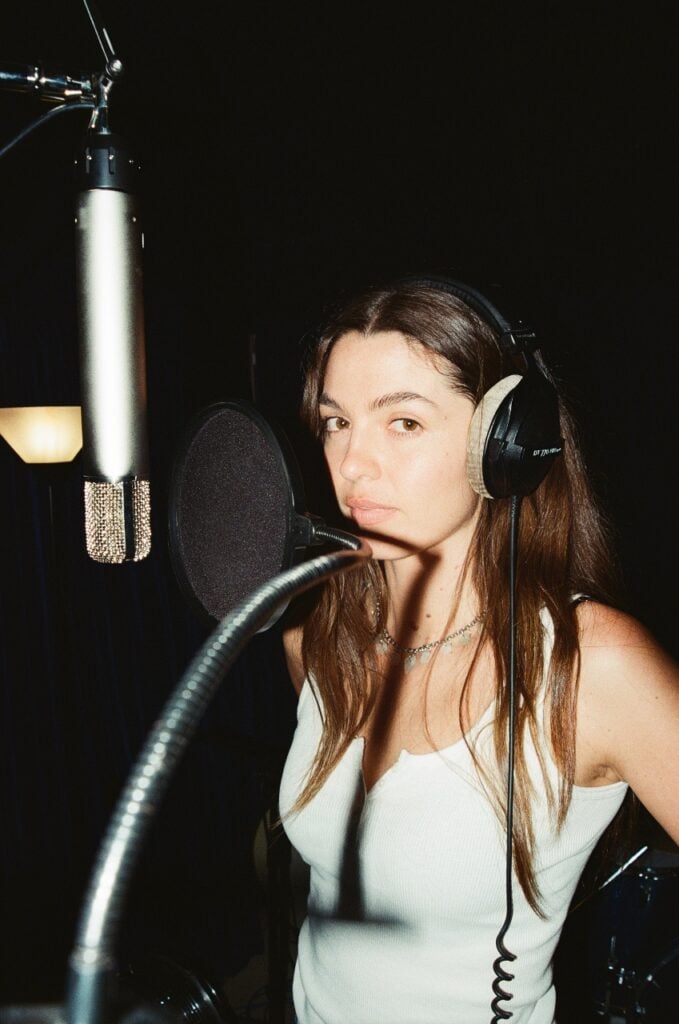
Credit: Kitty Callaghan
Then came a sentence that changed the trajectory of the album — and, by her account, her life.
“She told me, ‘Anger can bring about beautiful change. Anger does have a place in your life,’” she says. “No one’s ever told me I was allowed to feel anger.”
It’s a startling admission in a culture that rewards women for being agreeable, grateful, and emotionally tidy. In an era of affirmation cards and “good vibes only” captions, Alexander realised she had been overriding signals instead of listening to them.
“I don’t want to positive my way out of these feelings,” she says. “I just want to sit with it.”
Sitting with it, for Alexander, doesn’t mean chaos. It means information.
“It’s not like I let it control me or ruin my life,” she says. “I just now speak up and I say the things that are inside of me that I’m not shutting down anymore.”
“I didn’t think I was allowed to be an angry woman. Just to be the people-pleasing person you’re raised to be.”
@kitaalexander 🫠 🫠
As she’s begun presenting a less filtered version of herself publicly, she’s noticed the subtle recoil.
“Is it so uncomfortable for you to see a woman with anger?” she asks. “Why can’t I have a different kind of emotion?”
Female rage has become an aesthetic in film, fashion and pop culture. It’s stylised, curated, applauded. But lived anger — everyday irritation, boundary-setting, dissatisfaction — still makes people uneasy.
On RAGE, Alexander doesn’t theatricalise it. “It’s not an obvious rage,” she says. “It’s not a screamo record.” Instead, this is pop with friction.
“I love writing upbeat songs. I do love pop,” she says. That instinct hasn’t changed. What has changed is the depth of excavation. “This record… goes really into another layer of myself and a deeper place.”
Listeners can take it lightly or seriously. “People can listen to this music and switch off their ears and not dive into lyrics… and still have a good time,” she says. “Or, they can listen to the lyrics… and become introspective.”
That duality — sugar on the surface, weight underneath — has always been part of her craft. It’s how songs like “Hotel” slowly found their audience months after release. “A song can have a life a couple of years after it’s out,” she says. “As long as I’m happy with it and I love it. That’s the main thing.”
Growth has sharpened her perspective, though. Turning 30 looms large. There’s complexity in that milestone.
“Part of me is angry that I’m turning 30,” she admits. “I’m just allowing that to be there…”
That’s the quiet thesis of RAGE — coexistence.
“I can have both,” she says. “I can love and be appreciative… but I can also be frustrated and a bit angry.”
Even the visuals reflect that unfiltered stance. The video for the title track, directed by Roman Anastasios, is a raw one-take performance shot in Byron Bay. No frantic cuts. No polish. Presence over perfection.
“I had less pressure on myself to be perfect,” she says. “I could give myself all over to this video.”
After opening for Dua Lipa on the sold-out Radical Optimism Australian and New Zealand tour last year, Alexander saw what sustained power looks like night after night.
“That woman, working that stage with such confidence, such power [and] so much grace,” she says. “I was just in awe.” Watching Lipa push through exhaustion reframed endurance: “If you train hard enough, if you work enough, anything’s possible.”
But Alexander’s personal version of power now looks less like spectacle and more like acknowledgment.
“It’s taught myself that I’m normal,” she says.
That her anger isn’t monstrous. That it isn’t wrong. That it isn’t something to override with gratitude or swallow with a smile.
“It’s normal to feel anger and it has a place,” she says. “You can just be angry. You’re allowed to feel that way.”
Kita Alexander’s RAGE is out June 26th via Warner Music Australia (pre-save/pre-add/pre-order here).

