





























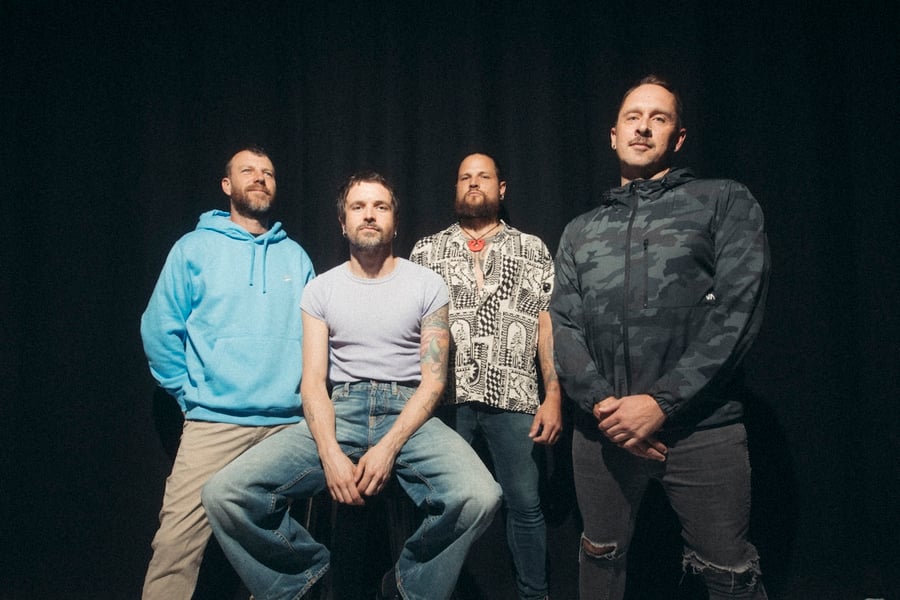
Seventeen years after their last album and more than a decade after they called it quits, Kisschasy are back — not as a nostalgia act, not for a victory lap, but as a band finally at peace with who they are.
At the centre of that return is Darren Cordeux, who found the title for the band’s first record since 2009 in an unlikely place: a thrift store in Los Angeles.
“It was a photography book,” he recalls. “The Pleasures and Terrors of Comfort. I was just in love with those words together.”
At the time, Cordeux didn’t realise how closely they reflected his own life. Living in the US, years removed from Kisschasy’s whirlwind rise in the mid-2000s, he found himself wrestling with a quiet sense of stagnation.
“You still think that by a certain age, you’re going to know exactly who you are,” he muses. “Then you get there and you’re like, ‘Oh… maybe not.’”
That feeling — of comfort becoming its own kind of trap — would eventually shape the band’s fourth studio album, The Terrors of Comfort, out today. It’s an album about growing older, shedding illusions, and learning how to be honest again. Both with yourself and with your audience.
For much of the past decade, Cordeux kept Kisschasy “in a box” creatively, emotionally, and psychologically.
Love Music?
Get your daily dose of everything happening in Australian/New Zealand music and globally.

When the band officially split in 2015, it wasn’t theatre or strategy — it was exhaustion.
“The whole reason why we broke up in the first place is because I tried to do a fourth album that none of us thought was up to par,” he admits. “That definitely hurt me, emotionally and creatively. It was scary to go back into that world and open myself up to that pain again.”
The failure of that unfinished record lingered long after the band stopped touring. For Cordeux, it became a quiet creative wound; something he carried without fully confronting.
“I honestly didn’t think we’d be doing this again,” he says now. “When we called it, that wasn’t a lie.”
The path back began almost accidentally. Over dinner in LA with former manager and Below Par Records founder Jai Al-Attas and bandmate Joel Vanderuit, an idea emerged: maybe write one song to coincide with an anniversary tour for Hymns for the Nonbeliever. Just one. No expectations.
Cordeux hesitated. But he agreed to try. What followed surprised him.
The first two songs he wrote, “Parasite” and “Bad News Baby”, didn’t sound like vintage Kisschasy. They sounded heavier. Moodier. More self-assured.
“‘Parasite’ was the one where I thought, ‘Oh, cool, this isn’t something we’ve released before, but it still feels like us,’” he says. “That’s when I realised I don’t have to be so genre-specific. It’s more about being energy-specific.”
It was a small shift in thinking, but a crucial one. Instead of trying to replicate the band’s pop-punk past, Cordeux leaned into what had always mattered most: emotional intensity.
Once the floodgates opened, everything rushed through.
He describes his creative process as seasonal — like a sponge that absorbs life experiences through summer and winter, only to release them in autumn and spring.
“When it can’t take any more, it just turns into music,” he says. “That’s what happened. I couldn’t stop.”
Within months, he had six songs. Then more. Soon, it was clear this wasn’t a one-off single.
“It had to be an album,” he says. “It had to be a story. An arc.”
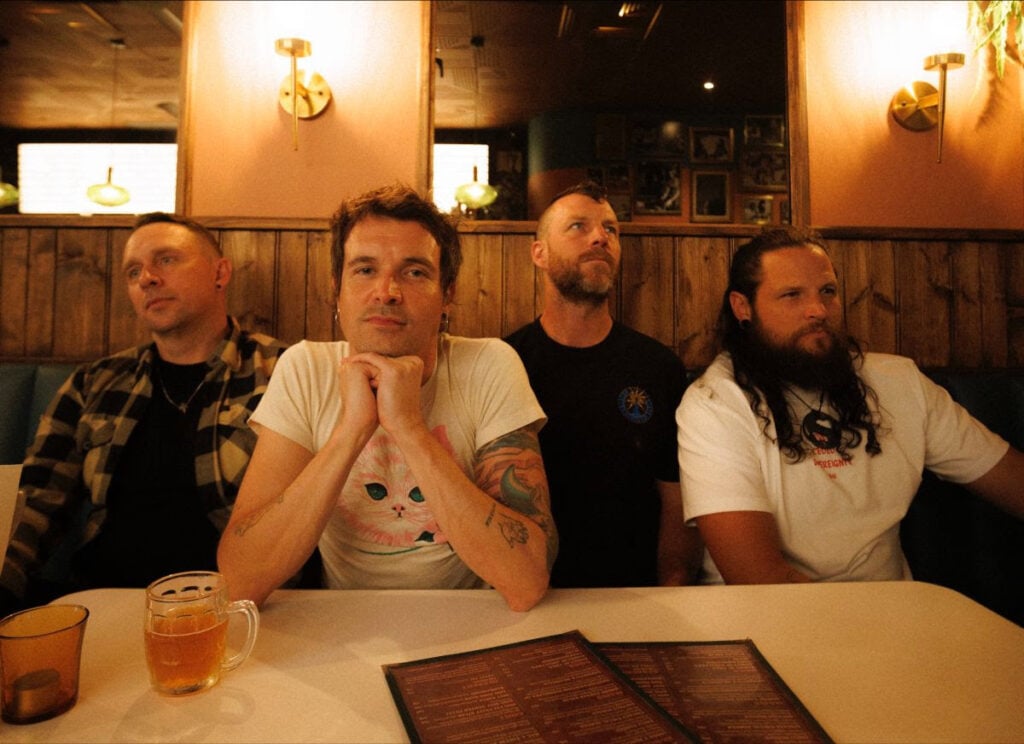
Credit: Marcus Coblyn
By early 2025, Kisschasy were back in a Melbourne studio, working at speed. They had limited time and no appetite for overthinking.
With Cordeux in LA and the rest of the band still in Australia — and bandmates Sean Thomas, Karl Ammitzboll, and Vanderuit now all juggling businesses and parenthood — there was no room for endless tinkering.
“We don’t have pressure to make money from this band,” Cordeux says. “So we don’t have to compromise. We’re just doing it because we love it.”
That freedom became their greatest asset.
Cordeux, producing a Kisschasy record for the first time, prepped the songs meticulously before sessions began. When the band arrived, they didn’t dismantle the demos; they amplified them.
“It just sounded bigger. Heavier. More commanding,” he says. “The way those guys attack their instruments, that’s something people sometimes miss. Live, we’re a heavy rock band.”
The record was tracked in five intense days. Vocals came later in LA, with Cordeux’s wife acting as an unofficial engineer and emotional sounding board.
“Nine times out of ten, she was spot on,” he laughs.
One of the defining qualities of The Terrors of Comfort is its texture. You can hear fingers sliding on strings. Amps buzzing between chords. Room noise bleeding into takes.
Cordeux calls it the album’s “secret weapon”: the hiss and the hum.
“We didn’t hide any of that,” he says. “It’s the sound of a real band in a real room.”
View this post on Instagram
In an era of hyper-polished digital production and AI-generated perfection, the decision feels quietly radical.
“People are going to yearn for that humanness,” he says. “We come from the world of real amps and cables. No tracks. No safety nets.”
He believes time will be kind to the record because of it — much like Hymns for the Nonbeliever, which continues to resonate years later.
“This is something we would listen to ourselves,” he says. “That matters.”
Perhaps the album’s most striking quality, however, is its lyrical maturity.
Cordeux was determined not to write a “throwback” record.
“I didn’t want it to feel like I was just talking about being a teenager,” he says. “So much life has happened since then. Maybe the biggest shit happens in your thirties and forties.”
Only one song, “The Quiet Sound”, looks back nostalgically — a memory of catching trains into Melbourne, hearing muffled music through club walls, discovering a future in noise.
The rest confront adulthood head-on: relationships that no longer fit, self-destructive patterns, emotional avoidance.
The album’s closer, “Better”, serves as its emotional resolution, an “inverted love song” about letting go of past selves.
“I’ve been through relationships where we weren’t good for each other,” he says. “And I’ve had dark moments with drugs. I was sober for four years leading up to this album.”
The song isn’t about redemption — it’s about honesty. “It’s about finally having the strength to let go,” he says.
Looking back, Cordeux sees much of his early anxiety as rooted in external validation.
“I had this pursuit of cool,” he says. “Trying to impress people.” Now, he laughs at it. “Every time I cringe, it’s something I was doing to impress somebody else. The truest me was actually the coolest me.”
That self-awareness runs throughout the record. There’s no posturing here. No attempt to chase trends or algorithms “Those numbers mess with your head,” he says. “Unless you’re completely in love with what you’re doing, it’s not worth it.”
This year, Kisschasy will take their new material to arenas, supporting Good Charlotte and Yellowcard — a full-circle moment for a band that toured with the former in 2007.
“Our songs still have those big choruses,” Cordeux says. “We’ve got enough experience in our pockets to translate.”
He’s especially excited to debut “Uncomfortably Numb”, a dynamic, slow-burn track with a shuffle beat inspired by Tears for Fears. “When it kicks in, you really feel it,” he says.
Sixteen years ago, Kisschasy walked away carrying unresolved disappointment. Today, they return with clarity.
“It feels exactly how I hoped it would feel,” Cordeux says. “Every little thing with this album has been better than I imagined.”
More importantly, it feels sustainable.
“We didn’t fuck it up,” he says. “We didn’t hate each other. We’re still the same four people.”
Asked where the band might be in five years, he doesn’t pretend to know.
“I just hope we keep making stuff this good,” he says. “I’m a bigger fan of our band than I’ve ever been. I just want to love the thing that I do.”
Kisschasy’s The Terrors of Comfort is out now.

