




























The first few minutes of the new documentary Kiss: End of the Road set up its next couple of hours. “We’re Superman with a guitar,” singer-guitarist Paul Stanley tells the camera. “Unfortunately, age is our kryptonite.” A few minutes later in the film, we see an exhausted Gene Simmons onstage at a 2023 gig in Manaus, Brazil, sweat dripping from his makeup as he collapses into a pile, catching his breath in a chair for several minutes. The scene was an inauspicious start to the first show of the final leg of the die-hard rockers’ “absolute final shows.” The band’s manager, Doc McGhee, recalls in the film: “Paul said, ‘I’m out of here. I’m not gonna die up here.’”
When Stanley hears those words today, though, he smirks and spins them into a positive. He’s dressed down in a hoodie, sitting in his home office for a Zoom interview. “Seeing my brother Gene not only struggling but failing, I said, ‘That’s it,’” he recalls. “I said, ‘Regardless of what he wants to do, I owe it to him to pull the plug … certainly for the evening.’”
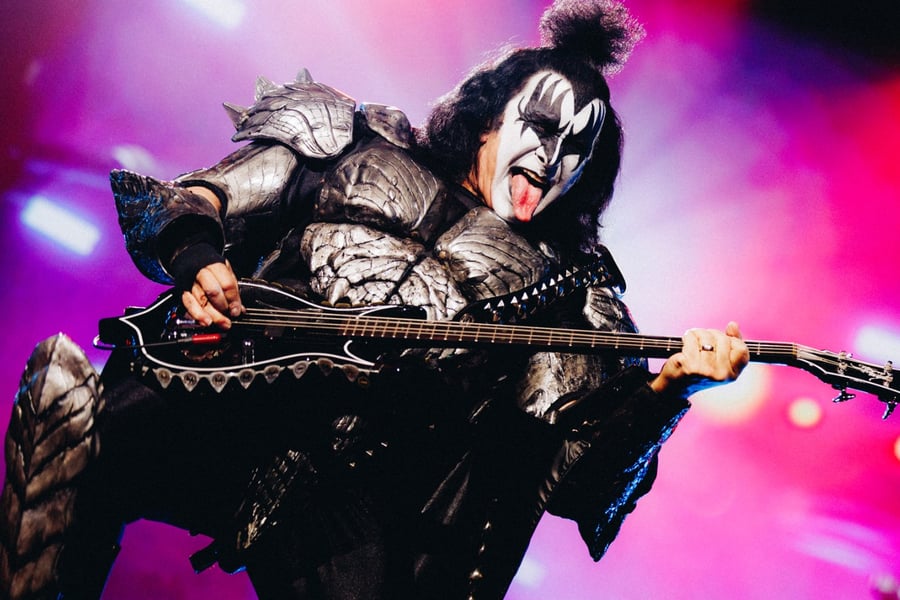
Simmons ultimately mustered the necessary strength to lift the 40 pounds of battle armour he was wearing and resume one of his signature songs, “Cold Gin.” After the show, in one of the stadium’s hallways, Simmons asks the cameraman, “Did you catch me throwing up?” which leads to McGhee conceding, “They’re showing their age.” Even though Simmons, Stanley, guitarist Tommy Thayer, and drummer Eric Singer were putting their all into performing tongue-waving, fire-breathing, ziplining, hard-rock hits like “Detroit Rock City,” “Lick It Up,” and “Love Gun,” rocking and rolling all night, let alone for a few hours, was beginning to look ambitious.
“If there’s such a thing as more than 100 percent humidity, it was there,” Simmons says today. He’s dressed entirely in black, including his baseball cap and sunglasses, to Zoom in from a solo-tour stop somewhere on the Dakotas border. “Combined with very high temperatures approaching 100 degrees, you walk out and you’re just drenched. Stupid me, I didn’t drink enough liquids, so down I went.”
Asked now what he thinks of Stanley’s impulse to pull the plug on the show, Simmons says, “Bitch, who do you think you’re talking to?”
Simmons and Stanley’s friendship remains brotherlike, though, as one especially funny scene from the doc, premiering here exclusively, shows.
Simmons’ bravado about his rocky start in Brazil can’t overshadow the hard truths Kiss faced on the tour. The two-part doc, which premieres Thursday as a pay-per-view stream, occasionally feels like Spinal Tap: The band straightens out botched pyro cues, deals with a wardrobe malfunction when Stanley’s guitar gets hooked on his boot, and keeps playing while the streamers meant to burst out during “Shout It Out Loud” instead dangle from the rafters, floating down for hours. Stanley also contracted a bout of flu that forced the cancellation of three gigs in close proximity to the final show at Madison Square Garden.
Love Music?
Get your daily dose of everything happening in Australian/New Zealand music and globally.

Kiss had put decades into living up to their intro rap — “You wanted the best, you got the best” — but in the film, they reveal how they faced long odds to make good on that claim in the lead-up to that MSG farewell show, which took place on Dec. 2, 2023. “These guys understood that for the film to be authentic, it had to be warts and all,” End of the Road’s director, DJ Viola, tells Rolling Stone via email. “Neither Gene nor Paul loved having a camera around during their lowest moments. Who would? But they understood why those moments mattered, and they trusted that the film would portray them honestly.”
Much of the documentary shows how hard Kiss work to get it right on the road, but longtime fans will be surprised to see how vulnerable their heroes appear. These are the guys who built their legend pouring their literal blood into the ink of a Marvel comic book, the guys whose hard-partying rock anthems influenced musicians as diverse as Nirvana, Pantera, and Garth Brooks. These are the guys who’ve plunked their logo on everything from condoms to caskets, the guys who kicked off a Farewell Tour in 2000 and refused to say goodbye.
Now Stanley is 74 and wants to spend time with his teenage kids, while Simmons is three years older and just wants to play gigs without Kiss’ heavy baggage — literally. “I’m a huge Radiohead fan,” Simmons says, “but if Thom [Yorke] got into my outfit, as my Italian friends in New York would say, fuhgeddaboudit.” Of course, they made it to MSG, and the movie gives a front-row view to why Kiss have (finally) retired from touring.
“There certainly was a long period of time where we projected invincibility and immortality,” Stanley says. “I think to humanize that now doesn’t weaken who we are. It actually strengthens it. I’m a big believer that the less secrets you have, the more free you are.”
Simmons is more guarded about what ended up onscreen. “The doc is really an interesting exercise in trying to figure out what to show, what not to show,” he says. “All in all, I think it’s pretty good.”
“Neither Gene nor Paul asked me to remove a single moment from the film,” says Viola, who previously directed A&E’s Biography: KISStory. “There wasn’t one scene that made it in or was left out because of a note from either of them.”
THE FILM’S MOST REVEALING moments show Stanley and Simmons weighing the future of their career, and like a few great Kiss songs, one of the most telling scenes takes place in the backseat of a car:
Stanley: Look, we were just offered a lot to continue.
Simmons: We were?
Stanley: Yes.
Simmons: I like money.
Stanley: I like pride.
Ultimately, pride won out — at least regarding touring. Other than special engagements like the band’s “unmasked” performance at its own Kiss Kruise: Land Locked in Vegas event this past weekend, the duo swear Kiss are done on the road. But there’s still plenty of money to be made.
Even if Kiss, the band, are done, the idea of Kiss will continue. Simmons, ever playing the role of rock’s answer to Don King, hypes a future that could include a Kiss cartoon, theme park, biopic, and the avatar shows they teased at their final show. Their multimillion-dollar rights deal with Pophouse positions Kiss, the brand, well.
The business can keep going, but as the doc shows, Stanley and Simmons had to learn to let go of the stage itself. “At a certain point we decided, ‘OK, this is the top,’” Simmons says. “It’s not going to get any better.”
Since 2004, Stanley has had both hips replaced, both rotator cuffs repaired, and he’s undergone repair surgery for torn biceps. Most recently, he had shoulder surgery in 2021. He reckons Kiss played some 250 shows on the End of the Road Tour while he was in his early seventies. “There are no 72-year-old football players, basketball players, or boxers,” he says. “I’ve sustained all the same injuries [as athletes].… On that final tour, that was our peak, to me, in terms of the band, the technology, the camaraderie.”
Stanley also feels good about bowing out now since Kiss have achieved what he calls “the trifecta”: trophies from the Rock & Roll Hall of Fame and the Songwriters Hall of Fame (they sit behind him on a marble table as he speaks), as well as a Kennedy Center Honor. Although Kiss redefined hard rock for multiple generations, their makeup and carnival stunts made them something of a pop-culture novelty to rock’s gatekeepers until recently. But good things come to those who wait, and Simmons and Stanley waited long enough.
“Kiss is timeless because Kiss has always been very adamant about not singing about politics or saving the whales or anything of that sort,” Stanley says. “There are people or media to take care of that. We’ve always been about, dare I say, great rock & roll, entertainment, escapism, and self-belief, preaching that if we can do this, you can do this.”
That raises an obvious question: Could accepting the Kennedy Center Honor, presented last year by President Trump, who plunged the Kennedy Center into turmoil, be perceived as political? “Not at all,” Simmons says. “Fuck politics. The Kennedy Center Honors are highest accolades a civilian can get … I don’t care how people think of the president. He was elected by the Electoral College.… It’s fair. If you don’t like it, vote somebody else in. But in the meantime, he’s the president. And if you don’t like the person, at least respect the presidency.”
Putting aside politics, Simmons believes the End of the Road Tour was “as good as we could do, and it’s never perfect.” Both musicians mention the glaring absence at the final show of the band’s other founding members, guitarist Ace Frehley (who later died in 2025) and drummer Peter Criss. “It became impossible, which shouldn’t be a surprise to me at this point,” Stanley says. “When people have either unrealistic expectations or demands, you just have to decide: Either you acquiesce or you move on.”
Simmons says he personally asked them multiple times to participate, but they declined. “Paul may have said it better than I did,” he says, “which is, ‘We wouldn’t have been here without Ace and Peter, but Kiss wouldn’t have existed with Ace and Peter.’”
“Even today, I love Peter to death,” he continues. “We went to the Kennedy Center Honors, and we were all sitting together, and it was great looking at old times. But Peter and his wife complained enough that the Secret Service just abandoned them and said, ‘OK. We’re done,’ and they just walked off. This is the Secret Service.” (A rep for Criss did not reply to Rolling Stone’s request for comment.)
One former Kiss member whom Simmons didn’t bother inviting to the final show was Vinnie Vincent, the reclusive guitarist who recently resurfaced hoping to sell CD singles for $225 and an entire album for $2 million. “He was a talented guy, but damaged, in my view,” Simmons says. “He has yet to this day to sign his contract with Kiss.… I wish him well. I wish everybody well. Life is short, and if you can get $2,500 for popcorn farts or whatever it is you want to do, God bless.”
Largely, the duo has few regrets about how the tour turned out. “Everything turned out the way it was meant to,” Stanley says. His only “minuscule” regret is that the band was a little hasty in unveiling in-production sketches of the avatars that will be part of Kiss’ ABBA-like show. He promises the real deal will be so much better.
“We see sketches, and Paul and I get in there and try to massage it and ‘Kiss-ify’ it,” Simmons says. Then he paints a vivid picture of how he sees the avatar shows looking: “Imagine virtual-reality glasses,” he says. “You walk into a room, you’re in another dimension, or dinosaurs are about to eat you up, all kinds of stuff. Now imagine seeing that reality without wearing glasses.”
“I’ll get old, he won’t,” Stanley says of the avatar. “Again, Kiss should transcend its inception and continue for decades to come in different forms, whether it’s ‘Kiss meets Scooby-Doo’ or the End of the Road Tour or Kiss Kruises, whatever it is. I was going to say it’s part of Americana, but it’s worldwide. We created something far bigger than us.”
WHEN STANLEY WATCHES End of the Road, he says he’s impressed by what he calls “the magnitude” of it. “We’ve always had a sense of responsibility to our legacy and to what people expect from us,” he says. “This was really a commitment by us to make sure that people felt validated and justified in their love for us.”
“For the first time, you get to witness the dedication, work ethic, obsessiveness, and love that goes into every single performance,” Viola says. But he also sees it as something more: “What this documentary captures is the last time Kiss brought thousands of people together in an arena to share that experience as one collective. There’s something incredibly powerful about that.”
In the years leading up to the final tour, Stanley became aware of what he calls “flaws in the armor.” Kiss are hyperaware of those sorts of shortcomings and don’t want to let their fans down. That’s clear in the film’s scenes of meet-and-greets and a fun one showing Stanley rehearsing his “People, let me hear you” and “Make some noise” cheers to an empty stadium before the show. “That’s me,” he says, shouting those same words out loud over Zoom. “That’s not an act.”
Simmons is happy to be done with the physical burdens of playing in Kiss. “I’m 77 now,” he says. “I’m doing OK. I got lots of hair — unfortunately, more on my ass and my back — but you have to know when to stop doing the thing that limits you physically, because I literally cannot do the same things we did when we were in our twenties. Neither can Paul. It’s just life.”
Kiss have not broken up. Stanley describes Kiss’ next phase as “diversifying,” as they explore the upcoming avatar shows and what lies beyond. Simmons also says more music is on the way. “We actually secretly recorded a new song Paul wrote,” he says. “I can’t tell you more about it than that.”
“We’re not invincible, but [the idea of] Kiss is,” Stanley says. “Kiss is pretty much impervious to anything. But the people behind the band are human, ultimately — as much as we would like to think otherwise.”
From Rolling Stone US

