




























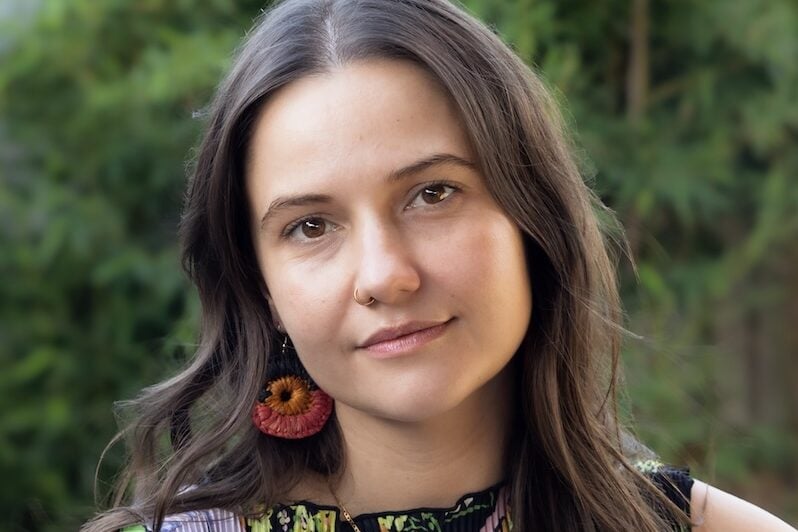
In her new book It’s Not for You, Camp Cope’s Kelly-Dawn Hellmrich speaks with women and gender-diverse artists who changed Australia’s music industry on their own terms.
It’s Not for You features interviews with Amyl and the Sniffers frontwoman Amy Taylor, Angie McMahon, Anna Lunoe, BARKAA, Courtney Barnett, Fanny Lumsden, Julia Jacklin, Kira Puru, Marcia Hines, and many more.
It’s Not for You goes beyond the music, offering a peek behind the curtain, generous personal reflection, catharsis, camaraderie, and inspiration for anyone who’s ever been told they were too much or not enough.
Read an exclusive excerpt from Hellmrich’s book, which is out now, below.
It’s Not for You is available to purchase here.
When people ask me how long I’ve been playing music, I say, “My whole life.” Mostly because I can’t remember a version of myself that wasn’t playing or learning an instrument. One of the earliest memories I have is asking my dad to teach me guitar. He would say, “Your hands are too small,” and stretch his fingers across the fretboard to show me. “I’ll teach you properly when you can wrap your hand around the neck.”
I checked every day. Wrapping my fingers around the neck of the guitar, trying to stretch them as far as they’d go, holding my hand up to his in the lounge room and hoping.
Love Music?
Get your daily dose of everything happening in Australian/New Zealand music and globally.

By thirteen I’d formed my first band. In Year 7 music class the boys always put dibs on the lead guitar and the drums, and girls were pushed towards playing acoustic or bass guitar if we wanted a place in the band. In rebellion to that, I and some of the girls in my music class made our own band instead. We learnt Grinspoon covers and called ourselves Barbie College.
No boys allowed. And here, in my first band, the girls let me play lead and encouraged me. I owe them so much for that.
Nicole was our drummer. She lived in a housing commission cul-de-sac where people threw rocks at her house, and once through her window, to get her to stop practising drums. She kept playing anyway. Gabby played piano and sang and was one of twelve kids, almost all of them able to sing or play piano. They are a warm, generous and endlessly talented family. Both of them stepped away from music after we left school, and I never understood it. They were as talented as many people I’ve met who went on to do it for a living.
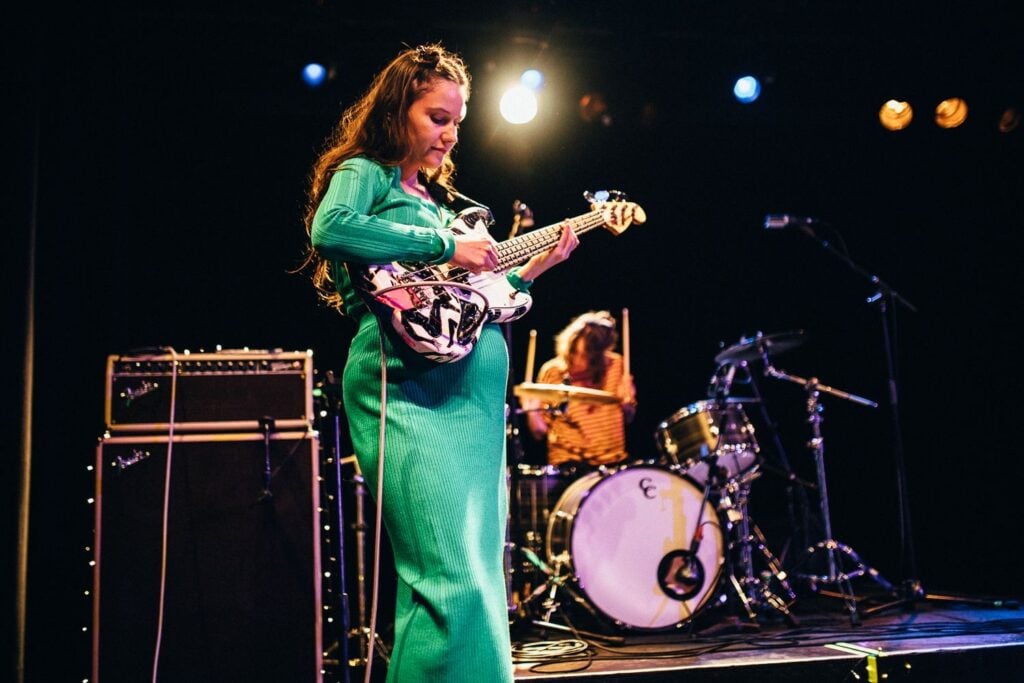
Credit: Matt Oxlade
When I was a teenager, I started going to local hardcore and punk shows around Western Sydney. The older men in the bands would let me and my friends sit behind the merch desk with them, and it made me feel included and a part of the music in some way. There were no women on stage or at the front of the mosh. It took me a long time to understand that as a girl who loved music, if I wanted to be around musicians, it often meant close proximity to men who controlled the rooms, the line-ups, the sound and the opportunities.
I learnt the hard way that the same people who recognised my passion for music and the artists who made it could also see it as my weakness. Some people notice the way you like to be close to the stage, the way you love music more than anything, and they use that devotion as an opening. I’ve been pressed against walls by men who owned rehearsal spaces. I’ve been dismissed and undermined by people I thought were peers. I’ve been told to take what I could get and be grateful. And told to be quiet about the injustices I saw and experienced.
View this post on Instagram
But this is not a story about hurt. It’s about love.
Because what kept me going, again and again, was the women and queer people I met along my journey. The ones I saw on stage, played with, wrote with, travelled with and learnt from. People who pulled me back into the room when I wanted to disappear. People who knew how heavy the industry could feel and still found ways to make joy and art and change. When the music industry broke my heart, they built it back up with their laughter, hard work, honesty and solidarity.
This book is for them. And for the ones who came before us, and the ones learning guitars in their rooms alone now, wondering if they should even dare to dream. It’s for every artist who felt pushed away, or talked over, or told that their place was somewhere else.
I wanted to create something that is ours, where our stories were the focal point. I wanted to talk to artists who shaped me, challenged my thinking and inspired me, or just simply reminded me that we deserved to be there. I asked the questions I wish I could have asked them when I was starting out. Had the discussions I needed when I was ready to quit.
Camp Cope has a song named “Keep Growing”, with a line Georgia wrote: “I have been growing my hair out and it’s not for you.” That line always got my heart pumping fast and hard. That whole song does that for me. It also has the line “That’s not me in the back row no more,” and every time we played it, it felt amazing and surreal to stand on a stage in front of so many people when I’d once felt as though I didn’t even deserve to be in the room; as though music wasn’t meant for me at all.
From our very first show in Brisbane in 2016, when we stopped mid-set to call out a guy who was pushing his way to the front and shoving women aside, we knew exactly what kind of space we wanted to build. One where women and queer people didn’t have to shrink themselves or brace for impact if they didn’t. And if you had a problem with that, it was not for you.
I hope the stories here show the depth and variety of women in music. I hope someone reads it and feels less alone. I hope someone reads it and feels inspired to write a song. If you want to quit, I hope this can be your sign not to.
I could have filled this book ten times over with extraordinary artists. The ones here are just a beginning. I’m proud to share their stories with you, and I’m grateful for every woman who kept me going long enough that I could write them down.

