





























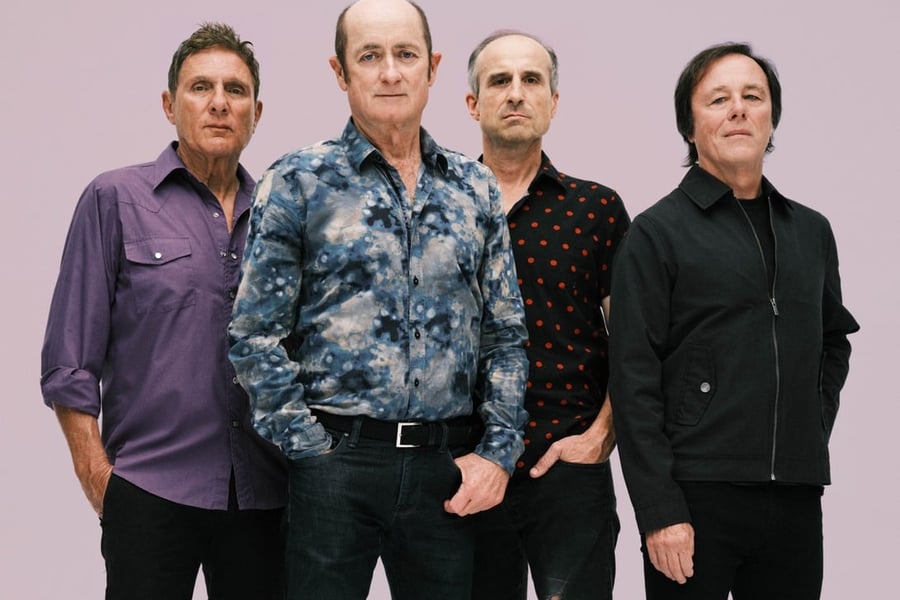
To celebrate 45 years since their formation, Hoodoo Gurus are heading out on their ‘Rewind Tour — All Killer, No Filler’.
The band will only play their singles – of which they released 42 in total – when they visit five Australian states throughout November and December. “We’re hoping to play every one of our singles at least once somewhere during this tour,” vocalist/guitarist Dave Faulkner said.
Ahead of the tour, Faulkner sat down with Rolling Stone AU/NZ for an in-depth interview. Read below.
Tour information is available here.
“People say we’re a great singles band”
“People say we’re a great singles band and we are, ‘cause the songs are memorable and they’re still hanging around so that says something. But as far as chart performance, we’ve underperformed. I mean, we’ve never had a number one. The closest we got was number three, with ‘What’s My Scene’. But we were never chart-toppers.
“When the songs are still alive and vital – that, to me, is great. And they don’t sound like they belong in a bygone era… The way they’re recorded might sound of its era, but the songs themselves are still communicating just as vitally as they ever did and that’s really incredible to me. As a songwriter, I’m really proud of that.”
Love Music?
Get your daily dose of everything happening in Australian/New Zealand music and globally.

Writing “My Girl”: “It was all there in my head”
“I wrote ‘My Girl’ when I was 21. I was out walking one day and that bassline, which is a classic chord progression, the 1–4–5, just popped into my head. And I started singing the melody that became the verse, and then the chorus, and it was all there in my head. Then the lyrics. And I actually came back home and sang it into my tape recorder – my little cassette player – and the whole song was kind of there. The only thing that was missing, in terms of melodies, was a lead solo, ‘cause that’s a strong melody in itself.
“But, yeah, I found the cassette the other day! In the last couple of months I’ve found all my old songwriting cassettes. I’ve got, like, 100 of them and I can see the beginnings of all these songs – like a little archaeological dig: ‘There’s the riff of “What’s My Scene” and there’s me singing the melody, and another thing.’ And, bit by bit, you see the song coming together in the space of a few minutes. So, several recordings – I was probably doing it in the space of an hour or two, recording the ideas as they’re coming to me and then stopping. And then playing around some more on the instrument, and then going back and recording a new bit I thought of.
“But ‘My Girl’ – I literally just sang it into the cassette player. I hadn’t even touched an instrument to do it, the melody was in my head and the lyrics were all there. It was fun.”
“Leilani”
“Our first single [1982’s “Leilani”] came out on Phantom [Records]. So that was a record shop that posed as a record label – for its own prestige, I think; it was more of a hobby for them. And they’d just pick up a couple of bands around the inner-city that were kind of making a noise, or that people liked. That was our first single, so that was zero pressure.
“Then when we signed up to Big Time Records, which was on the recommendation of Rob Younger [Radio Birdman’s frontman], actually – that was how we got signed. Michael McMartin – who ended up becoming our manager afterwards – was working for this little label, and he’d been involved with Birdman’s publishing and stuff before we went to Big Time. [McMartin] was involved with Trafalgar [Studios], who Birdman recorded with, so he asked Rob, ‘Who’s around town we should look at to sign up? We’re looking for new bands.’
“They’d been licensing stuff from Slash [Records] in the US, and other small labels, and they just wanted to find some cool indie stuff from Australia as well. And the first band he signed was Hoodoo Gurus.
“As it happened, Brad Shepherd had just joined us. And Brad had been in The Hitmen and had written a couple of songs – or certainly one song – for their second album, which was gonna be a single. So Michael was already kinda keen, ‘cause Chris Masuak [guitarist] from Birdman was in that band as well. So Michael was involved with Chris’s publishing and he thought, ‘Ooh, I haven’t got Brad Shepherd’s publishing, I should sign him up.’ And so hearing that he was in this band – the Hoodoo Gurus, that Rob Younger had just recommended – it gave him a double reason to come and check us out.
“So we went in there and pretty much did a demo, and it was like, ‘Well, “Tojo”’s the next single’. Then, later, ‘My Girl’ became a single. They were songs in our set and they just stood out as being – you know, we knew they were crowd favourites already. So yeah! It was just kinda natural [for them to be released as singles]; you know which songs jump out at you, more than anything.
“So we were on Big Time Records and they sub-licensed through major labels like EMI and then BMG, and we ended up suing Big Time after our third album [1987’s ‘Blow Your Cool’] – because they didn’t pay us some royalties – and we ended up winning the case and we got our freedom. They were only a small, little label anyway so, you know, there’s no controlling thing with that label.
“And when we were suing Big Time, we had nothing to do; it was a long period of barristers and the whole bit. And [bassist] Rick Grossman joined the band at that time, so we just decided to go and start doing some demos in Trafalgar Studios, which is where we recorded ‘Stoneage Romeos’ and most of ‘Mars’ [Needs Guitars!], and so forth.”
“Because we were successful live, we became acceptable to radio”
“We were lucky, because we were successful live. So, in fact, that’s how we got radio play. Because I mean, yes, we got support from independent media and indie stations – and your triple js, and what have you. But also, in those days, what they’d do to test records – to see if they were acceptable to be played on the air – for the commercial stations, they’d phone someone and play a little bit [of the song] to them down the telephone and ask them what they thought of it.
“So when you’re playing and you’re getting enough of a live following, I guess the dart hit a bullseye on fans of ours, ‘cause there were a lot of them out there already that knew what we sounded like. And they’d recognise [us]: ‘I like that.’ And so we started to be okay.
“It was because we were successful live that we became acceptable to radio. And then there was a self-fulfilling prophecy in the sense that we were on the radio, therefore we could be on the radio. And it’s the same thing if you’re not on the radio: you don’t deserve to be on the radio [laughs]. So that’s how we got on and it was always led through live work, from day one.”
Bittersweet: “Hoodoo Gurus would never play this song in a million years!”
“I wanted to write truthful things as well. But that was a conscious change and that was where ‘Bittersweet’ came from. And, in fact, when I was writing ‘Bittersweet’, I actually thought, ‘The Hoodoo Gurus would never play this song in a million years!’
“So when I got them to rehearse it, it sounded perfect, of course. But, in my imagination, I thought, ‘This sounds so different to anything we’ve been doing and no one’s gonna like this’ – it’s not the bright, jolly, cartoon stuff that we’d sort of been known for.
“So anyway, for whatever reason, I just felt like I found my feet as a writer at that time… I actually think from the second album, ‘Mars Needs Guitars!’, is kind of where I became the songwriter I am.
“But the songwriter I was, in a sense – that nascent songwriter – was pretty good. And that was in combination with Rod and Kimble and James, and just the influence of forming the band. That whole era – and just the whole character of what was going on around us, as well – just made a fairly special moment. And the songs were written in jest and stupidity, and that’s something I don’t like to do so much either.
“People would come up to me and ask me about the [‘Stoneage Romeos’] song ‘Arthur’, and they’d be quite sad about this poor guy that died – that was our bass player. And it was like, ‘Well, it’s a completely made-up story,’ you know? It’s a stupid gag about the fact that we didn’t have a bass guitarist, so we needed to get one. So we explained why we don’t have a bass guitarist and it was a stupid, circular thing.
“There’s a lot of songs like that – you know, ‘Leilani’ is about a Hollywood movie – and I thought, ‘I wouldn’t mind writing about real things, real emotions, and not just kind of pulling my punches and being sorta snide – oh, not snide, but just writing manufactured stories or whatever.”
Come Anytime: “The closest I came to trying to copy something I’d already done”
“The closest I came to trying to copy something I’d already done, really, was writing ‘Come Anytime’, where I was kind of writing something in a similar energy and effervescence as ‘What’s My Scene’.
“But it didn’t come out like ‘What’s My Scene’, you know? It was its own thing. But that’s the closest I’ve ever come to, ‘Oh, I’ll write another one like that’. But, generally speaking, you just can’t do it. If you try to write to a formula, or a prescription, it never turns out good.”
Big Deal: “Not radio-friendly at all”
“Putting this ‘Rewind Tour’ together – we’re doing only singles, so it’s been a little interesting [laughs]. Seeing what songs we did release as singles were kind of funny decisions a coupla times. Like, the first single off the album Blue Cave [1996] was a song called ‘Big Deal’.
“I mean, it’s insane that that would be our lead-off single, ‘cause it’s so loud and dyspeptic-sounding. It’s very confronting and not radio-friendly at all. It’s kinda like stoner-rock and it’s very heavy, and we just loved it so we went, ‘Well that’s a single!’”
“There’s songs that could’ve been hits if we were younger and were new”
“There’s songs that I think flew under other people’s radars. I mean, as a songwriter, I like songs that aren’t singles as much as I like singles. They don’t mean more or less to me, because of that status – that’s just a matter of circumstance.
“Some songs are obviously written more as a carefree, ‘Let’s just have a bit of a laugh,’ and those songs you can kinda dance to or whatever. And some songs are more to sit and think or to bare your soul [to]. But there’s a whole different range of things. And certain songs come back to me and say things to me, which I didn’t realise were in them, you know?
“I can’t think of a single where that happened specifically, at this moment, but there was a song called ‘Something’s Coming’ on ‘Kinky’ [1991] that – many years later – I was like, ‘Oh, is that what I was talking about. I kinda thought I was talking about this,’ you know? And it’s something else entirely to what – I realised, as a writer, the subconscious stuff goes in there and, just like anyone, you relate to a song differently at different times of your life.
“But there’s the songs that I think could’ve been hits if we were younger and were new, rather than being a veteran band when people don’t take you seriously and don’t wanna play you because you’re not hot, you’re not the young thing that everyone’s talking about. And I think the song ‘If Only’ is like that, in ‘Blue Cave ‘– I love that song. I think it’s got a huge amount of juicy melody and great lyrics and great energy, and I just love it. And ‘When You Get to California’ is a song I’ve always loved – that’s the song that I credit with getting the band back together.”
The song that got the band back together
“It was my idea to break up the band because – again – the ageism of the music industry. You get the hint that basically, you know, ‘We don’t wanna talk about you anymore – or notice you, particularly – because you’re old news.’ And you kinda take it on board and you think, ‘Oh, maybe we should get out while the going’s good before people start to get really bored with us and don’t show up at our shows anymore,’ or whatever. You start to think that you could have some sort of horrible decline and you’d be embarrassed for yourself [laughs].
“So I thought, ‘Let’s quit while we’re on top,’ and that’s what we did, and I felt really great about it. Also, I was about to turn 40 and I was thinking, ‘Am I gonna do something else with my life other than one band?’ I was questioning – a midlife crisis kind of thing. So for all those reasons I broke the band up and it was fun! I did that Antenna album.” (Antenna – Faulkner’s rock-electro project with Kim Salmon, Stuart McCarthy and Justin Frew – released an album, Installation, in 1998.)
“Hoodoo Gurus are still alive as a band”
“So there was that song and other songs – as I say – that were just crying out for, obviously, the Hoodoo Gurus. And it wasn’t until we got asked to do [Australian festival] Homebake four years after we broke up that I finally got the message that, in fact, the Hoodoo Gurus were actually alive and well, it’s just that I wasn’t allowing them to have the garage. And it was another two years before I finally got over myself and thought, ‘Well people are gonna criticise you for, you know, ‘It was a stunt, you broke up – it was always a big con.’
“‘Cause I heard people say that about KISS and whatever, you know? Doing the ‘final ever’ tours again and again and again – or [John] Farnham. So that was my thinking – I didn’t wanna retract that breakup. It took me two more years and I finally said, ‘Oh, fuck it! I know these songs are meant to be played with the Hoodoo Gurus and the Hoodoo Gurus are still alive as a band, it’s just not allowed out.’
“So I thought, ‘Well, we’ll do it and if people don’t wanna see us and they wanna keep hold of their memories of the band that was, before we broke up – that was the last time they ever wanna see us or think about us – that’s great! But if you wanna see what we’re up to now? We’re gonna be making music and continuing on, so…’ And now it’s been 19 years!”
Appreciating Hoodoo Gurus’ “chemistry” anew
“[Through re-forming] I discovered that whole thing about the chemistry, the uniting of four disparate people into one – not a hive mind, but kind of a common alloy sorta thing, which is different to the individual elements. A new sort of chemical thing with different properties that are different to the four different components. And that was what I hadn’t seen in the Hoodoo Gurus, because I’d been in it for all that time, you know? It was all around me, but I didn’t notice it forming.
“But when I was doing Antenna, that did happen. Halfway through the Antenna project, suddenly it all coalesced into this same energy where you wouldn’t really need to second-guess yourself, you could just know. You’d try an idea, someone would suggest something and then everyone would sort of know without really having to talk about whether it was gonna work, or whether that’s a good idea or not. And it was just bizarre how the band itself had come into existence as a separate entity that we were all subsumed by.
“So when I came back to the Hoodoo Gurus and we started rehearsing for Homebake, that’s what shocked me, because I saw that same energy and I hadn’t realised that it’d been there all along. So that’s when I knew that, yeah, there’s this thing, this beast…
“It felt like having a sports car in your garage but it’s up on blocks and the wheels are off and it’s got a tarp over it and you can never drive it. What the fuck am I doing with this valuable piece of equipment that will actually give me a lot of enjoyment? It’s no good in the garage when no one can enjoy it and it’s not fulfilling its purpose, so to speak. So you gotta let it freeeeee [laughs].”
Regrets, I’ve had a few…
“Often the things that you come back to, obviously, are the things where you could’ve done better and there’s so many things that you wish you could do again. One would obviously be ‘Blow Your Cool’. If we could do that the way we see it should be – I mean, of course it was a very successful record and people love it, but for us personally it just felt like a missed opportunity, or we kind of fumbled the ball.
“Obviously the James Baker thing – that was horrible. [Hoodoos’ original drummer departed a few months after ‘Stoneage Romeos’ dropped, just before the band headed to America] And I don’t wanna go into the ins and outs of how and why that happened, because that’s private stuff. But basically, it was just dreadful for all concerned – James as well. It was horrible for him, horrible for us, and I was vilified afterwards and, in some quarters, still am.
“But something that I’ve learnt from the experience – apart from so many other things I’ve learnt from that experience – was, again, that same thing I was talking about with the identity of the band and the alloy. I didn’t appreciate how much things would change after James left – not that it would’ve changed anything – but, yes, it’s just a shame, because we didn’t get to make any more music together. And I don’t know how that could’ve gone on any further, but I wish it had’ve, that’s all. So that’s a regret, in a sense.
“And I said it to James, actually, before he died. We had a chat and I was talking about those things and I just said, ‘Yeah, I’m sorry we didn’t get to make any more music together, because I know it would’ve been different to what ended up happening.’ As a songwriter – again, to follow that point about the energy of the band and the identity of the band as a unit – I don’t direct the band. I mean, I do in a sense where, ‘These are the songs and this is how they should sound, and we should play them this way and here’s the riff for this,’ and all those parts.
“But the actual selection of material is done by the band itself, just through the very act of playing it and making it sound like something – that’s when you know, ‘Oh, this is really working,’ or, ‘This is not working,’ and, ‘This is a song that’s maybe not gonna make it into anything, this song didn’t kind of take off.’
“And that’s why ‘When You Get to California’ was like, ‘That’s the Hoodoo Gurus coming out there,’ you know? They wanna be the Hoodoo Gurus on that song. And so it’s the same thing with that alloy of the first band – can’t be replaced or replicated. The alloy of the band with James and Clyde [Bramley, bassist who left after the third album] is another alloy that made its sort of sound.
“Then, of course, Mark Kingsmill was a major part of our career and that alloy. And then Rick joining – there’s so much, and I can see it all very clearly now as each one has its own identity and, yeah! It’s all part of our family, so to speak, and they’re all the Hoodoo Gurus but they’re all their own special brand of Hoodoo Gurus. And none is better than the other, that’s the thing. I mean, other people might have their own opinions, but I see them all with what they brought to bear. And this music and the things they’ve done – amazing things.
“It’s literally just the chemistry – it’s a silly word, but it really is the only one that fits. It’s the chemistry of that thing.
“Before Nik [Rieth] joined, so when Mark was still in the band, we did a gig where we had all the old lineups on one night, on one bill. So basically it started as Le Hoodoo Gurus – Kimble and Rod and James and myself – and then Kimble and Rod would go off stage and Brad would come on. And then Clyde. And so that became the first, ‘Stoneage Romeos’ version of the Hoodoo Gurus. And then we’d mutate, having Mark replace James in the set and then Rick would replace Clyde, and that was the whole night! And then at the end we all played together in an encore – all eight of us on stage. And now there’d be nine, with Nik.
“But the magic of it was, getting James on ‘Tojo’ again. As much as Mark is the most brilliant drummer, which he is – he’s probably the best drummer to come out of this country, or one of them, and explosive and incredible. James had his knack and when you heard James on ‘Tojo’ it was like, ‘Ah!’ – Brad and I both said it, you know? ‘This is the way it was meant to sound. This is the song as we think of it and how we feel it.’ It’s no slight on Mark, it’s just – that is in the DNA of that song, for me. So that energy – it’s not just the way James plays, it’s something else: that unit we become with that. Definitely his unique style was part of it, of course.”
“I didn’t know that all drummers weren’t great!”
“Then Mark and now Nik – we’re very lucky we’ve had three incredible drummers; all very different from each other, but all great. It’s been amazing! And that’s one thing I really have learnt to appreciate, ‘cause I didn’t know that all drummers weren’t great!’ [Laughs] ‘Cause I’ve worked with great ones and they’ve all had something really unique and fantastic about them. I realise now how lucky I’ve been.”
Some “Very Special Guests”
Ratcat “were stealing our thunder”
“I think they’re a good band and we always loved them back when they played with us before. We shared bills back in the day and we toured together, and they were great. And Simon [Day, frontman] is a fantastic person. And they were one of those bands that came in our wake that were stealing our thunder, in the sense that they’re the pop darlings now and you’ve already got your career.
“And we know what you’re doing, but who are these guys and what are they about to do? And aren’t they fabulous? And isn’t he a good-looking guy?’ as well. And all the girls are hot for him, ‘cause he’s very nice looking and a very great person. So curse him for that [laughs]. But he’s also a good songwriter and so, yeah!
“Ratcat had a nice career and I don’t know the ins and outs of how they eventually folded up the tent, but I’m glad they’re coming back out and having some fun.”
The Stems: “We have that commonality”
“We do meet in that ‘60s psychedelic basement; that’s the roots of [The Stems] and the same with us [Hoodoo Gurus]… They’re a great band and, as I say, we have that commonality – it makes sense that we’re on the same show together, but we’re not doing exactly the same thing.”

