



























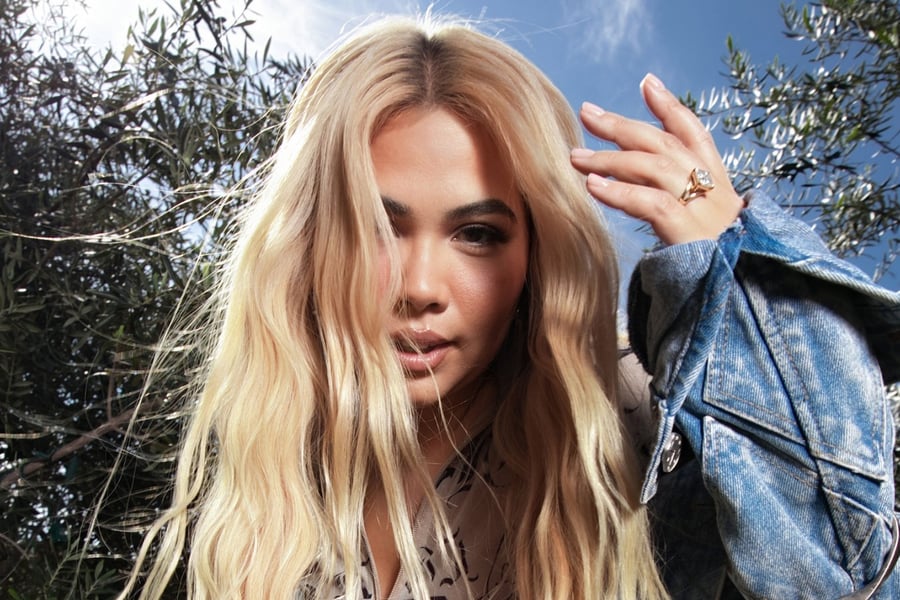
When the world needed Lesbian Jesus most, she disappeared. At least, that’s a bit what it felt like for fans of Hayley Kiyoko.
After the 2018 release of her debut album, Expectations, a synth-pop explosion of lesbian desire, listeners anxiously awaited her next project. So many were surprised when in January 2020, following the release of an EP called I’m Too Sensitive for This Shit, Kiyoko cancelled her North American tour entirely. In public, she was an artist brimming with potential and the momentum of a growing, queer, fanbase behind her, with no reason to suddenly go dark. But in private, she was struggling with a years-long dream project that seemed to be slipping further and further out of reach — turning her cult-classic 2015 song “Girls Like Girls” into a feature film.
“I felt like I was just trapped in stagnation,” Kiyoko says, hands reaching up to push back her signature bleach-blonde locks. “I kept cancelling my tours and putting my albums on pause because I thought I was gonna go shoot this movie, and the commitment is multiple years once you start. I didn’t think it was going to happen.”
Spoiler alert — it happened. Kiyoko is in New York for a quick 30-hour visit, hosting several early screenings for the Girls Like Girls film, out June 19. Directed by Kiyoko, the movie expands on the coming-of-age love story from the original music video, following teens Coley (Maya de Costa) and Sonya (Myra Molloy) as their growing attraction clashes with their ideas of sexuality, social standing, and personal relationships. It’s undeniably about queer love, but Kiyoko feels that everyone can relate to some aspect of the movie. “No matter who you love, every single person in this world has had to confront somebody about their feelings,” she says. “‘Oh my gosh, what are they gonna say?’ Are they gonna break my heart? Are they gonna accept me?’ And when you’re 16, it feels like life or death.”
The song “Girls Like Girls” never made the Billboard Hot 100 chart when it was released back in 2015. But it did something even more special — it helped define a generation of young queer women. It was the music video that got replayed at sleepovers, dissected in homerooms, or secretly watched behind doors. It was Kiyoko’s public coming-out statement, released the same week that Obergefell v. Hodges legalised same-sex marriage in all 50 states. But for countless Gen-Z fans, it became a personal revelation. “Hayley coming out with ‘Girls Like Girls’ was literally an earthquake,” singer-songwriter Gigi Perez — a collaborator on the Girls Like Girls soundtrack — told Rolling Stone in May. “She truly is a pioneer of queer music, of gay music, of lesbian music; she didn’t have a trampoline to fall back on. That was her truth.”
The release of Girls Like Girls will mark the end of Kiyoko’s decade-long stop-and-start journey to get her influential song onto film screens. But it’s also a tentpole moment in Kiyoko’s own life story. When she wrote the song in 2014, it was her official notice to the world that she liked women. But there were still parts of herself that she had to become more comfortable with, like embracing her Japanese heritage. When Girls Like Girls producers chose Kelowna, Canada, for filming, Kiyoko was surprised to realise it was the same town where her grandparents lived decades ago, and where she herself had visited summer after summer. In fact, her parents still have a treasured photo of Kiyoko taking her first steps while on a trip to Kelowna.
“I didn’t put myself in the music video at the time because I never saw myself as a main character,” she says, and quotes her own lyrics: “‘Stealing kisses from your missus,’ that line is a manifestation of wanting to be confident and be someone I did not feel like I was at that time. So to be able to [have] this evolution, where now I get to go shoot this film four streets down from my grandparents’ house, was pretty wild. This story has taken on so many life forms, and every version of it is just one step closer to my most authentic truth.”
Love Music?
Get your daily dose of everything happening in Australian/New Zealand music and globally.

The film’s accompanying soundtrack features a plethora of collaborators who, Kiyoko says, all have a “personal connection or impact” with “Girls Like Girls,” including Perez, Joy Oladokun, Tegan and Sara, Young Miko, and Chelsea Cutler. (The strongest song on the album — and one of Kiyoko’s favourites — is “Periwinkle Princess,” featuring newcomer August Ponthier.)
“I’ve always lacked community in the music space. So to be able to feel like I have artists [where] we feel seen by one another, taking their time to be part of this cultural moment, means the world to me,” Kiyoko says. “I feel like queer adventurers.”
Even after the film was completed, there were still hurdles left. One, which Kiyoko is still trying not to be too upset about, is the film’s rating from the Motion Picture Association. Given its minimal sexual nature and the important nature of its content, Kiyoko directed and worked on the script with the goal of a PG-13 rating. Instead, the film was given an R, citing “teen alcohol and drug use, and some language.”
Kiyoko’s face turns down into a wry grimace when I bring up the film’s rating. “We followed all the rules. They gave us an R because it’s called Girls Like Girls. There’s a double standard,” she says, slowing down and choosing her words carefully. “There’s a different hill we have to climb and fight for, of just having our love not being over-sexualised. So I’ll let you fill in the blanks.”
Now that Girls Like Girls is finally the movie she dreamed of, Kiyoko is free to keep evolving. She isn’t done as a singer — “Don’t say I’m quitting music,” she says, pointing a meticulously manicured fingernail my way — but when I ask if she sees a future where the title of director appears before musician, she answers with a decisive yes.
“Directing is what I want to do for the rest of my life,” she says. “It is my sole focus. I would love to be able to still write music, but through the lens of storytelling and world-building. Name 10 movies of girls falling in love. The list is short. And my goal in life is to make that list very, very long.”
From Rolling Stone US

