




























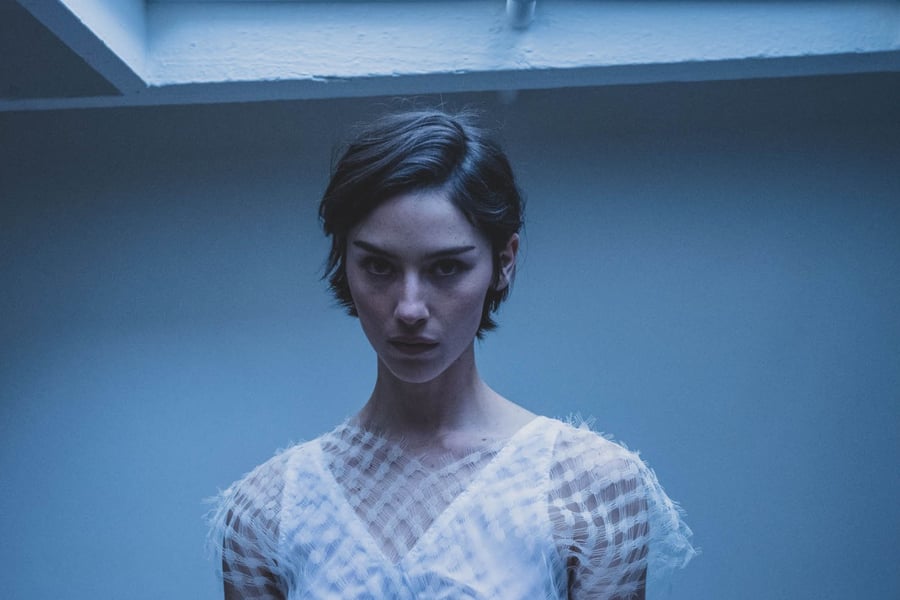
At present, Gracie Abrams is trying to give herself a little grace. “I’m very interested in softness these days,” she says, wearing a serene expression and a top that looks like a cirrus cloud.
She’s sitting onstage at New York’s famed Cherry Lane Theatre. Outside, it’s a soft October night. Inside, an audience of 150 is assembled for another edition of the Rolling Stone Residency, which involves a live edition of the Rolling Stone Interview followed by a stripped-down concert. Events have not gone as planned — Abrams was meant to perform with longtime collaborator Aaron Dessner of the National. “He was supposed to be here and is so sick,” Abrams tells the crowd. “So everything that I’m playing tonight is improvised arrangements of the songs” — arrangements she came up with that day. “It’s a funny little challenge,” she says, laughing. Another chance to give herself grace, to treat herself softly.
The past few months, Abrams admits, have sometimes made that difficult. In July, she released her third studio album, Daughter From Hell, her most ambitious and musically varied offering to date — a reflection on the perspective that comes from entering adulthood, and an artifact of the time of life when one develops that perspective. The day of the album’s release, she flew to Berlin to begin filming her first feature film, Please, the latest movie from Babygirl director Halina Reijn. The anticipation leading up to these milestones had worsened the panic attacks Abrams has been having since she was a kid. Stepping outside herself, and into a role she could inhabit, had provided a welcome relief — and, ironically, helped her return to a calmer, softer version of herself.
At the Cherry Lane Theatre, her calm and grace pay off: The six-song set she plays, stripped down to just her voice and a piano is hauntingly beautiful, with plenty of playful banter between Abrams and fans, one of whom came in from Alaska for the event. Before the set, in a wide-ranging conversation mixed with humour and candour, Abrams discusses the moment of life she’s in right now, her experience filming Please, her dream collaborations, and what’s still keeping her up at night.
The last time we talked, Daughter From Hell was coming out in two or three hours, and you were like, “I’m going to watch the last 20 minutes of Who’s Afraid of Virginia Woolf, turn off all devices, and be asleep before midnight.” Did that actually happen?
That did happen! I didn’t lie.
How do you do that? I imagine the anticipation is pretty strong at that moment in time.
In my experience thus far releasing something out into the world, it feels real when we’re on tour. When we are together is when it [feels] kind of legitimate. So I get the anticipatory adrenaline around shows, but [otherwise] I feel like I can retreat and still find peace.
So you woke up the next morning, and the album had come out. Do you go online then?
Well, my relationship with the internet has changed. I was lucky that the day the album came out, I went to Berlin and we started shooting this crazy project. It really was like [being in] a fully different universe the next day. I feel like I’ve not been in the regular, present-day world for the past three and a half months, really, so my attention wasn’t online much. I would check in every once in a while. My mom would text me screenshots of stuff, and I’d be like, “Thanks, mom,” or I’d be like, “Don’t send me that. That hurts.” [Laughs.]
Love Music?
Get your daily dose of everything happening in Australian/New Zealand music and globally.

You have a beautiful song about your mom on this album. Does she have people over for dinner and be like, “Oh, I’m just gonna put on this little ditty?”
No, no, no! Jesus. [Laughs.] No, she’s not like that. I love her so much, and she’s deeply supportive, but it would shock me to the core if I were to ever walk into the house and hear her playing the song. I would, in fact, turn around and leave.
Do your parents play your albums at home, though?
I don’t know. I don’t live there anymore, so I hope they’re listening to something else. But maybe?
Have you heard the album playing out in the world?
I was in the car today, and “Minibar” was on the radio, and I was like, “What?” Of course, it feels good, it feels lovely, but mostly it makes me feel like I am sick in the head because it feels like a hallucination. There’s nothing normal about it. It’s not casual, I would say. It’s very trippy.
It still doesn’t feel normal.
No. If you’re not personally choosing to hear your own voice, and all of a sudden it’s happening —
It feels like an affront?
Well, maybe. I haven’t unpacked this. I haven’t unpacked the psychology behind why it feels so weird.
We’re gonna get into psychology. Don’t worry.
Great, can’t wait. We’re set up for it. I feel like I should be lying back.
I know. We need a sofa here, clearly.
Yeah!
So you literally left the day the album came out to go make a movie with the amazing Halina Reijn. Can you talk about getting the role?
Well, Halina is a genius. She’s one of my favourite people to be around, and I fell in love with her work. I loved Bodies, Bodies, Bodies. I just thought it was so fun and epic, and made me laugh so hard. And then Babygirl, obviously, blew my mind. She and I have a mutual friend, and three years ago we were set up on a date, basically, like, “I think you guys would like each other and should know each other.”
Were you going to maybe write music for her? Or was it more of a friend date?
To me, it was. To me, I was just like, “I’m in love with you.” But I think she had some question marks around music for Babygirl at the time. Anyway, she let me watch it early, and I was like, “Ah!” But I met her, and it ended up just being one of those you-feel-like-you’ve-known-the-person-forever kind of a thing. And she’s a witch. Like, she’s really a witch.
I feel like you are too, though.
Thank you. But she really is. Anyway, right around this time last year, she texted me and said, “I wrote a script. Do you want to read it?” I thought she was just letting me read it. Like, I didn’t gather from anything that she said that she was implying that she would then like me to audition for it. But I read it immediately, and again, it just kind of blew my mind. Really blew my mind. And then she asked if I would audition for it, and then that was a whole long, amazing process where my expectations were completely nonexistent. It just was, for me, this really sick opportunity to spend another hour in her company.
Her energy is so infectious and wild and really singular. And as I grow up and meet women who are farther along in life than I am and are so smart, I just want to spend time around them. So for me, this experience of auditioning was just a really cool gift.
And she didn’t tell you that as she was writing the script, she was envisioning you?
She did not tell me that, no.
Would that have made you more nervous or less nervous?
Well, I just think probably I would have read it with a different lens initially — through the lens of just deafening fear.
And it would have been weirder if you didn’t get the part.
Yeah, imagine! Well, I was imagining that! I can’t believe we did it, and I just can’t believe it was documented.
It is, I believe, on film.
Yeah. Watch out!
So you show up in Berlin. Were you very quickly on set?
It was two days later.
Wow.
I don’t know what I’m allowed to talk about, but I feel like my entry point for this was just my experience touring, where it’s a group project. Everyone who’s there has to be there in order for the thing to work, and that requires a lot of trust and mutual respect. I mean, what a humbling thing to do.
You come from a Hollywood family. You know what this is to some extent, but you’ve never done it. What is going through your head?
Yeah, I knew that you go to set and you do something. [Laughs.] You can understand something in theory, but I [was thrown into] the deepest end possible. And, again, just a true credit to everyone there who for some reason trusted me to do it and taught me everything.
How Method did you go?
[Laughs.] Zero. I mean, definitely zero percent. I was not taking her home with me. But the reason that I fell in love with the character so much was because of how human she felt on the page. I was just trying to be as present as possible with it.
Did it feel pretty innate once you got going?
God, I don’t know. I don’t know yet how to talk about it because we wrapped three weeks ago, and it feels very fresh. And also, I don’t feel like I’ve remotely earned the right to speak about what it feels like to do these things. I’m green, and I’m grateful, and it’s still raw. But it felt really thrilling to have this kind of crazy environment, this universe that Halina dreamt up to try lots of different crazy versions of existing, and to do it with people who are so brilliant, who I got to watch. That was just entertaining on its own. I was like, “Whoa, you’re so talented!” all the time.
And I was so afraid leading up [to it]. This whole summer, with the album coming out and knowing that this [movie] was coming, as everything was inching closer, I was not really taking great care of myself for a good chunk of time, and it was catching up with me. I had had panic attacks in my childhood, but nothing close [to what] I started having. Like, you go to the hospital because you’re sure you’re dying, and then it’s like, “Oh, my God, how did I convince myself [of that]?” And then it makes you feel kind of powerful because you’re like, “I tricked myself into thinking [that].”
“Look at what my brain can do.”
Yeah, yeah. So that was heavy and not cool. And then I did do some stuff to help myself out. I felt like that helped prep me to get there and not be drowning in fear, and then it felt weirdly more relaxing than a lot of other parts of my life have felt over the past few years — I think because it wasn’t about, like, “Hi, my name is Gracie, and this is a story about my personal life, and I’m gonna go promote it.” That concept feels more and more complicated as I age.
As a sort of famously introverted person who has made a career baring your soul in music, was it a relief to be able to hide behind a character a little bit?
I think it was a relief to spend three months not thinking about myself and about presentation. It’s not a normal thing. I think that’s why so many people who get into public-facing careers — even if it’s in a lane that is based in true love and passion for the thing that they do — there’s something that is very insidious and twisted about the selling something, the perception thing.
The marketing of a human being.
Yeah, it’s just not nice. So that’s why I like touring: because I’m unavailable and with people who have taken the music and made it theirs. That tie is super powerful to me.
Did your amazingly talented partner, Paul Mescal, give you any acting advice?
I mean, [he was] just the most brilliant sounding board. Just any- and everything that went through my head, per usual, I’m just like, “What about this? Answer me that.” Any time I personally get to better understand the inner life of anyone that I love by doing something myself, it’s cool. I like to have a truer understanding of that.
You have talked before about how writing music brings up unexpected emotions that you then have to confront and deal with, which you do in part, I suppose, by writing the music. But I’m wondering, with Daughter From Hell, what came up that is an issue that, outside of the music, you have been thinking about and working through.
Just the strangeness and beauty of aging and seeing your parents as people that are doing all of this for the first time themselves too, and having a newfound softness and this internal switch from this constant urge to move far away, get far away. This switch flips, and all of a sudden, I’m on the phone to my mom six times a day. I just want to absorb as much of her wisdom as possible. I think it was nice to articulate that.
What is the existential crisis of the moment for you right now? Like, what’s keeping you up at night?
Oh, Jesus! Oh, God! I mean, there’s so much. Where do you even truly begin with the state of the world right now? I think bird’s-eye view, looking down on the crises, the amount of pain and suffering and targeted, inflicted harm upon so many people — so many people — right now the way that we treat each other outside of these institutions that are completely, horribly corrupt and sinister.
I feel like it’s one of the reasons that getting offline has felt so healthy for me. It’s just so normal to be so hateful, casually, and that feels unfortunate, because I think we benefit from having curiosity and compassion towards one another … And it’s weird, too, because I feel hyper-aware of what my bubble is. For the past five years being on tour, for example, that feels like an exception. It’s so beautiful on tour. It’s these spaces filled with people that are curious and compassionate and soft toward themselves and one another, at least in the room on that night. And then you end tour and you kind of reemerge into the world, and it just feels so awful. So I admire our audiences because they feel like the resistance or something.
I was gonna ask what you do for self-care these days, but you actually kind of just answered it,
To not be online?
Yeah, and to be in a room where people have gathered and chosen to come together and listen to music and celebrate that. Is there something else? Like, what is your home life like right now?
Well, it’s very small. All of our friends live kind of within 10 minutes of us, and it feels like a really tiny, tight-knit village. I walk a lot at the park. We watch a lot of documentaries. I think there’s something socially that’s happened to me in the past couple years where I really like to hang out. I used to really not.
Yes, it’s pretty fun, actually.
It’s so nice.
What does that mean, though? What does hanging out look like?
If friends are coming over and we are drinking wine or something, it’s very fun — it’s fun sober too — to do a blind-contour drawing. People always really like them and find them impressive, but they’re the opposite of impressive. I think people like to see themselves reflected back on paper or something. So anyway: writing, walking, sleeping.
What in the culture has its hook in you right now? What are you listening to? What are you reading?
I’m listening to a lot of Mick Flannery at the moment. There’s this song called “Baby Talk.” I was shown this song last week, and I’ve been obsessed with it. What did I just finish? You know when you get asked a question, [and] you’re like, “I’ve never had a single experience or thought in my life.” I’ve been writing a lot of music, to be honest.
I mean, you’re always kind of writing a lot of music.
Sort of, but when the album came out, I was in the middle of something completely different that really had a death grip on me. I wrote one song while I was in Berlin that was so sad and so upsetting. Honestly, it’s so upsetting. You would hate it. [Laughs.]
You’ve had a few weeks off. Have you made it up to Aaron Dessner’s studio at Long Pond?
No. I’ve just been sleeping, dude. I’m literally so tired.
Do you have plans to go?
I don’t right now have any plans. But, I mean, I can’t ever stay away for too long.
When I interviewed Aaron for [your cover] story, he said that when you go to Long Pond, you basically don’t leave. But I was wondering, when you do leave, what do you do? What is life like up there for you?
What is there to do? Well, I think once I drove from the city to Long Pond, and that’s the one time I had a car there.
So you’re there because you’re stuck.
Literally stuck. Happily stuck, though. But, yeah, Aaron is my chaperone whenever we go into town. I can only get there if he drives me, because we’re quite middle-of-nowhere vibes. But the thing is, when we do leave, we just leave and do the same thing that we do at the house. Which is, like, drink. [Laughs.]
I thought you were gonna say work on music, but no.
No. Just drink.
Both of you, together, have done collaborations with some amazing artists like Noah Kahan, Justin Vernon, Taylor Swift. Is there someone you haven’t collaborated with yet that you have in your sights?
Yeah, of course. I mean, I just want to sit in a room and watch people write. Adrianne Lenker, I would love to watch write. Hayley Williams, I would love to watch write. My algorithm is just Hayley Williams. It’s just videos of her onstage. Who else? Remi [Wolf]. Remi’s new album is so genius, and I love her so much. I just want to watch people write. I love doing stuff together in a room. That makes me happy.
Speaking of that, let’s talk about the Look at My Life Tour, which is coming up in December.
I feel like I’ve been under a rock in the sense that ahead of the album release, we kind of front-loaded a couple things, because I was about to be off the grid for three months. Now, I feel the funny lag period between release and then being like, “Wait, I’m here. We’re doing it now.”
But you’re going into lots of rehearsals for the tour.
Yeah, we ran through the full set list yesterday for the first time, which was really fun. It felt really good.
Is there a song you’re particularly excited about playing live?
Well, it’s kind of sweet at this point having the amount of music that I’ve made out in the world. You have to make choices about what you’re including and what you’re not including.
It must be kind of cool to reach that point.
Yeah, it’s fun to make new arrangements of old songs and see how they are in conversation with one another. I started having this weird fantasy yesterday mid-rehearsal: There’s a song from Good Riddance and a song from Secret of Us and a song from Daughter From Hell that all feel like a little triangle, like they’re so related, and then I had this fantasy, like, “I kind of want to do some kind of weird Frankenstein version of an album of songs that all feel really connected, and kind of reproduce them.”
But what song am I excited to perform? I love doing all of them. “Hit the Wall” I really love and am excited to play. “Death Wish” is one of my favourite songs to play.
Is there a song that you’re like, “Oh, no, I have to play this.”
I just don’t play them anymore! [Laughs.] No, I think I’ve been gone long enough that every sour emotion that I harbored has kind of dissipated, and now I’m feeling normal.
Do you feel like a different person coming off tour than you were when you started the tour?
Yeah, like broken? No, I’m just kidding! Yes, of course. For sure. There’s so much that you absorb getting to do [a tour]. The energy of the crowds is so pure that I feel like the Grinch where his heart grows 10 sizes. That’s how ending a tour makes me feel.
I know lyrics can feel like time capsules. Is there a particular lyric you have where, when you sing it, it continues to really resonate in the moment every time?
Oh, yeah, “I Told You Things.” Because of the weight of the relationship that that song is about, how lit on fire I felt writing that song, how in the trenches I felt, I think there’s something that will be permanently visceral for me. I think also it’s amplified by the crowd screaming it back. It’s like they’re enabling me. I’m like, “Straight to the vein.”
Last question: Do you have a mantra or a piece of guidance or advice that you hold close?
Let it be soft.
What does that mean?
To me it means that it’s OK to allow everything to exist at the same time. It doesn’t need to be my life experience that if I get scared or overwhelmed or frustrated with myself, that I’m attacking myself for those things. If I get overwhelmed or frustrated or scared, I like to now talk to myself with softness. There’s something about acknowledging it that makes it just continue to flow down the river.
Production credits
Hair by FABIO PETRI for THE WALL GROUP. Makeup by EMILY CHENG for THE WALL GROUP. Video-interview crew: DoP: ERIC BROUSE. Editor: ALEXA BARUCH. Camera operators: CHLOE RAMOS, CARLO ARAUJO, and ERIN HAYNES. Sound engineer: TYSON DAI. Gaffers: DAVID DJACO and SALIF SOUMAHORO.
From Rolling Stone US

