




























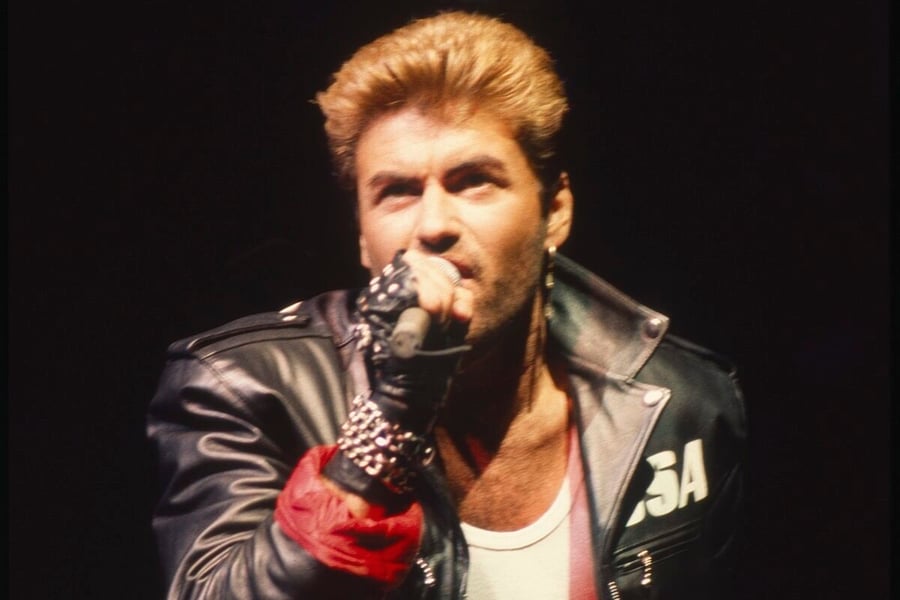
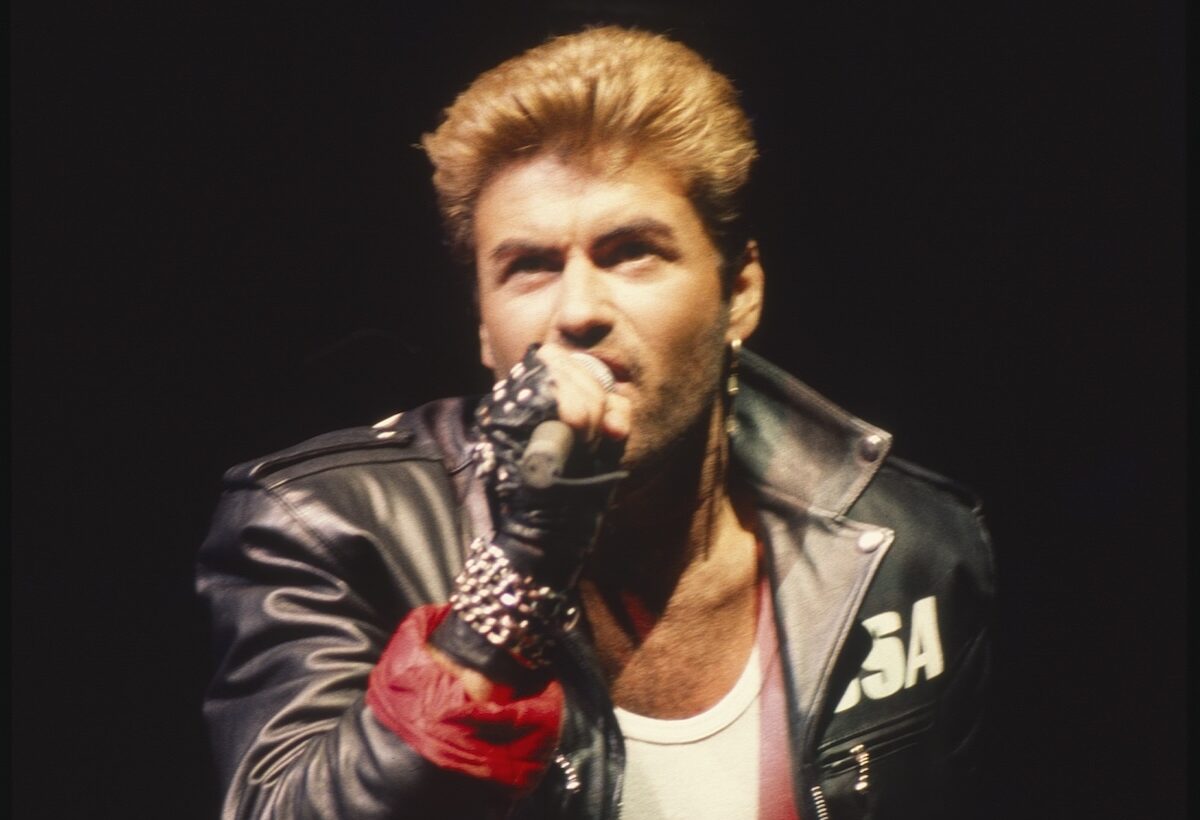
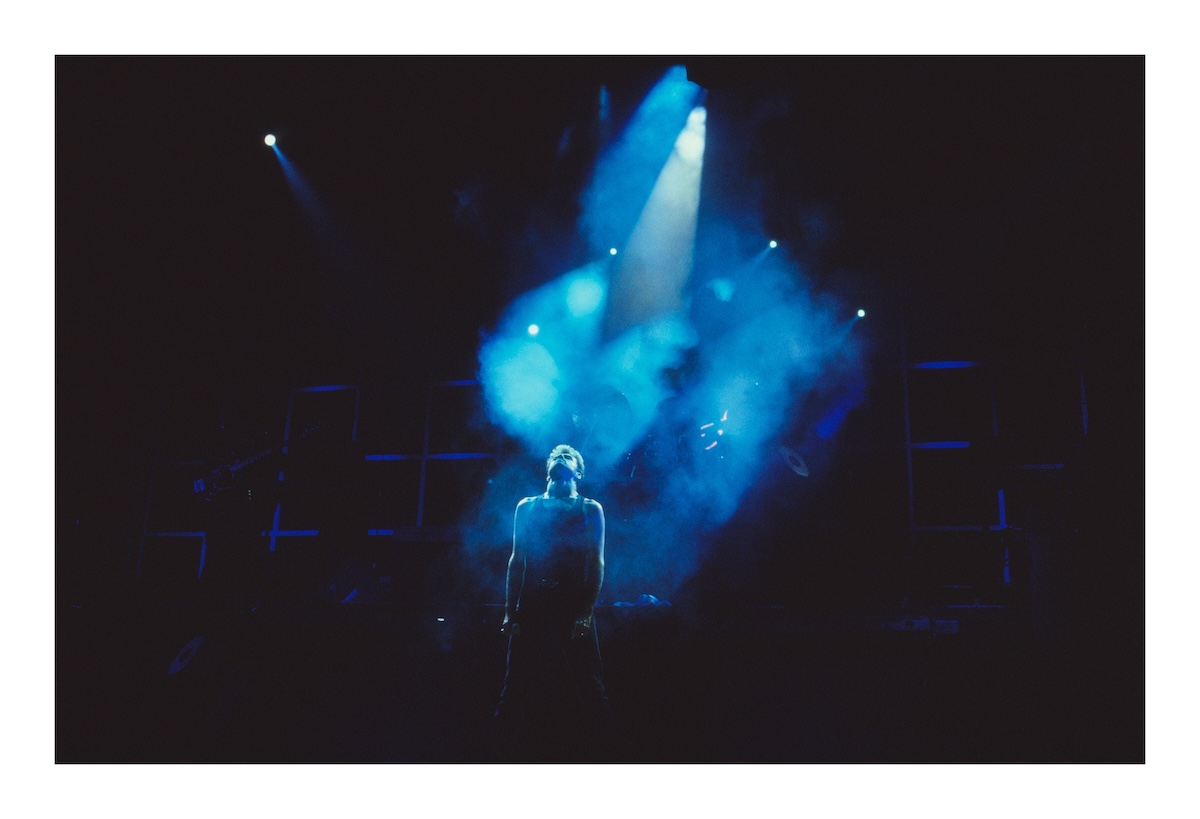
Who needs an LED backdrop when you’ve got George Michael’s kilowatt smile, boundless talent and total command of the crowd?
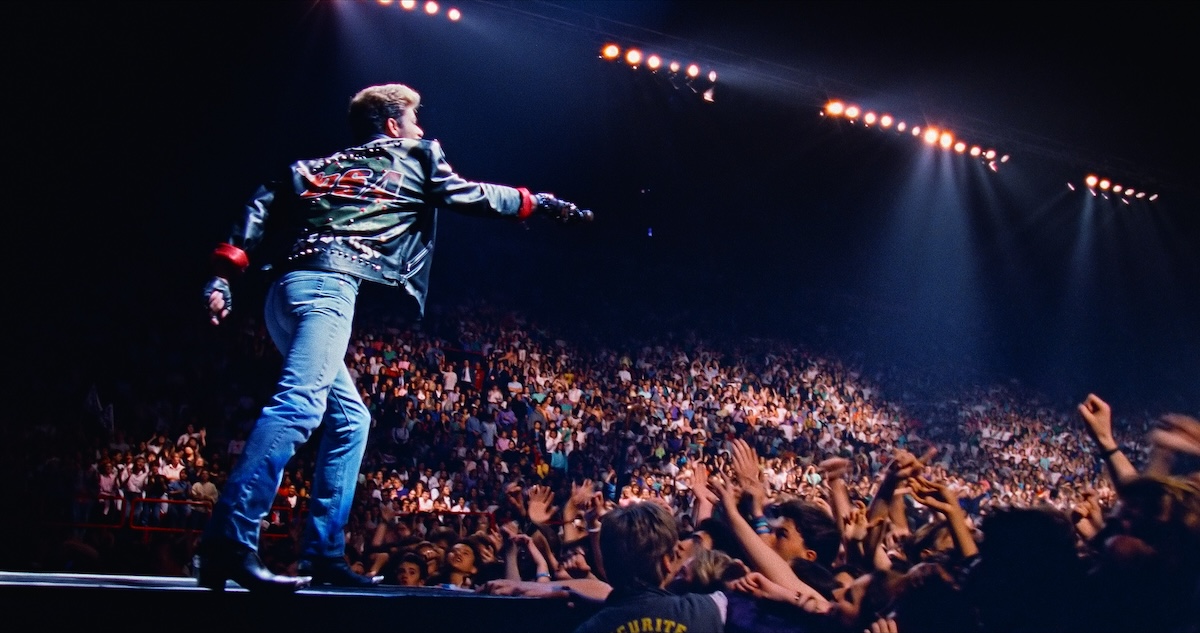
The Faith concert was originally captured using 16 cameras over two consecutive nights at the Palais Omnisports de Paris-Bercy (now known as Accor Arena). The unseen 35mm footage and unheard audio have now been expertly restored and remastered to deliver an immersive cinema experience. Spatial audio drops cinemagoers right into the throng.
Guided by George, the whole arena fist-pumps and squeals, “I’m your man,” in unison. Cigarette lighters are waved overhead during the power-ballad moments (see: the minimally backed “A Different Corner”, which showcases George’s velvety vocals to perfection). The level of crowd engagement makes us nostalgic for smartphone-less shows.
During “Everything She Wants”, George belts “I can’t work any harder than I do!” and we believe him. He leaves everything on that stage, yet somehow makes it all look effortless. He’s a natural mover, but Paula Abdul’s choreography adds sass. At the top of “Faith”, George hands lead vocals over to the 17,000-strong crowd while strumming along on acoustic guitar.
Stay seated as the end credits roll and you’ll be treated to a previously unreleased surprise track: George’s cover of Stevie Wonder’s “Too Shy To Say”.
Paired with the feature is Finding Faith, Mary McCartney’s seven-minute companion short about George on the eve of the tour. Watching the two back-to-back fully reignited our fandom. Prepare for George and Wham! songs to dominate your playlists once more.
To celebrate the film’s release in Australian and New Zealand cinemas on November 12th, we sit down with director David Austin (George’s lifelong friend and co-writer), co-director Andy Morahan, and Mary McCartney, who directed Finding Faith.
Love Music?
Get your daily dose of everything happening in Australian/New Zealand music and globally.

“The myth of the lost footage is slightly exaggerated”
Andy Morahan: “[The Faith concert footage] didn’t get shelved, though it ended up on a shelf [laughs]. It wasn’t lost, as such. George wanted me to shoot the show, ‘cause he really was at a comfortable point on the tour – he’d adjusted it, he just wanted to capture that moment. And the first port of call was to use some of the best bits for the ‘Monkey’ video, which was the fifth single from the [Faith] album.
“But then once George got to the end of Faith, rather than kinda dwelling on it he went straight into recording his next record, Listen Without Prejudice [1990]. He had a lot of creativity going on. He had a lot of ups and downs: his relationship with his fame, and what he had done, how he reacted to that and the pressures from the record company – all that kind of stuff.
“So [the footage] didn’t get shelved, it just kind of sat around. And I guess he was thinking we might return to it at some point, but we never did. And so the myth of the lost footage is slightly exaggerated. But we did have to dust off the film in the end, yeah.”
David Austin: “As Andy says, at that point in his career he was exhausted with fame and it’s very well documented – he talked about that. You’re an artist at the pinnacle of your game, you’re up there – the pantheon of the greats, you know? You see it with Adele, you see it with Taylor Swift, you see it with Harry [Styles] – the artists reach that point in their career but once in their life, and they very rarely go back and revisit it; they move on to different things.
“And I think George was exhausted after Faith. He made Listen Without…, but he didn’t wanna promote it. Then the situation happened with the label court case [George sued Sony Music in 1992, likening his contract to ‘professional slavery’], and Anselmo [Feleppa, George’s boyfriend] was unwell at the time – he was diagnosed with HIV, was terminally ill – and I think George’s head was in a different place.
“[The footage] was parked and forgotten about, and that’s where it was left, really. And so when we were archiving – which we’re doing at the moment – Andy was in to oversee the film side of things, and he said to me one day, ‘Look, you know what we’ve got here, we’ve got all the Faith stuff’. And I was like, ‘Shit, this is quite extraordinary!’
“And we’d recorded it, as well. George got a 24-track mobile unit in, at the time. I thought it belonged to The Stones, but Chris Porter [the legendary sound engineer who first worked with George in the early Wham! days] told me it belonged to The Manor recording studio. So we ended up with this extraordinary piece of film footage.”
“There weren’t a billion LEDs behind him and there weren’t 20,000 phones being held up”
Morahan: “When David and I decided this was a viable project to move ahead with – in terms of putting it together – our mantra was: we are gonna work with the best people we can, the people at Mercury Studios [production company] or Ben Wainwright-Pearce, who’s the editor, who’d worked with everybody from Taylor Swift [The Eras Tour] to James Cameron and Billie Eilish [Hit Me Hard And Soft: The Tour (Live in 3D)].
“Ben actually came to us during the edit and we asked, ‘How’s it going?’ And he’s going, ‘Well, it’s kind of editing itself’ [laughs], which says a lot about the way the music and George’s performance kinda pans out, and his engagement with the audience and stuff like that. So I think the musicality was in the [Faith] stage show anyway… it was just a natural byproduct of the show that we captured.”
Austin: “A show like this is well-oiled: it’s halfway through the tour, [George has] chopped and changed the set, he’s worked the dynamic into it, he knows every facet of the show, he’s timing everything – you know, it’s like making a record. It’s a different process, but the same idea behind it.
“And the fact that this show was in Paris. We were spending a lot of time in Paris. He loved it there; the city embraced him. The crowd was amazing. I mean, there was no health and safety – you saw that show, it was packed to the ceiling.
“But the main thing, also, is that there weren’t a billion LEDs behind him and there weren’t 20,000 phones being held up. And when you have a show where you’ve got all these people that are looking at these phones, there’s a different kind of engagement with the artists, you know? The dynamic goes from there – there’s a detachment, as it were – and that just doesn’t exist when you have no phones in there. The only thing that’s gonna happen is people are gonna put lighters up. And they turn them off after 15 seconds, ‘cause they’re burning their fingers [laughs].
“But there’s a different kind of engagement and you can feel that with the audience. People aren’t engaged with their phones, they’re not. And they don’t miss the show, they see the show and you can really feel it. And that also adds to the whole magic of the evening.”
“We never Auto-Tuned George”
Not many singers sound better live than on record, but George Michael: The Faith Tour reminds us that its star attraction did (see: the unexpected sustained note in the “Careless Whisper” intro).
Austin: “George served his apprenticeship with Wham!, completed Wham!’s American tour and had his eyes focused on the whole Faith thing. By the time George got to that stage of his career, he’d mastered writing and live performance. And his vocals, at the same time – he’d already performed with people like Aretha [‘I Knew You Were Waiting (For Me)’ first appeared on Aretha Franklin’s 1986 album Aretha]. He was fit as well, and that all builds into it.
“I think, vocally, he was just at the top of his game. He’d been at the top of his game many times in his career, in different places, you know what I mean? This was the Faith thing, and then there was an MTV Unplugged [recorded at London’s Three Mills Studios in 1996], and then there was Symphonica [2014 live album].
“The end track of the film is a surprise track, ‘Too Shy To Say’ – that is one vocal take, no repairs. Occasionally with live shows and things, you’ll have to clean it up a bit – you’ll get the microphone banging off the face or something like that, so you have to do that. But there was no trickery. There was no Auto-Tuning and stuff like that. We never Auto-Tuned George, anyway. George was a master of his own vocal, you know what I mean? He was a real musician. He mastered that voice, and he knew how to use it as well.
“After that performance in Paris – you know, when the machine was very oiled, and the show was very polished, and he’d found his form – he stopped the tour for a couple of months, two or three months, ‘cause he had nodules on his vocal cords. He went to have an operation, then came back and his vocal was just so much stronger. I mean, it sounded pretty good there in Paris as well, but for him – as a performer – his vocal performances were even better towards the end of that tour.”
“His career was a one-man show”
A followspot tracks George for virtually the entire film, and he carries the show single-handedly. It takes a rare talent to pull that off, and watching the concert film left us dissatisfied with our current crop of so-called global superstars.
Austin: “It’s really interesting you say that, because I was talking to the chairman of one of the labels, I think it was Universal – a very famous chairman – and I showed him the show. And he said to me, ‘You know what? My artists need to see this. This is what it’s all about.’
“And George’s career was a one-man show. Everything, from Cover To Cover [his second solo concert tour] – which happened after that [Faith tour] – 25 Live [his 2006–2008 world tour], Symphonica, MTV Unplugged – they were all one-man shows, you know what I mean? Not interacting so much with the band, but having the band right behind him. Like he aspired to be Queen, Elton [John] and those acts. A lot of people have said that young artists should come and see this.”
The “magical quality” of George in action
When asked to single out their highlight moments from this concert film, the directors struggle to narrow it down.
Morahan: “I can’t actually single one out. I have different ones for different reasons – having done quite a few of the videos with George over the years.
“I think the reprise of ‘I Want Your Sex’ is fantastic… When he sings a Stevie Wonder song, ‘Love’s In Need Of Love Today’, and totally captivates the audience. I think what struck me overall is the magical quality of him. His performance and interpretation of other songs, or his own songs, is just fantastic.”
Austin: “I love the beginning of the show with the turn of the ‘Revenge’ jacket [worn by George in the ‘Faith’ clip] and the big sonic bass drop. Then you see the cage coming up with the organ. And the audience – you just get a feel of what you’re getting into. As the show goes on, and you see him warmed up as well – I like that.
“The band was extraordinary. He’d switched from a lot of the players that he used in Wham!. A couple of the guys are still there: Chris Cameron, who was the MD, stayed with him and he had Deon Estus on bass – Deon came from the Marvin Gaye school [stay tuned for his dancing, slapping bass solo, which opens ‘I’m Your Man’]. And he had Moyes [Lucas] on drums and Carlos [Rios, guitar] – he had some great, great players with him. An absolutely extraordinary band and they were all vocalists, they all sang and could harmonise.
“I particularly like the end part of the show. So you come out of ‘Lady Marmalade’… I love that whole performance with Lynn Mabry, a backing vocalist who was an extraordinary vocalist. It was just one of those moments that kinda came together. But I love that performance of Pts. 1 and 2, ‘I Want Your Sex’ – the bit where he takes the jacket off and he starts doing all those head flicks back; can’t be good for your neck [laughs]. Just watching all of that stuff, I thought it was quite remarkable.
“And I love that shot at the end of the show where George looks up and he smiles at the audience – you know, two hours in, and he’s like, ‘I’ve got through this show!’ And it’s almost like, for two minutes, he steps out of being George Michael into being Yog [George’s childhood nickname], you know? He smiles and he’s so pleased with himself, and that’s the person that I knew my whole life. Then after that, he kind of puts his hand up and he snaps out of it and goes back into George Michael mode as the cage comes down – I love that.”
In memory of Michael Lippman
George Michael: The Faith Tour closes with a dedication to Michael Lippman.
Austin: “…At the very end [there’s a dedication] in memory of Michael Lippman: George’s manager at the time, who had passed away. Michael did a fabulous job back in the day, you know what I mean? He was really at the top of his game.”
Finding Faith
Finding Faith, the seven-minute companion short directed by Mary McCartney, captures George at 24, on the eve of the Faith tour, using only his voice and images.
“The more quiet, reflective side of George”
McCartney watched the finished version of George Michael: The Faith Tour before she started working on Finding Faith. Her vision for the short was to start by showing “the more quiet, reflective side of George” before exploring “the creative side of George and his craft”, then conclude with “George contemplating the Faith tour – what he’s embarking on – and his feeling and passion for touring and connecting with the audience.”
Making Finding Faith “brought us all closer to George”
Mary McCartney: “Early on, when I was thinking about it, I set myself the challenge of it just being his voice and his image. So it’s photos of him and his voice. There’s nobody else’s voice and there’s nobody else in the pictures, because I wanted us all to stay laser-focused on him. And the emotion of just looking at his image, [hearing] his voice – him and his words, at that time – had a real impact, I think.
“So that was slightly challenging, because it meant there were certain things that I couldn’t use. Because when you put them in, it would just take you out of the moment. Having said that, it was a good challenge, ‘cause I think it made the piece more powerful.
“Then also, it was the challenge of bringing photographs to life, because I used a lot of photography. And I did that by printing them. We had the very traditional technique of rostrum camera-ing, where you have a camera on a hydraulic arm that you move. So I was able to direct the camera and move around the image; that kind of stuff was great as well, ‘cause it’s about craft and George was a lot about craft.
“And the archive has been so well maintained. Again, that’s such a treat for me to be trusted to come in and look through all the photographs, to listen to the archive and pick out the parts. Having said that, it was really exciting ‘cause I feel like we all felt very emotional and it brought us all closer to George. When I would go and show them things, or work with my editor and my producer, we were able to talk about him. And each time we’d watch it, we’d feel something.”
Unseen Herb Ritts shots capture George “tapping into his sex appeal”
McCartney admits she was “very happy to include” some previously unseen Herb Ritts photographs in Finding Faith. Of these photos, she observes, “He’s got a real sort of James Dean quality. He’s sort of tapping into his sex appeal and, you know, he’s young! He’s 24, he’s growing into a man.”
The Tony Parsons interviews: “All of the nuggets were there”
McCartney: “I had an idea of what I wanted to go for. It’s very short, it’s only seven minutes long, so every single sentence needed to have a meaning and a reason to be there.
“When I was invited to do this, I wanted to have [George’s] voice, and I was like, ‘I can’t interview him now,’ so what is there? And I found out about these interviews he’d done for himself, with Tony Parsons. It sort of sounds like they were at a kitchen table, but it was ten hours of recordings. And there were other interviews. So we sifted through that.”
Parsons conducted these previously unheard interviews between 1989 and 1990, while researching Bare: George Michael, His Own Story, which was published in 1990.
“We were actually able to do [Finding Faith] because we had these amazing interviews,” McCartney acknowledges. “We got it all typed out and I went through with a marker, marking things. Then my team and I kinda came back together with all the pieces and jigsawed it together, basically. So all of the nuggets were there.
“The audio needed a lot of work on it, ‘cause it was so casual. You could hear teacups and doorbells ringing and stuff, but we cleaned it up enough.”
“He felt a real understanding that he’d been given a gift”
Quote from Finding Faith: “If you have a gift, you have to respect it. But I don’t think it’s indestructible.”
McCartney: “Through exhibiting at [The Goss-Michael Foundation] – [George’s] gallery with his partner at the time, Kenny [Goss] – I’d done a collaboration and a photography exhibition in their gallery in Dallas.
“I was able to meet George a little bit through that and I’d been a fan of his, growing up. So I kind of understood – from meeting him just a few times – his sensitivity and humour and how deep he was; you could sense it.
“He thought deeply about things and he cared deeply about things, and he cared deeply about his process. He cared deeply about his life and his family and his personal life, but he also felt a real sense of responsibility and connection to his audience. And he felt a real understanding that he’d been given a gift.
“Weirdly, I think I picked all that up from meeting him the first time; he just oozed it. So I didn’t get to know him that much, but the times that I did, I really felt like I understood him. And I was like, ‘Right, I’ve got an opportunity to show that.’ And so I kind of knew what I wanted to get out.
“And when I met David Austin and the team, the fact that I’d done the Abbey Road documentary [If These Walls Could Sing] came through. That has a personal, conversational element to it – that’s sort of how I like to work – so I think that was a good fit for the film.
“The way I like to work is to have something that has emotional depth to it.
“I think I was asked to do this because a lot of what I like to do has trust and intimacy. And his team really are very, very diligent about what they release and how they show George, ‘cause he was very specific about what he released himself. I know they feel a real love and sense of responsibility, so therefore I felt that, too. But luckily we all connected and agreed on everything.
“It was a very emotional situation to walk in on, because it’s not just a job. Everybody cares so much about George; it’s like you’re walking into quite a deep situation, which is what was so exciting about it.”
Wham! “made you happy to be alive”
McCartney: “I was a real Wham! fan, because, you know, I was a young teenager. Me and my best friend, we just loved the energy. There was a freedom and a fun adventure about them; it just made you feel really good and made you happy to be alive.
“I felt honoured to have been part of this process. It’s really amazing to have been such a fan, and then to be brought in in this official capacity feels very full circle.”
Finding the Faith look
In Robert Steele’s biography, Careless Whispers: The Life & Career Of George Michael, George bemoaned his inadvertent Wham! persona: “I had developed a character for the outside world that wasn’t me, and I was having to deal with people all the time who thought I was [like that].”
During Finding Faith, George admits he felt like “a fraud” in the Wham! days, adding he took a year off to “feel sorry for” himself before launching his solo era in earnest.
George also reveals his “Faith” video look was about as close as he could get to how he dressed in real life.
McCartney: “When he says that the ‘Faith’ image – the ‘Faith’ clothes – is the closest to him himself, I think it’s really great, because then you get an insight into it. It’s simple, but it’s iconic – you know, jeans, jacket, T-shirt – and it is kinda sexy.”
“It’s a real time capsule”
McCartney: “For this project, we really focused on a very exact point in time: this Faith tour. He’s come out of Wham!, then we know how it played out after that. This is him, this is his first foray into a solo career.
“He’d been on a wild ride already. He was a kid and he’s got a hot second to sort of reflect on that, and get himself together before he goes off on his own into this amazing performance that we all get to see in this tour.
“So it’s a super-interesting time. He’s just come out of Wham!, he’s gonna be the George Michael that we know. But I didn’t realise how much he had considered and pondered, and how much emotion and thought and consideration he’d put into it. And I think that’s what we’re showing here.
“He’s 24, and he’s like, ‘What am I gonna do? What do I want the audience to have?’ He says in [the film], ‘No one’s ever seen – this is gonna be a surprise, there’s not been a show on this scale before.’ He’s thinking of the stage set, the music, the audience, his energy. It’s a real time capsule.”
“Mum, why are you playing that song every single morning?”
Asked which George songs she returns to most, McCartney doesn’t stop at one.
McCartney: “Well, I have several. I have these songs that I’ll [play] in the morning to get me going for the day and for a long time I was playing ‘Freedom’ all the time. I’d be dancing in my bathroom playing ‘Freedom’ and my kids were like, ‘Mum, why are you playing that song every single morning when we walk past your bathroom?’
“And then recently I’ve been listening a lot to the collaboration [George] did with my dad [Sir Paul McCartney]. They recorded a version of ‘Heal The Pain’ and hearing them sing together makes me super-emotional. I think that they both joined together really beautifully.”
George Michael: The Faith Tour hits Australian and New Zealand cinemas on Thursday, November 12th.

