





























George Michael was on top of the world in the late Eighties. He’d made it big as the creative half of Wham!, his U.K. pop duo with his school friend Andrew Ridgeley. But for his solo flight, he wanted to prove himself as an adult. That meant sex. It meant sin. It meant stubble. George came back strong with his 1987 solo classic Faith, reborn as a black-leather stud, shocking the music industry that had always seen him as a disposable joke. Instead of burning out, he seduced the planet with the innovative hitcraft of “Faith,” “Father Figure,” and “I Want Your Sex.”
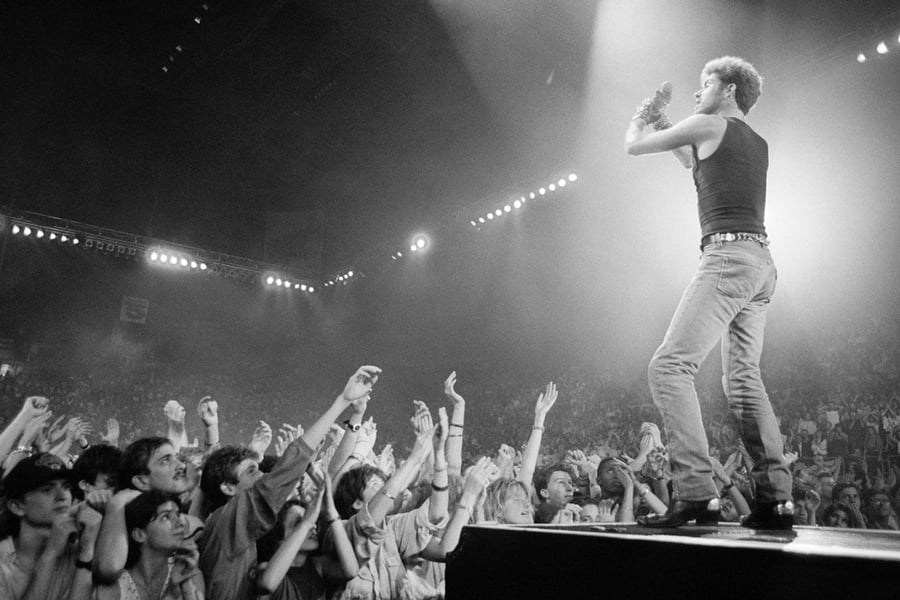
He also stepped out as a live performer, for his one and only solo mega-pop tour, the Faith tour in 1988. It’s a weirdly forgotten moment in his story — but it’s the one time in his life George Michael revelled in the role of a solo pop idol onstage, parading his sexual bravado, the ultimate larger-than-life dream lover.
The upcoming concert film George Michael: The Faith Tour, arriving in theatres Dec. 11, captures two nights in Paris, in the spring of 1988, from recently rediscovered footage. (He’ll also be honoured this weekend at the VMAs, with a special all-star tribute performance marking 10 years since his death.)
As you can see in the new trailer for The Faith Tour, his confidence was raging — night after night, he faced a crowd of strangers and sang the line, “If you ever hunger, hunger for me,” making everyone in the room hear it as a personal demand. For once, and only once, he was willing to live up to every crazed fantasy the world had about George Michael — and that includes his own secret fantasies about himself.
But he closed that door. He never tried this kind of spectacle again, and never preserved it in a proper concert film or album. So it’s been easy to overlook, even though his story has been told and retold so many times over the years. Pop fans know Faith inside out, but almost nobody has seen the way he brought it to life every night onstage.
Faith still holds up as one of the Eighties’ perfect pop statements, yet George made it only once. At the time, everyone expected him to keep knocking out a Faith every couple of years for the rest of his life. But his meteoric rise to the top just convinced him it wasn’t where he wanted to be.
He was the world’s most glamorous pin-up boy, but he was also a closeted, tormented, lonely gay man in a brutally homophobic era. As George says in footage from the 2023 Netflix doc Wham!, “I suddenly thought, ‘Oh my God, I’m a massive star and I’m gay.’ The depression was about that. It was about the way I boxed myself in. You know, be careful what you wish for.” Faith sounded like a new beginning — but it turned out to be his kiss goodbye.
Love Music?
Get your daily dose of everything happening in Australian/New Zealand music and globally.

The Faith Tour aims to document his brief fling with arena stardom. It’s directed by two of his longtime collaborators, Andy Morahan (he did the “Father Figure” and “Careless Whisper” videos) and David Austin (who made the Freedom Uncut doc). There will also be a live album of previously unreleased performances, similarly called The Faith Tour.
Live, George did almost all of Faith, but also more Wham! oldies than fans were expecting. After opening with the gritty one-two punch of “I Want Your Sex” and “Hard Day,” it was a bit of a head-snap to swerve right into Wham! bangers like “Everything She Wants” and “I’m Your Man.” But tellingly, he refused to sing “Wake Me Up Before You Go-Go” even once all tour. This was a No Jitterbug Zone.
He also sang some of his beloved Seventies soul covers — Stevie Wonder’s “Love’s In Need of Love Today,” LaBelle’s “Lady Marmalade,” and Wild Cherry’s “Play That Funky Music,” as well as the Aretha Franklin duet “I Knew You Were Waiting for Me.” By the time the tour wrapped in America that fall, he was occasionally mixing in more Stevie deep cuts.
Nobody attending these shows in 1988 would have imagined they were seeing George Michael for the last time. But he was resolute never to repeat the experience. His tortured sexuality made the pose unbearable. At a couple of summer shows, he sang Gladys Knight’s poignant “If I Were Your Woman,” changing the gender pronouns. It’s a song about a secret, forbidden, guilty desire, but he was clearly singing from the heart. He performed it at the June 1988 Nelson Mandela tribute concert at Wembley Stadium, televised around the world, making it sound like a pained cry from the closet. No wonder he couldn’t keep this pace going. “Life is so crazy and love is unkind,” indeed.
When George first showed up with Wham!, he was more than willing to play the role of a public fantasy. As he put it, he was “every little hungry schoolgirl’s pride and joy.” But since he was George Michael, he was already deeply conflicted about it. The opening line of his first hit, “Wham Rap,” was George declaring, “Hey, everybody, take a look at me! I’ve got street credibility!” But he burned out fast on both halves of that promise — not just the “street credibility” part, but the “take a look at me.” Few performers have ever been so naturally gifted at the pop-star pose, yet few have abdicated the gig so fast. Every night on the Faith tour, George sang his most famous solo hit, telling the audience, “It takes a strong man, baby, but I’m showing you the door!” Yet as it turned out, that’s exactly what he was doing.
That inner turmoil is all over Faith, which is why the album remains an eternal worldwide pop obsession. “Faith” is three minutes of paranoid lust, all breathy gasps and careless whispers. But it’s pure paradox: George’s sexiest hit is about refusing sexual temptations, just as “I Want Your Sex” is an abstract debate on theology and morality without any carnal contact anywhere in the song. “Father Figure,” damn — no matter how many thousands of times you hear it, it refuses to fade into the background. When George caresses the line “Beautiful darling, don’t think of meeeee,” he couldn’t sound more absolutely confident that you’ll think of him.
And those were just the hits. The best song on Faith wasn’t even a single: “Hard Day,” a filthy beatbox groove where George overdubs his voice so he can sing a duet with himself. He plays the double role of a bickering couple, fighting over money, fighting over sex, chanting “Don’t let me down,” until the final knockout when one George asks “Do you trust me?” and the other whispers “Yeah.” If any moment captures the genius of George Michael, it’s that one.
For his next album, Listen Without Prejudice Vol.1, he refused to allow his face or name on the cover. He wouldn’t make a video for the lead single “Praying for Time,” forcing the label to do a pompous crawl of the lyrics, making the song seem duller than it actually was. The album was designed to be impenetrable to pop blandishments beyond “Freedom ’90,” which ironically became his definitive star statement even though he spent it complaining about stardom. Funny how the pop audience gets drastically more interested in your personal problems when you get a crew of supermodels to lip-sync them.
He didn’t attempt anything even close to the scale of the Faith live shows. His 1991 Cover to Cover Tour was a subdued affair, just 29 shows. Instead of promoting the new album, George mostly ignored his own catalog, devoting two-thirds of the set to oldies by his heroes, including David Bowie, Chaka Khan, Culture Club, and Elton John. He didn’t tour again for 15 years.
But even when George was kissing off the pop audience, people craved more and more of him. He fluked into a Number One hit with his live 1991 version of Elton’s “Don’t Let The Sun Go Down On Me,” a duet where Captain Fantastic enters halfway through. (“Ladies and gentlemen…Mr. Elton John!”) Basically zero effort or thought or creativity went into this remake — but we all loved it anyway, because we were so grateful to hear the sound of George Michael having fun, a sound he was already holding back. We’d take anything he offered.
According to industry gossip at the time, the only reason George even released this single was his pure fanboy devotion. Elton had a historic record-setting run of consecutive years with at least one hit single on the Hot 100 charts, but since he didn’t have a hit in 1991, the streak was about to end. And since George was a stats-crunching charts geek as well as a lifelong Elton superfan, he couldn’t bear to see his hero’s winning streak die. So, they say, he took matters into his own hands and rushed out a karaoke duet quickie juuuuust in time. It made the chart in December.
Thanks to George, Elton was able to keep the streak going all the way until 2000, for 31 consecutive years. (Yes, that’s still the record, with Rod Stewart in second place, and no, nobody’s even close to catching up.)
But while Elton still had many hit-making years to go, George was already saying “Goodbye, yellow brick road.” He scored a delightful one-off comeback disco hit in 1992 with “Too Funky,” but he was totally finished with the pop hustle by the time his great successor Harry Styles was born in 1994. Harry, of course, has George’s “Careless Whisper” lyrics tattooed on his feet — “never gonna” on his left foot, “dance again” on his right. Who could ask for a better summary of George’s impact on history?
Somehow, George didn’t dare reveal the not-so-well-kept secret of his sexuality until 1998, ten years after the Faith tour, when he got busted by a cop in a public park and brilliantly chose to make that his grand coming-out party. But he lived his final years on his own terms, making music on a deliberately smaller scale. On his Faith tour, he’d already lived out his moment of reigning onstage each night, embodying all the audience’s dreams. It’s a tribute to George Michael that he was capable of doing this; it’s also a tribute to George Michael that he was capable of walking away.
From Rolling Stone US

